Navigating Import Duties and Tariffs on Solar Hardware
In multi-megawatt utility and C&I solar engineering, procurement, and construction (EPC), customs strategy directly determines project viability. With Basic Customs Duty (BCD) standing at 40% on modules and 25% on cells, coupled with rigorous ALMM mandates, complex HSN classification rules, and strict CAROTAR origin audits, customs missteps can wipe out 100% of an EPC's profit margin. Here is the definitive engineering and procurement guide to mastering solar import tariffs, duty optimization schemes, and port demurrage elimination.
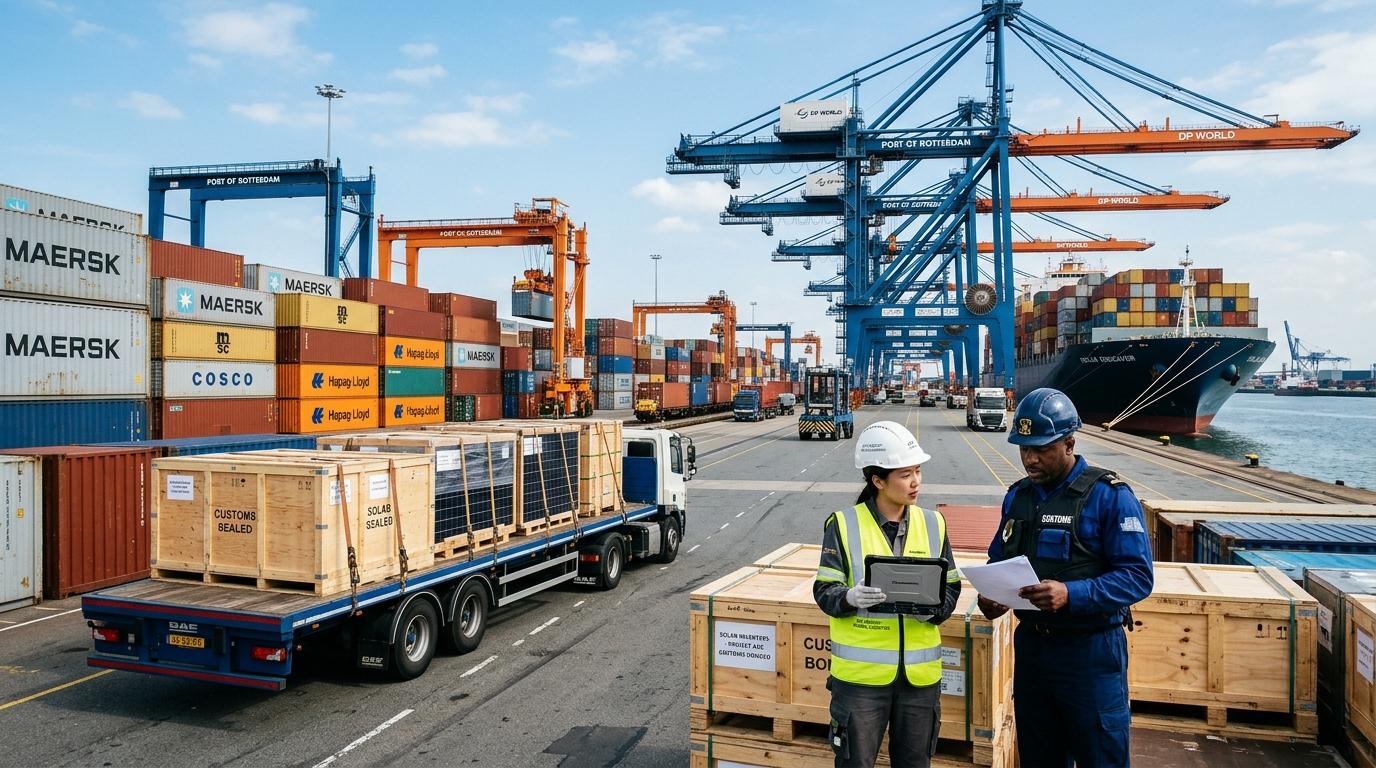
1. The Tariff Battlefield: Why Customs Strategy Dictates Solar EPC Margins
In utility-scale and commercial solar engineering, procurement, and construction (EPC) projects, major hardware procurement represents between 55% and 65% of total plant Capital Expenditure (CapEx). Solar photovoltaic (PV) modules alone consume 45% to 52% of the overall budget, while central or high-power string inverters, single-axis tracker drives, and specialized DC Balance of System (BOS) cabling command another 12% to 15%.
Because hardware procurement represents such an overwhelming fraction of project capital, government tariff policies and customs duty structures exert an immense influence on financial viability. Over the past decade, international solar supply chains have undergone dramatic geopolitical shifts. In India, policy has decisively transitioned from an import-dependent regime to aggressive trade protectionism aimed at establishing a resilient, self-sufficient domestic manufacturing value chain under the Atmanirbhar Bharat and Make in India initiatives.
For solar developers, Independent Power Producers (IPPs), and EPC contractors, this evolving regulatory environment has transformed customs clearance into a high-stakes operational battlefield:
- Narrow EPC Profit Margins: Typical competitive EPC contracts operate on thin margins between 6.0% and 9.5% of total project value. An unforeseen 40% Basic Customs Duty (BCD) on uncertified modules or a disputed 20% tariff reclassification on inverter skids does not merely trim profitability—it completely erases the EPC's entire operating margin and plunges the project into massive net cash deficits.
- Aggressive PPA Tariff Bidding: Solar power purchase agreements (PPAs) awarded through ultra-competitive reverse auctions often lock in fixed tariffs between ₹2.40/kWh and ₹2.75/kWh for 25 years. Developers who structured financial models on low global module spot prices without ring-fencing customs duties, currency hedging, and freight volatility face stranded capital assets and severe debt service coverage ratio (DSCR) breaches.
- Compounding Tax Layers: Customs duty in India is not a simple flat fee. It cascades through assessable CIF valuations, Basic Customs Duty (BCD), Social Welfare Surcharge (SWS), and Integrated Goods and Services Tax (IGST), compounding initial invoice costs by over 56.8% for solar modules.
- Catastrophic Demurrage Clocks: Unlike warehouse stock, maritime container shipments held at container freight stations (CFS) or port terminals accumulate exponential demurrage and shipping line detention charges. For a 100 MWp utility installation requiring over 2,200 shipping containers, a mere 14-day administrative or regulatory documentation hold can generate over ₹4.2 Crore ($500,000) in deadweight port penalties.
The Strategic Reality for Project Directors
In 2026 and beyond, customs clearance and international tariff compliance can no longer be delegated as an afterthought to third-party customs house agents (CHAs). Procurement heads, lead electrical engineers, and commercial project directors must architect customs strategy during the initial engineering and tendering phase. Engineering datasheets, purchase order BOM descriptions, and shipping manifests must align with surgical precision to ensure seamless, delay-free port entry.
2. The Indian Tariff Architecture: BCD, IGST, AIDC & SWS Breakdown
Understanding the financial mechanics of solar imports requires deconstructing the official customs tariff schedule governed by the Ministry of Finance (Department of Revenue) and Central Board of Indirect Taxes and Customs (CBIC).
Prior to April 2022, the government utilized temporary Safeguard Duties (SGD) and basic revenue cesses to regulate imports. However, under Ministry of Finance Notification No. 19/2022-Customs, a permanent, high-barrier tariff structure took effect on April 1, 2022:
Solar Photovoltaic Modules
Solar cells assembled in modules or made up into panels, whether monocrystalline, polycrystalline, bifacial N-Type TOPCon, or Heterojunction (HJT).
Solar Photovoltaic Cells
Solar cells whether or not assembled in modules; raw semi-processed crystalline silicon solar cells not yet framed or laminated into completed panels.
The Mathematical Duty Compounding Waterfall
Many procurement teams mistakenly assume that total import duty is simply calculated by adding the BCD rate to the GST rate ($40\% + 12\% = 52\%$). In statutory customs law, duties are levied sequentially in a compounding waterfall:
As demonstrated above, an EPC importing $10,000,000 worth of N-Type TOPCon bifacial modules will pay $4,000,000 in BCD and $1,680,000 in IGST at the port, resulting in a total landed cash disbursement of $15,680,000 before port handling, inland transit, or crane offloading charges.
The GST 70:30 EPC Composite Supply Rule
Under GST Notification No. 8/2021-Integrated Tax (Rate), renewable energy generating devices (solar panels, inverters, tracker skids) are subject to a concessional 12% IGST rate. However, EPC contracts are inherently composite contracts involving both goods supply and civil installation services (taxable at 18%).
To resolve nationwide tax litigation, GST law mandates a statutory 70:30 ratio for solar EPC contracts:
- 70% of the contract value is legally deemed as supply of goods and taxed at 12% GST.
- 30% of the contract value is deemed as installation/civil service and taxed at 18% GST.
- Effective Composite GST Rate: $(0.70 \times 12\%) + (0.30 \times 18\%) = 8.4\% + 5.4\% = \mathbf{13.80\%}$.
When an EPC imports equipment directly, the 12% IGST paid at customs can be utilized as Input Tax Credit (ITC) against the 13.8% composite EPC output GST liability. However, project developers holding direct PPAs sell generated electricity—an exempt good under GST Schedule. As a consequence, direct developers cannot utilize accumulated ITC, causing unabsorbed IGST to become a sunk CapEx addition unless structured through an EPC pass-through vehicle.
3. ALMM Mandate Compliance & BIS Certification Traps
Even if an EPC contractor possesses the capital to absorb 40% BCD, importing modules is strictly prohibited unless the equipment clears two non-negotiable statutory barriers: the Approved List of Models and Manufacturers (ALMM) and the Bureau of Indian Standards (BIS) Compulsory Registration Scheme (CRS).
The ALMM Order: The Gatekeeper of Grid Connectivity
Promulgated by the Ministry of New and Renewable Energy (MNRE), the ALMM Order mandates that only solar PV models and manufacturing facilities officially audited and enlisted by the National Institute of Solar Energy (NISE) and MNRE can be deployed across:
- Government-owned, government-assisted, and CPSU tenders (SECI, NTPC, NHPC, SJVN).
- Open Access and Captive / Group Captive solar installations feeding into state transmission networks.
- Rooftop solar under central subsidy schemes (PM Surya Ghar: Muft Bijli Yojana, PM-KUSUM).
While MNRE temporarily held ALMM in abeyance during FY 2023-24 to address acute domestic supply shortages, the mandate was re-imposed with full force on April 1, 2024. Enlistment in ALMM List-I (Solar PV Modules) requires an exhaustive factory inspection by Indian government auditors, verifying automated manufacturing lines, quality control testing, and supply chain traceability.
If an EPC contractor attempts to clear non-ALMM imported modules through customs for a project connected to the grid, state DISCOMs and central transmission utilities (CTU / PowerGrid) will flatly refuse grid synchronization, resulting in fatal PPA default and project stranding.
The BIS CRS Minefield: 4 Fatal Customs Clearance Traps
Under the Solar Photovoltaics, Systems, Devices and Components Goods (Requirements for Compulsory Registration) Order, all solar modules and inverters imported into India must hold valid BIS registration under:
- IS 14286: Design qualification and type approval for crystalline silicon terrestrial PV modules.
- IS/IEC 61730-1 & IS/IEC 61730-2: Photovoltaic module safety qualification (construction and testing).
- IS 16221 & IS 16169: Grid-connected power converters and anti-islanding protection standards for inverters.
Customs ports utilize automated risk management systems (RMS). The slightest discrepancy between physical cargo and statutory registrations will immediately halt automated clearance:
Trap 1: The Single-Character Model Suffix Discrepancy
International module manufacturers constantly optimize bill of materials (BOM), adding suffixes such as -BD (Bifacial Dual-Glass), -SF (Silver Frame), or -108 (Half-Cell count). If the commercial invoice or physical barcode label reads VTR-620W-TOP-BD but the official BIS CRS certificate lists only VTR-620W-TOP, Indian customs will categorize the shipment as uncertified goods under Section 111 of the Customs Act, blocking clearance and initiating seizure proceedings.
Trap 2: The Contract Manufacturing / OEM Plant Mismatch
A Tier-1 brand headquartered in Singapore or China may fulfill an Indian order from their factory in Vietnam, Malaysia, or Cambodia. BIS certification is strictly location-specific: it attaches to a physical manufacturing address, not an intellectual property brand. If the OEM shifts assembly to an unlisted secondary facility without an independent BIS factory audit and unique R-number, customs officers at Nhava Sheva or Mundra will refuse clearance.
Trap 3: Expired Validity During Ocean Transit
BIS registrations require periodic renewal every 2 years. If an OEM's certificate expires while a 30-day ocean cargo vessel is sailing between Shanghai and Mundra, the shipment cannot be cleared upon arrival. The customs automated ICEGATE system cross-checks active live status with the BIS portal at the exact hour of Bill of Entry filing.
Trap 4: Inverter Wireless Telemetry (WPC / ETA Approval)
Modern central and string inverters incorporate built-in Wi-Fi, Bluetooth, or 4G LTE IoT communication modules for SCADA telemetry. Under Indian telecommunications regulations, any imported equipment containing radio frequency transmitters must possess Equipment Type Approval (ETA) from the Wireless Planning & Coordination (WPC) Wing. Customs officers routinely hold inverter consignments lacking WPC import licenses.
4. HSN Classification Minefields: Trackers, Inverters & BOS Cabling
One of the greatest sources of customs litigation and retroactive tax penalties in solar EPC execution stems from Harmonized System of Nomenclature (HSN / ITC-HS) classification disputes. Misdeclaring cargo under a lower-tariff heading—even unintentionally—triggers Section 28 recovery notices, confiscation under Section 111(m), and mandatory 100% redemption fines.
1. Solar Single-Axis Trackers: Mechanical Machinery vs. Structural Steel
A single-axis horizontal tracker system is a complex electro-mechanical assembly comprising cold-formed steel torque tubes, drive shafts, foundation bearings, slewing motors, dampers, and astronomical algorithm micro-controllers.
Many foreign tracker suppliers issue single commercial invoices titled "1 Complete Set of 1P Horizontal Solar Tracker System" classified under HSN 8479 89 99 (Machines and mechanical appliances having individual functions - 7.5% BCD). Indian customs authorities routinely reject this umbrella classification:
2. Solar Inverters: Static Converters vs. Integrated Transformer Skids
Solar inverters convert direct current (DC) generated by PV modules into grid-compliant alternating current (AC). Under ITC-HS Heading 8504 40 80 / 8504 40 90, solar inverters carry a 20% BCD rate.
However, disputes arise with utility-scale central inverter skids (3.125 MW to 4.4 MW) that integrate an Inverter Duty Transformer (IDT), medium-voltage ring main unit (RMU), and auxiliary distribution boards into a single prefabricated outdoor enclosure. Customs appraisers often argue whether the entire skid should be classified under HSN 8504 22 / 8504 23 (Liquid dielectric transformers - 10% BCD), HSN 8537 (Switchgear boards - 15% BCD), or HSN 8504 40 (Inverters - 20% BCD). Structuring clean engineering BOM declarations prevents split-assessment disputes.
3. 1500V Solar DC Cabling: Copper vs. Aluminum Conductors
Solar DC cables engineered under EN 50618 / IEC 62930 carry voltages up to 1.5 kV DC. Under HSN 8544 60 90 (Other electric conductors for a voltage exceeding 1000V), standard BCD is 10%. Customs audits intensely scrutinize Country of Origin certificates and conductor metallurgical purity to prevent dumping of sub-standard non-annealed copper alloys misdeclared as certified photovoltaic string wire.
5. Project Imports Scheme (Heading 9801) vs. MOOWR Bonded Warehousing
To mitigate massive cash outflows from import duties during the 9 to 18-month construction cycle of utility solar plants, corporate developers and EPCs evaluate two primary statutory schemes: Project Imports under Chapter 9801 and the MOOWR Bonded Warehousing Scheme under Section 65.
Project Imports Scheme
Historically, the Project Imports Regulations allowed industrial projects (including power plants) to register with customs and import all machinery, instruments, and initial spare parts under a single unified tariff heading at a concessional BCD rate (previously 5% for solar power).
- • Requires pre-registration with Sponsoring Authority (MNRE / State Energy Dept).
- • Execution of heavy Provisional Assessment (PD) Test Bonds and Bank Guarantees.
- • Complex plant commissioning reconciliation audit by plant engineers.
- • Current Status: Recent Union Budgets have phased out concessional renewable power exemptions under 9801, bringing basic rates up to standard tariff levels (7.5%–15%).
MOOWR Bonded Warehousing
Under the Manufacturing and Other Operations in Warehouse Regulations (MOOWR), imported capital goods, raw materials, and solar components can be brought into a licensed private bonded warehouse with 100% duty and IGST deferral.
- • Zero Duty Cash Outflow: No BCD, SWS, or IGST payable at the time of maritime port clearance.
- • Indefinite Interest-Free Deferral: Duty is deferred without interest accrual until goods are cleared for domestic consumption.
- • 100% Duty Remission on Exports: If finished modules or equipment are re-exported, duty is completely forgiven.
- • Current Status: Highly effective for module assembly gigafactories and captive industrial solar setups operating in SEZ/bonded zones.
Section 49: The Demurrage-Free Rescue Strategy
When an imported consignment lands at port but cannot be immediately assessed—due to an unexpected ALMM clarification, pending test reports from a NABL laboratory, or an HSN classification dispute—port demurrage charges start accumulating immediately.
Under Section 49 of the Customs Act, 1962, an importer has the statutory right to request the Assistant Commissioner of Customs to transfer the un-cleared containers from the high-cost port terminal to a Public or Private Bonded Warehouse pending clearance.
The Section 49 Financial Impact:
Transferring 100 containers to a Section 49 warehouse stops the port terminal demurrage meter (which can reach ₹15,000 per container per day) and replaces it with standard bonded warehouse storage fees (typically ₹150–₹250 per container per day), saving tens of lakhs while legal counsel resolves customs paperwork.
6. Comprehensive Solar EPC Import Duty & Customs Matrix
The following technical reference matrix outlines the tariff classifications, statutory duty rates, mandatory certifications, and compliance risk flags across all major solar power plant hardware categories imported into India:
| Hardware Component | ITC (HS) Code | BCD Rate | IGST Rate | Mandatory Certifications | Key Customs Risk / Red Flag |
|---|---|---|---|---|---|
| Solar PV Modules (Crystalline/TOPCon) | 8541 43 00 | 40% | 12% | ALMM List-I, BIS (IS 14286, IS/IEC 61730) | Model suffix mismatch; non-enlistment of foreign assembly plant in ALMM. |
| Solar PV Cells (Unassembled) | 8541 42 00 | 25% | 12% | BIS CRS Registration, Country of Origin | Misclassification of partially assembled cell strings as raw cells. |
| Solar Central / String Inverters | 8504 40 80 | 20% | 12% | BIS (IS 16221, IS 16169), WPC/ETA for Wi-Fi | Lacking WPC RF license; disputes over integrated transformer skid classification. |
| Tracker Structural Torque Tubes & Purlins | 7308 90 90 | 15% | 18% | Mill Test Certificate (EN 10204 3.1), PosMAC/HDG | Misdeclared under HSN 8479 machinery to evade 15% structural steel duty. |
| Tracker Slew Drives & Electric Motors | 8501 31 19 | 10% | 18% | CE, IP65/IP66 Test Certificates, MTC | Undervaluing individual motor drives in composite system invoices. |
| 1500V Solar DC XLPO Cables | 8544 60 90 | 10% | 18% | EN 50618, IEC 62930, TUV Rheinland/UL | Country of Origin CAROTAR challenge; non-tinned copper conductor impurity. |
| Inverter Duty Transformers (IDTs) | 8504 22 00 | 10% | 18% | IS 2026, IEC 60076, NABL Short-Circuit Report | Dielectric oil moisture ingress during shipment; weight discrepancies on packing list. |
| Containerized BESS Lithium-Iron Phosphate | 8507 60 00 | 10%–20% | 18% | BIS (IS 16046), UN 38.3, UL 9540A | Dangerous Goods (Class 9) maritime hold; absence of UN 38.3 transport test report. |
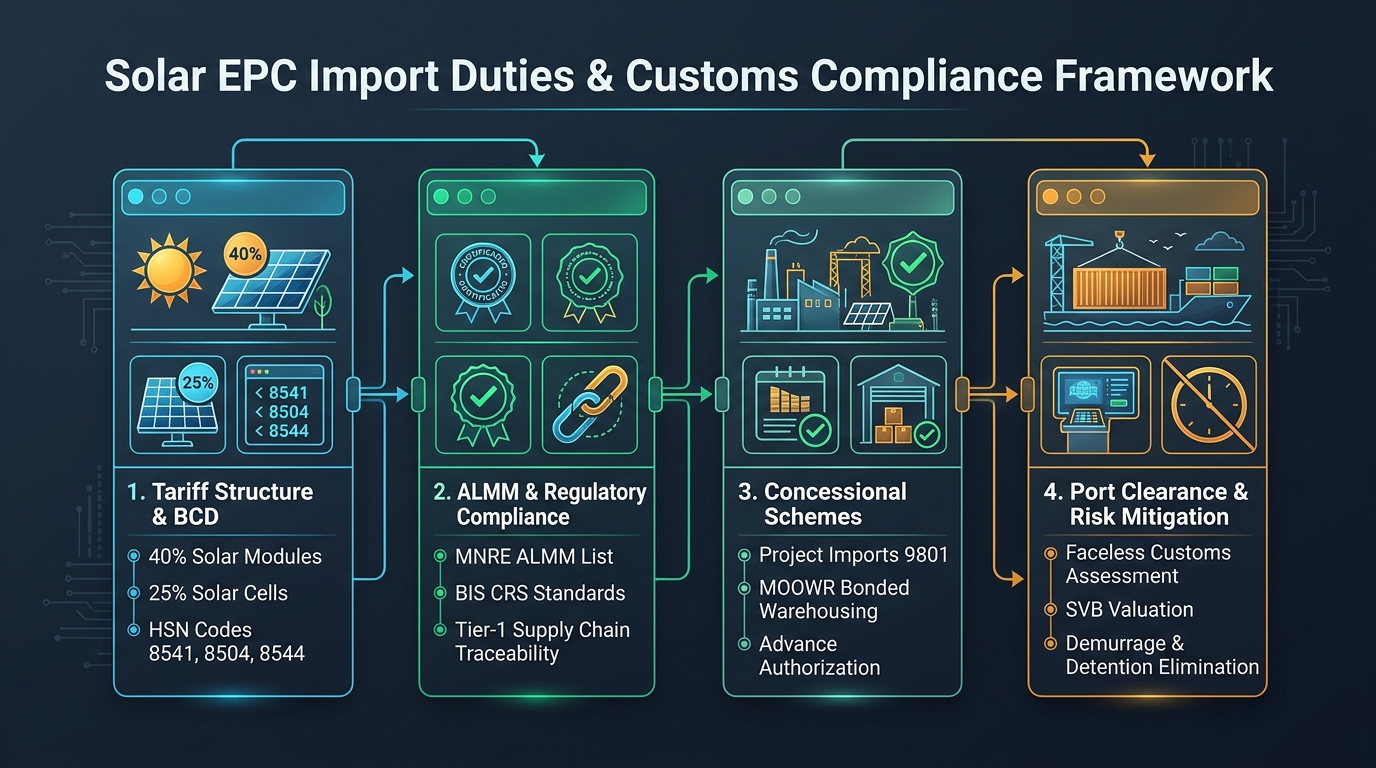
Figure 1: The 4-Phase Solar EPC Import Duties & Customs Compliance Framework, from pre-tendering tariff architecture to faceless port clearance.
7. Advance Authorization & FTA Concessional Duty Safeguards
In addition to standard domestic installations, large EPC conglomerates and module manufacturers participate in international EPC contracts (e.g., in the Middle East, Africa, and Southeast Asia) or supply domestic projects via specialized foreign trade channels.
The Advance Authorization Scheme (DGFT)
Issued by the Directorate General of Foreign Trade (DGFT) under the Foreign Trade Policy (FTP 2023), the Advance Authorization Scheme allows the duty-free import of raw materials and components (solar cells, POE/EVA encapsulant sheets, solar tempered glass, junction boxes, and aluminum frames) required for manufacturing export goods.
- Imports under Advance Authorization are 100% exempt from Basic Customs Duty (BCD), Social Welfare Surcharge (SWS), and Integrated GST (IGST).
- The importer is bound by a strict Export Obligation (EO): finished solar modules must be physically exported within 18 months, with a minimum 15% positive value addition.
- Failure to fulfill the export obligation triggers immediate retroactive recovery of all waived duties, alongside compound penal interest at 15% per annum from the original date of import.
Free Trade Agreements (FTAs) & The CAROTAR 2020 Trap
India has signed Free Trade Agreements (FTAs) and Comprehensive Economic Cooperation Agreements (CECAs) with several partner regions, including ASEAN (AIFTA), Japan, Korea, UAE, and Australia. Under preferential trade rules, certain goods can enter India at zero or concessional BCD rates.
To prevent third-party nations from routing cheap goods through ASEAN countries without genuine local manufacturing, the Ministry of Finance enacted the Customs (Administration of Rules of Origin under Trade Agreements) Rules, 2020 (CAROTAR 2020).
Why CAROTAR 2020 Shook Solar Module Procurement:
Under CAROTAR 2020, customs appraisers no longer accept a Certificate of Origin (Form AITIC) issued by overseas chambers of commerce at face value. The Indian importer must possess origin documentation proving:
- Change in Tariff Heading (CTH): Non-originating inputs must undergo a fundamental transformation resulting in an 8-digit HSN code shift.
- Regional Value Content (RVC): Minimum 35% local value addition generated within the exporting ASEAN territory.
- Audit of Ingot & Wafer Origins: If an overseas plant merely buys imported wafers from an unapproved origin and laminates them into modules, customs will reject the FTA certificate and issue a demand for the full 40% BCD plus 18% penal interest.
8. Port Logistics: Demurrage, Detention & Faceless Assessment Clearance
Even with flawless financial modeling, a solar EPC's balance sheet can be crippled by physical port logistics failures. International shipping of solar equipment involves two distinct, compounding daily penalty clocks:
1. Demurrage Charges
Levied by the port terminal operator or Container Freight Station (CFS) for keeping loaded containers inside the port premises beyond the allowed free days (typically 3 to 7 days).
Days 8–14: ₹3,000 / container / day
Days 15–21: ₹7,500 / container / day
Day 22+: ₹14,000 / container / day (Tiered Penal Escalation)
2. Detention Charges
Levied by the ocean shipping line (Maersk, MSC, CMA CGM) for holding their container equipment beyond the agreed free period (typically 7 to 14 days) before returning empty boxes to the port yard.
Days 15–20: $50 / container / day
Days 21–28: $100 / container / day
Day 29+: $175 / container / day
Navigating Turant Customs & Faceless Assessment
Under India’s Turant Customs (Faceless Assessment) initiative, the physical port of cargo arrival (e.g., Mundra or Nhava Sheva) does not assess the Bill of Entry. The electronic ICEGATE portal algorithmically assigns the assessment to an anonymous customs officer located anywhere in India—for instance, in Chennai, Delhi, or Visakhapatnam.
This faceless structure introduces unique operational challenges for solar EPCs:
- Electronic Query Loops: If the faceless officer requires technical clarification regarding an inverter's harmonics or a module's ALMM model, an electronic query is raised. Importers must respond with digitally signed technical datasheets within 24 hours to prevent assessment freezes.
- First Check Examination Orders: If documents appear ambiguous, the faceless officer may issue a First Check order, mandating that local docks officers physically destuff and inspect the containers before duty payment. Opening vacuum-sealed, palletized solar module crates in humid, dusty port environments drastically elevates the risk of micro-cracking and mechanical cell fracture.
- Special Valuation Branch (SVB): If the Indian EPC or developer is purchasing hardware from an overseas parent company or related entity, the transaction triggers mandatory SVB review under Section 14 of the Customs Act to verify that transfer prices are at arm's length. EPCs must maintain comprehensive Transfer Pricing Documentation to avoid Extra Duty Deposits (EDD) of 1% to 5% of invoice value.
9. Real-World Case Study: 300 MWp Solar Plant at Mundra Port
The Operational Crisis:
In late 2024, an Indian renewable independent power producer (IPP) was executing a 300 MWp project in Bikaner, Rajasthan. The developer ordered 1,820 shipping containers of high-efficiency N-Type TOPCon bifacial modules from an audited manufacturer's plant in Southeast Asia.
Upon arrival at Mundra Port, the faceless assessment group in Kolkata flagged two severe queries:
- ALMM Date Discrepancy: The manufacturer had secured official ALMM enlistment on the 12th of the month, but the ocean Bill of Lading (B/L) on the initial 400 containers bore a sailing date of the 8th. Customs automated profiling flagged the cargo as pre-enlistment, non-compliant hardware.
- CAROTAR Wafer Origin Scrutiny: Customs demanded comprehensive proof of country of origin for the silicon ingots and wafers to substantiate the preferential AIFTA tariff claim, threatening to impose 40% BCD retroactively (a ₹112 Crore cash liability).
The Engineering & Legal Countermeasures:
V-TECH RENEWABLES advisory team assisted the EPC and developer in executing a 4-step emergency resolution strategy:
Financial & Project Outcome:
All 1,820 containers were dispatched to the Bikaner project site without physical container destuffing at the port, preserving 100% module integrity with zero micro-cracks. The Section 49 transfer saved an estimated ₹5.42 Crore in terminal demurrage and container detention. The project completed synchronization 11 days ahead of PPA milestone deadlines, securing full tariff billing.
10. 15-Point Solar EPC Customs Compliance & Tariff Audit Checklist
This comprehensive 15-point audit checklist serves as the operational blueprint for Solar EPC Heads, Chief Procurement Officers, and Commercial Managers before executing international hardware purchase agreements:
| # | Audit Checkpoint | Operational Scope & Verification Protocol | Responsible Team | Compliance Gate |
|---|---|---|---|---|
| 01 | ALMM List-I Model Enlistment | Verify exact model number, frame dimensions, and wattage rating in current MNRE Gazette. | Procurement & Tech | Pre-PO Award |
| 02 | BIS CRS Certificate Validation | Confirm physical manufacturing address matches BIS R-number with minimum 6 months validity. | QA/QC & Legal | Pre-PO Award |
| 03 | Incoterms & Demurrage Allocation | Enforce minimum 14–21 container free days at Indian discharge ports in ocean freight contracts. | Commercial / Logistics | Contract Finalization |
| 04 | Itemized HSN Code Breakdown | Prohibit lumpsum tracker/inverter billing; enforce separate lines for steel, motors, and controllers. | Finance & Engineering | PO Formulation |
| 05 | MOOWR / Bonded License Review | Assess project eligibility for Section 65 bonded warehouse license to defer BCD and IGST cash flows. | Taxation & Legal | Financial Close |
| 06 | CAROTAR 2020 Origin Dossier | Collect supplier factory cost breakdown, CTH proofs, and minimum 35% RVC audit sheets. | Overseas Auditor | Pre-Dispatch (PDI) |
| 07 | Physical Barcode Label Audit | Verify crate and module barcode labels match invoice model codes and BIS text verbatim. | Third-Party Inspector | Pre-Dispatch (PDI) |
| 08 | WPC / ETA Wireless License | Ensure inverter integrated Wi-Fi/Bluetooth modules hold valid WPC import approvals. | Electrical Engineering | Pre-Dispatch (PDI) |
| 09 | Pre-Filing Bill of Entry (Advance B/E) | File advance Bill of Entry on ICEGATE 48–72 hours prior to vessel vessel arrival to secure faceless assessment. | Customs Broker (CHA) | Pre-Arrival |
| 10 | Special Valuation Branch (SVB) Documentation | Verify arm's length transfer pricing documentation if purchasing from related multinational entities. | Corporate Tax Group | Pre-Arrival |
| 11 | Section 49 Contingency Protocols | Pre-identify licensed public bonded warehouses near port to divert containers if queries exceed 4 days. | Logistics Lead | Arrival Gate |
| 12 | Faceless Assessment Query Fast-Response Desk | Establish 12-hour technical turnaround SLA for uploading signed engineering datasheets to ICEGATE. | Engineering & Legal | Customs Assessment |
| 13 | Dock Inspection & Micro-Crack Prevention | Mandate certified crane spreader bars and prevent crate un-banding during dock physical examinations. | Port Logistics Officer | Dock Examination |
| 14 | IGST Input Tax Credit (ITC) Reconciliation | Verify electronic ICEGATE bill of entry data flows into GST portal Form GSTR-2B for seamless ITC claim. | Accounts & Tax | Post-Clearance |
| 15 | 5-Year Statutory Audit Dossier Archival | Archive complete digital dossier (B/L, test reports, MTCs, customs entries) for 5-year Post Clearance Audit (PCA). | Compliance / Records | Post-Clearance |
11. Frequently Asked Questions
What is the difference in Basic Customs Duty (BCD) between solar cells and assembled modules, and how does it drive domestic manufacturing?
Under Ministry of Finance Notification No. 19/2022-Customs, solar PV modules (HSN 8541 43 00) attract 40% Basic Customs Duty (BCD), whereas solar PV cells (HSN 8541 42 00) attract 25% BCD. This 15% tariff differential was intentionally designed to incentivize domestic module assembly within India by protecting Indian module manufacturers while they rely on imported high-efficiency crystalline silicon cells (such as N-Type TOPCon or HJT) prior to full backward integration into domestic ingot and wafer processing.
Can solar EPC contractors claim Input Tax Credit (ITC) on the Integrated GST (IGST) paid on imported solar equipment?
Yes, but with critical statutory restrictions under Section 17(5)(c) and (d) of the CGST Act. While IGST paid at customs on movable capital goods (solar modules, inverters, and battery racks) is fully eligible for Input Tax Credit, GST input on civil construction works, piling foundations, boundary fencing, and control room buildings is legally classified as works contract for immovable property and is strictly blocked from ITC. Furthermore, power-generating developers selling electricity (an exempt supply under GST) cannot offset ITC against power generation revenue, turning unabsorbed IGST into a stranded capital cost unless structured through EPC billing mechanisms.
How does CAROTAR 2020 impact module imports from Southeast Asian countries under ASEAN-India FTA?
Under the Customs (Administration of Rules of Origin under Trade Agreements) Rules, 2020 (CAROTAR 2020), Indian customs no longer accepts a simple Certificate of Origin (COO Form AITIC) at face value. Importers must possess an exhaustive origin dossier proving a Change in Tariff Heading (CTH) and a minimum 35% Regional Value Content (RVC). If an overseas factory merely cuts wafers or solders imported Chinese cells without substantial transformation in the exporting ASEAN country, customs will revoke preferential zero-duty or concessional benefits, issuing retrospective demands for the full 40% BCD plus 18% penal interest.
What happens if an imported solar module shipment arrives with a minor model suffix or wattage increment not listed on the BIS certificate?
Indian customs enforces absolute zero-tolerance on Bureau of Indian Standards (BIS) Compulsory Registration Scheme (CRS) compliance under IS 14286 and IS/IEC 61730. If the physical barcode label, datasheet, or shipping invoice reflects even a minor uncertified suffix (such as '-BD' for bifacial dual-glass or a 5W power bin increment like 625W instead of certified 620W), customs automated profiling halts clearance. Port authorities will issue a First Check examination order, holding the cargo in customs quarantine and triggering severe container demurrage until the OEM completes an official BIS model addition endorsement.
How does the MOOWR scheme differ from Project Imports under Chapter 9801 for solar capital goods?
Project Imports under Chapter Heading 9801 allows project-wide registration under a single assessment heading, but recent Union Budgets have largely phased out concessional renewable duty exemptions under 9801. In contrast, the MOOWR scheme (Section 65 of the Customs Act) allows EPCs and developers to import capital goods and components into a licensed private bonded warehouse with 100% duty and IGST deferral indefinitely. No customs duty or interest is payable until the asset is cleared into the Domestic Tariff Area (DTA), eliminating upfront working capital lockup during plant installation and commissioning.

V-TECH RENEWABLES Solar Engineering & Regulatory Advisory Group
Owner's Engineering • Technical Due Diligence • Customs & Tariff Advisory • Pune, India
V-TECH RENEWABLES provides end-to-end solar engineering consulting, detailed project reports (DPR), PVsyst energy simulations, structural STAAD.Pro analyses, and regulatory customs advisory for utility-scale and commercial solar projects across India, the Middle East, and Southeast Asia. We help developers, IPPs, and EPC contractors navigate complex trade tariffs, optimize balance of system engineering, and accelerate plant commissioning.
Related Engineering & Procurement Guides
Inventory Management for Fast-Paced Solar EPC Execution
Preventing multi-crore site delays from missing BOS hardware, ABC/FSN categorization, and block-level JIT kitting.
How to Vendor-Qualify Balance of System (BOS) Manufacturers
Auditing structural steel, zinc coatings, EN 50618 DC cables, and third-party laboratory testing.
The Rise of N-Type TOPCon Modules: Procurement Implications for 2026
Evaluating 22.5%+ module efficiencies, superior temperature coefficients, BOS CapEx savings, and 25-year LCOE gains.
Optimize Your Solar Project Procurement & Customs Strategy
Consult with V-TECH RENEWABLES senior engineering team for bankable PVsyst yield analyses, structural STAAD.Pro evaluations, technical due diligence, and statutory customs compliance advisory.