The Rise of N-Type TOPCon Modules: Procurement Implications for 2026
In 2026, Tunnel Oxide Passivated Contact (TOPCon) technology has completely eclipsed P-Type Mono PERC as the utility-scale and commercial solar benchmark. With module efficiencies breaching 23.5%, temperature coefficients of -0.30%/°C, and bifaciality exceeding 80%, TOPCon is reshaping Balance of System (BOS) budgets and levelized cost of energy (LCOE) financial models. Here is the definitive engineering and procurement analysis for solar EPC directors, purchase managers, and Owner’s Engineers navigating 2026 module procurement.

1. The Paradigm Shift: Why P-Type Mono PERC Hit the Theoretical Ceiling
For nearly a decade, Passivated Emitter and Rear Cell (P-Type Mono PERC) architecture formed the backbone of global solar PV expansion. PERC revolutionized the industry by introducing an aluminum oxide ($Al_2O_3$) and silicon nitride ($SiN_x$) passivation stack on the rear of p-type boron-doped silicon wafers. However, between 2023 and 2025, Mono PERC collided with an unyielding thermodynamic barrier: its practical laboratory efficiency reached 24.5%, while mass-production commercial cell efficiencies stagnated between 21.4% and 21.8%.
Three fundamental physical mechanisms prevent P-Type PERC from advancing further:
In PERC cells, screen-printed metal contacts sit in direct physical contact with bare silicon at localized rear opening points. This high contact recombination velocity ($S_{contact} > 10^5 \text{ cm/s}$) severely caps the open-circuit voltage ($V_{oc}$) at 685–690 mV.
P-type wafers are doped with boron ($B$). During early sunlight exposure, interstitial oxygen atoms bond with boron to create metastable $B_i\text{-}O_2i$ defect complexes, triggering 1.5%–2.5% Light-Induced Degradation (LID) and irreversible Light- and elevated Temperature-Induced Degradation (LeTID).
The full-area screen-printed aluminum back surface field on monofacial PERC, or narrow grid lines on bifacial PERC, imposes severe optical absorption losses. Bifacial PERC rarely achieves bifaciality coefficients above 70% (typically 68%–70%).
With global polysilicon and manufacturing capacities rapidly scaling, leading Tier-1 manufacturers recognized that squeezing marginal 0.1% gains from PERC was economically non-viable. In 2026, newly installed cell capacity globally is overwhelmingly (>82%) dedicated to N-Type technologies, with TOPCon taking the dominant share (>70%) due to its lower CapEx retrofit compatibility with existing PERC lines compared to Heterojunction (HJT) or Back Contact (xBC).
2. TOPCon Physics: Tunnel Oxide Passivated Contacts Explained
Tunnel Oxide Passivated Contact (TOPCon) technology, pioneered by Fraunhofer ISE, replaces conventional direct metal-to-silicon contacts with a full-area passivated contact scheme on an n-type phosphorus-doped silicon substrate. The fundamental elegance of TOPCon lies in quantum mechanical carrier selectivity.
The TOPCon Passivated Contact Stack Architecture
On the rear surface of the n-type monocrystalline silicon base wafer ($N_D \approx 10^{15} \text{ cm}^{-3}$), two nanoscale layers are deposited in sequence:
- Ultra-Thin Tunnel Silicon Dioxide ($SiO_2$) Layer (1.2–1.5 nm): Grown via thermal oxidation or chemical wet oxidation. This layer is thin enough that majority carriers (electrons in n-type silicon) can easily tunnel through quantum mechanically via Fowler-Nordheim or direct quantum tunneling, yet thick enough to physically isolate metal contacts from the silicon crystal lattice.
- Heavily N-Doped Polycrystalline Silicon Layer ($poly\text{-}Si(n^+)$, ~100–150 nm): Deposited via LPCVD (Low-Pressure Chemical Vapor Deposition) or PECVD (Plasma-Enhanced Chemical Vapor Deposition). This heavily doped layer ($N_D > 10^{20} \text{ cm}^{-3}$) creates a powerful electric band-bending field (field-effect passivation) that repels minority carriers (holes) while attracting majority carriers (electrons).
Crucially for solar EPCs and purchase managers, phosphorus-doped n-type wafers contain zero boron atoms. As a result, Boron-Oxygen LID is physically impossible in N-Type TOPCon modules. Initial light-induced power drop is effectively eliminated, providing rock-solid nameplate watt-peak power from day one.
3. Five Core Performance Advantages Driving Procurement Decisions
When evaluating module procurement specs, forward-looking EPC engineering heads look far beyond standard STC nameplate wattage ($W_p$). Energy generation in the field depends on dynamic environmental response factors. Here is how TOPCon outperforms Mono PERC across the five most critical operational metrics:
01 Superior Temperature Coefficient (-0.30%/°C vs. -0.35%/°C)
+2.2% Annual YieldUnder IEC 61215 Standard Test Conditions (STC), module power is rated at a cell temperature of 25°C. In real-world desert and tropical installations across India (Rajasthan, Gujarat, Andhra Pradesh, Maharashtra), modules routinely operate at 60°C to 72°C during peak irradiance hours ($+35\text{°C}$ to $+47\text{°C}$ delta above STC).
$$\text{Power Loss}_{\text{TOPCon}} = 45\text{°C} \times (-0.30\%/\text{°C}) = -13.50\%$$
Δ Advantage: +2.25% instant active power generation during peak solar hours!
02 Higher Bifaciality Factor (80%–85% vs. 70%)
+1.5% to +3.0% Rear GainBifaciality coefficient ($\phi_{bifacial} = P_{max,rear} / P_{max,front}$) dictates how effectively the rear surface converts albedo reflected light. In P-type PERC, the rear electrode structure limits bifaciality to 68%–70%. In N-Type TOPCon, the symmetrical transparent passivated contact architecture yields bifaciality coefficients of 80% to 85%. On high-albedo surfaces such as white TPO commercial roofs (albedo 0.60–0.75), light-colored desert sands (0.25–0.35), or concrete pavement (0.30–0.40), TOPCon delivers an additional 1.5% to 3.2% net generation boost over bifacial PERC.
03 Superior Weak-Light & Diffuse Spectral Response
+1.0% Dawn/Dusk YieldDue to longer minority carrier lifetimes in n-type silicon (>1,000 μs vs 100–300 μs in p-type) and lower contact recombination, TOPCon maintains high quantum efficiency under low irradiance ($G \le 200 \text{ W/m}^2$). During dawn, dusk, heavy monsoon cloud cover, and hazy winter conditions, TOPCon modules wake up inverters earlier in the morning and remain online longer in the evening, capturing 0.8% to 1.4% additional daily energy.
04 Minimal First-Year & Linear Annual Degradation
87.4% Output at Year 30Standard Tier-1 Mono PERC warranties stipulate ≤2.0% first-year degradation and 0.55%/year linear degradation thereafter, guaranteeing ~84.8% power at Year 25. N-Type TOPCon manufacturer warranties enforce:
- First-Year Degradation: ≤1.0% (zero boron-oxygen LID).
- Annual Linear Degradation: ≤0.40%/year (Years 2 to 30).
- 30-Year Retained Output: ≥87.4% (vs 80.0%–82.0% for legacy PERC at Year 30).
05 Higher Nameplate Power Density (600W–630W+ on M10R / G12)
Reduced Area FootprintOn the standardized 2,278 × 1,134 mm form factor (M10 rectangular wafer format M10R: 182.2 × 188 mm), Mono PERC topped out at 550W–560W. N-Type TOPCon reliably delivers 590W to 630W+ with module conversion efficiencies ranging from 22.8% to 23.6%. This 8%–12% higher power density directly unlocks massive Balance of System (BOS) CapEx savings.
4. The CapEx Premium vs. Balance of System (BOS) Savings Equation
The most common hesitation among procurement managers is the factory-gate price differential: N-Type TOPCon modules typically quote a premium of $0.008 to $0.015 per watt-peak (₹0.70 to ₹1.30/Wp) over residual Mono PERC stock.
However, evaluating solar procurement strictly on factory-gate module cost is a severe financial trap. In utility-scale and large commercial projects, modules represent approximately 50%–55% of CapEx. The remaining 45%–50% comprises area-dependent Balance of System (BOS) components: land, civil pile foundations, structural mounting steel, DC cabling, trenching, combiner boxes, and installation labor.
Area-Dependent BOS Cost Reduction Breakdown (100 MWp DC Plant)
| BOS Component | Mono PERC (550W) | N-Type TOPCon (615W) | Quantitative Variance | CapEx Savings |
|---|---|---|---|---|
| Total Module Quantity | 181,818 modules | 162,601 modules | -19,217 modules (-10.6%) | Fewer handling units |
| Driven Steel Piles | 15,150 piles | 14,540 piles | -610 piles (-4.0%) | ₹36,60,000 |
| Structural MMS Steel | 3,200 Metric Tons | 3,070 Metric Tons | -130 MT steel (-4.1%) | ₹1,10,50,000 |
| DC String Cable (4/6 mm²) | 385,000 meters | 368,000 meters | -17,000 meters (-4.4%) | ₹18,70,000 |
| Land Footprint / Grading | 385 Acres | 368 Acres | -17 Acres (-4.4%) | ₹85,00,000 |
| Mechanical Unloading & Mounting | 181,818 lifts | 162,601 lifts | -19,217 installations | ₹23,06,000 |
| Net BOS Cost Savings | Area-dependent CapEx reduction | ₹2,73,86,000 (₹0.27/Wp) | ||
As demonstrated above, the ₹0.27/Wp BOS savings directly neutralizes a significant portion of the module price premium. When combined with the higher annual energy output, the project’s net initial equity requirement is virtually unchanged, while the 25-year revenue generation is substantially expanded.
5. 25-to-30 Year LCOE Modeling & Thermal Economics
Levelized Cost of Energy (LCOE) is the ultimate metric for project bankability and investor returns, defined as:
In financial models, N-Type TOPCon alters both the numerator and the denominator favorably:
- Lifetime Energy Generation (Denominator): A 100 MWp TOPCon plant generates 3.2% to 4.5% more electricity annually than a Mono PERC plant due to the combined effect of temperature coefficient gains (+2.2%), bifacial rear gain (+1.8%), and low-light yield (+0.8%).
- 30-Year Compounding Degradation: Over 25 years, TOPCon loses only 10.6% of original output compared to 15.2% for PERC. Over 30 years, TOPCon retains 87.4% rated power versus ~80.0% for PERC.
- LCOE Differential: Under standard financial assumptions (70:30 debt-to-equity, 8.5% cost of debt, 12% equity IRR, 25-year PPA), N-Type TOPCon slashes LCOE by ₹0.15 to ₹0.22 per kWh ($4.5% to 7.2%).
Discounted Cash Flow (DCF) Payback Analysis on Module Premium
For a 100 MWp plant in Western India with an average tariff of ₹2.65/kWh:
6. TOPCon vs. Mono PERC Architectural Comparison Matrix
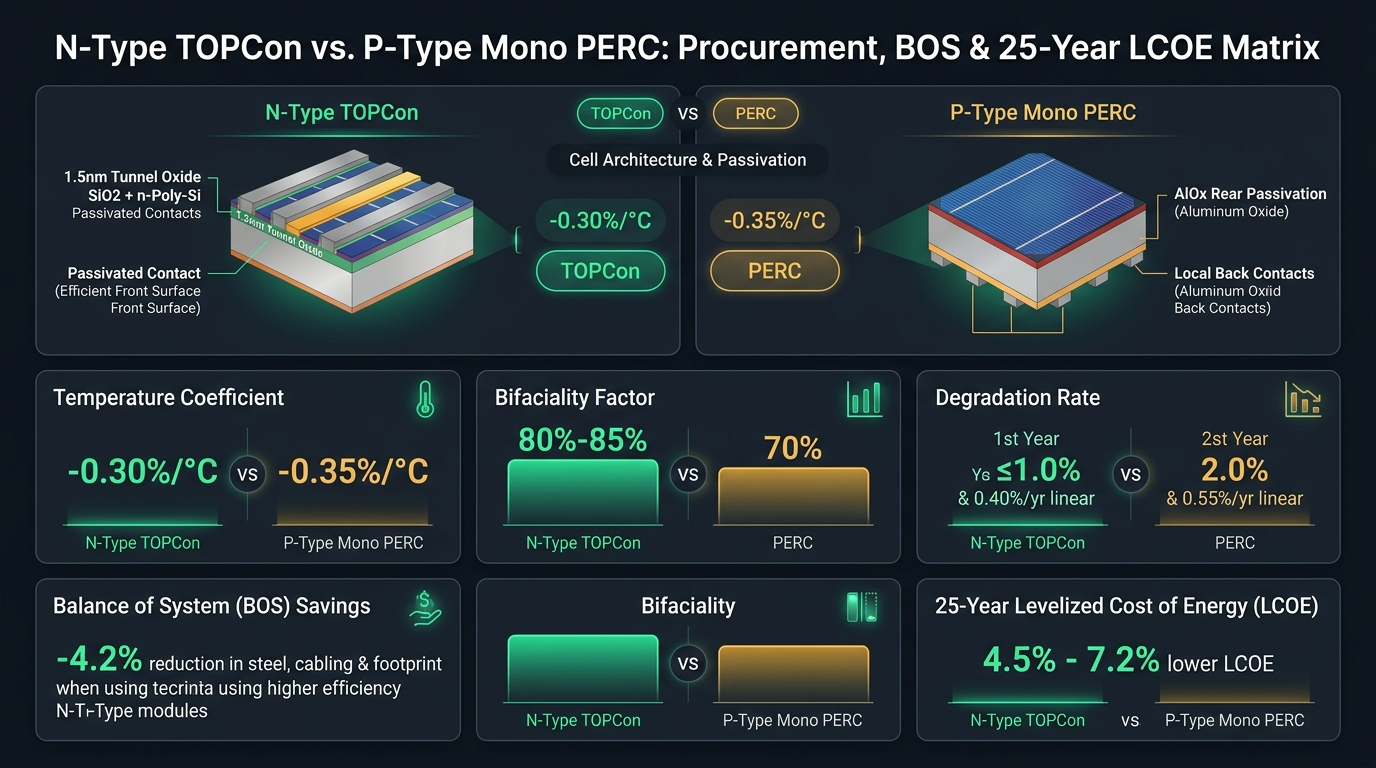
Below is the technical architecture comparison infographic highlighting the structural, optical, and electrical shifts from legacy P-Type Mono PERC to modern N-Type TOPCon bifacial modules:
Comprehensive Engineering Specification Matrix
| Parameter | P-Type Mono PERC | N-Type TOPCon (2026) | Technical Impact |
|---|---|---|---|
| Base Silicon Wafer | P-type (Boron-doped) | N-type (Phosphorus-doped) | Zero Boron-Oxygen defect complexes |
| Passivated Contact Scheme | Localized dielectric opening ($Al_2O_3 / SiN_x$) | Tunnel $SiO_2$ (1.5nm) + $poly\text{-}Si(n^+)$ | Eliminates contact recombination |
| Commercial Cell Efficiency | 21.4% – 21.8% | 25.5% – 26.2% | +3.8% to +4.4% absolute gain |
| Module Efficiency (STC) | 21.0% – 21.5% | 22.8% – 23.6% | Up to 630W+ on standard footprint |
| Open-Circuit Voltage ($V_{oc}$) | 685 – 692 mV | 730 – 738 mV | Higher voltage per cell string |
| Temperature Coefficient (Pmax) | -0.35% / °C | -0.30% / °C | +2.0% to +2.5% energy in hot climates |
| Bifaciality Coefficient | 68% – 70% | 80% – 85% | +1.5% to +3.0% additional rear yield |
| First-Year Degradation | ≤ 2.0% | ≤ 1.0% | Zero Boron-Oxygen LID |
| Linear Annual Degradation | ≤ 0.55% / year | ≤ 0.40% / year | 87.4% power retained at Year 30 |
| Encapsulation Film Standard | Standard EVA / EVA | POE / POE or EPE / POE | Prevents PID & acetic acid corrosion |
7. Navigating the 2026 Procurement Landscape: ALMM, BCD Tariffs & Bankability
Procuring N-Type TOPCon modules in India in 2026 requires navigating stringent statutory and commercial trade frameworks. Solar EPCs must align their procurement timeline with regulatory gateways:
ALMM Mandate Compliance
Under the Ministry of New and Renewable Energy (MNRE) guidelines, the Approved List of Models and Manufacturers (ALMM) is strictly enforced for all government, subsidized, open-access, and C&I net-metered solar projects. In 2026, leading domestic Indian module manufacturers (such as Waaree, Adani Solar, Vikram Solar, Premier Energies, and Tata Power Solar) have commissioned extensive multi-gigawatt N-Type TOPCon cell and module lines that are fully listed on ALMM Order I.
Basic Customs Duty (BCD) & Cell Sourcing
India applies a 40% BCD on imported solar modules and 25% BCD on imported solar cells. While domestic module manufacturing capacity has surged past 60 GW, domestic N-type cell capacity remains in active expansion. Procurement contracts must explicitly account for cell origin, ensuring domestic content requirement (DCR) eligibility where mandated by PSU bids (such as SECI, NTPC, and SJVN tenders).
BloombergNEF (BNEF) Tier-1 Criteria
Non-recourse project lenders require module manufacturers to hold active BloombergNEF Tier-1 bankability status. In 2026, BNEF criteria require vendors to have supplied proprietary-manufactured modules to six distinct non-recourse project-financed solar projects (>5 MW each) financed by six different commercial banks. Purchase contracts must contain a representation and warranty that Tier-1 status will be maintained throughout the manufacturing and warranty window.
Wafer Standardization: M10R vs. G12
Wafer size standardization has converged around two dominant platforms: M10 Rectangular (M10R: 182.2 × 188 mm, 54-cell and 72-cell formats) and G12 (210 × 210 mm, 66-cell and 132-half-cell formats). M10R modules maximize container shipping volume (packing up to 620W without exceeding container door heights or pallet weights), minimizing international and domestic freight costs per watt.
8. Quality Gateways: POE Encapsulation, SMBB & Factory Acceptance Audits
N-Type TOPCon cells possess distinct chemical and physical vulnerabilities that require rigorous factory gate quality controls. Because TOPCon rear passivated contacts utilize ultra-thin silver-aluminum ($Ag\text{-}Al$) paste contacts, they are more sensitive to moisture-induced corrosion and Potential-Induced Degradation (PID) than PERC.
Mandatory Technical Bill of Materials (BOM) Fingerprint
Purchase agreements must strictly prohibit standard EVA/EVA encapsulation. Ethylene Vinyl Acetate releases acetic acid in the presence of trace moisture, which corrodes the $Ag\text{-}Al$ grid and breaks down the 1.5nm tunnel oxide layer. The BOM must mandate either 100% pure Polyolefin Elastomer (POE) on both sides, or a high-grade co-extruded EPE (EVA-POE-EVA) film with a minimum POE core thickness of ≥120 μm and Water Vapor Transmission Rate (WVTR) ≤ 0.5 g/m²/day.
Mandate 16 or 18 circular micro-busbars (Ø 0.22–0.25 mm) with low-temperature soldering or electrically conductive adhesive (ECA). Circular round ribbons increase light trapping via internal reflection and decrease mechanical stress on silicon wafers, preventing micro-cracks under dynamic wind-load flexing.
For utility-scale installations, mandate dual-glass construction. Glass-glass packaging provides a zero-permeability hermetic barrier against moisture ingress, eliminates rear backsheet chalking, and delivers superior fire classification (Class A per IEC 61730 / UL 790).
Require the OEM to provide certified test results from PVEL (PV Evolution Labs) or RETC (Renewable Energy Test Center) demonstrating:
- Damp Heat (DH 2000h): Power degradation ≤ 2.0% (double the IEC 61215 standard).
- Potential-Induced Degradation (PID 192h): Power degradation ≤ 1.5%.
- Dynamic Mechanical Load (DML 1000 cycles + 50 Thermal Cycles): Power degradation ≤ 1.5% with zero broken busbars.
During Factory Acceptance Testing (FAT), deploy independent Third-Party Inspection (TPI) engineers to verify Golden Module flash calibration against primary calibrated reference cells (per IEC 60904-1) and enforce 100% darkroom Electroluminescence (EL) testing before crating.
9. Real-World Case Study: 100 MWp Utility-Scale Project in Jodhpur, Rajasthan
To quantify the real-world financial return of N-Type TOPCon technology, V-TECH RENEWABLES conducted an Owner’s Engineering evaluation for a 100 MWp grid-connected ground-mount solar project in Phalodi, Jodhpur district, Rajasthan. The site exhibits extreme solar resource conditions: GHI of 1,980 kWh/m²/year, peak summer ambient temperatures exceeding 47°C (cell temperatures >68°C), and high sandy ground albedo (~0.28).
Project Engineering & Financial Comparison
10. 12-Point N-Type TOPCon Procurement & Audit Checklist
Solar purchase directors and procurement committees should utilize this standardized 12-point audit checklist before executing purchase contracts and authorizing milestone letters of credit (LC):
ALMM & Statutory Validity
Confirm exact model numbers are actively listed on MNRE ALMM Order-I with valid BIS certification per IS 14286 / IEC 61215.
BNEF Tier-1 Listing Verification
Obtain latest quarterly BloombergNEF Tier-1 certificate issued directly in the OEM’s exact corporate manufacturing entity name.
Contractual BOM Fingerprint Lock
Specify bill-of-materials in contract annexure: POE/EPE encapsulant resin (no pure EVA), 2.0mm dual semi-tempered glass, and SMBB 16BB interconnects.
Temperature Coefficient Cap
Enforce guaranteed Pmax temperature coefficient of ≤ -0.30% / °C backed by flash test reports across five random factory batches.
Guaranteed Bifaciality Coefficient
Contractually enforce bifaciality factor ≥ 80% (±3%) tested under rear-irradiance flash protocols per IEC TS 60904-1-2.
Degradation Warranty Milestones
Enforce ≤ 1.0% Year 1 degradation, ≤ 0.40%/year linear degradation (Years 2–30), and ≥ 87.4% power output at Year 30.
Non-Cancellable Third-Party Warranty Insurance
Require back-to-back third-party warranty insurance underwritten by Munich Re, Swiss Re, or Ariel Re naming the SPV as beneficiary.
PVEL / RETC Reliability Scorecards
Verify Top Performer ratings in DH 2000h, PID 192h, TC 600 cycles, and Dynamic Mechanical Load sequences.
Golden Module Flash Calibration
Mandate factory solar simulators are Class AAA and calibrated weekly against Fraunhofer/TÜV Rheinland primary reference cells.
100% Inline EL Defect Auditing
Mandate high-resolution 4-camera Electroluminescence (EL) imaging pre- and post-lamination to reject micro-cracks, finger voids, and cell mismatch.
Incoterms & Transit Packaging Standard
Enforce vertical landscape wooden pallet crating, ISPM-15 compliance, calibrated strapping (1,800–2,100 N), and air-suspension trucking.
Factory Acceptance Testing (FAT) Access
Secure unrestricted factory audit access for Owner’s Engineers and TPI inspectors to witness flash testing, peel tests, and gel content tests.
11. Frequently Asked Questions (FAQs)
Why has N-Type TOPCon completely displaced P-Type Mono PERC in 2026 utility-scale procurement?
P-Type Mono PERC reached its practical commercial ceiling at 21.4%–21.8% module efficiency and suffers from inherent Boron-Oxygen defect complexes that trigger Light-Induced Degradation (LID) and Light- and elevated Temperature-Induced Degradation (LeTID). In contrast, N-Type TOPCon utilizes phosphorus-doped silicon wafers that completely eliminate boron-oxygen defects. Combined with quantum-tunneling oxide passivated contacts, TOPCon delivers commercial module efficiencies of 22.5% to 23.6%, a superior temperature coefficient (-0.30%/°C vs -0.35%/°C), higher bifaciality (80%–85% vs 70%), and first-year degradation of ≤1.0% (vs 2.0% for PERC). This combination unlocks 3.0% to 4.5% higher lifetime energy yield and slashes project LCOE by ₹0.15 to ₹0.22/kWh.
How does the CapEx premium of N-Type TOPCon modules offset overall project Balance of System (BOS) costs?
While N-Type TOPCon modules carry a modest purchase price premium of $0.008 to $0.015 per watt-peak over legacy PERC, their higher power density (600W to 630W+ on M10R and G12 formats) produces fewer total modules required for a fixed DC capacity. This directly reduces Balance of System (BOS) costs: mounting structure steel weight is reduced by 3.8% to 4.5%, foundation piles decrease by 4.0%, DC string cabling length decreases by 4.2%, and total project land acquisition and grading footprints shrink by 4% to 6%. In utility-scale solar projects, these BOS savings often exceed the module procurement price premium, resulting in a neutral or lower initial project CapEx per watt-peak.
Why is POE or EPE encapsulation mandatory instead of standard EVA for N-Type TOPCon bifacial modules?
Standard Ethylene Vinyl Acetate (EVA) encapsulant is prone to hydrolysis in humid and high-temperature environments, breaking down into acetic acid. Acetic acid corrodes the ultra-thin silver-aluminum front metallization contacts and damages the delicate tunnel oxide passivation layer of N-Type TOPCon cells, triggering severe Potential-Induced Degradation (both PID-p and PID-s) and delamination. High-grade Polyolefin Elastomer (POE) or co-extruded EPE (EVA-POE-EVA) offers a Water Vapor Transmission Rate (WVTR) that is two orders of magnitude lower than EVA (<0.5 g/m²/day vs >25 g/m²/day) and generates zero acidic byproducts, preserving 30-year linear power warranties.
How does the superior temperature coefficient of N-Type TOPCon impact energy yield in hot regions like Rajasthan and Gujarat?
During peak summer months in western and central India, solar module operating temperatures frequently reach 65°C to 70°C—which is 40°C to 45°C above Standard Test Conditions (STC 25°C). At -0.30%/°C, an N-Type TOPCon module suffers a thermal efficiency loss of only 12.0% to 13.5%, compared to 14.0% to 15.75% for a Mono PERC module (-0.35%/°C). Over an entire operating year, this 0.05%/°C temperature coefficient advantage alone contributes an extra 1.8% to 2.4% generation boost in high-ambient solar corridors, dramatically increasing project Net Present Value (NPV).
What must solar purchase managers check during Factory Acceptance Testing (FAT) for N-Type TOPCon modules?
During FAT and pre-dispatch inspections, purchase managers and third-party inspectors must: (1) verify Golden Module flash calibration against accredited reference cells per IEC 60904-1; (2) audit inline darkroom Electroluminescence (EL) testing for micro-cracks, finger interruptions, and inactive cell areas; (3) perform Bill of Materials (BOM) fingerprinting to confirm POE/EPE encapsulant resin, high-purity glass, and junction box diodes; (4) verify manufacturer compliance with the Approved List of Models and Manufacturers (ALMM); and (5) inspect low-light performance data (200 W/m²) and bifaciality coefficient flash reports.
V-TECH RENEWABLES • Engineering & Procurement Advisory
With over 500+ MWp of solar PV designs engineered across 110+ projects in India, V-TECH RENEWABLES acts as the premier Owner’s Engineer and procurement technical advisor. We assist solar EPCs, developers, and investment funds in BOM optimization, PVsyst energy simulation audits, factory gate QA/QC inspections, and bankability due diligence.
Related Procurement & Engineering Articles
Managing Logistics and Transit Damage for Delicate PV Modules
Mitigating micro-cracks in large-format N-Type TOPCon dual-glass modules: 3-axis shock loggers, air-suspension trucking, and mobile EL darkroom audits.
Procurement AdvisoryEvaluating Solar Inverter Warranties: What Purchase Managers Must Check
Understanding performance guarantees, service SLAs, MTTR commitments, parts-only traps, and Munich Re third-party warranty insurance.
Optimize Your Next Solar Procurement Package
Whether you are evaluating Tier-1 N-Type TOPCon modules for an upcoming utility bid or conducting pre-dispatch factory acceptance audits, V-TECH RENEWABLES delivers precision engineering, PVsyst yield simulations, and independent technical due diligence.