Managing Logistics and Transit Damage for Delicate PV Modules: Best Practices for Safe Site Delivery and Warehousing
Modern 600W+ dual-glass bifacial solar modules utilize thinner silicon wafers, 2.0mm semi-tempered glass, and oversized frames that are acutely susceptible to dynamic transit shock, improper crane rigging, and laydown yard moisture degradation. Here is the comprehensive technical and operational playbook for solar EPC heads, logistics directors, and Owner’s Engineers to eliminate transit micro-cracks, enforce 3-axis shock monitoring, optimize site warehousing, and secure 100% insurance claim recoveries.
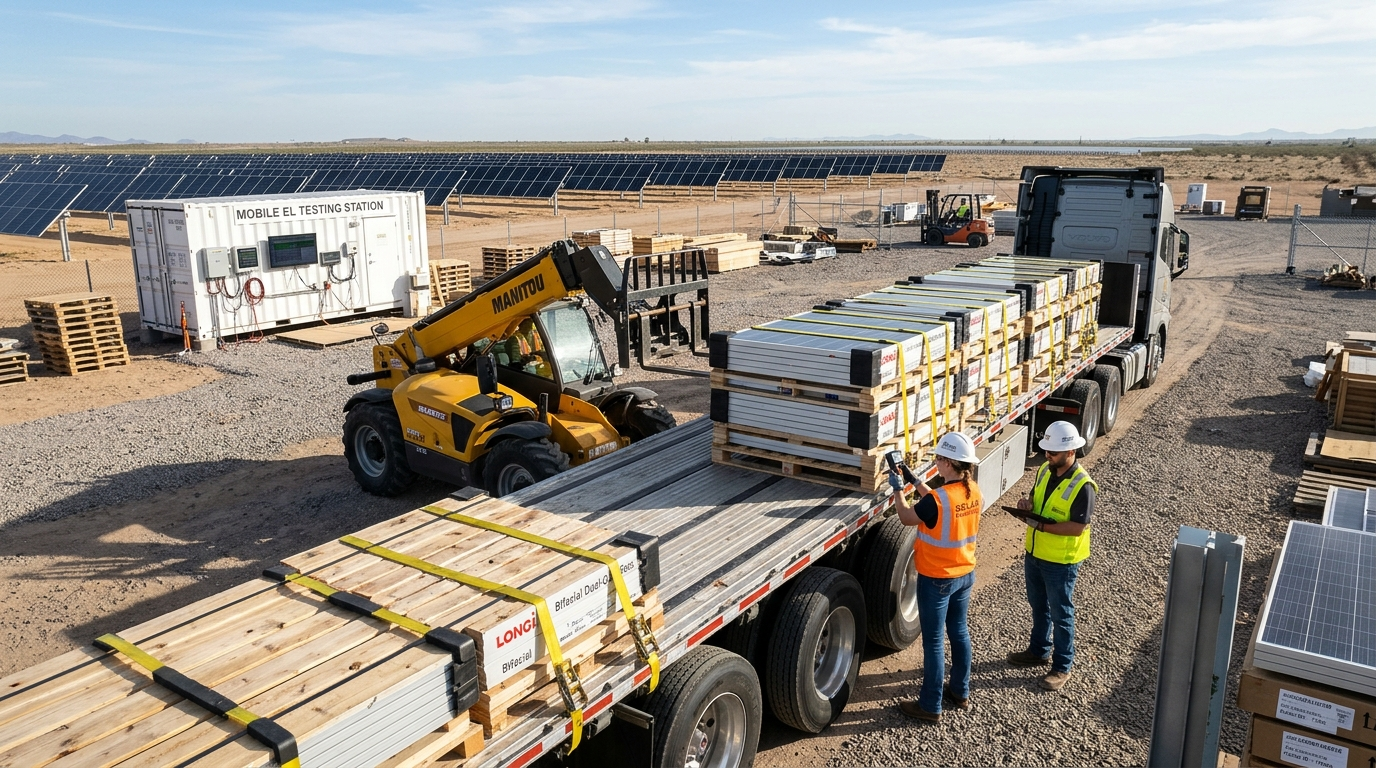
In utility-scale solar EPC projects, photovoltaic modules account for 50% to 58% of total project capital expenditure. Consequently, procurement heads spend months negotiating fractions of a cent per watt-peak ($/Wp) on factory bill-of-materials (BOM), Tier-1 bankability warranties, and third-party flash test certifications.
However, a catastrophic operational blind spot frequently occurs the moment finished modules roll off the factory automation line. Transporting hundreds of thousands of delicate semiconductor devices across intermodal shipping routes, container ports, congested national highways, and rutted rural dirt tracks presents severe mechanical risks. A single unmonitored road pothole, improper forklift tine insertion, or waterlogged laydown yard can induce pervasive, sub-visual silicon micro-cracking that destroys plant performance ratio (PR), voids OEM warranties, and creates millions of dollars in unrecoverable insurance repudiations.
Managing module logistics and site warehousing is therefore not a commoditized freight-forwarding task—it is an exacting quality-assurance engineering discipline that directly safeguards the 25-year financial viability of the solar asset.
1. The Delicate Giant: Why 600W+ Bifacial Modules Are Fragile
To engineer effective logistics safeguards, project teams must first recognize how modern photovoltaic technology has evolved. A decade ago, the standard utility module was a 300W–330W 72-cell polycrystalline panel measuring approximately 1.95m × 0.99m, encased in a rigid 40mm aluminum frame with a robust 3.2mm tempered front glass sheet and a polymer backsheet. Silicon wafers were 180µm to 200µm thick, providing substantial mechanical resilience against flexural shock.
Today's utility-scale gold standard is radically different:
Modern 600W–720W panels exceed 2.38m in length and 1.30m in width, acting as massive flexural membranes under dynamic transit vibrations.
Transition to N-Type TOPCon and HJT cells reduced wafer thickness by over 30%, drastically lowering the critical fracture stress limit ($\sigma_f$).
Semi-tempered dual-glass structures offer high bifacial energy gain and fire ratings, but have lower localized impact and edge chipping resistance than 3.2mm tempered glass.
Because modern modules weigh between 32 kg and 38 kg and feature a narrower frame profile (typically down-gauged to 30mm or 35mm to save aluminum CapEx), any localized bending moment or point impact creates severe stress concentrations. When subjected to the dynamic harmonics of long-distance transport, the wafer substrate inside the laminated sandwich experiences mechanical strain that exceeds the brittle yield threshold of crystalline silicon.
2. Micro-Crack Dynamics: How Invisible Fissures Destroy Yield
The most insidious consequence of transit trauma is that silicon micro-cracks are completely invisible to the human eye. When an improperly supported pallet bounces violently over an expansion joint, the exterior 2.0mm glass sheets often remain pristine without a single visible scratch. Inside the cell laminate, however, crystalline silicon undergoes microscopic brittle cleavage.
The Lifecycle Propagation of Transit Micro-Cracks
Micro-cracks generated during transport do not remain static. Over a 25-year operational lifecycle, they undergo dynamic deterioration governed by thermal and mechanical fatigue:
- Immediate Elastic Cleavage: During transit impacts exceeding 2.0G, micro-fissures propagate across cell finger grids, typically oriented along the crystal lattice cleavage planes (100 or 111 directions).
- Diurnal Thermal Cycling Stress: Under daily field operations, module temperatures cycle from nighttime lows of 10°C to peak summer operating temperatures of 65°C to 75°C ($\Delta T \approx 55^\circ\text{C}$). Because the thermal expansion coefficient of copper ribbon ($\alpha_{Cu} \approx 16.5 \times 10^{-6}/\text{K}$) is substantially higher than silicon ($\alpha_{Si} \approx 2.6 \times 10^{-6}/\text{K}$), cyclic shear stresses pull the cracked wafer edges apart.
- Electrical Cell Isolation: Over 12 to 36 months, micro-cracks branch and intersect primary busbars, severing current collection pathways. Isolated cell fragments become electrically disconnected ("dead cell areas" or "black patches").
- Severe Hot Spot Genesis & Fire Hazard: Because current is forced through constricted conductive bridges, localized series resistance ($R_s$) skyrockets. The isolated cell region becomes reverse-biased, converting generated DC power into intense localized heat. Hot spot temperatures frequently exceed 120°C to 160°C, causing EVA encapsulant browning, backsheet delamination, glass thermal shatter, and catastrophic DC arc-fault fires.
Financial Impact on Plant Performance Ratio (PR)
EPRI (Electric Power Research Institute) and TÜV Rheinland field studies indicate that plants constructed with unmitigated transit micro-crack rates exceeding 4% suffer an irreversible 1.8% to 3.5% drop in first-year generation, accelerating to over 0.8% annual degradation (compared to the warranted 0.40% linear rate). For a 100 MWp utility plant, this translates to over ₹3.5 Crore to ₹5.2 Crore in lost annual revenue over its lifetime.
3. Multi-Modal Transit Stressors: Maritime vs. Overland Hauling
From manufacturing cleanrooms in Southeast Asia or coastal Indian gigafactories to interior solar parks in Rajasthan, Gujarat, Karnataka, or Madhya Pradesh, module pallets endure multiple transportation phases, each possessing distinct vibrational signatures:
| Transit Mode | Dominant Dynamics | Frequency / Acceleration | Primary Risk Vector |
|---|---|---|---|
| Ocean Shipping (Container Vessel) | Low-frequency rolling, pitching, continuous wave swell vibrations | 0.1 Hz – 2.0 Hz 0.3G – 0.8G sustained |
Container sweat / moisture condensation; pallet friction chafing. |
| Intermodal Port Gantry Handling | Container set-down impacts, rail-car shunting, rough reach-stacker drops | Shock pulses < 20 ms 2.0G – 4.0G instantaneous |
Bottom module frame buckle; glass edge impact shatter. |
| Overland Highway (NH / Expressways) | Tire rolling resonance, expansion joints, moderate braking forces | 8.0 Hz – 25 Hz 0.5G – 1.2G |
Fatigue resonance vibrating center of module laminates. |
| Last-Mile Rural & Site Access Roads | Deep potholes, unpaved corrugations, steep cambers, washboard tracks | Dynamic shock impulses 3.0G – 5.5G severe spikes |
Severe multi-axis cell cracking; strap snapping; pallet tipping. |
4. The Trucking Dilemma: Mechanical Leaf vs. Air-Suspension Fleet
In Indian solar construction logistics, the choice of overland transport fleet represents the single highest variance in transit damage rates. The vast majority of domestic commercial logistics providers deploy standard multi-axle trailers equipped with stiff mechanical multi-leaf spring suspensions.
Leaf-spring suspensions are designed to survive 40-metric-ton bulk aggregate loads on rough roads. When loaded with lightweight volumetric cargo like solar modules (where a 40-foot flatbed holds only 18 to 22 metric tons across 18 to 22 pallets), the mechanical springs remain largely uncompressed. In this unyielding state, the trailer behaves like a rigid lever arm, transmitting high-frequency road vibrations directly into the wooden pallet stringers.
Mechanical Leaf-Spring Trailers
- • Transmits 2.5G to 4.5G shock spikes across potholes and bridge expansion joints.
- • High vibrational frequency (15–30 Hz) matches the natural resonance frequency of large glass panels.
- • Pallet bounce creates internal slack, causing modules to slam against packaging spacers.
- • Average micro-crack incidence upon site receipt: 3.8% to 6.2%.
Pneumatic Air-Suspension Trailers
- • Pressurized pneumatic air bellows dampen shocks, capping vertical spikes to < 1.0G – 1.2G.
- • Isolates cargo deck from road harmonic frequencies; eliminates high-G impact pulses.
- • Constant ride height maintains even weight distribution across all trailer axles.
- • Average micro-crack incidence upon site receipt: < 0.25% (pristine delivery).
Procurement Recommendation: EPC supply agreements and logistics tenders must explicitly mandate pneumatic air-suspension trailers for all transit legs exceeding 100 km, or enforce a strict contractual penalty clause for carriers utilizing conventional leaf-spring flatbeds without secondary shock-absorbing timber/rubber deck matting.
5. Packaging Engineering: Landscape Crating & Strapping Tension
Historically, smaller PV modules were shipped stacked flat (horizontal portrait stacking). For modern 2.4-meter modules, horizontal stacking is obsolete: the bottom module would bear the dead weight of 30 panels above it (over 1,000 kg), causing severe glass bowing and edge crushing.
Leading Tier-1 manufacturers package modern panels in a vertical landscape orientation (resting vertically on their long aluminum frame edges, packed face-to-face with protective polymer corner caps and corrugated separators). While vertical crating dramatically improves weight distribution, it introduces critical packaging parameters that procurement managers must audit:
- Pallet Deck Rigidity & Stringer Alignment: Pallets must feature heavy-duty three-stringer or four-stringer wooden bases constructed from kiln-dried hardwood or engineered LVL (Laminated Veneer Lumber) treated to ISPM-15 standards. Deck board deflection under full dynamic load must not exceed 8mm.
- Calibrated Strapping Tension: Packaging crates rely on high-tensile polyester (PET) or steel-composite composite strapping. If strap tension is too low (<1,200 N), panels shift and vibrate against one another, causing anti-reflective (ARC) glass abrasion. If tension is too high (>2,500 N), the strapping deforms the top frame profiles and induces localized edge cell fracture. Factory packaging lines must operate automated, torque-calibrated tensioning tools set strictly between 1,800 N and 2,100 N.
- Corner Protector Integrity: Molded high-density polyethylene (HDPE) or multi-ply corner buffer caps must be fitted to all four corners of every single module to eliminate direct metal-on-metal or glass-on-glass contact points.
6. Continuous Telemetry: 3-Axis Shock Loggers & Tilt Indicators
In the event of in-transit damage, logistics carriers, freight forwarders, and marine insurance underwriters inevitably point fingers at one another. The freight forwarder claims the factory packed defective modules; the EPC claims the trucker hit a ditch; the trucker claims the site crane dropped the pallet.
To eliminate ambiguity and establish an unassailable digital chain of custody, EPC heads must mandate dual-tier shock monitoring on every shipment:
SpotSee ShockWatch & TiltWatch
Tamper-evident physical indicators affixed to the external packaging of every individual pallet.
- • ShockWatch 2G / 5G Tubes: Chemically activated capillary tube turns vivid red if threshold G-force is exceeded.
- • TiltWatch Plus: Records angular tilt beyond 30°, 40°, 50°, and 80°, detecting tipping or horizontal laying.
- • Serial-Numbered: Logged on Bill of Lading (BOL) at factory gate to prevent field tampering.
3-Axis Digital Accelerometer Loggers
High-precision tri-axial digital loggers recording X, Y, and Z acceleration curves with GPS time-stamping.
- • Sampling Rate: High-frequency 1,000 Hz logging capturing milliseconds-long impact shockwaves.
- • Environmental Sensors: Synchronously logs temperature, relative humidity, and barometric pressure.
- • GPS Geofencing: Pinpoints the exact geographical coordinate, road kilometer marker, and timestamp of every shock event >1.5G.
7. Safe Site Offloading: Forklift Tines, Spreader Bars & De-Banding
Arrival at the project site does not mean modules are out of danger. In fact, over 40% of all transit-attributed micro-cracking occurs during the final 100 meters: offloading from the truck bed and de-banding in the staging yard.
Rule 1: Forklift Blade Length Must Match Pallet Depth (≥ 2.0m – 2.2m)
Standard industrial forklifts ship with 1.1m or 1.2m tines designed for standard Euro pallets. A utility solar module pallet is 2.35m to 2.50m long.
Inserting 1.2m forks into a 2.4m pallet leaves the rear half of the 1,100 kg load completely unsupported. As the forklift lifts, the center of gravity creates massive bending moments across the wooden stringers. The bottom pallet deck snaps upward, punching into the cardboard carton and destroying the aluminum frames and silicon wafers of the bottom three to five modules. Site managers must strictly prohibit offloading until certified slip-on fork extension tines (≥2.0m length) are mechanically locked onto the forklift carriage.
Rule 2: Crane Offloading Requires Certified 4-Point Spreader Beams
When offloading from high-sided trailers using mobile cranes or rough-terrain telehandlers, riggers frequently loop standard two-leg wire rope or chain slings around the pallet. Under crane tension, the slings pull inward at a 45-degree angle, generating crushing horizontal compressive forces across the top packaging edges that fold module frames.
Crane rigging must exclusively utilize a rigid 4-point structural spreader beam that ensures all four polyester web slings drop perfectly vertical (90 degrees to the pallet plane), exerting pure vertical lifting force with zero lateral pinching.
Rule 3: Deploy Anti-Collapse De-Banding Safety Cages
When unpackaging vertical landscape pallets in the field, cutting the exterior tension straps can trigger the deadly domino collapse effect. If the pallet is on a slight 2-degree ground slope, the 31 vertical modules will cascade forward with over a ton of dynamic force, crushing workers and completely shattering all panels.
Site Standard Operating Procedures (SOPs) must enforce the use of a steel de-banding safety support rack or mobile cage that physically secures both sides of the vertical pack while straps are cut, allowing technicians to slide out modules one by one from a stabilized jig.
8. Staging Yard Engineering: Drainage, Stacking & Microclimates
Large utility solar plants often store module pallets in site staging yards for 30 to 90 days prior to structural table mounting. Neglected laydown yards can turn pristine modules into scrap through environmental degradation:
- Civil Yard Elevation & Drainage: The staging yard must be leveled, compacted with an aggregate base course (GSB/WMM), and elevated at least 250mm to 300mm above the surrounding terrain with a minimum 1.5% transverse drainage slope. Pallets placed on raw agricultural soil will sink into mud during rainstorms; waterlogging saturates wooden pallet bases, causing microbial decay, structural wood collapse, and bottom-module immersion.
- Ground Contact Isolation: Pallets must never rest directly on bare soil. Set pallets onto continuous heavy-duty plastic runners, precast concrete sleepers, or treated hardwood dunnage beams.
- Stacking Rules (The 2-High Maximum): Unopened factory-sealed crates may be stacked a maximum of 2 tiers high, provided the ground is laser-leveled and compacted (≥95% Proctor density). Stacking 3 tiers high concentrates over 2.2 metric tons on the bottom carton corners, risking catastrophic tipping during high wind gusts. Opened or partially unpacked pallets must NEVER be stacked under any circumstance.
- Breathable Weatherproofing vs. The "Plastic Oven" Trap: Wrapping pallets in transparent polythene cling wrap creates an intense greenhouse microclimate in sunny desert environments. Interior crate temperatures soar past 75°C, causing EVA encapsulant cross-linking degradation, connector sealing ring embrittlement, and moisture condensation inside the junction boxes. Warehousing yards must use heavy-duty, UV-stabilized, breathable silver-coated woven poly tarpaulins secured with eyelets and weighted ballast, maintaining continuous underside cross-ventilation.
9. Quality Gateways: Inbound AQL & Mobile Darkroom EL Audits
Visual inspection at the delivery gate catches only shattered glass and warped frames. To uncover sub-visual transit micro-cracks before legal liability transfers to the EPC, projects must implement an on-site Mobile Darkroom Electroluminescence (EL) Inspection Gateway.
Operating out of an air-conditioned, light-tight 20-foot modified shipping container positioned directly at the site security gate, the mobile EL system subjects incoming modules to rigorous non-destructive diagnostic screening:
| Inspection Gate | Sampling Protocol | Diagnostic Tooling | Rejection Threshold |
|---|---|---|---|
| Gate 1: Inbound Receiving Inspection (IRI) | 100% of trucks and pallets | Visual audit, seal verification, ShockWatch/TiltWatch barcode scan | Any triggered ShockWatch (>2G) or broken strap quarantines pallet immediately. |
| Gate 2: Statistical Inbound EL Screening | ISO 2859-1 Level II Normal (AQL 0.65 / 1.0) + 100% of shocked pallets | Mobile container darkroom, 24MP InGaAs NIR camera (950–1150 nm), 0.1× to 1.0× $I_{sc}$ forward bias | Micro-cracks intersecting >2 busbars; inactive cell area >1.5%; dendritic fractures. |
| Gate 3: I-V Flash Power Verification | 1 out of every 500 modules (0.2%) | Class AAA mobile LED solar simulator calibrated to factory Golden Module | Power output below warranted negative tolerance (-0.0% / +3.0%). |
| Gate 4: Pre-Commissioning Aerial Drone IR | 100% of mounted array strings (IEC 62446-3) | Radiometric thermal drone ($640\times512$, NETD ≤ 30mK) during full sun (>700 W/m²) | Any $\Delta T \ge 10^\circ\text{C}$ hotspot triggers module replacement before CEIG sync. |
10. Solar PV Module Transit & Warehousing Mitigation Matrix
To provide a standardized visual framework for site logistics coordinators, EPC project directors, and third-party inspectors, our engineering team synthesized the end-to-end material handling protocol into an operational architecture matrix:
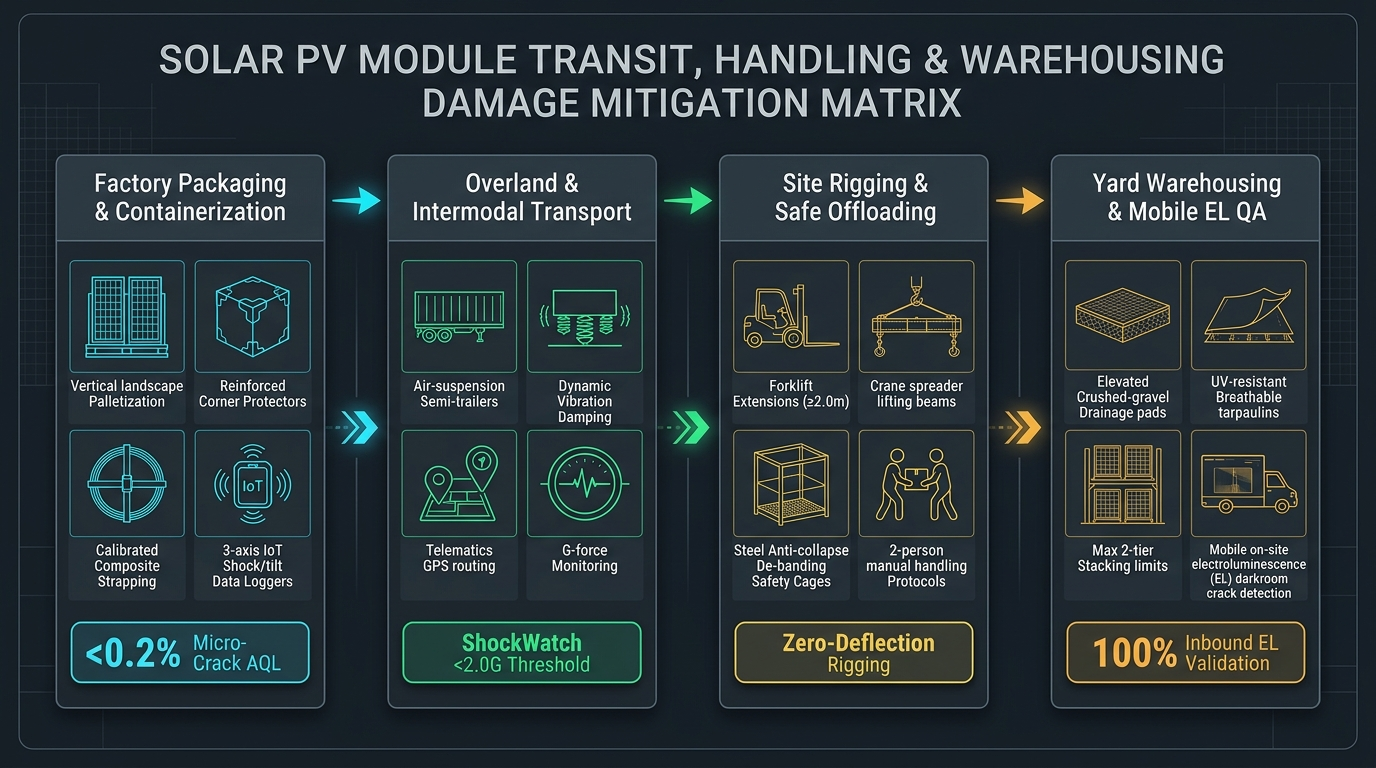
The matrix establishes four unbroken defensive perimeters across the equipment supply chain:
Packaging Integrity & Shock Sealing
Automated strapping tension validation (1,800–2,100 N), vertical landscape packing, dual serial-numbered ShockWatch/TiltWatch indicators, and ISO-certified container dunnage inflatable air cushions to suppress maritime surging.
Air-Suspension Logistics Fleet
Mandatory pneumatic air-suspension trailers limiting vertical dynamic shocks to <1.2G, active 3-axis IoT accelerometer telematics, geofenced route speed limits across rural terrain, and prohibition of open-top hauling without tarpaulins.
Engineered Lifting & De-Banding
Forklift tines ≥2.0m providing full pallet bottom stringer support, 4-point crane spreader beams eliminating lateral sling pinch, zero two-tier stacking of opened pallets, and anti-collapse de-banding safety cages.
Mobile Darkroom Electroluminescence (EL)
AQL Level II statistical EL sampling within 72 hours of site arrival in an on-site climate-controlled darkroom container, capturing hidden cell micro-fractures before signing unconditional Goods Receipt Notes.
11. Incoterms 2020 & The 14-Day Hidden Damage Insurance Trap
Technical precautions are toothless without water-tight contractual risk allocation. During procurement negotiations, commercial terms dictate who bears financial responsibility when modules arrive cracked:
Incoterms 2020: Why EPCs Must Avoid CIF / FOB and Insist on DAP / DDP
- FOB (Free on Board) / CIF (Cost, Insurance & Freight): Under FOB or CIF terms, the risk of loss or damage transfers from the module manufacturer to the EPC the instant the modules pass the ship's rail at the foreign port of departure. If damage occurs during maritime storms, port transshipment, or inland transit across India, the foreign manufacturer has zero legal liability and retains 100% of your payment. The EPC is left filing exhausting, protracted claims against marine insurers.
- DAP (Delivered at Place) / DDP (Delivered Duty Paid): Under DAP/DDP project site terms, risk remains squarely with the seller/manufacturer until the transport vehicle arrives at the solar project site boundary. Any damage sustained during ocean transit or highway hauling is the manufacturer’s and freight forwarder’s financial responsibility.
The 7 to 14-Day "Hidden Damage" Insurance Trap
Under standard Institute Cargo Clauses (A) 'All Risks' marine and inland transit cargo policies, insurers enforce a strict Hidden/Concealed Damage reporting clause:
Most standard insurance contracts stipulate that any damage not visible on the exterior carton packaging must be discovered and officially notified to the insurance surveyor within 7 to 14 calendar days of site arrival. If an EPC signs a clean Goods Receipt Note (GRN) upon delivery and leaves unopened pallets sitting in the laydown yard for 60 days before installation, any subsequent discovery of shattered glass or micro-cracks will be summarily repudiated by insurance adjusters as post-delivery site mishandling!
The Golden Rule for Site Storekeepers: Never sign an unconditional Goods Receipt Note (GRN). Always stamp all carrier delivery challans with the standard legal reservation: "Received subject to internal technical unpacking, count verification, and mobile electroluminescence (EL) defect audit."
12. Real-World Case Study: 150 MWp Solar Park in Jaisalmer
To illustrate the tangible financial value of rigorous transit and logistics risk engineering, consider a recent 150 MWp utility-scale solar project in Jaisalmer, Rajasthan engineered with V-TECH RENEWABLES advisory oversight.
Procured 246,000 N-Type TOPCon 610W dual-glass bifacial modules shipped through Mundra Port and hauled over 650 km across rural Rajasthan terrain.
Logistics tender contractually stipulated pneumatic air-suspension trailers equipped with dual 3-axis IoT accelerometer loggers and ShockWatch indicators on all pallets.
The Incident & Diagnostic Discovery
During week 4 of delivery, 22 trucks were diverted around an unannounced state highway bridge closure onto an unpaved, rutted desert detour. IoT shock telemetry automatically flagged severe acceleration events:
- Truck telemetry logged multiple vertical shock impulses between 2.8G and 3.6G along a 18 km stretch of washed-out gravel road.
- Upon site arrival, the external cardboard packaging and exterior glass appeared completely undamaged. However, 19 of the 22 trucks had triggered SpotSee ShockWatch indicators.
- The on-site Mobile Darkroom EL container immediately quarantined the 760 pallets from those trucks and initiated 100% Electroluminescence screening under ISO 2859-1 tightened protocols.
- The Diagnostic Result: EL imagery revealed that 5.4% of the modules (1,248 panels) had suffered severe diagonal cross-cracking and severed cell busbars due to road vibration shockwaves. In contrast, modules transported on the normal paved highway using air-suspension trailers exhibited a micro-crack rate of just 0.14%.
Commercial Resolution & Financial Impact
Because the EPC had deployed IoT GPS time-stamped telemetry and conducted mobile EL testing within 48 hours of arrival, the logistics carrier and transit insurance underwriters had zero legal grounds to dispute the claim.
100% full replacement value and re-freight charges paid by the cargo insurer within 24 calendar days without litigation.
Eliminated 1,248 latent hot-spot generators, preventing an estimated ₹6.8 Crore in cumulative 10-year generation degradation.
The entire cost of leasing the on-site mobile EL darkroom station for 3 months was recouped more than fourteen times over.
13. 12-Point Pre-Dispatch & Site Logistics Audit Checklist
Before issuing dispatch clearances or signing receiving documents, solar EPC project directors and logistics managers should enforce this 12-point quality assurance protocol:
Incoterms Risk Demarcation
Structure module purchase agreements under DAP or DDP project site terms, ensuring manufacturer and freight forwarder retain full cargo risk until site gate arrival.
Packaging Specification Sign-Off
Verify vertical landscape packing on ISPM-15 treated hardwood/LVL pallets with HDPE corner protectors and automated strapping tension calibrated to 1,800–2,100 N.
Fleet Suspension Mandate
Contractually stipulate pneumatic air-suspension trailers for all overland transit exceeding 100 km; prohibit rigid leaf-spring flatbeds without secondary shock matting.
Dual Shock & Tilt Monitoring
Affix serial-numbered SpotSee ShockWatch (2G/5G) and TiltWatch indicators to 100% of pallets, and install 3-axis IoT accelerometer loggers on every trailer.
Forklift Blade Extensions (≥2.0m)
Strictly prohibit forklift offloading unless carriage is fitted with certified slip-on fork extensions supporting the full 2.4m length of the pallet stringers.
Crane Rigging Spreader Beams
Mandate certified 4-point structural spreader beams for all crane lifts to maintain vertical sling drop and eliminate lateral crushing of module frame corners.
Anti-Collapse De-Banding Safety Jigs
Enforce the mandatory use of steel de-banding support cages prior to cutting packaging straps, preventing domino cascade collapses and personnel crushing.
Elevated Staging Yard Civil Drainage
Grade and compact the laydown yard with aggregate base ≥250mm above terrain, ensuring ≥1.5% cross-fall to eliminate waterlogging and wood pallet softening.
Stacking Limits Enforcement
Enforce strict maximum 2-high stacking for unopened factory crates on compacted ground; enforce ZERO stacking for opened or partially utilized pallets.
Breathable UV Tarpaulin Coverings
Cover stored pallets with heavy-duty, breathable UV-resistant silver-coated poly tarpaulins; eliminate clear polythene cling wraps that create 75°C solar ovens.
On-Site Mobile Darkroom EL Screening
Deploy an on-site mobile EL darkroom container to test statistical samples (AQL Level II) and 100% of shocked pallets within 72 hours of site arrival.
Conditional GRN Endorsement
Sign delivery challans strictly as 'Conditional Receipt Subject to Internal EL Audit' within the mandatory 14-day insurance hidden damage reporting window.
14. Frequently Asked Questions
Protect Your Module Shipments from Costly Transit Micro-Cracks
At V-TECH RENEWABLES, our Owner's Engineers and quality assurance teams conduct factory pre-shipment inspections, draft airtight logistics specifications, deploy mobile darkroom Electroluminescence (EL) testing trailers, and secure bankable transit insurance settlements for utility-scale solar developers across India.
Related Engineering Articles
Evaluating Solar Inverter Warranties: What Purchase Managers Must Check
Standard vs extended coverage, parts-only traps, Munich Re insurance, service SLAs, and MTTR guarantees.
BOM Optimization: Balancing Tier-1 Quality with Project Budgets
Selecting high-efficiency N-Type TOPCon modules, central vs. string trade-offs, and factory BOM fingerprinting.
Mitigating Component Price Volatility in Solar EPC Contracts
FIDIC price escalation formulas, raw material indexing, forex hedging, and volume reservation pegging.