Evaluating Solar Inverter Warranties: What Purchase Managers Must Check
Solar inverters represent less than 10% of total plant CapEx but drive over 70% of 25-year unscheduled maintenance and generation downtime risks. Here is the rigorous technical and contractual playbook for purchase managers, EPC heads, and asset owners to evaluate warranty terms, negotiate bankable SLAs, avoid hidden exclusions, and protect lifetime project yields.
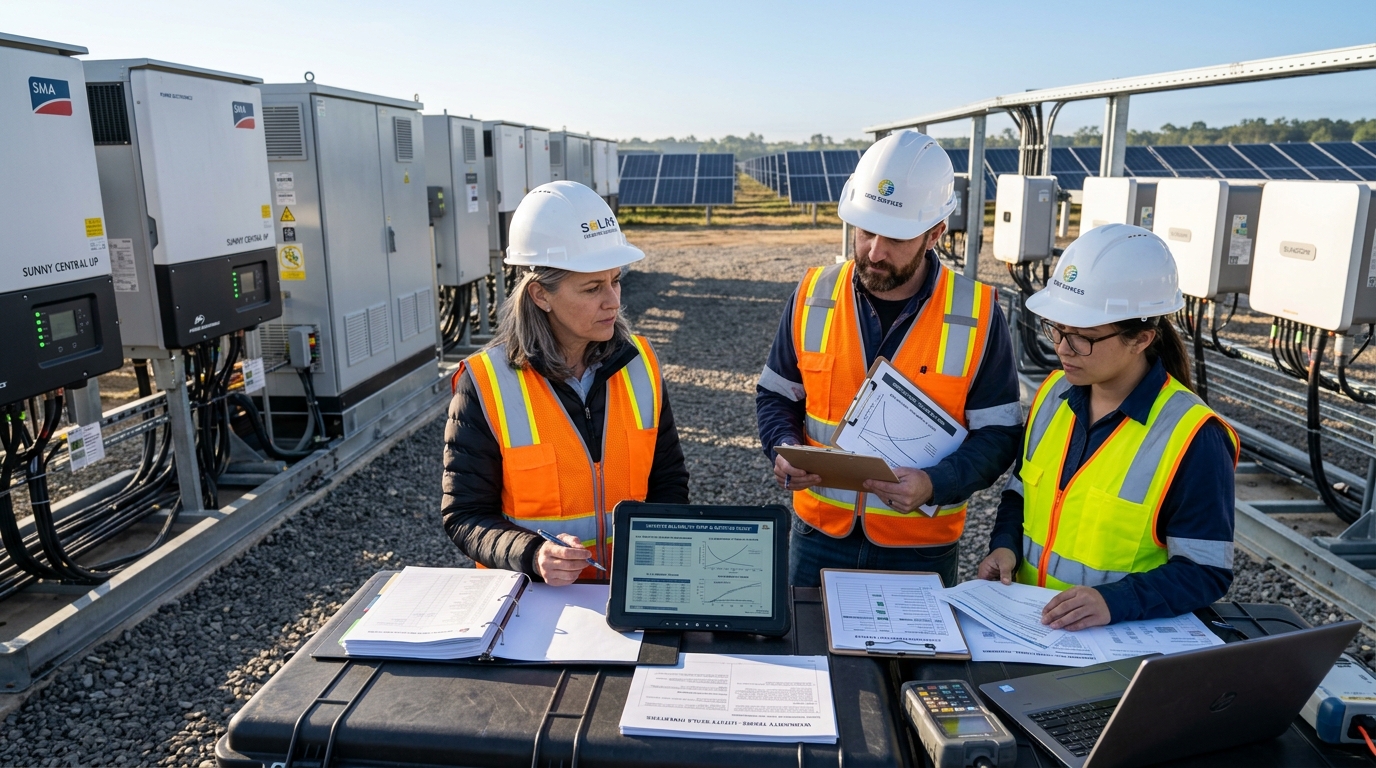
In utility-scale and commercial & industrial (C&I) solar project development, procurement teams routinely spend 90% of their negotiation bandwidth scrutinizing photovoltaic module pricing, Tier-1 rankings, and cell technology roadmaps. Yet, across operating solar portfolios globally, photovoltaic modules are remarkably passive: with no moving parts and solid-state construction, their failure rates remain well below 0.05% per year.
In sharp contrast stands the solar inverter. Operating as the mission-critical beating heart of the solar plant, the inverter synchronizes pulsating DC strings into high-voltage AC grid power through continuous high-frequency pulse-width modulation (PWM), handling thousands of thermal expansions, lightning induction impulses, harmonic oscillations, and utility grid voltage sags each day.
When an inverter trips or burns out an insulated-gate bipolar transistor (IGBT) block, revenue halts instantaneously. If the procurement contract contains vague warranty clauses, slow response times, or exclusions for ambient summer heat, the asset owner is left absorbing crippling downtime losses. Evaluating inverter warranties is therefore not a routine legal checkoff—it is a foundational risk-mitigation engineering discipline.
1. The Inverter Paradox: 10% CapEx, 70% Downtime Risk
To understand why inverter warranties require forensic examination, purchase managers must look at lifetime cost breakdowns rather than initial capital expenditure.
Inverters account for a modest fraction of initial plant CapEx (typically ₹0.18 to ₹0.28 per Wp for string/central hardware).
According to EPRI and TÜV Rheinland benchmarks, inverters cause over 70% of all unplanned field maintenance events across 25 years.
Inverter-related outages account for the vast majority of lost kilowatt-hours and Performance Ratio (PR) penalties during operation.
Unlike PV modules that enjoy a 25- to 30-year linear performance warranty, inverters follow a classic Weibull distribution (bathtub curve) of reliability:
- Infant Mortality (Months 1–12): Assembly solder defects, loose busbar torque, firmware bugs, or capacitor seal issues during initial grid synchronization.
- Useful Operational Life (Years 2–6): Relatively low failure rates (typically 0.8% to 1.5% annually) when operated within thermal and grid voltage envelopes.
- Wear-Out Phase (Years 7–14): Electrolytic capacitor dry-out, thermal fatigue of IGBT solder joints, DC contactor pitting, cooling fan bearing seizures, and optocoupler degradation, resulting in failure rates soaring to 8% to 15% annually.
If your procurement team accepts a standard 5-year warranty without pre-negotiated extensions, replacement parts guarantees, or local buffer stock, your project enters its most vulnerable degradation phase completely uninsured.
2. Standard vs. Extended Warranties: 5-Yr vs 10/15/25-Yr
Most Tier-1 inverter original equipment manufacturers (OEMs) provide a standard base factory warranty of 5 years for utility-scale central inverters and commercial three-phase string inverters. Residential string inverters occasionally carry 10 years as standard to compete in retail markets.
| Warranty Model | Duration | Typical Incremental Cost | Recommended Project Application | Strategic Considerations |
|---|---|---|---|---|
| Standard Base Factory | 5 Years | Included in Base Price | Short-term merchant assets or self-performing O&M teams | Leaves asset unhedged during peak wear-out years (6–12). |
| Extended Tier 1 | 10 Years | +12% to +18% Inverter CapEx | Utility-scale PPA projects with non-recourse bank debt | Matches debt repayment period (often 7 to 10 years). Highly recommended. |
| Extended Tier 2 | 15 Years | +22% to +32% Inverter CapEx | C&I OPEX/RESCO models and long-term institutional pension funds | Covers primary inverter lifetime up to repowering threshold. |
| Full-Lifecycle Coverage | 20 – 25 Years | +45% to +65% Inverter CapEx | Critical infrastructure, airport solar, sovereign wealth funds | Often structured as an all-inclusive Long-Term Service Agreement (LTSA). |
The Financial Rule of Thumb: When purchasing extended warranties upfront during master supply agreement negotiations, OEM discounts range from 35% to 50% compared to buying warranty extensions post-commissioning in year 4. If project financial models indicate a target equity IRR above 13%, purchasing a 10-year warranty extension upfront is virtually always net-positive on a discounted cash flow basis.
3. The "Parts-Only" Trap vs. Full-Turnkey Replacement
The single most financially devastating mistake made by inexperienced purchase managers is executing an inverter warranty agreement that guarantees only "Parts Supply" rather than "Full-Turnkey Replacement".
Anatomy of the "Parts-Only" Disclaimer:
"Manufacturer warrants that the hardware will be free from defects in material and workmanship. In the event of a confirmed defect, Manufacturer’s sole liability shall be, at its option, to repair or provide a replacement component FOB Manufacturer's Factory or Port of Origin. Customer shall bear all costs of disassembly, return freight, import duties, inland transit, specialized rigging/crane hire, re-installation labor, and statutory re-testing."
Consider what happens when a 3.125 MW central inverter fails in an arid solar park in Western India:
- Factory Gate Replacement: The OEM agrees the central inverter phase-leg IGBT stack is defective and supplies a new stack at their manufacturing hub.
- The Hidden Costs Incurred by EPC:
- Airfreight or express maritime shipping from China or Europe: ₹3,50,000 – ₹6,00,000.
- Customs clearance, port handling, and domestic GST: ₹1,80,000 – ₹2,50,000.
- 50-ton hydraulic mobile crane rental and mobilization to a remote desert site: ₹2,00,000 – ₹3,50,000.
- OEM-certified service engineer travel, per diem, and commissioning labor: ₹1,50,000 – ₹2,80,000.
- Revenue loss during 3 weeks of customs and transit delay: ₹8,00,000 – ₹14,00,000.
Under a "Parts-Only" contract, the EPC or owner incurs over ₹16 Lakh to ₹28 Lakh in direct expenses for a component that the OEM technically "repaired under warranty." Purchase managers must explicitly mandate DDP (Delivered Duty Paid) to Site + Labor Inclusive Warranty Exhibits.
4. OEM Bankability, Balance Sheets & Munich Re Insurance
A 10-year or 20-year warranty is only as solvent as the corporation underwriting it. The solar power industry has witnessed numerous prominent inverter manufacturers enter liquidation, exit utility markets, or undergo debt restructuring, leaving hundreds of gigawatts of operating plants with "orphaned" inverters for which no spare parts or firmware updates exist.
BloombergNEF Inverter Bankability
Unlike PV modules where BNEF publishes a strict quarterly Tier-1 list, BNEF publishes an Annual Inverter Bankability Survey based on commercial bank feedback.
Lenders evaluate whether an inverter brand can be financed on a non-recourse basis without project sponsor balance sheet guarantees.
Third-Party Warranty Insurance
Top-tier manufacturers back their 10–25 year warranties with non-cancellable third-party insurance underwritten by global syndicates such as Munich Re, Swiss Re, or Ariel Re.
If the OEM enters bankruptcy, the reinsurance carrier steps into the OEM's shoes to reimburse component replacements and repair expenses.
Purchase Manager Action: Demand a formal certificate of insurance issued by the reinsurance syndicate naming your project Special Purpose Vehicle (SPV) as a loss payee, and verify that the policy cannot be cancelled due to OEM premium default.
5. Service Level Agreements (SLAs), MTTR & Uptime Guarantees
A warranty clause stating that the manufacturer will repair a defect is meaningless without precise, legally binding operational metrics. A bankable inverter contract must define three critical timeframes:
Acknowledgment of fault ticket by a certified level-3 technical specialist.
Physical presence of factory-certified field engineer at the project gate.
Total elapsed clock time until inverter is re-synchronized to the grid and generating power.
Contractual Inverter Availability Guarantees
In addition to MTTR, utility contracts must enforce an annual Inverter Uptime Availability Guarantee of at least 99.0% to 99.5% during daylight generating hours.
If availability drops below 99.0% across any contract year, the OEM must be subject to Liquidated Damages (LDs) calculated on the basis of actual lost generation multiplied by the PPA tariff plus applicable statutory grid deviation penalties.
6. Local Spare Parts Warehousing & Escrow Buffers
Even the most aggressive MTTR commitments fail if the required spare parts are sitting in a factory warehouse in Shanghai or Munich subject to air-cargo backlogs and customs delays.
Purchase contracts must codify a two-tiered spare parts architecture:
-
On-Site Project Spares Consignment (Mandatory at COD):
For string inverters: 1.5% to 2.0% spare complete inverters stored in climate-controlled site containers. For central inverters: complete spare power modules (IGBT stacks), driver boards, AC/DC disconnects, contactors, cooling fans, and ribbon harnesses stored on site.
-
Regional Bonded Warehouse Buffer SLA:
Contractual obligation for the OEM to maintain a guaranteed minimum quantity of replacement units and critical parts in a bonded warehouse within the same country or state, guaranteeing delivery to the site within 24 to 36 hours of notification.
-
Source Code & Firmware Escrow:
Deposit of communication protocols, register maps (Modbus/SunSpec), and firmware source binaries in a third-party legal escrow account. In the event of OEM insolvency, the asset owner receives unencumbered rights to access and modify the firmware to interface with modern SCADA and cybersecurity protocols.
7. Fine-Print Traps: Grid Transients, Heat & Lightning Exclusions
When inverter claims are disputed, OEMs almost invariably point to standard exclusion clauses tucked away in the appendix of warranty certificates. Purchase managers and electrical engineers must actively negotiate these clauses:
1. Grid Voltage & Harmonic Distortions Exclusions
Many rural and industrial grids in emerging markets experience frequent voltage swells (±10% to 15%), frequency swings (48.5 Hz to 51.5 Hz), and Total Harmonic Distortion (THD) exceeding 5%. Standard warranties state that any failure caused by "abnormal grid disturbances" void coverage.
2. High Ambient Temperature & Direct Sunlight Derating
Inverter internal electronics operate under extreme thermal stress. Some manufacturer warranties state that the warranty is void if the ambient temperature exceeds 50°C or if the inverter is mounted without an overhead solar canopy in direct UV sunlight.
3. Atmospheric Lightning & Surge Suppression (SPD) Claims
Inverters contain internal Type II Surge Protective Devices (SPDs). When indirect lightning surges enter via DC string cables or AC collector feeders, OEMs frequently claim the failure was a "Force Majeure act of God" caused by lightning.
4. Telemetry Logging & Mandatory Firmware Updates
Certain OEM contracts stipulate that if the inverter is disconnected from the manufacturer's cloud server for more than 30 consecutive days, or if the EPC fails to execute an Over-The-Air (OTA) firmware update within 14 days of release, the warranty is terminated.
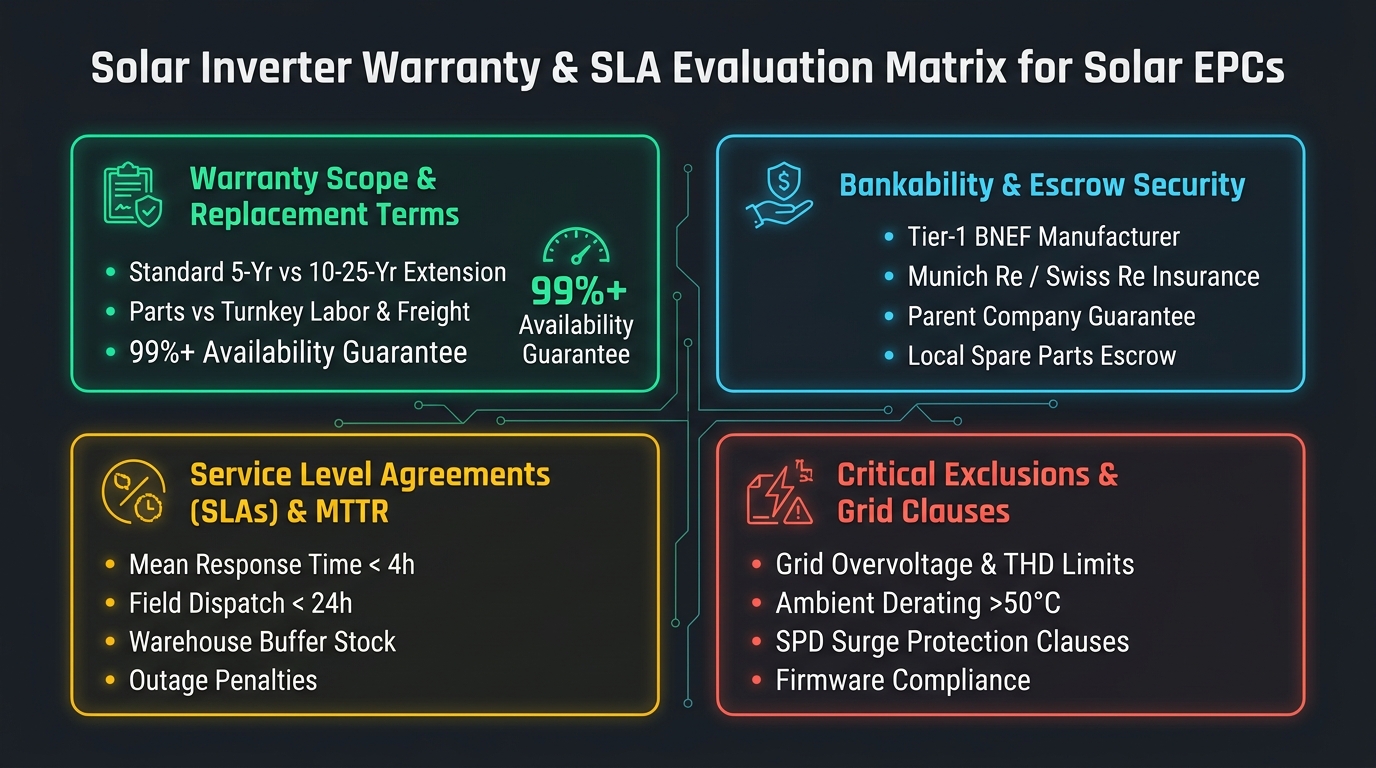
8. Solar Inverter Warranty & SLA Evaluation Matrix
To provide purchase managers and technical directors with a unified decision framework, V-TECH Renewables has synthesized the critical warranty verification vectors into an executive engineering infographic:
9. Central vs. High-Capacity String Inverter Warranty Economics
The choice between central inverter skids (3.125 MW to 4.4 MW) and high-capacity string inverters (250 kW to 350 kW, 1500V DC) fundamentally alters the legal and financial structure of the warranty:
| Evaluation Vector | Central Inverter Stations (3.125 – 4.4 MW) | High-Capacity String Inverters (250 – 350 kW) |
|---|---|---|
| Servicing Methodology | Component-level field repair (replace IGBT power stack, driver cards, or cooling fans on site). | Whole-unit plug-and-play swap (disconnect DC/AC cables, unmount unit, install pre-tested spare). |
| Mean Time to Replace (MTTR) | 48 – 96 Hours (requires factory field tech) | < 4 – 8 Hours (site electrical team) |
| Generation Loss at Failure | Severe: 3.125 to 4.4 MW plant block completely offline. | Negligible: Only 0.25 to 0.35 MW affected (<0.5% of 100 MWp plant). |
| Heavy Equipment Dependency | Requires 20–50 ton mobile hydraulic cranes and heavy access roads. | 2 to 4 technicians with basic mechanical rigging or pickup truck. |
| Critical Warranty Focus | Strict on-site technician response SLA (<24h) and 99.2%+ availability guarantee with revenue LDs. | On-site spare inverter buffer stock (2%) and local warehouse swap fulfillment SLA. |
| 10-Year Lifecycle O&M Cost | Higher field technician retainers; lower upfront purchase CapEx. | Higher initial CapEx; substantially lower 25-year unscheduled O&M overhead. |
10. Real-World Case Study: 100 MWp Plant in Rajasthan
How an Ambiguous Warranty Clause Cost an EPC ₹1.85 Cr in Jodhpur
The Project Background: A leading EPC contractor commissioned a 100 MWp utility-scale solar PV plant in the Thar desert near Jodhpur, Rajasthan, utilizing 32 units of 3.125 MW central inverter skids. The purchase manager signed the OEM's "Standard 5-Year Global Commercial Warranty" without seeking technical advisory review.
The Failure Event: During mid-May in year 2 of operation, ambient temperatures surged to 49.4°C. Eight central inverter skids suffered catastrophic IGBT gate-driver explosions and DC link capacitor ruptures within a 10-day heatwave window, taking 25 MWp of generating capacity completely offline.
The Contractual Ambush: When the EPC submitted warranty claims, the OEM legal department rejected immediate replacement under two fine-print clauses:
- The warranty certificate limited full-load operation to 45°C ambient, requiring linear de-rating above 45°C. Telemetry proved the inverters were running at 100% capacity due to high solar irradiance when ambient hit 48°C.
- The warranty was strictly "FOB OEM Factory Gate (Shanghai)" for parts only. The OEM demanded that the EPC pay for air charter freight, import duties, and crane mobilization, while replacement parts had a 6-week factory manufacturing lead time.
The Financial Impact: The plant suffered 38 days of partial outage during peak summer generation, incurring ₹1.15 Cr in lost PPA billing, ₹42 Lakh in emergency expedited air freight and crane rentals, and ₹28 Lakh in DISCOM availability deviation fines.
The V-TECH Intervention: Following this dispute, V-TECH Renewables was retained to renegotiate the Master Service Agreement across the developer's 450 MW pipeline. We restructured the inverter exhibits to enforce 50°C non-derated operation, DDP site delivery of replacement power stacks within 48 hours from a domestic Delhi warehouse, an audited 99.2% availability guarantee, and third-party warranty backstopping underwritten by Munich Re.
11. 12-Point Inverter Warranty Audit Checklist for Purchase Teams
Before executing any inverter supply contract or Master Purchase Agreement (MPA), ensure that your legal, commercial, and technical teams have verified all twelve items on this audit checklist:
12. Frequently Asked Questions
Protect Your 25-Year Plant Revenue with Bankable Inverter Warranties
At V-TECH RENEWABLES, our Owner’s Engineers and procurement specialists perform forensic reviews of inverter supply agreements, negotiate robust Service Level Agreements (SLAs), audit local spare parts reserves, and structure bankable warranty exhibits for solar developers and EPCs across India.
Related Engineering Articles
BOM Optimization: Balancing Tier-1 Quality with Project Budgets
Selecting high-efficiency N-Type TOPCon modules, central vs. string trade-offs, and factory BOM fingerprinting.
Mitigating Component Price Volatility in Solar EPC Contracts
FIDIC price escalation formulas, raw material indexing, forex hedging, and volume reservation pegging.
Inverter Station Layout Optimization: Saving Space and Installation Time
IS 456/2911 plinth sizing, thermal cross-ventilation, CEA arc-flash egress, and CBIP 299 oil pits.