Mitigating Component Price Volatility in Solar EPC Contracts
Protecting solar EPC operating margins against global supply shocks: FIDIC contractual price escalation clauses, raw material indexing (polysilicon, copper, steel), Tier-1 vendor lock-in strategies, forex hedging (USD/INR), and technical value engineering.

In the high-stakes world of utility-scale and commercial & industrial (C&I) solar engineering, procurement, and construction (EPC), profitability is rarely won on installation speed alone. It is won—or permanently lost—in the commercial structuring of equipment procurement. Across India, Southeast Asia, and global renewable markets, solar EPC contractors routinely operate on razor-thin net profit margins ranging between 6% and 9%.
Yet, between the day an EPC submits a binding commercial tender and the day physical modules arrive at the site 6 to 12 months later, global commodity markets undergo violent gyrations. A sudden 30% surge in polysilicon feedstock, a geopolitical disruption in maritime container freight, an export tariff imposition, or a 6% depreciation in the Indian Rupee (INR) against the US Dollar (USD) can instantly obliterate multi-crore operating margins. In the worst cases, unhedged component price volatility forces contractors into insolvency, triggers project abandonment, and results in catastrophic liquidated damages (LDs).
Leading solar EPCs and astute developers no longer treat procurement as a passive purchasing function. Instead, they deploy an integrated defense: formulaic contractual risk-sharing under FIDIC contract frameworks, multi-tiered financial and currency hedging, strategic Master Supply Agreements (MSAs), and agile technical value engineering that designs flexible, interchangeable Bills of Materials (BOM) right at the AutoCAD drawing board.
1. The Anatomy of Solar EPC Margin Erosion
To understand why solar EPC contracts are exceptionally vulnerable to inflation, one must examine the capital expenditure (CapEx) composition of a modern grid-connected solar power plant. Unlike conventional civil infrastructure projects where labor, cement, and regional aggregates dominate, a solar plant is essentially a massive assembly of highly commoditized, capital-intensive technology components.
| Cost Center / Equipment | % of Total EPC CapEx | Primary Underlying Commodity Drivers | Price Volatility Risk Exposure |
|---|---|---|---|
| Photovoltaic Modules (N-Type / PERC) | 50% – 60% | Polysilicon, Silver paste, Solar glass, EVA/POE, Freight | Critical / Extreme |
| Module Mounting Structures (MMS) | 12% – 15% | Hot-Rolled Coil (HRC) Steel, Zinc, Aluminium-Magnesium alloy | High |
| Power Conditioning Units (Inverters) | 8% – 10% | IGBT semiconductors, Copper inductors, Capacitors, Microchips | Medium-High |
| Cables & Electrical Balance of System (EBOS) | 7% – 9% | Electrolytic Copper (LME), Aluminium ingots, XLPE polymer | High |
| Transformers & Grid Switchyard | 5% – 7% | CRGO electrical steel, Mineral oil, Copper windings | Medium |
| Civil Works, Erection & Commissioning | 10% – 14% | Cement, Aggregate, Steel rebar, Skilled & semi-skilled labor | Low-Medium |
Because equipment and raw materials dictate over 80% of project costs, any upward adjustment in component pricing impacts the bottom line exponentially. If an EPC signs a fixed-price Lump-Sum Turnkey (LSTK) contract with a 7% net profit margin, a mere 12% increase in module prices ($0.11/Wp to $0.123/Wp) erodes 6.5% of total project value—effectively wiping out the contractor's entire projected profit before ground is even broken.
2. Deconstructing Solar Commodity Sensitivities
Procurement managers and contract negotiators must develop granular visibility into how raw commodity spot prices translate directly into delivered component unit costs. When negotiating with OEMs or drafting indexation clauses, the EPC must quantify the exact raw material content per unit of product.
Polysilicon to Module Price Pass-Through
Modern N-Type TOPCon and heterojunction (HJT) wafers have achieved significant kerf-loss reduction and thickness thinning (130–140 μm), requiring approximately 2.0 to 2.2 grams of high-purity polysilicon per watt-peak.
A $10/kg surge in polysilicon spot price increases module manufacturing costs by approximately $0.022/Wp (≈ ₹1.85/Wp), an 18% swing on a $0.12/Wp base.
Steel Coil to Mounting Structure (MMS)
Fixed-tilt ground-mount structures consume between 22 and 28 metric tons of structural steel per MWp, while single-axis trackers consume 30 to 36 MT/MWp. Structural steel pricing is pegged directly to Hot-Rolled Coil (HRC) spot prices.
A ₹8,000/MT spike in domestic steel prices adds ₹2,00,000 per MWp (≈ ₹0.20/Wp), directly hitting the structural line item.
Copper & Aluminium Cabling Sensitivities
A 100 MWp solar farm utilizes over 450 km of string DC cabling and 60 km of HT/LT AC power cables. Copper conductors track the London Metal Exchange (LME), while aluminium tracks the NALCO/LME benchmark.
LME copper fluctuations of ±15% alter overall EBOS procurement budgets by ₹35L to ₹50L per 50 MWp block.
Silver Metallization Paste Dynamics
N-Type TOPCon cells require higher silver paste consumption (10–12 mg/W) than legacy P-Type PERC cells. Bullish precious metal runs on global commodities markets directly apply pressure to cell conversion premiums.
Accelerating R&D adoption of copper-plated metallization and LECO (Laser Enhanced Contact Optimization) aims to cap this exposure.
3. FIDIC Contractual Price Escalation Formulas
The most potent tool for defending EPC solvency is shifting away from unbending LSTK contracts toward structured, formulaic price adjustment mechanisms. The international benchmark for engineering procurement contracts is the FIDIC Conditions of Contract (EPC/Turnkey Projects – Silver Book, and Plant and Design-Build – Yellow Book).
Under FIDIC Clause 13.8 (Adjustments for Changes in Cost), the contract price is adjusted to reflect rises or falls in the cost of labor, goods, and other inputs through an agreed mathematical formula:
P0: Original contract price at the base tender date.
a: Fixed, non-adjustable element (typically 15%–20% profit/overhead).
b, c, d, e: Weighted cost coefficients for modules, steel, copper, labor (sum of a + b + c + d + e = 1.0).
Sn / S0: Current vs. baseline Domestic Steel Price Index (e.g., RBI WPI Steel / JPC).
Cn / C0: Current vs. baseline London Metal Exchange (LME) Copper Index.
Ln / L0: Current vs. baseline Consumer Price Index for Industrial Workers (CPI-IW).
The Neutral Deadband (Collar) Mechanism
Developers often resist open-ended escalation formulas because project financing models (debt-to-equity ratios and lender DSCR covenants) require certainty on maximum capital costs. To reconcile this tension, astute legal and commercial teams negotiate a Mutual Risk Collar (Deadband):
- ±5% Neutral Zone: If the composite indexed price fluctuates within a ±5% band relative to the base date, no contract price adjustment occurs. The EPC contractor absorbs the slight increase or retains the minor savings.
- Beyond +5% Escalation: If raw material prices surge beyond +5%, the developer reimburses 80% to 100% of the delta above the 5% threshold, preventing contractor distress.
- Beyond -5% De-escalation: Conversely, if global module or steel prices plunge by more than 5%, the developer receives a contract price discount, ensuring the project remains competitive against prevailing spot tariffs.
- Overall Cap / Floor: A hard ceiling (e.g., +12% maximum contract escalation) provides project lenders with the bankability assurance needed for financial close.
4. Foreign Exchange (Forex) Exposure & USD/INR Currency Hedging
A hidden trap in solar EPC contracting is currency mismatch. In markets like India, EPC contracts with power developers and government agencies (SECI, NTPC, state DISCOMs) are denominated in Indian Rupees (INR). However, Tier-1 solar photovoltaic modules, string inverters, and specialized tracking electronics are overwhelmingly quoted, manufactured, and settled in US Dollars (USD).
If the Indian Rupee depreciates from ₹83.50/USD at bid submission to ₹87.00/USD at Letter of Credit (LC) issuance—a 4.2% slide—a $50 million module procurement order incurs an unbudgeted currency loss of ₹17.5 Crore ($2.1 million).
1. Plain Vanilla FX Forwards
The EPC enters into a forward contract with its authorized dealer bank, locking in an exact forward exchange rate for delivery 3, 6, or 9 months out matching equipment shipping dates.
Advantage: 100% certainty, zero downside risk.2. Zero-Cost Currency Collars
Simultaneously purchasing an Out-of-the-Money (OTM) USD Call Option (protecting against sharp INR depreciation) while selling an OTM USD Put Option (giving up gains if INR appreciates).
Advantage: Zero net premium cost to the EPC.3. Contractual Forex Pass-Through
Embedding a contractual currency peg in the EPC agreement: establishing a baseline reference rate (e.g., RBI Reference Rate on bid date), with any variance at LC retirement settled via client debit/credit note.
Advantage: Complete operational de-risking.5. Upstream Procurement Lock-In: Master Supply Agreements & Volume Reservation
Relying on ad-hoc purchase orders (POs) placed weeks after EPC contract signing leaves the contractor at the mercy of OEM factory allocation queues. When silicon wafer shortages or international trade disputes erupt, Tier-1 module makers prioritize gigawatt-scale global utilities, deferring or cancelling smaller 20 MW to 100 MW orders.
To insulate against allocation rationing and mid-cycle price hikes, institutional EPCs establish Master Supply Agreements (MSAs) coupled with strategic volume reservation mechanisms:
Production Slot Reservation Agreements
Securing manufacturing capacity 4 to 6 months in advance with nominal refundable reservation deposits (1%–2% of order value). The OEM commits specific monthly production slot megawatts, shielding the delivery timeline from market crunches.
Milestone-Linked Raw Material Escrow
Staging advance payments specifically earmarked for raw wafer and cell procurement. By tying tranche disbursements to verified raw material batch purchase orders deposited in bonded third-party warehouses, the OEM locks in silicon feedstock prices before assembly begins.
Tier-1 Dual Sourcing Strategy (70 / 30 Allocation)
Never placing 100% of equipment volume with a single manufacturer. Sourcing 70% from a primary Tier-1 partner and 30% from a pre-qualified secondary Tier-1 vendor creates healthy commercial tension, prevents hostage negotiation dynamics, and guarantees delivery redundancy.
6. Technical Value Engineering: Designing Multi-Wattage Interchangeable BOMs
Traditional solar engineering creates rigid, brittle designs: an AutoCAD single-line diagram (SLD) and structural framing layout tailored to a single, hyper-specific module model (e.g., Brand X 585W bifacial). If Brand X hikes its price by 15% or experiences an 8-week customs delay, the EPC cannot switch to an alternative 600W or 615W module without completely re-engineering the project: recalculating structural pile spacings, altering string DC cable trenches, and resubmitting DISCOM/CEIG approvals.
Resilient engineering begins with parametric flexibility at the drawing board. At V-TECH RENEWABLES, our design teams embed tolerance envelopes directly into Issued-For-Construction (IFC) blueprints:
Electrical Multi-Wattage Binning
String lengths are configured around maximum open-circuit voltage limits at minimum design site temperature (−5°C to +10°C) ensuring the string voltage stays safely below the 1500V DC threshold across multiple power bins (580W to 625W).
Benefit: Enables procurement to purchase surplus production bins at deep 5%–8% spot discounts without invalidating electrical calculations.
Structural Slotted Purling Kinematics
Module mounting structure (MMS) purlins are drafted with standardized slotted bolt hole patterns and adjustable mid/end clamps capable of accommodating module dimensional widths between 1,130 mm and 1,136 mm.
Benefit: Eliminates structural re-drilling or fabrication delays if procurement switches module suppliers mid-project.
Structural Steel Weight Optimization in STAAD.Pro
When domestic steel prices surge, the most direct lever to defend margins is steel tonnage reduction. By transitioning from conventional hot-rolled mild steel (IS 2062 Gr. E250) to Cold-Formed High-Strength Steel (HSS YSt 450/550 with Zn-Al-Mg coatings), structural engineers down-gauge section thicknesses from 2.5 mm to 1.6–1.8 mm.
Coupled with continuous multi-span purlin kinematics (which cuts maximum bending moments from $wL^2/8$ down to $wL^2/10$), an optimized structural design reduces structural steel consumption from 32 MT/MWp to 24 MT/MWp—a massive 25% weight reduction that insulates the project budget against steel price inflation.
7. Vendor Qualification & Factory Gate QA Audits: Preventing Sub-Tier Dumping
A dangerous side-effect of component price volatility is quality degradation. When raw material costs soar and an OEM is locked into a tight fixed-price order, dishonest suppliers face immense temptation to cut production corners:
- Substituting specified EVA/POE encapsulant films with thinner, non-UV-stabilized alternatives prone to rapid yellowing and PID.
- Downgrading silver paste consumption in busbars, creating high-resistance localized micro-contacts.
- Mixing lower-efficiency B-grade and C-grade cell wafers into A-grade module production runs.
- Using lower-grade junction boxes with substandard bypass diodes that fail under high-ambient thermal stress.
Cost mitigation must never degenerate into quality compromise. To ensure that hedged procurement delivers 25-year bankable assets, EPCs must enforce non-negotiable Quality Gateways:
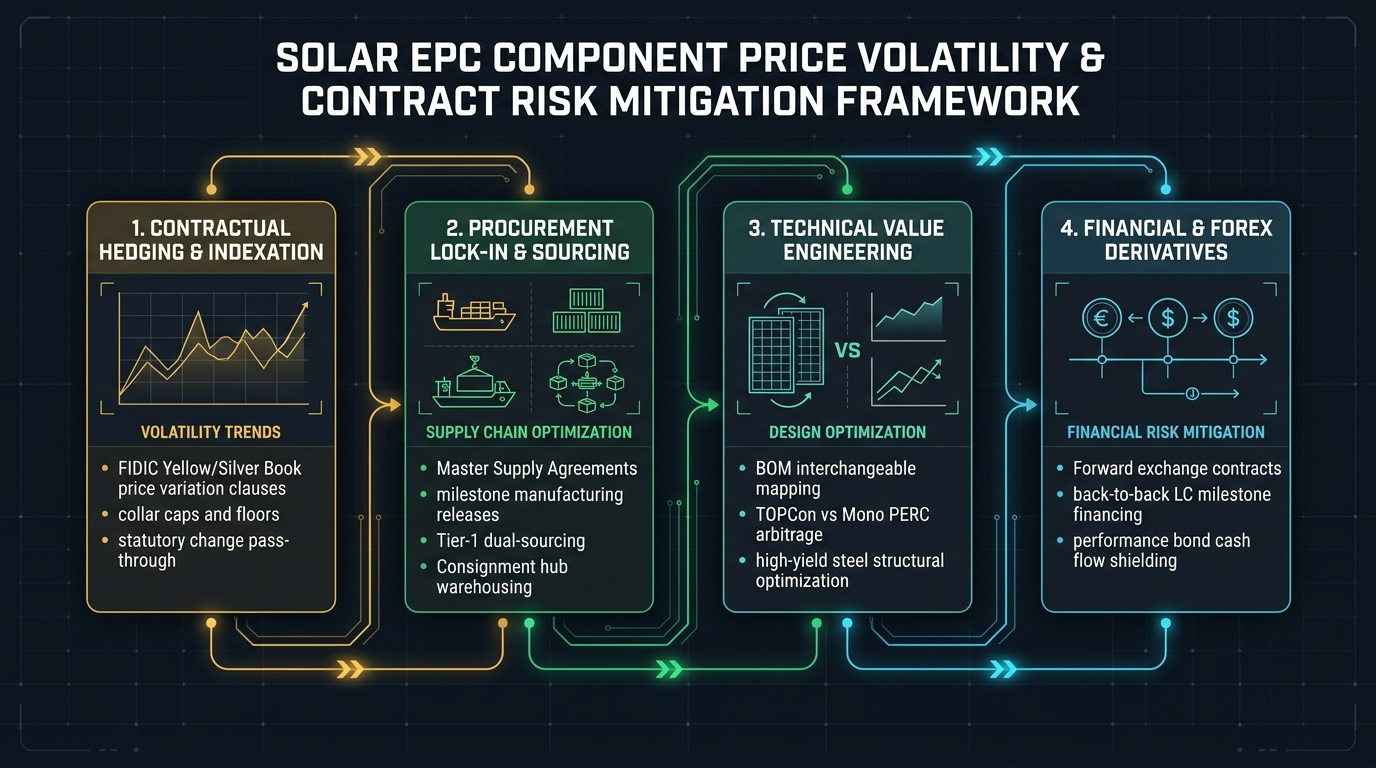
8. Component Price Volatility Hedging Architecture Matrix
Successfully navigating market volatility requires synchronizing four distinct disciplines across the solar project lifecycle. Below is the comprehensive architectural matrix:
9. Comparative Analysis: LSTK vs. Formula-Indexed vs. Open-Book EPC
Different commercial contract models allocate risk in fundamentally different ways. Selecting the appropriate model depends on project financing timelines, commodity cycle volatility, and developer sophistication:
| Contractual Dimension | Fixed-Price LSTK | FIDIC Formula-Indexed | Hybrid Open-Book EPC |
|---|---|---|---|
| Commodity Risk Allocation | 100% on EPC Contractor | Shared Equitably (±5% collar) | 100% on Asset Owner / Developer |
| Initial Tender Bid Price | Highest (contains heavy contingency premium) | Competitive & Market-Reflective | Lowest (at-cost passthrough + fixed margin fee) |
| Contractor Insolvency Risk | Very High during price spikes | Extremely Low | Zero |
| Lender Bankability / DSCR | High (rigid known CapEx ceiling) | High (when paired with defined escalation caps) | Requires specialized lender approval |
| Upside Benefit if Prices Fall | 100% retained by EPC | Shared with Developer | 100% passed to Developer |
| Administrative Complexity | Minimal | Moderate (monthly index tracking) | High (continuous transparent book auditing) |
10. Real-World Case Study: 120 MWp Solar Park in Gujarat
Navigating a 22% Module & Steel Price Spike on a 120 MWp Utility Project
Project Context: In late 2024, a leading regional EPC was awarded a 120 MWp utility-scale solar project under the Gujarat Urja Vikas Nigam Limited (GUVNL) open access scheme. During the 8-month window between PPA signing and equipment delivery, unexpected international polysilicon curtailments and an increase in domestic steel tariffs triggered a 22% surge in bifacial module costs and an ₹11,000/MT rise in structural steel.
The Integrated Defense Deployed:
- Contractual Risk Sharing: Rather than accepting a rigid LSTK format, the EPC had negotiated a FIDIC Clause 13.8 variation formula with a ±5% collar tied to the PV InfoLink index and RBI WPI Steel. The developer absorbed 75% of the verified commodity delta exceeding the 5% threshold, preventing catastrophic contractor loss.
- Forex Forward Cover: The EPC had locked in $32 million in USD/INR forward exchange contracts at ₹83.85/USD simultaneously with PPA financial closure, completely shielding the project from a subsequent INR drop to ₹86.40/USD (saving ₹8.16 Crore).
- Structural Value Engineering: V-TECH RENEWABLES re-engineered the module mounting structures in STAAD.Pro, migrating from standard 2.2 mm C-channels to high-strength YSt 550 cold-formed steel sections with continuous purlin spans, slashing steel consumption from 29 MT/MWp to 23.5 MT/MWp (saving 660 metric tons of steel).
- Multi-Wattage Binning: The electrical design team adapted string layouts to accommodate a blend of 585W and 600W TOPCon modules, allowing the procurement team to secure 40 MWp of discounted surplus production bins from a secondary Tier-1 manufacturer.
11. 10-Point Pre-Procurement Price Risk Audit Checklist for Solar EPC Project Directors
Before signing turnkey contracts or committing to major equipment purchase orders, project directors and procurement heads should run this 10-point audit:
12. Frequently Asked Questions
Shield Your Solar EPC Operating Margins from Global Market Volatility
At V-TECH RENEWABLES, our multi-disciplinary engineering and procurement advisory teams help developers, EPCs, and IPPs structure bankable contract escalation formulas, optimize structural steel weight in STAAD.Pro, and execute rigorous factory-gate QA inspections across India and global supply chains.
Related Engineering Articles
How Digital Twin Technology is Changing Solar Plant Engineering
3D BIM asset modeling, IEC 61724-1 telemetry, PVsyst digital baselines, and predictive maintenance.
BOS Cost Reduction Through Optimized Structural Design
Cutting mounting structure steel weight by 18% to 25% without compromising IS 875 wind resistance.
Standardizing Drawing Templates Across Multi-Location Solar Projects
AIA/ISO 13567 layering standards, dynamic blocks, automated BOM extraction, and CDE revision control.