How Digital Twin Technology is Changing Solar Plant Engineering
Architecting high-fidelity solar digital twins: 3D BIM asset modeling, IEC 61724-1 sensor telemetry, real-time PVsyst baseline comparison, predictive inverter IGBT thermal modeling, dynamic tracker pitch control, and autonomous O&M work orders.
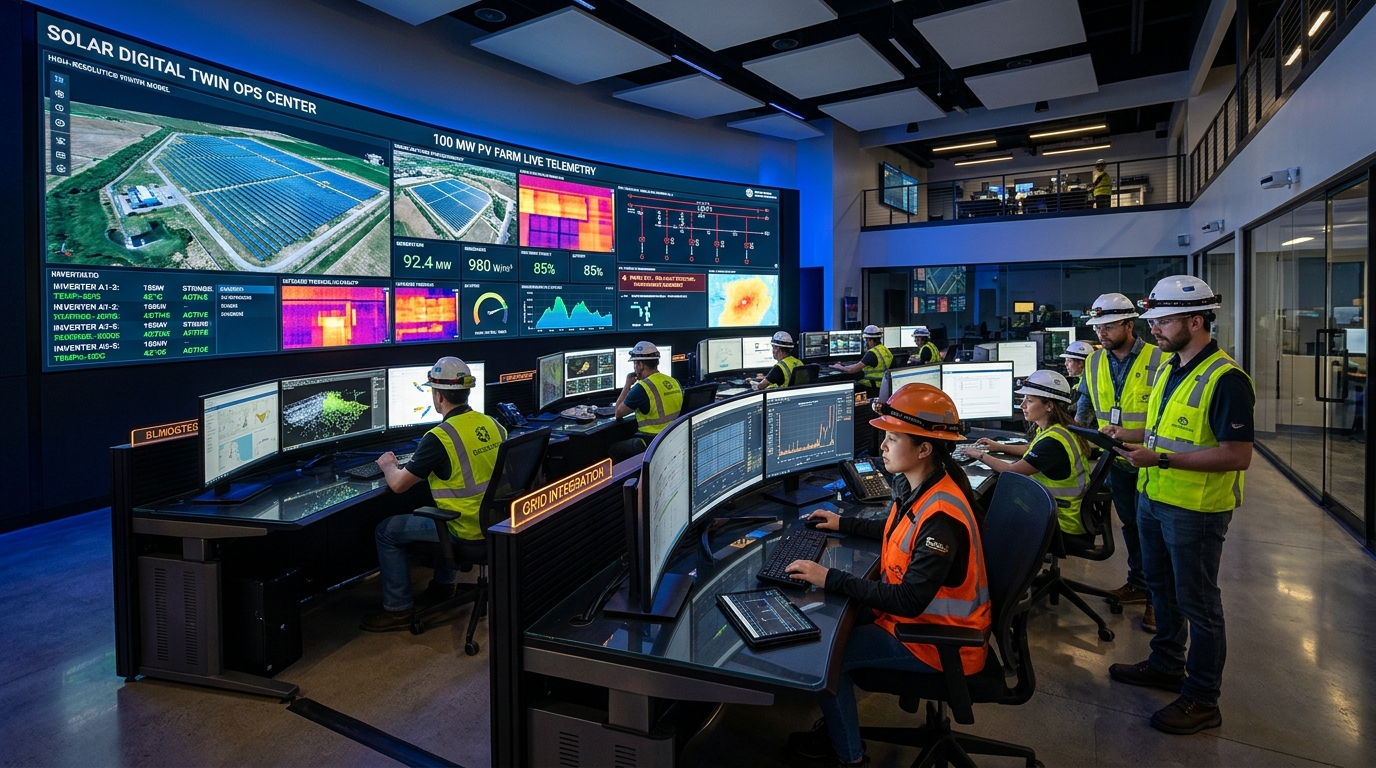
For over two decades, the utility-scale and commercial solar engineering workflow followed a rigid, one-way path: engineers conducted site surveys, performed PVsyst yield simulations, drafted 2D AutoCAD single-line diagrams, executed civil foundations, and handed over static paper as-builts to Operations & Maintenance (O&M) teams. Once the plant was commissioned, the original engineering intelligence was effectively discarded. Plant operators were left monitoring basic SCADA dashboards with crude megawatt-level alarms, discovering critical sub-array degradation, string open-circuits, or inverter thermal throttling only weeks after revenues had already leaked.
Today, the convergence of High-Fidelity 3D Building Information Modeling (BIM), autonomous drone LiDAR photogrammetry, high-frequency IoT edge gateways, and Physics-Informed Neural Networks (PINN) has birthed the modern Solar Digital Twin. A digital twin is not a passive 3D CAD visualization or a standard SCADA supervisory screen. It is an active, real-time, bi-directional cyber-physical replica that synchronizes the physical solar PV plant with a calibrated mathematical and structural baseline throughout its 25-year operational lifecycle.
By linking design-phase engineering models directly to operational sensor telemetry, solar EPCs and asset owners are achieving unprecedented performance transparency: isolating micro-level soiling losses, forecasting inverter IGBT junction burnout days before hardware failure, dynamically steering tracker tables under diffuse sky cover to capture an extra 2% to 3% annual generation, and slashing Mean Time to Repair (MTTR) by over 40%.
1. The Paradigm Shift: From Static Blueprints to Living Cyber-Physical Systems
In conventional solar plant engineering, the disconnect between design intent and field operations represents the single largest source of financial underperformance. Design assumptions—such as module temperature coefficients, soil resistance values, string wiring ohmic drop (< 1.5%), and inter-row shading geometry—are treated as static constants in PVsyst reports. In reality, a operating solar power plant is an evolving thermodynamic organism subject to localized microclimates, seasonal dust deposition, tracker mechanical wear, and component degradation.
The solar digital twin bridges this chasm by progressing through three distinct evolutionary tiers of engineering capability:
3D BIM & Digital Thread
Georeferenced 3D digital model incorporating exact terrain topography, pile coordinates, module serial numbers, cable trench routes, and inverter string schedules. Provides 100% spatial transparency during EPC handovers and asset refinancing.
Physics-Informed Analytics
Executes continuous real-time simulations comparing live IEC 61724-1 telemetry against digital design baselines. Decomposes performance loss into specific causal factors: soiling, PID, thermal derating, bypass diode shorts, and tracker misalignment.
Closed-Loop Cyber-Physical Action
Actively closes the operational loop: automatically re-calibrates tracker backtracking algorithms during diffuse irradiance events, throttles cooling fans based on predicted IGBT junction stress, and dispatches robotic cleaning crews via automated CMMS work orders.
2. Multi-Source Ingestion & IEC 61724-1 Monitoring Architecture
A digital twin is only as credible as the fidelity and calibration of its sensory nervous system. In high-capacity utility-scale solar farms, monitoring standards must conform rigorously to IEC 61724-1 Class A (High Accuracy) requirements. Feeding substandard sensor data into an advanced analytical twin produces algorithmic drift and false alarms.
| Measurement Parameter | IEC 61724-1 Class A Specification | Sensor Technology & Calibration | Telemetry Sampling & Protocol |
|---|---|---|---|
| Plane of Array (POA) Irradiance | Uncertainty ≤ 1.5%, Response time < 0.5s | Secondary-standard thermopile pyranometer with quartz dome & active heater | 1-second raw sampling, 1-minute averaged over Modbus RS-485 / TCP |
| Direct Normal Irradiance (DNI) | Uncertainty ≤ 1.0% | Normal Incidence Pyrheliometer (NIP) mounted on dual-axis sun tracker | 1-second sampling, Modbus TCP to Weather Station PLC |
| Module Surface Temperature ($T_{mod}$) | Uncertainty ≤ 1.0°C across −40°C to +100°C | 4-wire PT100 RTD thermally bonded to rear center of central cell | 5-second sampling, localized Modbus RTU transmitter |
| Inverter AC & DC Electricals | Current & Voltage accuracy ≤ 0.5% | Hall-effect DC transducers, multi-channel MPPT current shunts | 1-second streaming over IEC 60870-5-104 / Modbus TCP |
| Substation Tariff Metering | Active Energy Class 0.2S, Reactive Class 0.5S | Precision CT/PT tri-vector meter with ABT frequency logging | Sub-second pulse accumulation, DLMS/COSEM & IEC 61850 MMS |
| Atmospheric Wind & Ambient | Wind speed ≤ 0.3 m/s, Ambient temp ≤ 0.5°C | Ultrasonic 2D/3D anemometer (no moving bearings), aspirated radiation shield | 1-second gust capture, Modbus TCP to SCADA Edge Gateway |
At the network edge, hardened industrial edge gateways (compliant with IEC 62443 industrial cybersecurity) run lightweight containerized runtimes. Instead of flooding cloud endpoints with millions of uncompressed SCADA registers, the edge gateway executes sub-second data filtering, deadband compression, and local physics calculations. Cleaned, time-synchronized packets are then streamed via MQTT with Sparkplug B payloads or OPC Unified Architecture (OPC-UA) over redundant fiber rings directly into the cloud-hosted digital twin engine.
3. High-Fidelity 3D BIM & Drone Photogrammetry Fusion
The foundation of the digital twin's spatial intelligence is the fusion of design-phase Building Information Modeling (BIM) with post-construction aerial drone survey data. While traditional solar EPCs deliver fragmented 2D DWGs, digital twin engineering establishes an open Industry Foundation Classes (IFC 4.3) parametric database representing every asset down to bolt and connector hierarchies:
- Digital Elevation & Terrain Model (DTM/DEM): High-density LiDAR point clouds (150+ points/m²) capturing site grading, slope variances, natural drainage swales, and soil settlement envelopes with ±15mm vertical accuracy.
- Parametric Structural Mesh: Driven steel pile profiles, torque tube kinematics, purlin spans, and module mounting clamps fully modeled with real material elastic moduli for STAAD-integrated stress tracking.
- Electrical Asset Graph: Fully georeferenced electrical connectivity graph linking every individual PV module serial number → string identifier → DC combiner box → inverter MPPT channel → 33 kV step-up transformer → main plant switchyard breaker.
Automated Aerial Drone Thermography Integration (IEC 62446-3):
During routine aerial O&M inspections, high-resolution radiometric thermal cameras (e.g., 640×512 resolution, NETD ≤ 30mK) identify thermal anomalies: single-cell hot spots (ΔT > 15°C), bypass diode open-circuits (ΔT ≈ 8–12°C across sub-strings), and PID module clusters. Instead of generating static PDF inspection reports, computer vision algorithms orthorectify and project thermal heatmaps directly onto the 3D BIM twin coordinate space. The twin automatically cross-references the hot spot's spatial coordinates against inverter MPPT telemetry, confirming whether an identified thermal anomaly is causing actual string-level yield clipping.
4. Physics-Informed Analytical Twins vs. Empirical Black-Box Machine Learning
Many early digital twin attempts in the renewable energy sector failed because data science teams relied exclusively on generic, "black-box" machine learning algorithms (such as standard Random Forests, XGBoost, or pure Long Short-Term Memory networks). Solar power plant performance is governed by immutable physical laws of thermodynamics, quantum semiconductor mechanics, and electrical circuit theory.
When an unconstrained statistical ML model encounters unprecedented conditions—such as a dense winter fog layer, sudden hail storm, or novel inverter firmware throttling—it frequently "hallucinates" or fits noise, generating spurious anomaly alerts. Modern solar engineering solves this by deploying Physics-Informed Neural Networks (PINN):
The Mathematical Engine: Real-Time Ideal Power Baseline
The digital twin runs a continuous, real-time mathematical baseline in parallel with actual plant operations. For every string and inverter sub-array, theoretical ideal DC power ($P_{dc,ideal}$) is computed every 10 seconds:
Where instantaneous cell temperature ($T_{cell}$) is derived using the empirically calibrated Faiman Thermodynamic Thermal Model:
Constants: $u_0$ (constant heat transfer component ≈ 25.0–29.0 W/m²K), $u_1$ (convective wind cooling factor ≈ 1.2–1.5 W/m²K·(m/s)), $\gamma$ (temperature coefficient of power ≈ −0.35%/°C for TOPCon/HJT, −0.38%/°C for mono PERC).
Because the digital twin knows the exact theoretical output under instantaneous weather physics, the residual power deviation—$\Delta P(t) = P_{actual}(t) - P_{dc,ideal}(t)$—is isolated and decomposed into granular physical loss vectors:
- $\Delta P_{soiling}$: Quantified by comparing clean reference cell irradiance against co-located optical soiling sensor measurement grids.
- $\Delta P_{thermal}$: Residual power drop exceeding predicted Faiman cell temperature equations, pinpointing localized heat stagnation or ventilation blockages.
- $\Delta P_{shading}$: Geometric 3D ray-tracing against drone-scanned topography, surrounding vegetation growth, or tracker table inter-row shadows.
- $\Delta P_{clipping}$: DC-to-AC saturation losses when solar irradiance pushes DC input power beyond the inverter's maximum apparent power rating ($S_{max}$).
- $\Delta P_{electrical}$: Sub-array impedance mismatches, high-resistance dry joints in DC connectors, blown string fuses, or module bypass diode conductances.
5. Predictive Inverter & Substation Component Diagnostics
In utility-scale plants, unexpected inverter and transformer failures account for over 70% of total plant downtime losses. Traditional O&M practices rely on scheduled annual preventative maintenance or emergency response following catastrophic equipment tripping. The digital twin transitions asset management to true condition-based predictive maintenance:
Inverter IGBT Thermal Junction Stress Twin
The twin models Insulated Gate Bipolar Transistor (IGBT) junction temperature ($\Delta T_j = T_j - T_c$) via Foster/Cauer thermal impedance networks based on instantaneous switching frequency, phase current, and heatsink RTD measurements.
DC-Bus Electrolytic Capacitor Health Twin
Electrolytic DC-link capacitors undergo electrolyte vapor leakage under sustained elevated temperatures. The digital twin continuously tracks high-frequency DC ripple voltage ($V_{ripple}$) and ripple current ($I_{rms}$).
Power Transformer Dissolved Gas Analysis (DGA) Twin
Online DGA monitors measure fault gas generation rates in main step-up transformers (33 kV / 132 kV / 220 kV). The twin maps gas concentrations into standardized Duval Triangle and IEC 60599 gas ratio matrices.
Single-Axis Tracker Slew Drive Mechanical Twin
Motors driving single-axis tracker torque tubes draw specific current waveforms during rotation. The twin continuously monitors motor current signature ($I_{motor}$ vs. $\theta_{angle}$).
6. Dynamic Single-Axis Tracker & Diffuse Radiation Optimization
Standard single-axis tracker controllers rely on static astronomical algorithms (such as the NREL Solar Position Algorithm - SPA) to orient module tables perpendicularly to the sun's direct vector. While this maximizes yield on pristine clear-sky days, it significantly underperforms during overcast, monsoon, or high-smog conditions.
Under heavy cloud cover or atmospheric aerosol scattering, Diffuse Horizontal Irradiance (DHI) constitutes up to 70% to 90% of total solar radiation. Tilting panels at steep angles (e.g., 45° or 55°) toward an obscured sun causes the modules to face a narrow slice of sky while heavily shading adjacent rows.
Closed-Loop Adaptive Diffuse Backtracking:
The autonomous digital twin continuously evaluates the atmospheric clearness index ($k_t$) and diffuse ratio ($DHI / GHI$). When diffuse irradiance dominates, the twin overrides astronomical tracking and calculates the optimal Sky View Factor (SVF):
- • During dense diffuse cover, tracker tables are commanded to flatten to a near-horizontal pitch ($0^\circ \text{ to } 10^\circ$).
- • This maximizes unshaded hemispherical sky exposure across both front and rear faces of bifacial PV modules.
- • When cloud fronts pass, satellite cloud motion vector feeds and on-site pyranometer gradients cue tracker tables to smoothly re-engage standard astronomical tracking before direct beam irradiance strikes.
7. Autonomous CMMS Work Orders & Statutory CEIG Compliance
The ultimate value of a digital twin lies in closing the operational loop: turning raw computational insights into concrete field actions. In conventional plants, an engineer notices a underperforming inverter, logs a manual spreadsheet note, emails the site supervisor, and a technician is dispatched 4 to 7 days later with multimeter probes.
In a digital twin-enabled facility, the entire workflow is automated through seamless integration with Computerized Maintenance Management Systems (CMMS):
- Automated Anomaly Validation: The twin verifies that a string underperformance is sustained across multiple 10-minute intervals and cannot be explained by transient cloud shadows or inverter clipping.
- Financial Threshold Evaluation: The twin calculates the daily revenue loss of the fault: $$\text{Daily Loss} = \Delta P_{\text{fault}} (\text{kWh}) \times \text{PPA Tariff (₹/kWh)}$$ If the cumulative projected loss exceeds the technician labor cost, the fault is escalated to a high-priority work order.
- Automated Ticket Dispatch: The twin issues a geo-tagged work order to the technician's mobile tablet. The ticket includes the exact GPS coordinates of the faulty module/string, drone infrared thermograms, the required spare part SKU code, and manufacturer replacement manuals.
- Statutory CEIG / CEA Compliance Logging: Regulatory mandates in India (under Central Electricity Authority Safety Regulations 2010 and State Chief Electrical Inspectorate - CEIG rules) require stringent documentation of earth pit resistance, insulation resistance (Megger logs), and protective relay trip logs. The twin automates continuous digital logging, ensuring 100% first-pass annual statutory audit compliance.
8. Digital Twin System Architecture Matrix
To implement an enterprise-grade solar digital twin, engineering heads must integrate physical assets, edge telemetry, analytical modeling, and business execution into a cohesive 4-layer architecture:
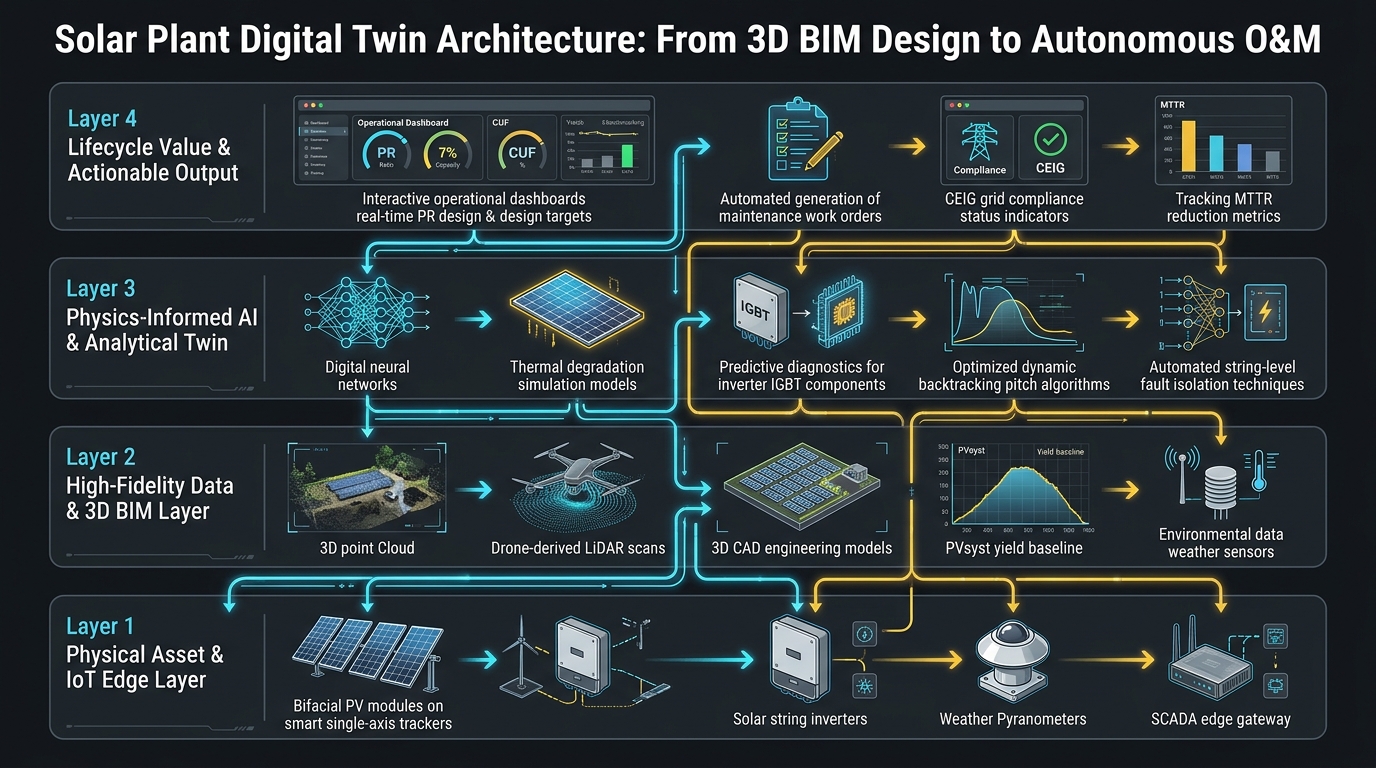
Figure: Complete 4-Layer Cyber-Physical Architecture for Utility-Scale Solar Digital Twins (Design, Edge Telemetry, Physics AI, and Autonomous Asset Management).
9. Comparative Analysis: Legacy SCADA vs. Physics-Based Twin vs. Autonomous Twin
| Engineering Dimension | Traditional SCADA Only | Physics-Based Digital Twin | Autonomous Self-Optimizing Twin |
|---|---|---|---|
| Spatial Asset Context | Static 2D schematics, no spatial awareness | Full 3D BIM & DGPS-georeferenced digital mesh | Dynamic 3D BIM with live drone aerial thermography overlays |
| Performance Benchmarking | Crude PR calculation based on monthly billing meters | Sub-minute PVsyst physics model running in parallel | Physics-Informed Neural Network with continuous parameter self-tuning |
| Loss Decomposition | None; lump-sum shortfall treated as "unexplained" | Separates soiling, thermal, wiring drop, and clipping | Real-time string-level decomposition with financial loss prioritization |
| Tracker Control | Static astronomical algorithm (NREL SPA) | Terrain-aware 3D backtracking correction | Closed-loop diffuse optimization & cloud motion vector adaptation |
| Maintenance Strategy | Reactive (repair after trip or fire) | Predictive (flags failure indicators 7–14 days early) | Prescriptive (automated CMMS dispatch with replacement SKU kits) |
| Mean Time to Repair (MTTR) | 7 to 18 working days | 2 to 4 working days | < 24 to 36 hours (−42% MTTR reduction) |
10. Real-World Case Study: 200 MWp Utility-Scale Solar Park in Pavagada, Karnataka
Digital Twin Deployment on 200 MWp Single-Axis Tracker Portfolio
A prominent Indian Independent Power Producer (IPP) operating a 200 MWp utility-scale solar facility in Pavagada suffered chronic underperformance: recurring central inverter thermal tripping during pre-monsoon heatwaves (ambient temperatures exceeding 43°C), severe string soiling variance across red-soil farmland, and uncoordinated tracker backtracking causing inter-row shading on rolling terrain.
Digital Twin Engineering Interventions:
- High-Resolution DTM Re-Survey: Drone LiDAR mapped the exact undulations of the 1,000-acre site, updating 3D tracker tilt parameters to eliminate morning and evening inter-row shade clipping.
- Inverter Thermal Stress Twins: Continuous modeling of IGBT junction thermal resistance identified clogged inlet air filters in 14 inverter cabins, averting thermal derating before peak afternoon generation.
- Dynamic Diffuse Sky Optimization: Enabled automated tracker flattening during monsoon cloud surges, capturing an incremental 4.1 GWh of diffuse irradiance over 5 months.
- Automated Soiling Mapping: Deployed localized soiling indices across 8 sub-blocks, eliminating wasteful calendar-based water washing and transitioning to high-ROI targeted cleaning.
11. 10-Point Solar Digital Twin Readiness & Implementation Audit Checklist for EPC Heads
Before procuring or deploying a digital twin platform, solar EPC engineering heads and asset owners must verify that their plant design, instrumentation, and data pipelines meet core readiness criteria:
12. Frequently Asked Questions
Transform Your Solar Plant from Static Blueprints to an Autonomous Digital Twin
At V-TECH RENEWABLES, our multi-disciplinary engineering teams combine advanced 3D BIM modeling, high-precision PVsyst simulation, and IoT telemetry architecture to build enterprise digital twins that maximize plant yield, eliminate unscheduled downtime, and protect 25-year investor returns.
Related Engineering Articles
Standardizing Drawing Templates Across Multi-Location Solar Projects
AIA/ISO 13567 layering standards, dynamic blocks, automated BOM extraction, and multi-state compliance.
Understanding Wind Tunnel Testing Reports for Large Solar Arrays
Translating BLWT aerodynamic data into robust single-axis tracker and fixed-tilt designs.
PVsyst Simulation: The Complete Guide for Solar Engineers (2025)
Mastering energy yield analysis, PR calculation, CUF, P50/P90 estimates, and bankable reports.