Inventory Management for Fast-Paced Solar EPC Execution
In multi-megawatt solar engineering, procurement, and construction (EPC) projects, time is the ultimate cost multiplier. Piling rigs and grading graders can sprint across acres of land, but entire project schedules collapse when low-cost balance of system hardware goes missing. Here is the comprehensive technical framework for architecting high-velocity solar site inventory, digital WMS laydown yards, dynamic safety stock formulas, and block-level JIT kitting.
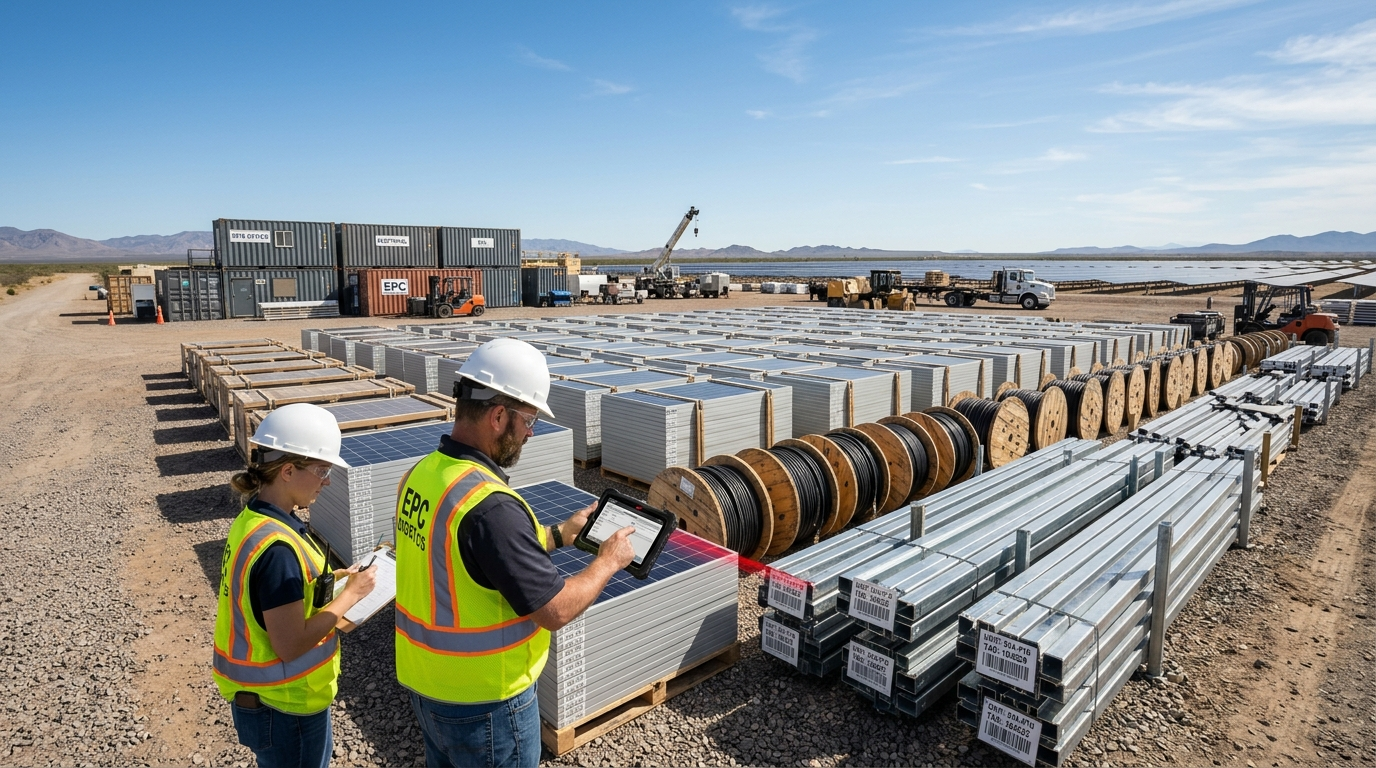
1. The Construction Velocity Trap: The High Cost of Missing Parts
In utility-scale and commercial rooftop solar EPC projects, site execution schedules are built around the concept of unbroken installation momentum. Project developers establish aggressive completion targets—often driven by stringent PPA tariff deadlines, tax equity windows, or severe Liquidated Damage (LD) penalties ranging from 0.5% per week up to 10% of total contract value.
To meet these milestones, EPC contractors mobilize substantial site machinery: tractor-mounted hydraulic ramming pile drivers, trench excavators, telehandlers, and labor teams exceeding 200 to 500 mechanical and electrical technicians. The civil engineering phases (grading, contouring, road formation, and pile driving) typically proceed at rapid velocities.
Then, the project collides with what seasoned construction managers call The Construction Velocity Trap:
A site has 50 MW of modules and thousands of structural columns on ground, but is missing 4,000 specialized SS 304 anti-slip end clamps or specific M10 Grade 8.8 flange serrated bolts. Mounting crews cannot complete table locking against wind uplift, halting the entire array line.
Subcontractors bill fixed daily idle standing charges for idle machinery and technicians. An idle installation crew of 200 workers plus crane rentals burns between ₹3,50,000 and ₹6,00,000 ($4,200 to $7,200) every single day while waiting for an emergency hotshot courier.
When procurement teams panic, they order bulk materials and dump them haphazardly across the raw land. Hardware gets trampled into desert silt, cable drums get crushed by reversing trucks, and workers cannibalize parts from adjacent blocks, destroying all inventory accuracy.
The root cause of these costly bottlenecks is rarely the high-visibility Tier-1 equipment. Major equipment—PV modules, central inverters, and main step-up transformers—commands high-level management attention, executive trackers, and dedicated factory inspectors. Delays invariably stem from the neglected Balance of System (BOS) consumables, structural fasteners, and DC string cabling components that fall through the cracks between central corporate procurement and remote site laydown realities.
2. Solar BOM Taxonomy: ABC & FSN Criticality Classification
Managing a solar EPC Bill of Materials (BOM) comprising over 250 distinct stock-keeping units (SKUs) across 500,000+ individual parts requires structured prioritization. Standard industrial inventory models treat parts by cost alone. A high-velocity solar site demands a dual-matrix approach combining ABC Analysis (Value-Based) with FSN Analysis (Velocity-Based: Fast-moving, Slow-moving, Non-moving).
A. The ABC Classification Hierarchy in Solar EPC
Capital-Dominant & Long-Lead Equipment (~70%–75% CapEx, <10% of SKUs)
Components: N-Type TOPCon/HJT PV Modules, Central Inverter Stations (3.125–4.4 MW) or High-Power String Inverters (250–350 kW), Inverter Duty Transformers (IDTs), 33 kV Gas/Air Insulated Switchgear (GIS/AIS), and Main Power Evacuation Conductors.
Logistics Strategy: Staggered JIT direct-to-block deliveries; zero prolonged site warehousing; OEM bonded buffer storage; pre-dispatch inspection (PDI) and flash test calibration at factory gate.
Volumetric Structural & Electrical BOS (~20% CapEx, ~25% of SKUs)
Components: Module Mounting Structure (MMS) cold-formed C/Z purlins, rafters, columns, torque tubes, 1500V DC solar cables (4mm², 6mm², 10mm² EN 50618 XLPO), String Combiner Boxes (SCB), perforated galvanized cable trays, and chemical earth electrodes.
Logistics Strategy: Regional warehousing buffer; batch manufacturing synchronized with structural piling velocity; rigorous Mill Test Certificate (MTC 3.1) and Positector coating verification.
High-Risk Consumables & Fasteners (<5% CapEx, >65% of SKUs)
Components: Mid and end clamps (anodized aluminum 6063-T6), Grade 8.8 Dacromet-coated bolts, serrated flange nuts, WEEB grounding washers, genuine MC4/Evo2 connectors, branch connectors, heat-shrink cable joints, UV-resistant nylon 6.6 cable ties, stainless steel 316 clips, and cable identification ferrules.
Logistics Strategy: 100% upfront procurement; 15% safety stock buffer; stored exclusively in climate-controlled central containers; dispensed strictly via block kits.
B. The FSN Velocity Matrix for Remote Laydown Yards
Not all components move at the same cadence across a 6-month construction cycle. Organizing a central site yard by FSN velocity prevents logistics congestion:
| Category | Site Movement Pattern | Key Components | Yard Placement Strategy |
|---|---|---|---|
| Fast-Moving (F) | Daily, high-volume outward dispatch aligned with installation squads | MMS purlins, mid/end clamps, M10 bolts, 4/6mm² DC string cables, zip ties | Front perimeter beside main exit artery; drive-through loading bays |
| Slow-Moving (S) | Staged draws tied to specific civil/electrical milestones | MV AC cables, inverter transformer plinths, lightning masts, combiner boxes | Mid-yard paved zones; accessible by 10-ton mobile cranes and forklifts |
| Non-Moving (N) / Milestone Items | One-time installation during final pre-commissioning | SCADA RTU racks, weather monitoring stations (pyranometers), calibration plugs, fire systems | Locked, climate-controlled containerized storage at rear of logistics hub |
3. Mathematical Safety Stock & Buffer Formulations for Remote Solar Sites
Remote utility solar projects in arid regions (e.g., Thar Desert, Deccan Plateau, Kutch) operate under severe geographical friction. A missing component cannot simply be picked up from a local hardware store; the nearest supplier is often 800 to 1,500 kilometers away in an industrial hub like Pune, Ahmedabad, or Bengaluru.
Standard supply chain models assume deterministic lead times and steady daily demand. On a solar site, both installation velocity ($D$) and transit lead time ($L$) are volatile stochastic variables. Rainstorms submerge haul roads, customs authorities hold imported containers at ports, and mechanical contractor productivity swings from 0.5 MWp/day during sandstorms to 2.5 MWp/day during clear weather.
A. The Dual-Variability Safety Stock Equation
To insulate project schedules from catastrophic stock-outs without overloading working capital, site materials managers must apply the combined standard deviation safety stock equation:
Where Z is the service level factor, L is average vendor lead time (days), σD is standard deviation of daily field consumption, D is average daily consumption, and σL is standard deviation of transit lead time (days).
For Class-C consumables (clamps, MC4 connectors, grounding clips), project teams cannot afford a single day of stock-out. Enforce a 99.0% service level (Z = 2.33) or 99.9% (Z = 3.09). For bulky Class-B structural members, use a 95.0% service level (Z = 1.65).
Never assume a supplier's quote of "7 days delivery" is static. If historical transit to remote site coordinates shows deliveries varying between 5 and 13 days, σL is approximately 2.5 days. Factoring σL prevents the catastrophic blind spot of traditional single-variable models.
B. Dynamic Reorder Point (ROP) with Weather Acceleration Buffer
The purchase requisition trigger must incorporate both theoretical consumption, safety buffer, and seasonal weather windows:
ΔWeather represents an empirical pre-monsoon or pre-cyclone surge reserve (typically 7 to 10 days of additional consumption) mobilized before unpaved access roads become impassable for heavy trailers.
C. Practical Scrap & Loss Multipliers for BOM Orders
Never order exact mathematical CAD takeoffs. Even with flawless site management, physical losses occur during assembly, cutting, and handling. The table below outlines mandatory minimum BOM contingency factors:
| Component Type | Theoretical CAD Takeoff | Mandatory Buffer / Scrap Factor | Engineering Rationale |
|---|---|---|---|
| Solar DC String Cable (4/6 mm²) | 100% 3D Polyline Route | +2.5% to +3.5% | Terrain undulations, sag allowances inside cable trays, terminal strip trimming, and drum residual scrap |
| Module Mounting Hardware & Clamps | Exact Table Clamp Count | +3.0% to +5.0% | Over-torquing shear bolt fractures, dropped fasteners in gravel/brush, thread stripping, wind buffer |
| MC4 / Evo2 Connectors | 2 Pairs per String | +5.0% to +7.0% | Pin crimping calibration rejections, cable cross-polarity re-terminations, testing pull failures |
| Structural Purlins & Rafters | Exact Structural Tonnage | +0.5% to +1.0% | Minor handling bends during offloading; replacement for mismatched hole punch tolerances |
4. Digital Laydown Yard Architecture & Zoning Blueprint
A 100 MWp to 250 MWp solar farm covers between 400 and 1,000 acres of remote terrain. When logistics managers treat the laydown yard as a casual open dump, material retrieval times balloon, stock gets misplaced, and internal transport equipment burns excessive fuel traversing muddy fields.
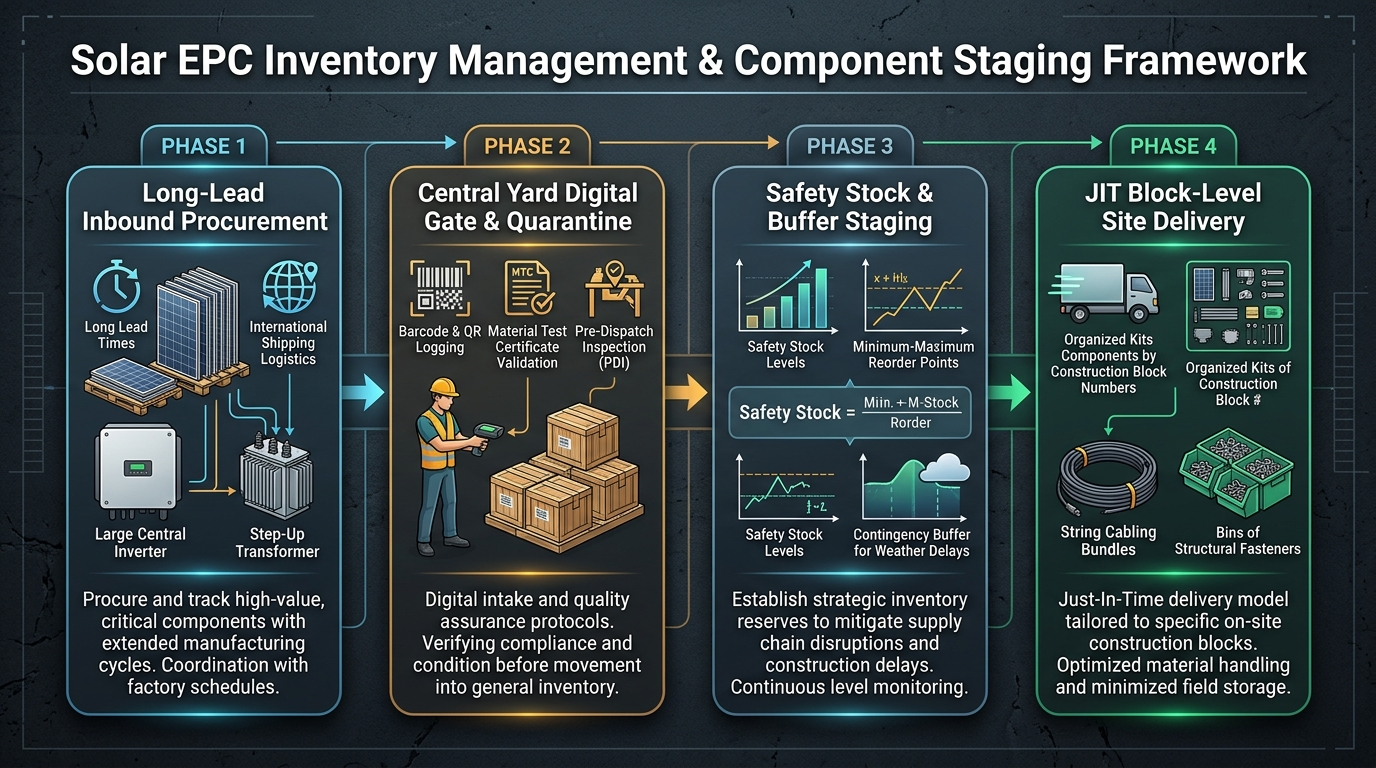
A high-efficiency project requires transforming raw land into an ISO-compliant, digitally mapped Logistics Hub structured around 5 disciplined operational zones:
Every arriving transport vehicle enters through a dedicated gate equipped with a certified gross weighbridge and an Inbound Receiving Inspection (IRI) portal.
- • Barcode/QR Intake: Logistics clerks scan delivery challans and physical QR codes, instantly logging arrivals into the cloud ERP.
- • Document Verification: Mill Test Certificates (MTC 3.1), PDI clearance certificates, and packing slips are verified against purchase orders before unloading.
- • Red Quarantine Hold: Any consignment with broken packaging, missing documentation, or physical damage is diverted to a fenced, red-flagged Quarantine Bay. Non-compliant stock never enters active construction inventory.
- • Mobile Darkroom EL Testing Trailer: Incoming module crates undergo statistical electroluminescence (EL) sampling to identify transit micro-cracks before offloading sign-off.
High-sensitivity electrical and electronic equipment must never be stored under open tin sheds exposed to ambient dust, desert heat, and monsoon humidity.
- • Modified 40-foot insulated sea containers equipped with heavy-duty split air conditioners and dehumidifiers maintaining internal relative humidity below 60% RH.
- • Houses: String inverters, SCADA remote terminal units (RTU), calibrated electronic torque wrenches, fiber optic splice trays, protection relays, and all Class-C connector hardware.
Cable drums represent high capital value and severe damage risk if improperly handled.
- • Compacted Crushed-Gravel Surface: Elevated ≥200 mm above natural grade with a 1.5% drainage gradient to prevent drum flanges from sinking into waterlogged mud.
- • Upright Flange Staging: Drums must strictly be stored standing vertically on both circular flanges with heavy wooden chocks nailed to the ground. Never store cable drums flat on their sides, which crushes internal conductor layers.
- • Weatherproof heat-shrink end caps checked weekly to eliminate moisture ingress into conductor cores.
Cold-formed steel purlins, rafters, and tracker tubes require structured stacking to prevent mechanical deformation and zinc coating corrosion.
- • Purlin bundles rest on heavy wooden dunnage sleepers (100 mm × 100 mm treated timber) elevated off bare earth to prevent galvanic white rust caused by soil moisture.
- • Stack height restricted to a maximum of 3 bundles with uniform timber spacers aligned vertically to prevent sagging or flange pinching.
- • Segregated strictly by array block number with high-visibility weather-resistant signboard markers.
The central hub's dispatch engine where outward installation materials are assembled, verified, and loaded onto specialized site utility trailers.
- • Daily material requisitions are pre-assembled the evening before work shifts.
- • Features covered drive-through loading aprons where telehandlers and flatbed trailers load without blocking yard internal traffic.
5. Block-Level Kitting & Just-In-Time (JIT) Site Distribution
The traditional method of solar site distribution—where suppliers drop full truckloads of 5,000 clamps, 20 drums of cable, and 100 crates of modules directly into the open solar field—is the single greatest driver of material shrinkage, contractor disputes, and damaged components.
V-TECH Renewables mandates the Modular Block-Level Kitting Workflow. Under this methodology, the central logistics hub acts as a manufacturing assembly line, supplying site installation squads with modular, self-contained installation kits:
Anatomy of a 1 MWp Solar Block Installation Kit
- • Purlin & Rafter Sets: Exact bundle count matching the 1 MW block layout drawing.
- • Pre-Counted Fastener Boxes: Heavy-duty sealed plastic bins containing exact numbers of M10 bolts, spring washers, and nuts plus a 3% scrap allowance.
- • Anodized Clamps: Color-coded bags of mid-clamps and end-clamps matched to module frame depth (30 mm / 35 mm).
- • Grounding WEEB Washers: Exact quantity required for UL 2703 equipment bonding across all tables.
- • Pre-Cut String Jumpers: DC cable cut to exact CAD lengths on calibrated yard de-reelers, eliminating field cutting waste.
- • Pre-Terminated MC4 Leads: Factory-crimped and pull-tested branch leads labeled with string numbers (e.g., Block 04, Inverter 02, String 14).
- • Cable Management Packs: UV-resistant SS 316 edge clips and polyamide ties bundled in bags of 500 units.
- • Safety & Circuit Identification: Engraved UV-resistant Warning and String ID labels ready for immediate application.
The Golden Rule: The Mechanical Sign-Off Gate
The most critical operational discipline in block kitting is the Module Release Gate:
PV module crates are never dispatched to an installation block until the QA/QC structural engineer signs off that 100% of the mounting tables in that block are fully erected, aligned with laser levels, and torqued to specified values with torque-seal paint marks applied. If modules arrive while racking is incomplete, crates sit on dirt roads where they are subjected to accidental equipment impacts, dust accumulation, wind tip-overs, and improper field staging.
6. Outdoor Preservation Protocols for High-Value Hardware
A dangerous misconception among rookie site engineers is that because solar components carry outdoor ratings (IP65, IP66, NEMA 4X, UV resistance), they are immune to damage while sitting packed in open laydown yards. The opposite is true: un-energized components packed in shipping materials are highly vulnerable to localized micro-climates, water pooling, and thermal degradation.
A. Dual-Glass PV Modules: Preventing Greenhouse Delamination
Modern large-format bifacial modules utilize dual 2.0 mm semi-tempered glass with polyolefin elastomer (POE) or EVA encapsulation sheets. Staging crates outdoors requires strict controls:
- Eliminating the "Greenhouse Oven" Effect: Covering module crates with transparent or tight impermeable black plastic tarpaulins creates an intense greenhouse trap. Under $40^\circ\text{C}$ to $45^\circ\text{C}$ desert sun, internal temperatures inside tightly wrapped crates soar beyond $75^\circ\text{C}$. This softens the cross-linking sheets, causing plasticizers to boil off and leave cloudy chemical residues on anti-reflective (ARC) glass coatings. Always use breathable, light-colored, UV-reflective canvas tarpaulins elevated on timber framing to allow continuous airflow.
- Maximum 2-Tier Stacking: Never stack module pallets more than 2 high in the laydown yard. Stacking 3 or 4 high places extreme dynamic static loads on bottom corner posts, inducing torsional deflection in outer frames and creating microscopic silicon wafer micro-cracks before the modules are even unboxed.
- Pallet Dunnage Elevation: All crates must rest on elevated timber dunnage or concrete pads elevated at least 200 mm above grade to prevent water capillary suction from ground puddles during unexpected rainfall.
B. Inverter Stations & Step-Up Transformers: Moisture Condensation Control
Central inverter power conversion systems (PCS) and Inverter Duty Transformers contain sensitive IGBT bridge semiconductors, microprocessors, and hygroscopic cellulose insulation:
When high-power inverters sit un-energized on their outdoor concrete plinths during prolonged grid connection delays, diurnal temperature swings (daytime $40^\circ\text{C}$ to nighttime $15^\circ\text{C}$) cause moisture to condense inside electronic cabinets.
Mandatory Protocol: Run auxiliary power cables from a site diesel generator to energize internal enclosure space heaters, or install temporary silica gel desiccant bags replaced every 14 days with sealed inspection logs.
Large utility transformers shipped gas-filled (without oil) to reduce transport weight must have their dry nitrogen ($N_2$) blanket pressure monitored daily using calibrated pressure gauges.
Mandatory Protocol: Positive pressure ($0.15$ to $0.25\,\text{bar}$) must be maintained at all times. If gauge pressure drops to zero, atmospheric air and humidity have contaminated the core insulation, requiring expensive on-site vacuum oven drying.
C. Solar DC & AC Cable Drum Preservation
Cable drums must undergo weekly inspection protocols:
- Hermetic End Sealing: Both the inner and outer ends of the cable must be sealed with factory-grade heat-shrink end caps. Using standard electrical tape is completely prohibited. If an end cap falls off during handling, water will enter through capillary action along the stranded conductor, oxidizing the tinning and causing insulation resistance test (Megger) failure during commissioning.
- Lagging Protection: Never remove the outer protective wooden lagging battens from cable drums until the drum is mounted on hydraulic jacks at the trench pulling location. Lagging protects the outer sheath from fork-tine punctures during yard movements.
7. Theft Prevention, Material Reconciliation & Scrap Minimization
Remote utility solar sites face substantial security and inventory leakage challenges. High-value copper grounding tape, heavy solar DC cables, aluminum busbars, inverters, and PV modules represent liquid assets in regional scrap and resale markets.
Simultaneously, unmonitored cable pulling operations routinely produce 5% to 8% scrap rates, destroying hundreds of thousands of dollars in project profit margins. Maintaining control requires a three-pillar asset protection system:
A. High-Tech Laydown Security & Access Controls
Deploy autonomous, mobile solar-powered camera masts equipped with dual-spectrum optical and thermal night vision, AI boundary breach detection, and 110 dB siren strobe warnings along the perimeter.
Strict single-gate perimeter access with biometric turnstiles and RFID vehicle tracking. Subcontractor vehicles are logged with gross/tare weights upon entry and exit to prevent covert scrap smuggling.
All site telehandlers, forklifts, and tractors operate with real-time GPS telemetry and electronic geofencing. Operating outside designated laydown corridors or during unauthorized night hours automatically locks ignitions.
B. The Daily Mass-Balance Reconciliation Equation
To eliminate the dreaded "phantom inventory" crisis—where inventory exists in corporate ERP databases but cannot be found on site—logistics teams must perform a daily mass-balance reconciliation across every active installation block:
Installed quantities are audited not by subcontractor self-reporting, but through QA/QC drone aerial orthomosaic mapping and tablet-based punch list sign-offs. If physical stock differs from ERP stock by more than 0.5%, all new issuances to that subcontractor are frozen until the variance is investigated.
C. Cable Cutting Schedules & Drop Scrap Control
To compress DC string cable scrap below 1.2%:
- Combinatorial Master Cutting Schedules: Central warehouse software calculates optimal cutting sequences from standard 1,000 m and 2,000 m master drums based on exact 3D CAD string runs (e.g., cutting combinations of 42 m, 68 m, and 95 m runs that exhaust the entire spool with less than 5 m residual scrap).
- Mandatory Scrap Return: Subcontractors must return all offcuts and empty wooden reels to the warehouse to obtain clearance for new spools. All scrap cable is weighed, logged, and audited weekly.
8. Comprehensive Solar EPC Inventory Management Matrix
To establish a disciplined, repeatable operational framework across utility-scale and commercial solar portfolios, V-TECH Renewables synthesizes component parameters into a master logistics control matrix. Below is the technical architecture mapping lead times, critical failure risks, safety stock rules, and storage specifications:
| Hardware Category | Typical Lead Time | Stock-Out Criticality | Minimum Buffer Stock | Storage & Environmental Spec | Inward Verification Gate |
|---|---|---|---|---|---|
| N-Type TOPCon PV Modules | 10–16 Weeks | Extreme (PPA COD Delay) | 0.5% to 1.0% | Max 2-tier stacked; elevated >200 mm; breathable UV canvas; shaded zone | Mobile EL test; flash calibration check; Golden Module verification per IEC 60904 |
| Structural MMS Steel Purlins | 4–8 Weeks | High (Stalls Module Mounting) | 1.0% to 2.0% | Heavy timber dunnage; max 3 bundles; drainage slope; avoid wet soil contact | Positector gauge (≥80 µm HDG or ≥ZM310 Zn-Al-Mg); MTC 3.1 chemical verification |
| Solar DC String Cable (1.5 kV) | 4–6 Weeks | Moderate to High | 2.5% to 3.5% | Upright flange storage; compacted gravel pad; sealed heat-shrink end caps intact | Kelvin double bridge resistance ($R_{20}$); Hot Set elongation test per IEC 60811 |
| Mid/End Clamps & Fasteners | 2–4 Weeks | Critical (Complete Array Stoppage) | 5.0% to 7.0% | Enclosed container storage; moisture-free bins; <60% RH to prevent oxidation | Anodization thickness (≥15 µm AA15); bolt torque testing; Dacromet salt spray report |
| MC4 Connectors & Branch Leads | 2–3 Weeks | Critical (Electrical Stoppage) | 5.0% to 8.0% | Locked climate-controlled warehouse container; original sealed OEM packaging | 1500V DC UL 6703 certification; calibrated crimp tool pull-force test (>310 N) |
| Inverter Duty Transformers (IDT) | 14–22 Weeks | Fatal (Grid Interconnection Stoppage) | 0% (OEM Bonded Spares) | Direct to plinth; positive N2 pressure ($0.2\,\text{bar}$); silica breathers active | Full factory routine FAT report; DGA oil test; core insulation resistance check |
9. Real-World Case Study: 200 MWp Plant in Jodhpur, Rajasthan
In mid-2025, a premier independent power producer (IPP) contracted a fast-track 200 MWp single-axis tracker solar PV plant in the arid desert terrain of Phalodi, Jodhpur district, Rajasthan. The project was governed by a rigid 120-day Commercial Operation Date (COD) deadline, carrying an unyielding Liquidated Damages clause of ₹15 Lakh ($18,000) per calendar day of delay.
The Supply Chain Crisis & Flash Flood Shock
The Unforeseen Disaster
On Day 45 of construction, unseasonal cyclonic cloudbursts washed out two primary railway culverts and severed highway bridges connecting northern Gujarat industrial hubs to western Rajasthan. Over 40 transport trailers carrying structural tracker components and DC cables were stranded 350 km away for 14 consecutive days.
Typical Conventional Outcome: 200+ mounting technicians idle; ₹80 Lakh in standing equipment penalties; 14-day schedule slip triggering over ₹2.1 Crore in utility LD penalties.
The Digital Inventory Buffer Defense
V-TECH Renewables had architected a comprehensive digital inventory control system during site mobilization:
- • Dynamic Buffer Stock Activated: A 12-day pre-calculated safety stock ($SS$) was physically staged in the central laydown yard, insulating mechanical assembly lines from road paralysis.
- • Modular Block Kitting: The warehouse continued issuing pre-kitted fastener and cable sets for completed racking blocks without a single hour of technician downtime.
- • Zero Damaged Stock: Elevated gravel staging pads and breathable canvas tarpaulins prevented flooding losses across all module pallets.
The Financial & Schedule Result: While competing projects in the same sub-station cluster suffered an average 25-day delay, the 200 MWp project achieved COD 8 days ahead of schedule, saving millions in liquidated damages and delivering exceptional financial performance:
10. 15-Point Site Inventory & Logistics Audit Checklist
Solar EPC Project Directors, Site Logistics Managers, and Lead Quality Engineers should enforce this 15-point checklist before and during site execution to ensure unyielding inventory control:
Dual ABC/FSN BOM Categorization
Structure all project BOM line items into ABC value tiers and FSN movement speeds prior to issuing site purchase orders.
Mathematical Safety Stock Formulation
Calculate buffer stocks for remote coordinates using the dual-variability formula accounting for vendor lead time variance (sigma_L).
Digital WMS & Barcode Intake Portal
Equip the site receiving gate with barcode/QR scanning linked live to cloud ERP, ensuring no unlogged material enters the yard.
Red Quarantine Bay Enforcement
Physically isolate broken, uncertified, or non-compliant consignments in a locked quarantine area pending formal rejection.
Mobile Darkroom EL Verification
Conduct inbound statistical electroluminescence (EL) sampling on module crates to identify transit micro-cracks before supplier sign-off.
Climate-Controlled Containerized Storage
Store string inverters, telemetry, relays, and MC4 connectors in insulated containers with dehumidifiers maintaining <60% RH.
Hardstanding Cable Drum Yard Drainage
Store cable drums strictly upright on both flanges over elevated compacted gravel (>200 mm above grade) with 1.5% drainage slope.
Heat-Shrink Cable End Seal Verification
Audit cable drums weekly to ensure factory-grade heat-shrink end caps remain intact, preventing moisture capillary wicking.
Purlin Timber Dunnage & Stack Height Limits
Elevate structural steel on 100x100 mm timber dunnage to avoid soil moisture contact, limiting bundle stacks to a maximum of 3 tiers.
Breathable Canvas Tarpaulins for PV Modules
Never use impermeable plastic wraps on module crates; mandate breathable, UV-treated canvas with active internal ventilation.
Block-Level Modular Kitting Architecture
Pre-package daily mechanical and electrical hardware into discrete 500 kW or 1 MW array block kit boxes before field delivery.
Mandatory Mechanical Sign-Off Gate
Strictly enforce the zero-module dispatch rule until table racking alignment and bolt torquing are 100% QA/QC certified.
Combinatorial Cable Cutting Schedules
Execute master de-reeling cutting schedules based on 3D CAD takeoffs to keep residual DC drop scrap strictly below 1.2%.
Daily Drone & Tablet Mass-Balance Audit
Reconcile physical stock against drone-verified installation progress daily; freeze new issuances if discrepancies exceed 0.5%.
Autonomous Perimeter AI Security Surveillance
Protect high-value cabling and inverters with solar camera towers, thermal night vision, and geofenced machinery controls.
11. Frequently Asked Questions
Why do small Balance of System (BOS) components cause more site delays than large equipment like modules or inverters?
While Tier-1 PV modules and inverters command the highest procurement visibility and financial focus, they are tracked with dedicated expediting teams. In contrast, low-cost Class-C consumables—such as specialized SS 304/316 mid and end clamps, grounding WEEB clips, 1500V MC4 connectors, specific hydraulic crimping dies, and UV-resistant cable glands—account for less than 2% of project CapEx but possess a 100% critical path dependency. If an installation block of 10,000 modules is missing 200 end clamps or specific torque-indicating shear nuts, mounting crews cannot secure the tables against wind uplift, halting the entire mechanical workflow and idling hundreds of technicians at massive standing costs.
How is safety stock mathematically formulated for remote utility-scale solar sites?
Safety stock (SS) on remote solar EPC sites must account for both installation velocity variance and supply chain lead-time volatility using the formula: SS = Z * sqrt(L * (sigma_D^2) + (D^2) * (sigma_L^2)), where Z represents the service factor (typically 2.33 for a 99% non-stockout confidence level), L is average vendor replenishment lead time, sigma_D is the standard deviation of daily field consumption (driven by weather swings and crew scaling), D is average daily consumption, and sigma_L is the standard deviation of transit lead time (reflecting monsoon road washouts, interstate permits, and port congestion). A dynamic acceleration buffer (Delta_Weather) is added to establish robust Reorder Points (ROP = D*L + SS + Delta_Weather).
What is Block-Level Kitting, and why is it superior to bulk field distribution?
Block-Level Kitting is an advanced logistics methodology where the central site warehouse bundles all necessary mechanical fasteners, electrical jumpers, string cables, clamps, and labels into dedicated, pre-counted, weatherproof containers corresponding exactly to a specific array block (e.g., 500 kWp or 1 MWp). In conventional bulk distribution, pallets of hardware are dumped across raw fields, resulting in 4% to 8% component loss from trampling into dust, misplacement, weather degradation, and informal swapping between subcontractor teams. Kitting eliminates site clutter, cuts technician walking transit by over 60%, enables exact daily reconciliation, and prevents module mechanical damage by releasing modules only after table racking QA/QC is certified.
How should high-value components be protected against environmental damage during site laydown?
Outdoor components are engineered for environmental resistance once energized, but remain vulnerable during unenergized packaging storage. Dual-glass N-Type TOPCon modules must be stacked no more than 2 crates high on elevated compacted gravel pads (>200mm above flood levels) and covered with breathable, UV-resistant tarpaulins to avoid internal plastic greenhouse condensation (>70°C) that triggers POE/EVA sheet degradation. Central inverters stored in open kiosks require active auxiliary heating or regular desiccant replacement to prevent internal PCB condensation. Solar DC cable drums must always be stored upright on their flanges (never flat), with hermetically heat-shrunk end caps intact to prevent moisture capillary wicking into conductor strands.
How can solar EPCs prevent cable scrap and high-cost material wastage on site?
To minimize high-cost copper and aluminum cable scrap, EPCs must implement a Three-Way Alignment: 3D CAD digital terrain polyline takeoffs, drum cutting optimization schedules, and strict drum tracking. Before cutting from a master 1,000m or 2,000m drum, the warehouse cutting software calculates combinatorial string lengths to ensure residual drop scraps stay under 1.5%. Field teams must return all offcuts and empty spools to the central warehouse before new drums are issued, preventing undocumented scrap hoarding and deterring copper pilferage through daily mass-balance reconciliations.
Accelerate Solar EPC Execution with V-TECH Renewables
Eliminate project delays, protect cash flow, and avoid costly liquidated damages. V-TECH Renewables provides independent Owner's Engineering, site logistics architecture, third-party quality audits, and construction management support for utility-scale solar projects across India.
Consult Our Engineering Advisory TeamRelated Procurement & Engineering Articles
How to Vendor-Qualify Balance of System (BOS) Manufacturers
Shop-floor technical audits for solar structural steel, EN 50618 DC cables, inverter duty transformers, and factory QMS protocols.
Logistics & QualityManaging Logistics and Transit Damage for Delicate PV Modules
Mitigating micro-cracks in N-Type TOPCon modules, air-suspension transit, spreader bar handling, and mobile darkroom EL testing.
Execute Your Utility-Scale Solar Projects on Time and on Budget
From pre-construction 3D layout optimization and bill of materials validation to on-site quality assurance and commissioning oversight, V-TECH Renewables is your trusted engineering excellence partner.