How to Vendor-Qualify Balance of System (BOS) Manufacturers
In utility-scale and commercial solar engineering, Tier-1 modules and high-efficiency inverters capture the headlines. Yet, over a 25-to-30 year operating lifespan, more than 80% of catastrophic plant failures, structural collapses, electrical fires, and expensive warranty disputes originate within non-module Balance of System (BOS) components. Here is the definitive, shop-floor engineering audit and vendor qualification framework for solar EPC directors, purchase managers, and Owner’s Engineers.
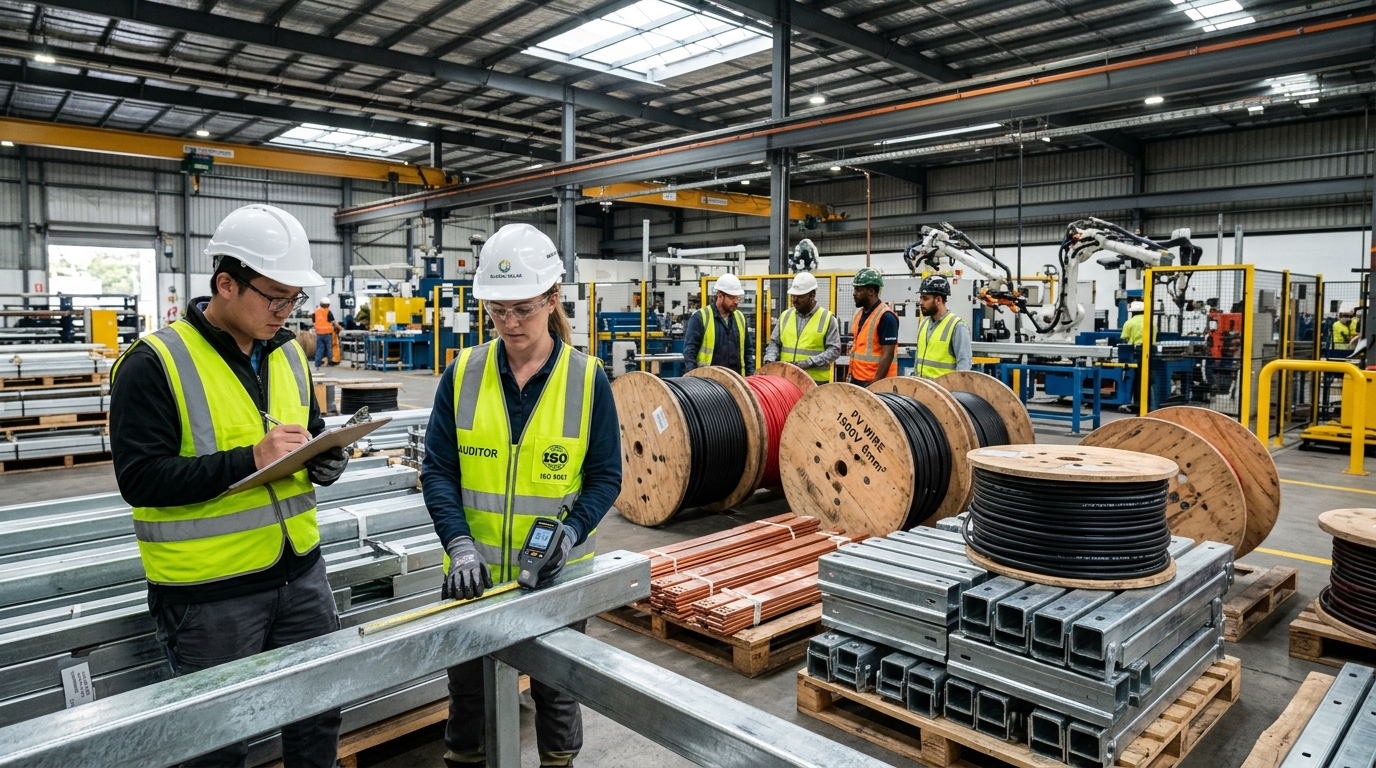
2. The True Risks of Unqualified BOS Subcontractors
Why do sub-standard BOS components proliferate in the solar supply chain? Unlike modules—where Tier-1 certification, IEC 61215/61730 type testing, and ALMM listing impose clear entry gates—the BOS ecosystem is heavily fragmented. Hundreds of regional roll-forming mills, cable extruders, galvanizing job shops, and switchgear fabricators compete aggressively on wafer-thin margins.
Without an assertive vendor qualification protocol conducted by qualified Owner's Engineers or technical specialists, procurement teams frequently fall victim to six critical failure modes:
Commercial Mill Steel Dilution & Re-Rolled Scrap
Unscrupulous fabricators substitute prime-grade certified structural coils (e.g., IS 2062 E350/E450 or ASTM A653) with uncertified secondary re-rolled steel containing excessive phosphorus ($P > 0.05\%$) and sulfur ($S > 0.05\%$). This introduces severe brittleness, micro-cracks at cold-bend radii, and yield strengths 30% below structural design calculations.
Skimped Galvanization & Uneven Zinc Baths
Hot-dip galvanizers cut costs by dipping structural steel for insufficient duration, operating depleted zinc baths, or omitting flux pre-treatment. Purlins and column posts specified for $80\,\mu\text{m}$ coating thickness arrive at site with barely $35\,\mu\text{m}$ to $45\,\mu\text{m}$ of porous zinc, causing premature red rust oxidation within 3 to 5 operating monsoons.
Sub-Standard Copper & Under-Cured Cable Insulation
Cable vendors adulterate electrolytic copper with recycled non-EC grade copper scraps ($< 99.5\%$ purity), dramatically increasing electrical resistance ($R_{20}$), voltage drop, and operating $I^2R$ heating. Concurrently, insufficient electron-beam irradiation during cross-linking leaves polyolefin molecules linear rather than 3D networked, leading to catastrophic thermal melting and sheath embrittlement.
Counterfeit Type Test Certificates & 'Golden Sample' Scams
Shady suppliers submit genuine CPRI, ERDA, or TÜV type test certificates conducted years earlier on hand-crafted 'golden prototypes'. In commercial mass production, however, raw materials, copper gauges, insulation thicknesses, and contact plating are systematically downgraded without notifying the EPC.
Dimensional Drift & Site Rework Nightmares
Roll-forming lines without optical laser guidance or automated CNC punching produce purlins with warped flanges and hole pitch variances exceeding $\pm 4\,\text{mm}$. On-site installation crews are forced to gas-cut, re-drill, or hammer galvanized sections, stripping the protective zinc layer and creating instant corrosion hotspots.
Zero Heat-Number Traceability
When a single structural purlin snaps or a cable reel fails during commissioning, the lack of barcode or heat-number traceability forces the EPC into an impossible dilemma: either tear down hundreds of MWs of installed tables or face complete insurance denial for latent defect claims.
3. Pillar I: Structural Mounting Steel & Tracker Hardware Qualification
Solar Module Mounting Structures (MMS) must support dynamic mechanical loads exceeding $1.8\,\text{kN/m}^2$ (equivalent to cyclonic wind speeds of $160\,\text{km/h}$ to $180\,\text{km/h}$) across 25 to 30 years without permanent deformation or structural resonance. Qualifying structural steel fabricators demands a multi-point metallurgical and manufacturing inspection:
A. Raw Material Metallurgy & Mill Test Certificates
Never accept an MMS vendor's self-declaration. The vendor qualification team must demand primary steel mill test certificates (MTC) conforming strictly to EN 10204 Type 3.1 (or Type 3.2 for critical tracker torque tubes) directly from certified primary producers (e.g., Tata Steel, JSW, ArcelorMittal, POSCO). The MTC must confirm:
- Chemical Composition: Carbon ($C \le 0.20\%$), Manganese ($Mn \le 1.50\%$), Silicon ($Si \le 0.40\%$), Sulfur ($S \le 0.040\%$), and Phosphorus ($P \le 0.040\%$). Carbon equivalent ($CE_{IIW}$) must remain below $0.42\%$ to guarantee cold formability and field weldability.
- Mechanical Strength: Minimum Yield Strength ($R_{eH}$) matching structural design specifications—typically $YSt\,250\,\text{MPa}$, $YSt\,350\,\text{MPa}$, or high-strength $YSt\,450/550\,\text{MPa}$ per IS 2062, ASTM A653, or EN 10025.
- Elongation ($A_5$): Minimum $18\%$ to $22\%$ ensuring the steel can undergo tight cold-roll bend radii without microscopic tensile fracturing on the outer radius.
B. Corrosion Protection: Hot-Dip Galvanization vs. Zinc-Aluminium-Magnesium (Zn-Al-Mg)
Atmospheric and soil corrosion dictate the functional lifespan of solar arrays. During shop-floor audits, auditors must inspect the galvanizing bath or verify continuous pre-galvanized coil specifications:
| Coating Technology | Applicable Standard | Minimum Coating Thickness / Weight | ASTM B117 Salt Spray Red Rust Limit | Best Application Environment |
|---|---|---|---|---|
| Hot-Dip Galvanizing (HDG) - Post Fabrication | IS 4759 / ASTM A123 / ISO 1461 | 80 µm to 120 µm (575 to 860 g/m²) | ≥ 720 to 1,000 Hours | Heavy structural columns, driven piles, inland C2/C3 environments |
| Zinc-Aluminium-Magnesium (Zn-Al-Mg / PosMAC / Magnelis) | ASTM A1046 / EN 10346 | ZM 310 to ZM 430 g/m² (23 to 32 µm) | ≥ 1,500 to 2,500 Hours | Cold-formed purlins, tracker rafters, aggressive C4/C5 coastal & agricultural ammonia soils |
| Continuous Pre-Galvanized (GI) Sheet | IS 277 / ASTM A653 | GP 275 to GP 550 g/m² (19 to 38 µm) | ≥ 250 to 500 Hours | Low-corrosion C1/C2 arid inland rooftops (requires cut-edge protection) |
Never rely on manufacturer batch test tags. Bring a calibrated magnetic-induction coating thickness gauge (e.g., DeFelsko PosiTector 6000 or Elcometer 456) calibrated against certified zero and shims. Take a minimum of 10 spot readings across web centers, flange edges, and hole boundaries on at least 5 randomly selected purlins per coil batch. Flange edge coatings must not drop below 80% of specified thickness.
C. Fasteners, Torque Tubes & Tracker Actuators
A single corroded bolt can collapse an entire module table. Qualification audits must confirm:
- Hardware Metallurgy: Structural connection bolts must be Grade 8.8 or Grade 10.9 high-tensile steel hot-dip galvanized per ISO 10684 or coated with inorganic zinc flake (Geomet / Dacromet / Delta Protekt) yielding $\ge 1,000\,\text{hours}$ salt spray resistance without hydrogen embrittlement.
- Module Clamps: Extruded aluminum alloy 6063-T6 or 6005-T6 anodized to a minimum coating thickness of $15\,\mu\text{m}$ (Class AA15 per ISO 7599) with integrated stainless steel 304/316 grounding clips to provide UL 2703 electrical bonding.
- Tracker Torque Tubes: Large-diameter circular or square torque tubes (e.g., $150\,\text{mm} \times 150\,\text{mm}$ with $3.5\,\text{mm}$ to $4.5\,\text{mm}$ wall thickness) must possess verified torsional stiffness ($J$) and yield strength ($R_e \ge 355\,\text{MPa}$) to eliminate aeroelastic flutter and torsional galloping under dynamic wind conditions.
4. Pillar II: Solar DC & AC Cable Quality Assurance
Solar DC cables are subjected to the harshest environmental conditions in the entire plant. They lie in open perforated cable trays or clip directly beneath modules, enduring ambient temperatures from $-15^\circ\text{C}$ to $+50^\circ\text{C}$, direct solar thermal absorption driving conductor operating temperatures up to $+90^\circ\text{C}$ (with maximum conductor design temperatures up to $120^\circ\text{C}$), high relative humidity, and uninterrupted $1,500\,\text{V DC}$ electrical stress.
Qualifying solar cable manufacturers requires an uncompromising verification of international standards, conductor purity, and insulation cross-linking:
A. Mandatory Harmonized Standards: EN 50618 & IEC 62930
Legacy building-wire standards (e.g., IS 694 or generic multi-core PVC/XLPE) are strictly prohibited for solar DC string runs. The cable manufacturer must hold current, accredited Type Test certifications for:
- EN 50618: Electric cables for photovoltaic systems (Type H1Z2Z2-K).
- IEC 62930: Electric cables for photovoltaic systems with a rated voltage of 1.5 kV DC.
- TÜV 2 Pfg 1169/08.2007: Recognizable international safety benchmark.
B. Conductor Metallurgy & Tinned Stranding
During factory audits, inspect the wire-drawing and tin-plating lines:
- Copper Purity: Conductors must utilize Electrolytic Tough Pitch (ETP) or Oxygen-Free (OF) annealed high-conductivity copper with minimum electrical purity of $99.9\%$. Verify copper scrap quarantine bays to ensure no non-certified recycled ingots are melted in-house.
- Tinned Coating: Each fine copper strand (Class 5 flexible conductor per IEC 60228) must undergo continuous hot-dip or electrolytic tinning with a minimum tin coating thickness of $1.0\,\mu\text{m}$. Pure copper bare strands will react with atmospheric sulfur dioxide and moisture, causing rapid black wire oxidation that increases contact resistance at MC4 connectors and induces catastrophic thermal fires.
- Conductor Resistance ($R_{20}$): Perform on-site Kelvin double bridge resistance tests on sample drums. A $4\,\text{mm}^2$ tinned copper conductor must have a maximum DC resistance of $5.09\,\Omega/\text{km}$ at $20^\circ\text{C}$, while a $6\,\text{mm}^2$ conductor must not exceed $3.39\,\Omega/\text{km}$.
C. Insulation & Sheath Chemistry: The Electron-Beam Cross-Linking Mandate
The core technological differentiator in solar DC cabling is the cross-linking mechanism. Standard chemically cross-linked polyolefin (silane/moisture-cure) frequently suffers from uneven curing and moisture entrapment. Electron-Beam (E-Beam) irradiated cross-linking is the industry gold standard:
High-energy electron accelerators (1.5 to 3.0 MeV) bombard extruded polyolefin molecules, breaking carbon-hydrogen bonds and forging a permanent 3D covalent thermoset polymer matrix.
- • Thermal endurance: $120^\circ\text{C}$ for 20,000 hrs per IEC 60216
- • Short circuit temperature limit: $250^\circ\text{C}$ for 5 seconds
- • Completely zero halogen ($< 0.5\%$ HCl emission per IEC 60754)
- • High resistance to solar UV, ozone, and acid hydrolysis
Linear thermoplastic chains that soften, deform, and undergo plastic flow under sustained mechanical pressure (cable tray rungs) and thermal cycling.
- • Begins softening at $70^\circ\text{C}$ to $85^\circ\text{C}$
- • Melts and shorts during DC ground fault conditions
- • Emits toxic hydrochloric acid (HCl) gases upon combustion
- • Sheath cracks under 24 to 36 months of intense UV exposure
Shop-Floor Hot Set Test Verification: Require the manufacturer's lab technician to perform the Hot Set Test per IEC 60811-507 in your presence. Cut dumbbell specimens of insulation and outer sheath, place them in an oven at $200^\circ\text{C}$ with a suspended mechanical load of $20\,\text{N/cm}^2$ for 15 minutes. Maximum elongation under load must not exceed $100\%$, and permanent residual set after cooling must remain below $25\%$. If the sample breaks or stretches beyond $100\%$, the entire batch was insufficiently irradiated and must be rejected.
5. Pillar III: Transformers, Switchgear & Combiner Boxes
Medium-voltage balance of plant assets—Inverter Duty Transformers (IDTs), 33 kV Ring Main Units (RMU), HT switchgear vacuum circuit breaker (VCB) panels, and String Combiner Boxes (SCB)—represent the nerve center of power evacuation. An unexpected transformer failure shuts down multiple megawatts of generation for months due to long lead times for custom high-voltage coils.
A. Inverter Duty Transformers (IDTs): Specialized Solar Physics
Standard distribution transformers designed for smooth $50\,\text{Hz}$ sinusoidal utility distribution cannot survive the harsh operational duty of solar plants. During vendor audits of IDT manufacturers, verify compliance with specialized solar duty requirements:
- Harmonic Withstand & K-Factor: Multi-megawatt central and string inverters inject significant high-frequency Pulse Width Modulation (PWM) switching harmonics (5th, 7th, 11th, 13th, and higher order carrier frequencies). The transformer design must incorporate a certified K-factor rating (typically $K \ge 4$ to $K \ge 9$) with low-loss core laminations (CRGO steel Grade M3/M4 or laser-scribed domain refined) preventing excessive stray flux eddy current heating.
- Multi-Winding Split Isolation: Modern solar central inverter blocks utilize multi-winding transformers (e.g., dual or quadruple low-voltage windings evacuating two or four separate 1,500V inverter outputs to a single 33 kV bus). The vendor must demonstrate electrostatic shielding between each LV winding and the HV winding to isolate high-frequency common-mode inverter noise and suppress switching surges.
- Conservative Temperature Rise Limits: In arid solar zones (Rajasthan, Gujarat, Andhra Pradesh), summer ambient temperatures inside kiosk enclosures reach $50^\circ\text{C}$. The IDT must be designed with reduced temperature rise limits: top oil temperature rise capped at $\le 45^\circ\text{C}$ to $50^\circ\text{C}$ and winding temperature rise capped at $\le 50^\circ\text{C}$ to $55^\circ\text{C}$ above ambient per IEC 60076-2.
B. String Combiner Boxes (SCBs) & DC Disconnects
String Combiner Boxes operate at the high-voltage front line, consolidating 16 to 32 parallel strings into unified DC busbars. Shop-floor audits must inspect:
- Enclosure Ingress & Impact Protection: Enclosures must be fabricated from glass-fiber reinforced polyester (SMC/FRP) or powder-coated 304/316 stainless steel rated to IP65 / IP66 ingress protection per IEC 60529 and mechanical impact protection of IK08 / IK10 per IEC 62262, equipped with breathable Gore-Tex pressure equalization vents to prevent internal moisture condensation.
- DC Fuse & SPD Bankability: Fuses must be 1,500V DC rated gPV fuses certified to IEC 60269-6 from reputable manufacturers (Bussmann, Mersen, Littelfuse). Surge Protective Devices (SPDs) must be Type 1+2 or Type 2 certified to EN 50539-11 with pluggable metal oxide varistors (MOV) and thermal disconnect status indicators.
- Busbar Plating & Creepage Clearances: Copper busbars must be electrolytic grade ($99.9\%$) electroplated with silver (minimum $5\,\mu\text{m}$) or tin (minimum $10\,\mu\text{m}$) to prevent galvanic corrosion and thermal runaway. Internal clearance and creepage distances must strictly adhere to IEC 61439-1/2 for 1,500V DC operating voltage ($> 25\,\text{mm}$ clearance, $> 40\,\text{mm}$ creepage).
6. Comprehensive BOS Vendor Qualification & Audit Matrix
To eliminate subjectivity and establish repeatable supplier scorecards across multi-location solar EPC projects, V-TECH Renewables utilizes a 4-Pillar BOS Vendor Qualification Architecture. Below is the comprehensive technical audit matrix mapping mandatory standards, key inspection parameters, critical rejection thresholds, and laboratory witness protocols:
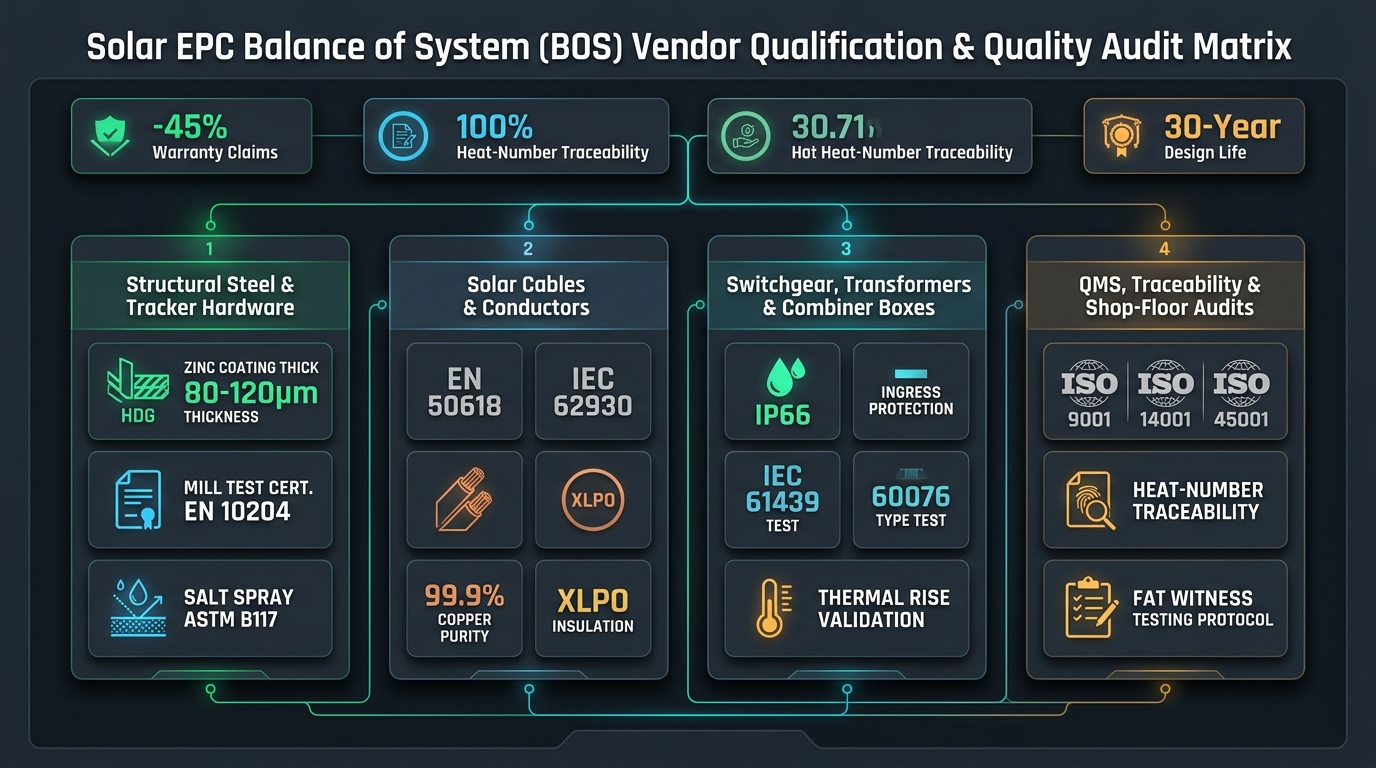
| BOS Sub-System | Governing Standards | Mandatory Inspection Checkpoints | Critical Rejection Gateways | Witness Testing Protocol |
|---|---|---|---|---|
| Structural Mounting Steel (MMS) | IS 2062, ASTM A653, IS 4759, EN 10346 | Raw coil MTC 3.1 verification, Positector zinc coating gauge, roll-forming hole pitch, flange squareness | Zinc coating <80 µm HDG (or <ZM310 for Zn-Al-Mg); yield strength <350 MPa; sulfur/phosphorus >0.04% | ASTM B117 salt spray (1000 hrs), tensile test on finished profile cutouts |
| Solar DC Cables (1.5 kV) | EN 50618, IEC 62930, IEC 60228 | Conductor resistance ($R_{20}$), tin coating thickness, Hot Set elongation, sheath thickness uniformity | Hot Set elongation >100%; non-tinned copper strands; spark test failure; halogen emission >0.5% | Inline 10 kV AC spark test, thermal endurance (120°C / 20k hrs), water immersion dielectric test |
| Inverter Duty Transformers (IDT) | IEC 60076, IS 2026, IEEE C57.12.00 | CRGO core grade, winding temperature rise, harmonic K-factor rating, electrostatic shield continuity | Winding temperature rise >50°C above ambient; missing short-circuit type test; DGA gas anomalies | Full routine FAT: ratio, vector group, load loss, no-load loss, induced overvoltage & separate source withstand |
| String Combiner Boxes (SCB) | IEC 61439-1/2, IEC 60529, IEC 62262 | IP65/IP66 enclosure seals, busbar tin/silver plating, 1500V gPV fuse ratings, MOV SPD status | Creepage distance <40 mm; copper purity <99.9%; uncertified DC disconnect switch; IP test failure | Dielectric withstand test (10 kV DC / 1 min), thermal imaging under 100% rated string current |
| Earthing & Lightning BOS | IEEE 80, IS 3043, IEC 62305, UL 467 | Copper-bonded earth electrode plating (≥250 µm), Earth Enhancement Compound (resistivity <0.12 Ω·m) | Copper coating <250 µm; carbon fly-ash adulterated backfill; non-certified exothermic weld molds | Adhesion peel test per UL 467, soil resistivity 4-point Wenner test, lightning impulse testing |
7. Factory Acceptance Testing (FAT) & PDI Gateways
Paper certifications mean nothing without physical shop-floor verification. A robust vendor qualification framework must mandate staged Factory Acceptance Testing (FAT) and Pre-Dispatch Inspection (PDI) protocols witnessed in-person by certified Owner's Engineers or accredited third-party inspectors:
A. Statistical Sampling per ISO 2859-1 (AQL Level II)
Inspectors must not evaluate supplier-curated display samples. Testing lots must be sampled randomly using ISO 2859-1 (Sampling procedures for inspection by attributes) General Inspection Level II, Normal Single Sampling:
- Critical Defects (AQL 0.1): Defects causing total structural collapse, dielectric breakdown, or fire hazard (e.g., failed cable spark test, un-galvanized weld zones, incorrect transformer impedance). Zero acceptance allowed ($Ac = 0$).
- Major Defects (AQL 1.0): Defects impairing long-term durability or site installation (e.g., zinc thickness below 80% tolerance, hole pitch variance $\pm 2\,\text{mm}$, Hot Set elongation $> 100\%$). Tight acceptance limits ($Ac/Re$ per sample size).
- Minor Defects (AQL 4.0): Cosmetic imperfections (e.g., minor packaging scuffs, localized labeling errors).
B. Laboratory Apparatus & Calibration Auditing
Before initiating FAT witness testing, the audit inspector must demand current calibration certificates for all shop-floor and laboratory instrumentation:
- All digital micrometers, vernier calipers, coating thickness gauges, torque wrenches, micro-ohmmeters, and High-Pot test sets must carry calibration tags from NABL (India) or ILAC-MRA accredited calibration laboratories with calibration dates within the preceding 12 months.
- Verify master calibration standards (e.g., certified reference shims, standard resistance shunts) used to calibrate shop instruments daily.
- Inspect the factory's raw material incoming quarantine bay. Reject any factory where incoming un-inspected steel coils or copper rods are commingled with accepted production inventory.
8. Contractual Safeguards: Retention, Warranties & Liquidated Damages
Engineering audits are only as potent as the commercial contracts backing them. To protect project finance returns and shield the EPC balance sheet against rogue suppliers, procurement contracts must incorporate four non-negotiable legal covenants:
The BOS vendor's warranty must match or exceed the EPC's contractual obligation to the project developer. Mandate:
- • Mounting Structures: 10-year manufacturing defect warranty + 25-year structural anti-perforation corrosion warranty.
- • Solar DC Cables: 10-year defect warranty + 25-year thermal and dielectric performance warranty.
- • Transformers & Switchgear: 5-year comprehensive on-site replacement warranty including crane mobilization and oil replacement.
Never pay 100% of purchase order value at factory dispatch. Structure payment terms around rigorous verification milestones:
- • 70%–80%: Payable upon successful PDI witness report approval and shipping documents (B/L, LR).
- • 10%–15%: Payable upon physical site receiving inspection and zero-defect inventory sign-off.
- • 10%: Performance retention held for 12 months post-COD, or backed by an irrevocable Bank Guarantee (PBG) from an 'A'-rated bank.
Latent Defect & Recall Covenants: Standard commercial purchase orders often limit supplier liability to repairing defective parts returned to the factory gate. For utility-scale solar projects, this is useless. Contracts must explicitly stipulate that if a BOS component exhibits a failure rate exceeding $2.0\%$ across the installed fleet during the warranty period, it is legally classified as a Serial Latent Defect. The supplier is contractually obligated to execute a 100% full-fleet replacement, covering all on-site disassembly, freight, replacement hardware, and crane re-installation costs at their sole expense.
9. Real-World Case Study: 150 MWp Plant in Coastal Gujarat
In late 2024, a major Indian solar developer awarded a 150 MWp ground-mounted utility project in the Kutch coastal region of Gujarat. The site environment is classified as C5 Marine / High Corrosivity under ISO 12944, featuring airborne salinity, saline groundwater, and cyclonic wind exposure ($V_b = 50\,\text{m/s}$ per IS 875 Part 3).
The Procurement Crisis Averted
Initial EPC Subcontractor Proposal
The EPC proposed a low-cost mounting structure fabricator offering standard $45\,\mu\text{m}$ hot-dip galvanized cold-formed C-purlins and solar DC cables from a local extruder claiming 'EN 50618 equivalent' compliance, saving approximately ₹4.2 Crore on initial CapEx.
Projected Outcome: Severe structural red rust within 4 years; catastrophic cable insulation breakdown under saline moisture; projected 25-year remediation cost exceeding ₹14 Crore.
V-TECH Renewables Technical Audit Intervention
Acting as Owner's Engineer, V-TECH Renewables conducted comprehensive shop-floor audits of both proposed facilities:
- • Steel Audit: Rejected the fabricator after Positector gauges revealed uneven zinc coatings ($32\,\mu\text{m}$ to $48\,\mu\text{m}$) and MTC records revealed uncertified re-rolled steel coils.
- • Cable Audit: Rejected the cable vendor after laboratory Hot Set tests failed with $145\%$ elongation, proving insufficient E-Beam cross-linking.
The Engineering Solution & Financial Impact: V-TECH Renewables mandated empaneling a pre-qualified steel manufacturer utilizing continuous Zinc-Aluminium-Magnesium (Zn-Al-Mg ZM 430 g/m²) pre-galvanized high-strength steel ($YSt\,450\,\text{MPa}$) and certified TÜV-listed EN 50618 / IEC 62930 electron-beam cross-linked solar cables.
10. 15-Point BOS Vendor Qualification & Audit Checklist
Solar EPC Project Directors and Quality Assurance Managers can utilize this 15-point inspection checklist during shop-floor audits and vendor pre-qualification scoring:
Mill Test Certificate (MTC) Provenance
Verify EN 10204 Type 3.1 certificates directly from primary steel/copper producers with verified chemical heat-numbers.
Structural Steel Mechanical Properties
Confirm yield strength (≥350/450 MPa per IS 2062 / ASTM A653) and elongation (≥18%) via universal tensile testing machines.
Zinc Coating Thickness (Positector Audit)
Audit 10 spot readings per section: ≥80 µm for HDG steel (IS 4759) or ≥ZM310/ZM430 g/m² for Zn-Al-Mg (EN 10346).
Salt Spray Corrosion Test Validation
Review independent NABL/TÜV ASTM B117 salt spray test reports certifying ≥1,000 to 1,500 hours without red rust.
Roll-Forming & Punching Tolerances
Verify automated CNC roll-forming line with optical laser sensors: hole center pitch ±1.0 mm, web straightness ≤1.5 mm/m.
Structural Fastener Grade & Coating
Ensure all mounting hardware is Grade 8.8/10.9 hot-dip galvanized or Dacromet coated (≥1000h salt spray) per ISO 10684.
Solar DC Cable Certification
Verify accredited Type Test certificates for EN 50618 (H1Z2Z2-K) and IEC 62930 from TÜV Rheinland, UL, or CPRI.
Electrolytic Copper Conductor Purity
Verify Class 5 tinned copper purity (≥99.9% EC grade) with minimum 1.0 µm tinning; conduct Kelvin bridge resistance test.
Hot Set Cross-Linking Curing Audit
Perform witness Hot Set test per IEC 60811 at 200°C: elongation under load ≤100%, residual permanent set ≤25%.
Cable Spark Testing & Water Immersion
Audit 100% online 10 kV AC spark testing and verify 24-hour water immersion dielectric withstand testing per IEC 60811.
Transformer Short-Circuit Type Test
Inspect accredited CPRI/ERDA Dynamic Short Circuit test certificate (IEC 60076-5) conducted within the last 5 years.
IDT Temperature Rise & Harmonic K-Factor
Verify K-factor rating (K≥4 to K≥9) and conservative winding temperature rise limit (≤50°C above ambient) per IEC 60076-2.
Combiner Box Enclosure Ingress & Clearances
Inspect IP65/IP66 certificate, breathable vents, internal creepage distances (>40 mm for 1500V), and silver-plated busbars.
Raw Material Quarantine & Barcode Tracking
Verify physical isolation bays for incoming raw materials and end-to-end heat-number barcode tracking to final packaged crates.
Contractual Latent Defect & Retention Terms
Embed 10-year structural / 25-year anti-perforation warranties, 10% 12-month post-COD retention, and Serial Defect clauses.
11. Frequently Asked Questions
Why does Balance of System (BOS) vendor qualification matter when modules and inverters are already Tier-1?
While solar PV modules and inverters capture the highest procurement visibility, Balance of System (BOS) hardware—including structural mounting steel, tracking actuators, DC/AC cabling, combiner boxes, and transformers—accounts for more than 80% of catastrophic plant field failures, premature degradation, and insurance disputes over a 25-year asset lifecycle. Sub-standard structural steel collapses under cyclonic wind shears, inadequate galvanizing leads to severe corrosive section loss within 5 to 7 years, and non-compliant solar cables degrade under 1500V DC thermal stress, creating severe arc flash and fire hazards. Qualifying BOS manufacturers ensures that Tier-1 module performance is actually delivered to the grid without mechanical or electrical bottlenecks.
What are the mandatory quality checks for solar mounting structure steel fabricators during shop-floor audits?
A rigorous technical audit of a Module Mounting Structure (MMS) fabricator requires: (1) verifying raw steel coil Mill Test Certificates (MTC per EN 10204 Type 3.1 or 3.2) to confirm chemical composition and mechanical yield strength (IS 2062, ASTM A653, or EN 10025); (2) auditing cold roll-forming dimensional tolerances (flange angles, web straightness, hole center-to-center pitch within ±1.0 mm); (3) measuring zinc protective coating thickness using calibrated electromagnetic Positector gauges (minimum 80 µm for inland C3 environments, ≥100–120 µm for coastal C4/C5 soils per IS 4759 and ASTM A123, or 310–430 g/m² for pre-galvanized Zn-Al-Mg / PosMAC / Magnelis); (4) reviewing third-party accredited ASTM B117 salt spray corrosion test reports validating ≥1,000 to 1,500 hours without red rust; and (5) verifying automated heat-number barcode traceability from raw master coils to finished bundled purlins.
How do purchase managers verify solar DC cable compliance against counterfeit or sub-standard products?
Procurement managers must mandate full compliance with EN 50618 and IEC 62930. During vendor audits and pre-dispatch inspections (PDI), engineers must verify: (1) conductor metallurgy—confirming electrolytic-grade annealed tinned copper with ≥99.9% electrical purity and uniform tin coating thickness (≥1.0 µm) to prevent black wire oxidation; (2) insulation chemistry—verifying cross-linked halogen-free polyolefin (XLPO) electron-beam curing, ensuring thermal endurance at 120°C for 20,000 hours per IEC 60216 and zero toxic halogens per IEC 60754; (3) factory inline high-voltage spark testing (6 kV to 10 kV AC) across 100% of manufactured cable length; and (4) independent laboratory test certificates (TÜV Rheinland, UL, or NABL-accredited labs) validating long-term water immersion dielectric resistance (IEC 60811) and flame retardancy (IEC 60332-1-2).
What type tests must Inverter Duty Transformers (IDTs) possess before vendor empanelment?
Inverter Duty Transformers (IDTs) operate under demanding non-sinusoidal pulsed square-wave PWM inverter outputs with high harmonic content (K-factor) and elevated DC bias. Before vendor empanelment, EPCs must inspect third-party type test reports from accredited laboratories (CPRI, ERDA, or equivalent) conducted within the last 5 years on an identical or higher MVA rating. Mandatory type tests include: (1) Dynamic and Thermal Short-Circuit Withstand Test per IEC 60076-5 / IS 2026; (2) Temperature Rise Test per IEC 60076-2 demonstrating that winding temperature rise does not exceed 50°C/55°C above ambient under full rated inverter harmonic spectrum; (3) Lightning Impulse Withstand Test (BIL); (4) Acoustic Sound Level Test; and (5) Zero-sequence impedance and electrostatic shielding isolation between multi-split LV inverter windings.
What contractual warranties and financial safeguards should solar EPCs enforce with BOS suppliers?
To mitigate balance sheet risk, solar EPCs should embed four contractual safeguards: (1) a comprehensive 10-year structural manufacturing defect warranty and a 25-year anti-perforation corrosion warranty for mounting structures; (2) a 10-to-25 year linear performance warranty for solar DC cables backed by parent company guarantees; (3) milestone-based retention payments withholding 5% to 10% of total contract value until 12 months after Commercial Operation Date (COD) or successful Performance Ratio (PR) acceptance; and (4) liquidated damages (LDs) for delivery delays (typically 0.5% per week capped at 10%) and latent defect rectification clauses requiring OEM site replacement within 7 to 14 calendar days.
Vendor-Qualify Your Solar BOS Supply Chain with V-TECH Renewables
Protect your project CapEx, debt covenants, and 25-year asset yields. V-TECH Renewables provides independent Owner's Engineering, factory technical audits, third-party FAT witnessing, and ISO 9001/14001/45001 QMS quality surveillance across mounting structure fabricators, solar cable extruders, and transformer manufacturers across India.
Consult Our Technical Audit TeamRelated Procurement & Engineering Articles
The Rise of N-Type TOPCon Modules: Procurement Implications for 2026
Strategic analysis of N-Type TOPCon technology: 22.5%+ efficiency, -0.30%/°C temperature coefficient, 80%-85% bifaciality, and BOS CapEx offsets.
Value EngineeringBOM Optimization: Balancing Tier-1 Quality with Project Budgets
Selecting high-yield modules, inverters, structural steel optimization in STAAD.Pro, and factory-gate BOM fingerprinting.
Secure Your Solar Plant's 25-Year Structural & Electrical Integrity
Whether you need shop-floor supplier audits, raw material metallurgical testing, or independent third-party inspection for high-value tenders, V-TECH Renewables safeguards your investments.