Zero-Harm Safety Culture: Managing Risk on Solar Construction Sites
An authoritative, boots-on-the-ground engineering and occupational health and safety (HSE) field playbook for utility-scale ground-mount and C&I solar EPC project directors, construction heads, and Owner’s Engineers: operationalizing a proactive zero-harm safety culture across 1500V DC electrification, heavy pile-driving machinery, deep trench excavation, working-at-heights fall arrest systems, and extreme desert heat stress under ISO 45001, OSHA 1926, and CEA Safety Regulations.
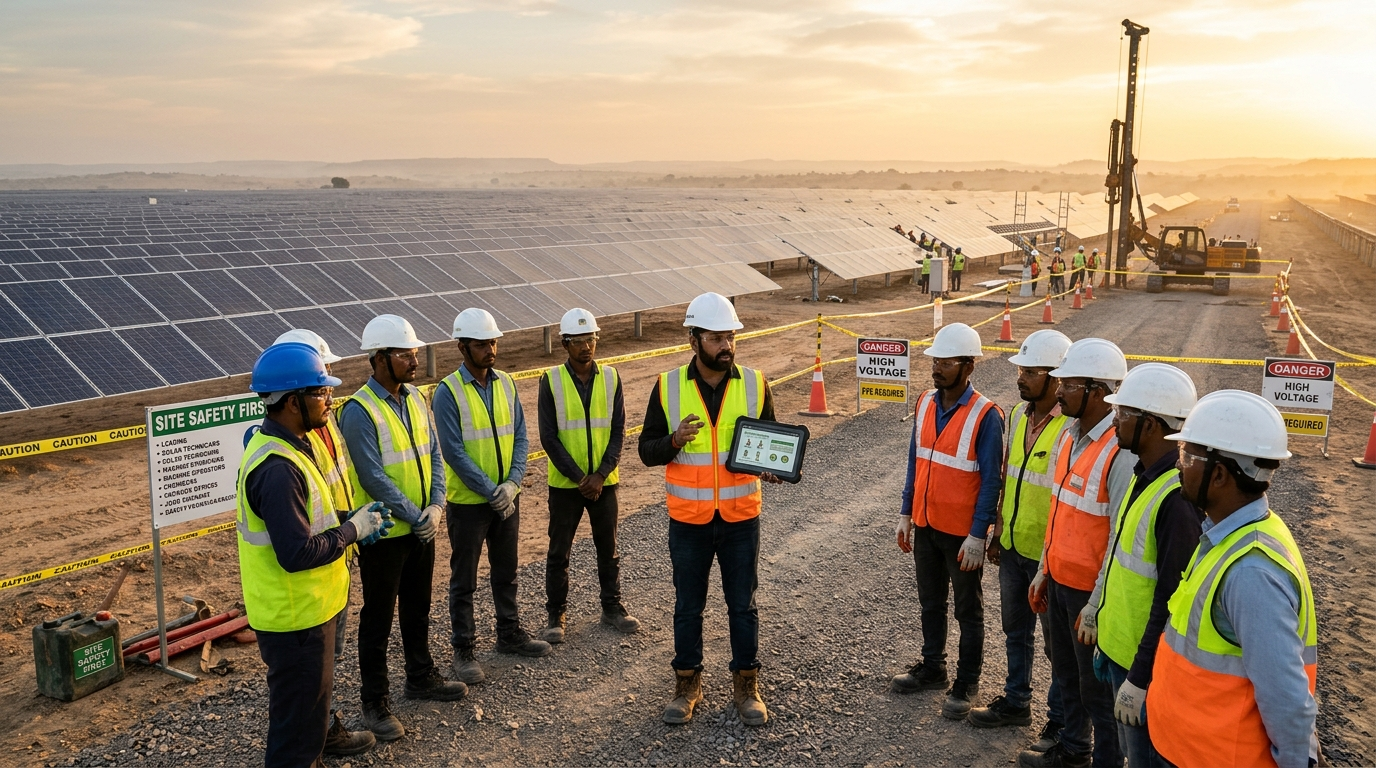
1 The High-Hazard Reality: Deconstructing Fatalities in Solar EPC
Within the renewable energy sector, solar photovoltaic construction is frequently misperceived as a benign, low-risk engineering discipline compared to offshore wind, oil and gas, or heavy petrochemical infrastructure. There are no high-pressure hydrocarbon pipelines, massive rotating turbine blades, or deep subterranean shafts. This perception is not only profoundly flawed; it is deadly.
A utility-scale solar power plant is an expansive, high-velocity open-air industrial construction zone spanning 500 to 5,000 acres. Under aggressive commissioning deadlines, hundreds of sub-contracted workers operate concurrently alongside high-speed hydraulic ramming rigs, heavy excavators, mobile cranes, and energized medium-voltage switchgear. In this environment, five lethal hazard clusters account for over 90% of severe injuries and fatalities across global and Indian solar construction sites:
Unlike AC power grids that can be centrally switched off at a substation breaker, solar PV modules generate instantaneous, un-switchable lethal DC voltage (up to 1,500V DC) whenever sunlight strikes the glass face. Touching exposed string terminations or un-mated MC4 connectors causes sustained electrical arcing and severe electrocution.
Torque tubes on single-axis solar trackers reach 2.2 to 2.8 meters above ground level at maximum morning/evening tilt. Workers improperly walking on round tubes or standing on makeshift drum platforms to secure module clamps suffer traumatic spinal and head injuries.
Continuous maneuvering of tracked hydraulic pile drivers, vibratory compactors, telehandlers, and flatbed transport trailers across dusty, uneven terrain creates severe blind spots, leading to ground worker crush and run-over fatalities.
Excavating dozens of kilometers of MV cable trenches (1.2 to 1.6 meters deep) in unstable, sandy, or moisture-weakened soils without proper benching or shoring boxes traps cable pulling crews in sudden asphyxiating collapses.
Transitioning an EPC organization from mere “safety compliance on paper” to an unyielding Zero-Harm Safety Culture requires embedding safety into engineering design, operational discipline, contract incentives, and daily leadership accountability.
2 Statutory HSE Framework: OSHA 1926, IS 45001 & CEA 2010
A bankable solar project must satisfy a multi-layered matrix of international occupational standards and national statutory mandates. Operating in legal ambiguity exposes EPC directors, project managers, and asset owners to direct criminal liability, astronomical statutory fines, and insurance policy invalidation following an incident.
The Core Solar Construction Safety Regulatory Triad
Provides the overarching procedural architecture: continuous hazard identification, risk assessment (HIRA), legal compliance evaluation, worker consultation, emergency preparedness plans, and corrective action tracking (CAPA) with Plan-Do-Check-Act (PDCA) governance.
Sets quantitative engineering thresholds enforced by global financial institutions (IFC, World Bank, ADB): Subpart M (Fall Protection ≥ 1.8 m / 6 ft), Subpart K (Electrical Safety & Grounding), Subpart P (Excavations ≥ 1.2 m), and Subpart CC (Cranes & Derricks in Construction).
Mandates statutory Indian standards: Regulation 35 (safe clearance distances for high voltage), Regulation 43 (safety provisions for electrical installations), mandatory Central/State Electrical Inspectorate (CEIG) approvals before energization, and IS 3521 full-body harness certifications.
Non-negotiable compliance with these standards must be codified within the EPC contract. Subcontractors who fail safety audits or violate life-saving rules are subjected to escalating contractual liquidated damages, work stoppage notices, and site expulsion.
3 The Hierarchy of Safety Controls in Solar Construction
A frequent failure in solar site management is relying almost entirely on Personal Protective Equipment (PPE) to protect workers. PPE is the lowest, least effective tier in the classic NIOSH Hierarchy of Controls. True zero-harm engineering designs hazards out of the project before site mobilization even begins:
Pre-assembling tracker torque tubes and drive mechanisms at ground-level workstations prior to crane hoisting, eliminating 70% of working-at-heights exposure. Specifying modular factory-skidded inverter-transformer stations that arrive pre-wired and factory-tested, eliminating weeks of open trench terminations.
Installing physical hard-mesh barricades around energized switchyards and inverters; deploying automated touch-safe finger-proof MC4-Evo2 connectors and IP2X touch-safe combiner boxes; constructing permanent perimeter handrails and catwalks on elevated power stations.
Enforcing rigorous Permit to Work (PTW) gates for Hot Work, Confined Space, Electrical Tie-In, and Excavation. Conducting mandatory morning 15-minute Toolbox Talks (TBT), dynamic Job Safety Analysis (JSA), and assigning dedicated safety marshals per 50 MWp construction block.
Full-body certified harnesses (IS 3521 / EN 361) with twin-tail shock-absorbing lanyards; NFPA 70E Category 2 to 4 Arc Flash suits (8 cal/cm² to 40 cal/cm² ATPV) for MV switchgear switching; Class 00 (500V) and Class 0 (1000V) dielectric gloves tested per ASTM D120; UV-protective tinted safety spectacles and high-ankle steel-toed boots with puncture-resistant soles.
4 1500V DC Arc Flash & Electrification: LOTO Protocols
The shift from legacy 1000V DC to 1500V DC system architecture in utility-scale solar has delivered substantial Balance of System (BOS) capital savings by allowing 30 to 36 modules per string. However, this voltage elevation dramatically alters site electrical hazard physics:
The Physics of 1500V DC Electrical Arcing vs. AC Grids
Alternating current (AC) cycles through zero volts 100 times per second (in 50 Hz systems), providing a natural window for an electric arc to quench. In direct current (DC), voltage is constant and continuous. An arc initiated at 1500V DC across un-mated connectors or crushed insulation ionizes ambient air into superheated conductive plasma exceeding 19,000°C. Once struck, a DC arc will not extinguish until conductors physically vaporize or string fuses blow.
To guarantee absolute electrical safety during string aggregation, inverter DC busbar tie-ins, and substation testing, EPCs must enforce the Golden Rules of Electrical Isolation:
Open all circuit breakers, isolators, and DC load-break disconnect switches upstream and downstream. Secure switches in the open position with dedicated safety padlocks and tagged lockout hasps.
Every authorized technician working on the isolated circuit attaches their individual personal padlock to the lock box. One technician, one lock, one key. Master keys on energized sites are strictly prohibited.
Verify zero energy state using an appropriately rated 1500V DC contact multimeter tested against a known live source before and after the test. Discharge DC bus capacitors and apply temporary portable earth grounds.
5 Working at Heights: Tracker Torque Tubes & Module Erection
Falls from elevation remain the leading cause of construction fatalities globally. On utility ground-mount solar plants, the primary fall hazard occurs during single-axis tracker torque tube assembly, bearing housing installation, and PV module mounting.
Modern single-axis trackers employ large diameter round or octagonal torque tubes (130 mm to 170 mm outer diameter) elevated 1.8 to 2.8 meters above ground level to allow module rotational clearance. Unskilled workers frequently attempt to walk or crawl along these slick, curved metal tubes to tighten mid/end clamps or route module interconnect cables. A momentary loss of balance results in catastrophic head strikes against driven steel H-piles below.
Mandatory Fall Protection Protocols on Single-Axis Trackers
-
✓
Strict Prohibition on Torque Tube Walking: Walking on torque tubes, purlins, or module glass surfaces is classified as a Critical Life-Saving Rule Violation, resulting in immediate removal from site.
-
✓
Mobile Podium & Scaffolding Platforms: Providing crews with wide-base, counterbalanced aluminum mobile work platforms with built-in guardrails and locking castor wheels, allowing ergonomic access to module clamps without climbing structures.
-
✓
Engineered Lifelines for Inverter Platforms: Prefabricated inverter skids and elevated central control rooms elevated above flood levels must feature permanent perimeter handrails (1050 mm top rail, 500 mm intermediate rail, 150 mm toeboard) before equipment mounting commences.
-
✓
100% Tie-Off Rule ≥ 1.8 Meters: Where permanent platforms cannot be deployed, workers must wear full-body harnesses (EN 361 / IS 3521) with twin-tail shock-absorbing lanyards anchored to certified structural points rated to 22.2 kN (5,000 lbs).
6 Heavy Civil Machinery & Hydraulic Piling Exclusion Zones
A 100 MWp utility solar plant requires driving approximately 35,000 to 50,000 steel H-piles into the ground. To maintain schedule velocity, EPCs deploy fleets of 10 to 20 continuous-track hydraulic ramming rigs (such as Vermeer, Gayk, or Pauselli). These high-energy machines operate with hydraulic hammer impact energies exceeding 1,000 Joules at 800 to 1,200 blows per minute.
The human-machine interface around active piling machinery is among the highest fatality risk zones on site. Ground helpers positioning piles by hand risk severe amputation or crush injuries if the hammer strikes prematurely or if hydraulic lines rupture under 200+ bar pressure.
A non-negotiable 10-meter radius around every active piling rig is demarcated with high-visibility warning cones. No personnel may enter this boundary while the mast is raised or the hydraulic engine is running.
Hand-holding piles during initial hammer positioning is strictly prohibited. Piles are aligned using hydraulic mast clamping jigs or rigid guiding tongs, eliminating worker hands from pinch-point zones.
Rig operators must complete and sign a daily digital checklist verifying hydraulic hose integrity, whip-checks on high-pressure lines, emergency stop push-buttons, rollover protective structures (ROPS), and reverse alarms.
Before a single pile is driven, the civil surveying team must cross-reference geotechnical bore logs and conduct Ground Penetrating Radar (GPR) sweeps to ensure zero clash with buried electrical lines, gas pipelines, or water conduits.
7 Deep Trenching & Excavation Safety: Shoring & Cave-In Prevention
Cabling infrastructure on a large solar park requires excavating tens of kilometers of trenches: shallow DC string trenches (0.8 m to 1.0 m) and deep 33 kV Medium Voltage (MV) AC transmission corridors (1.2 m to 1.6 m depth).
Excavation collapses happen without warning. One cubic yard of soil weighs approximately 1,200 to 1,500 kg (over 1.3 tons)—roughly the weight of a passenger automobile. A worker caught in a trench collapse suffers suffocation and crushing asphyxiation within minutes, even if their head remains above soil level.
Excavation Safety Rules (OSHA 1926 Subpart P & IS 3764)
Any trench exceeding 1.2 meters depth in unstable or cohesive soil must be sloped at a minimum 1:1 ratio (45°) or stepped back with 0.5-meter safety benches on both sides.
Where narrow corridor constraints prevent sloping, pre-engineered aluminum hydraulic trench boxes or timber shoring must be installed before workers enter to lay sand beddings.
Secured industrial ladders must be positioned inside trenches every 7.5 meters (25 ft), extending at least 1.0 meter above the trench shoulder for rapid emergency evacuation.
Excavated spoil dirt, heavy cable drums, and vehicles must be kept at least 1.0 meter back from trench edges to prevent surcharge weight from triggering side-wall shearing.
8 Extreme Heat Stress & Occupational Wellness (WBGT Protocols)
The most productive solar irradiance zones in India and globally—such as Rajasthan (Bhadla, Bikaner), Gujarat (Khavda), and Maharashtra—are situated in harsh desert and semi-arid climates. During peak construction seasons, ambient shade temperatures frequently exceed 45°C (113°F), while solar module glass and galvanized steel racking heat up to 65°C to 75°C.
Under these extreme conditions, standard ambient air thermometers fail to capture the true physiological stress imposed on the human body. High-velocity EPCs mandate monitoring via the Wet Bulb Globe Temperature (WBGT) Index:
WBGT = 0.7 × Tnw (Natural Wet Bulb) + 0.2 × Tg (Black Globe Radiant) + 0.1 × Td (Dry Bulb)
| WBGT Reading | Thermal Stress Category | Mandatory Work-Rest Regimen | Hydration Standard |
|---|---|---|---|
| < 28.0°C | Normal / Low | Continuous normal work; standard 15-min mid-shift breaks | 0.5 L water per hour |
| 28.0°C – 29.9°C | Moderate Alert | 45 minutes continuous work / 15 minutes rest in shade | 0.75 L electrolyte solution / hr |
| 30.0°C – 31.4°C | High Risk | 30 minutes work / 30 minutes rest; buddy monitoring | 1.0 L electrolyte solution / hr |
| ≥ 32.2°C | Extreme Danger | Cease all strenuous outdoor labor; shift to indoor/shaded pre-fab | Mandatory medical triage check |
On zero-harm sites, mobile air-conditioned or misted shade containers are stationed within 150 meters of active work fronts. Ice-cooled electrolytic hydration points (Oral Rehydration Salts - ORS) are replenished every two hours, and shifts are split into early morning (05:30 to 11:30) and late afternoon (15:30 to 19:00) blocks during summer peak months.
9 Technical Infographic: Zero-Harm Safety Framework
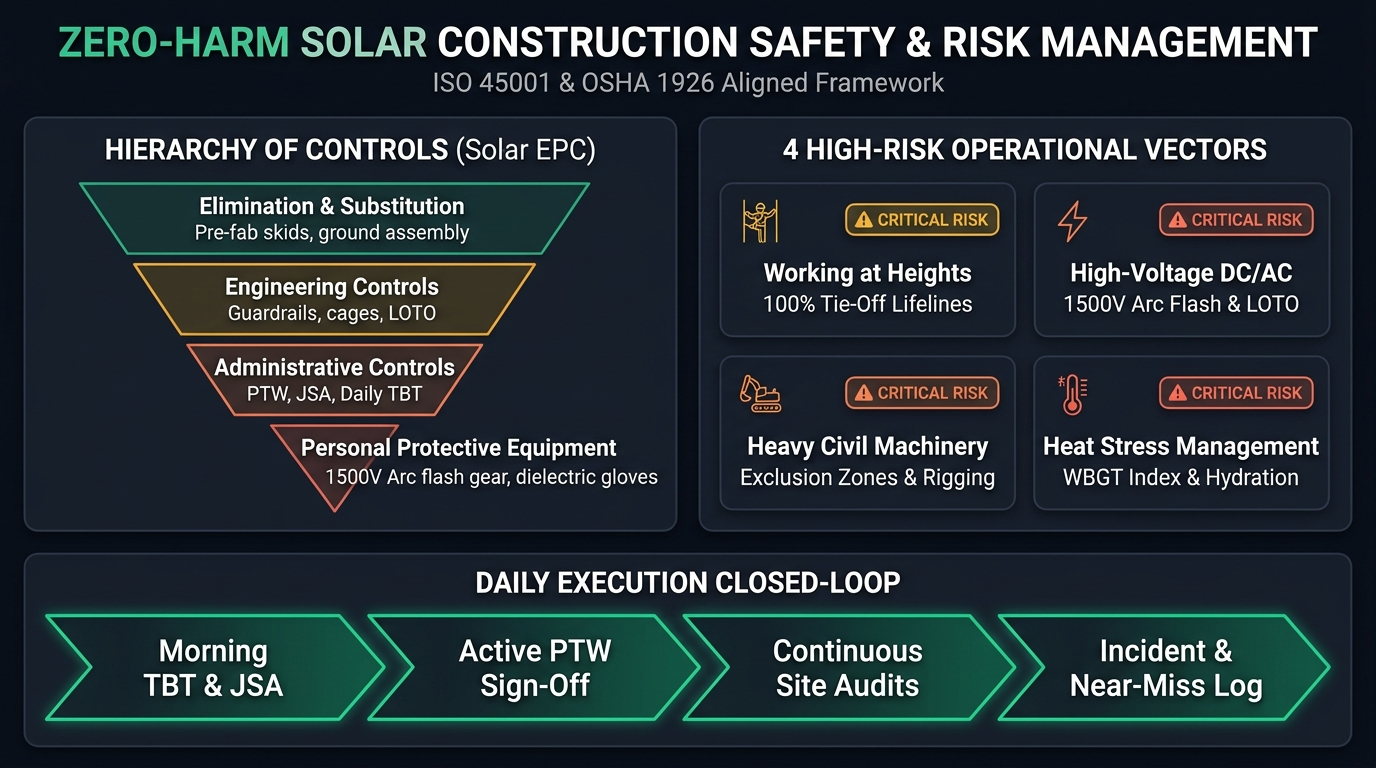
The architectural blueprint below illustrates the four synchronized operational safety pillars and daily closed-loop governance cycle deployed by tier-1 solar EPC project heads to achieve zero lost-time injuries across multi-hundred-megawatt installations:
10 Administrative Rigor: Digital JSA/HIRA & Toolbox Talks
A culture of safety cannot survive on slogans; it requires rigid administrative habits executed daily. Paper-based safety forms filled out in air-conditioned site trailers at the end of the week provide zero protective value to workers on the ground.
Modern solar EPCs digitize their safety workflows through three daily operational rituals:
Every work gang conducts a mandatory 15-minute Toolbox Talk (TBT) before touching equipment. Conducted in native languages (Hindi, Marathi, Gujarati, Telugu), the TBT reviews the exact tasks of the day, identifies specific zone hazards, and verifies PPE fit.
Job Safety Analysis is conducted at the workface using ruggedized mobile tablets. Supervisors photo-document safety controls (e.g., trench shoring, LOTO locks) before the digital Permit-to-Work (PTW) is electronically signed off by the HSE Manager.
Every worker on site—from the most junior helper to the chief surveyor—is granted unconditional Stop Work Authority without fear of retribution if they observe an unsafe condition. Rewarding proactive hazard reporting builds true site trust.
11 Technical Comparison: Reactive Compliance vs. Zero-Harm Culture
The matrix below compares key operational practices between conventional reactive solar EPC contractors and the proactive zero-harm safety engineering enforced by V-Tech Renewables:
| Operational HSE Domain | Conventional Reactive Solar EPC | Proactive Zero-Harm Protocol (V-Tech Standard) |
|---|---|---|
| Electrical Isolation & LOTO | Informal breaker switches; paper tags; no individual padlocks | Strict personal LOTO hasps; proven dead with 1500V DC rated testers; earth grounds applied |
| Fall Protection on Trackers | Workers walk on bare torque tubes; makeshift drum stands | Mobile aluminum podium platforms; strict zero-walking on tubes; 100% tied-off harnesses |
| Hydraulic Pile Driving | Helpers hand-align piles under moving hammers; no demarcated zones | Mandatory 10-meter exclusion radius; mechanical guide tongs; GPR underground utility sweep |
| Cable Trench Excavation | Vertical unshored trench cuts; spoil dirt piled right on trench lip | 1:1 sloping or modular aluminum shoring; spoil 1.0 m set back; egress ladders every 7.5 m |
| Heat Stress Management | Warm tap water drums; no wet bulb monitoring; work continues in 46°C | Calibrated WBGT indexing; chilled electrolyte stations; AC shade shelters within 150 m |
| Toolbox Talks & JSA | Generic weekly paper sign-offs; language barrier ignored | Daily 15-min vernacular TBTs; dynamic mobile photo-verified JSA before permit issuance |
| Incident & Near-Miss Reporting | Near-misses hidden to avoid penalties; blame culture | Gamified near-miss reporting rewards; Root Cause Analysis (RCA); mandatory lessons learned |
| HSE Staffing Ratio | 1 safety officer per 100 MWp; overwhelmed and purely administrative | 1 certified HSE officer per 25 MWp + dedicated marshals per high-risk gang |
| Lost Time Injury Rate (LTIR) | 0.85 – 1.50 per 200,000 man-hours | 0.00 Achieved (Zero Lost Time Incidents) |
12 Real-World Case Study: 300 MWp Ground-Mount Solar in Rajasthan
To appreciate the real-world operational and commercial return of an institutionalized Zero-Harm Safety Culture, consider a landmark 2026 utility-scale project delivered in the high-irradiance Thar Desert corridor:
- 1,400 acres of undulating sand dunes with peak summer temperatures reaching 48.5°C.
- Severe dust storms (Andhi) causing sudden zero-visibility conditions and 70 km/h wind gusts.
- Peak workforce of 1,250 multi-regional laborers speaking four different vernacular dialects.
- Installation of 115,000 ram-driven steel piles and 540,000 bifacial TOPCon solar modules.
- Daily calibrated WBGT monitoring with automated siren alerts for mandatory heat-rest cycles.
- Fleet of 18 mobile air-conditioned cooling pods stationed across active tracker zones.
- 100% mechanical pile-clamping tongs and 10-meter laser-demarcated piling exclusion barriers.
- Color-coded digital LOTO padlock management across 28 prefabricated modular inverter stations.
13 16-Point Solar Construction Site HSE Audit Checklist
Solar EPC directors, construction heads, and HSE safety managers should audit active site operations against this 16-point gate verification protocol:
14 Frequently Asked Questions (FAQ)
Why are 1500V DC solar circuits significantly more dangerous to site personnel than standard AC distribution voltages?
Unlike standard 50 Hz or 60 Hz Alternating Current (AC) which naturally crosses a zero-voltage point 100 to 120 times every second allowing electrical arcs to extinguish, Direct Current (DC) maintains continuous voltage pressure. When a 1500V DC string disconnects under load or experiences an insulation breach, the resulting electric arc does not extinguish naturally; it ionizes air into an intense, persistent plasma reaching temperatures exceeding 19,000°C. Furthermore, DC current triggers involuntary sustained muscle tetanus, preventing a victim from releasing an energized conductor. Solar EPCs must enforce strict Lockout/Tagout (LOTO), use DC-rated disconnect switches with arc-chutes, and mandate 1000V/1500V Class 00/0 dielectric gloves with leather protectors.
What are the core fall protection mandates for single-axis tracker structural assembly and module mounting?
During structural assembly and module mounting on single-axis trackers, torque tube elevations frequently exceed 1.8 to 2.4 meters above grade at maximum tilt angles. Under OSHA 1926.502 and IS 3521, any work performed above 1.8 meters mandates active fall protection. Leading EPCs eliminate walking on elevated torque tubes by utilizing mobile adjustable aluminum podium platforms or scissor lifts on compacted haul roads. Where lifelines are necessary, crews use continuous horizontal static lifelines anchored to certified structural points rated to 22.2 kN (5,000 lbs) with dual-lanyard shock absorbers providing 100% continuous tie-off.
How should utility-scale solar sites manage the human-machine interface around hydraulic pile-driving machinery?
Hydraulic pile-driving rigs (operating with high-frequency percussion hammers) present extreme strike, pinch, and rollover hazards. Zero-harm sites implement a mandatory 360-degree, 10-meter Exclusion Zone demarcated by physical high-visibility cones and barrier tapes around every active piling machine. No ground surveyor or helper may enter this zone until the machine operator lowers the mast to ground level, turns off hydraulic pressure, and gives explicit eye-contact verbal or two-way radio clearance. Rigs must undergo mandatory daily pre-shift hydraulic line, emergency stop, and rollover protective structure (ROPS) inspections.
What precautions prevent catastrophic cave-ins during medium-voltage (MV) AC cable trenching?
Medium-voltage (33 kV) cable trenches in utility solar parks are typically excavated to depths of 1.2 to 1.5 meters through varying soil strata, often including loose sandy loam or black cotton soil prone to sudden shear collapse. Under OSHA 1926 Subpart P and IS 3764, trenches deeper than 1.2 meters require engineered benching, 1:1 slope tapering, or modular aluminum trench shoring boxes. Ingress and egress ladders must be installed every 7.5 meters (25 feet), and excavated spoil piles must be kept at least 1.0 meter back from trench edges to avoid surcharge loading.
How does the Wet Bulb Globe Temperature (WBGT) index dictate heat stress management on remote desert solar parks?
In arid solar regions like Rajasthan, Gujarat, and Maharashtra where ambient summer temperatures exceed 45°C with intense solar radiation, ambient thermometers underestimate heat stroke risk. Sites deploy calibrated Wet Bulb Globe Temperature (WBGT) monitors that account for dry air temperature, radiant solar heat, relative humidity, and air velocity. When WBGT reaches 28.0°C–29.9°C, a 45-minute work / 15-minute rest cycle is triggered; between 30.0°C–31.4°C, work drops to 30 min / 30 min; and at WBGT ≥ 32.2°C, all non-emergency strenuous outdoor work halts. Sites mandate cooled shade shelters within 150 meters, chilled electrolytic hydration solutions (ORS), and mandatory buddy wellness monitoring.
Need Rigorous HSE Leadership & Owner’s Engineering for Your Solar Portfolio?
From pre-construction geotechnical clash audits and 1500V DC LOTO engineering to on-site third-party safety supervision, high-voltage pre-commissioning verification, and ISO 45001 governance, V-Tech Renewables empowers utility-scale and C&I developers to safeguard personnel and eliminate execution downtime.
Related Technical Articles in This Series
Accelerating Commercial Rooftop Solar Installation Timelines
Pre-mobilization 3D LiDAR surveys, non-penetrating clamping, and fast-track DISCOM commissioning.
Construction & PrefabricationHow Modular Skid Solutions Speed Up Utility-Scale Construction
Factory-integrated power stations, civil strip footings, and 70% site labor reduction.
Electrical Safety & GroundingEarthing and Lightning Protection Layouts for Solar Farms
Touch/step potential modeling, IEEE 80 compliance, and soil resistivity testing.