Accelerating Commercial Rooftop Solar Installation Timelines: The EPC Project Head's Field Playbook
An authoritative, boots-on-the-ground engineering and site execution masterclass for commercial and industrial (C&I) solar EPC project heads, construction managers, and Owner’s Engineers: transforming chaotic rooftop retrofits into precision fast-track operations through 3D LiDAR surveys, non-penetrating clamping mechanics, crane hoisting staging, lean DC string electrification, zero-downtime industrial safety, and parallel DISCOM statutory approvals.
1 The Execution Bottleneck: Why Rooftop Projects Slip by 40%
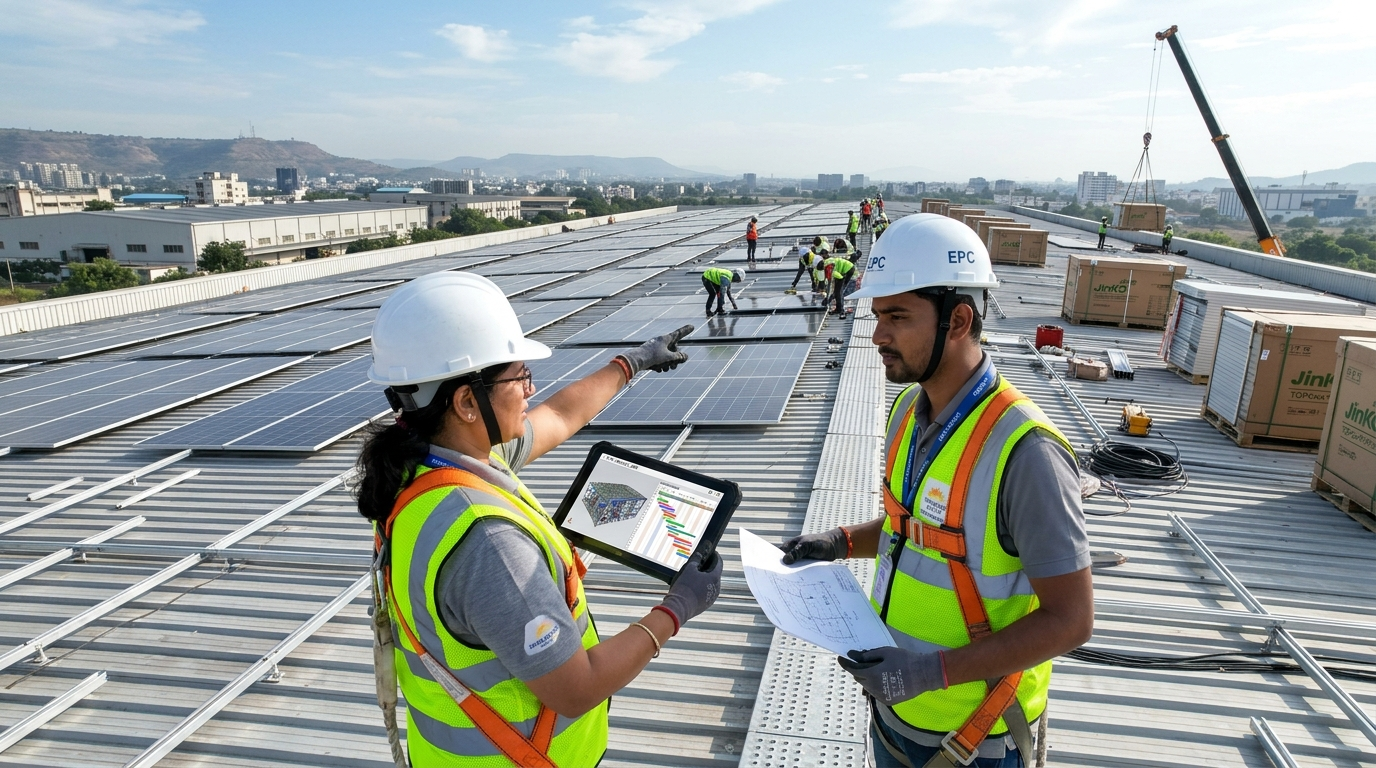
Commercial and Industrial (C&I) rooftop solar installations represent one of the most operationally complex frontiers in renewable engineering. Unlike utility-scale ground-mount projects where contractors command unobstructed acreage and dedicated laydown corridors, commercial rooftop engineering takes place directly atop live, operational industrial facilities. Every drilling vibration, crane swing, crane outrigger placement, and electrical busbar tap has the potential to trigger catastrophic manufacturing halts, cleanroom contamination, or industrial safety violations.
Historically, over 65% of C&I rooftop projects exceed their initial scheduled Commercial Operation Date (COD) by 30% to 50%. A systematic root-cause autopsy across 150+ multi-megawatt rooftop installations reveals that schedule slippage does not stem from slow panel mounting; rather, it originates from five fundamental execution friction points:
Purlin spacings differing by 150–300 mm from architectural blue-prints, undisclosed roof sag, localized corrosion under insulation, and undocumented fiberglass skylights discovered only after modules are hoisted to the roof deck.
Mobile crane access restricted to weekend hours due to factory logistics yards, causing crane demobilization fees, idle installation labor, and roof structural overload hazards from haphazard module pallet clustering.
Disputes with building owners and roofing sheet OEMs (e.g., Kirby, Tata BlueScope) over screw punctures, water leakage liability, and voided roof warranties halting structural attachment for weeks.
Treating statutory approvals as a sequential step initiated only after full mechanical completion, subjecting completed assets to 45–90 days of idle depreciation while awaiting utility meter synchronization.
Accelerating commercial rooftop timelines from the conventional 75–90 days per megawatt down to an agile 35–45 calendar days requires abandoning ad-hoc site management in favor of a lean, militaristic execution playbook built upon pre-mobilization precision, non-penetrating mechanical speed, and parallel-path electrical engineering.
2 Pre-Mobilization: 3D LiDAR & Automated Clash Detection
The single most effective lever for compressing construction schedules happens before the first pallet arrives on site: digitizing the host facility’s roof down to millimetric tolerances. Traditional site surveys rely on technicians traversing hazardous roofs with tape measures and clinometers, inevitably missing critical structural obstructions like HVAC condensation piping, high-voltage cable trays, roof vents, expansion joints, and skylight brittle zones.
The 48-Hour Digital Pre-Mobilization Protocol
Autonomous photogrammetry flight producing a geo-referenced digital twin with ±5 mm spatial resolution, capturing true roof slope, azimuth variations, and gutter elevations.
Importing point clouds into Revit/Civil 3D to identify clashes against skylights, exhaust vents, and parapet shadow zones across full 365-day solar elevation paths.
Modeling primary rafters, secondary Z/C purlins, and sag rods under IS 875 (Part 3: 2015) wind pressure combinations to establish maximum allowable dead loads per bay.
By finalizing structural drawings and module string layouts against a digital twin, EPCs eliminate the notorious “field re-engineering cycle”—where mounting crews halt work halfway across a roof bay because a string row collides with an undocumented smoke extraction cowl. Fabrication shops receive precise bill-of-material cut lists for mounting rails and cable containment trays with zero field cutting required.
3 Non-Penetrating Clamping vs. Ballasted Wind Aerodynamics
Mechanical mounting represents 30% to 40% of physical rooftop installation labor. The choice of structural interface determines not only installation velocity, but also long-term asset bankability and roof weather-tightness. Commercial roofs fall into three primary architectural categories, each demanding specialized fast-track anchoring engineering:
Standing Seam Metal Roofs (Klil-Lok, Butler, Kalzip)
Fastest: 180 kWp/day crew velocityDeploying non-penetrating aluminum seam clamps (e.g., S-5! or PV-EZRack clamps) that grip the standing seam ridge via round-point set screws torqued to 15–18 N·m. Because no sheet perforations occur, the building owner’s 20-year watertightness warranty remains 100% intact. Modules attach directly to clamps via integrated grounding mid/end clamps or ultra-short aluminum mini-rails, reducing dead weight to just 9.5–11.0 kg/m².
Trapezoidal / Corrugated Metal Roofs
Rapid: 130 kWp/day crew velocityTransitioning away from heavy continuous steel purlins running spanning structural bays. Instead, high-velocity EPCs install short aluminum mini-rails (150 mm to 380 mm length) fastened directly to the crown of the trapezoidal rib using bi-metal stainless steel self-drilling screws with factory-vulcanized EPDM sealing gaskets. This slashes structural steel procurement costs by 65%, reduces dead load by 12 kg/m², and eliminates thermal expansion stresses that cause screw-hole enlargement over time.
Flat Reinforced Concrete (RCC) Roofs
Aerodynamic Ballasted: 100 kWp/day crew velocityPouring cast-in-place concrete footings on RCC roofs requires 28 days of curing time and punctures waterproofing membranes during chemical anchoring. Accelerated execution utilizes wind-tunnel-optimized ballasted mounting systems equipped with front and rear aerodynamic wind deflectors. Aerodynamic downward wind suction reduces required ballast concrete by up to 50%, while pre-cast modular ballast blocks are set on protective EPDM rubber pads without a single roof anchor puncture.
4 Precision Crane Rigging & Roof Load Staging Protocols
The vertical crane hoisting operation is the most hazardous and logistically constrained bottleneck in C&I solar construction. Active factories will rarely permit mobile cranes to block loading docks, dispatch bays, or tanker transit lanes during weekday production shifts. EPC project managers must execute vertical material lifting during compressed weekend 12-hour hoisting windows.
Hoisting 5,000+ solar panels, 40 tons of aluminum rails, and miles of cable trays in a single weekend requires rigorous structural rigging engineering to avoid exceeding the host building’s roof point-load thresholds.
The Rooftop Structural Load Distribution Golden Rule
A typical pallet of 36 Tier-1 TOPCon modules weighs approximately 1,100 kg with dimensions of 2.3 m × 1.15 m, imposing a concentrated static load of 415 kg/m². Placing this pallet mid-span on a 0.5 mm trapezoidal roof sheet designed for a 75 kg/m² live load will cause catastrophic sheet dishing, purlin buckle, or roof collapse.
Accelerated operations implement Just-in-Time (JIT) Kitting. Pallets are unboxed at the ground laydown staging yard, where mid-clamps, end-clamps, grounding clips, and torque-calibrated battery tools are pre-sorted into color-coded utility bags per roof bay. When the crane hoists modules to Bay 3, the exact complement of mounting hardware arrives simultaneously, eliminating worker downtime spent walking back and forth across 200-meter roof spans.
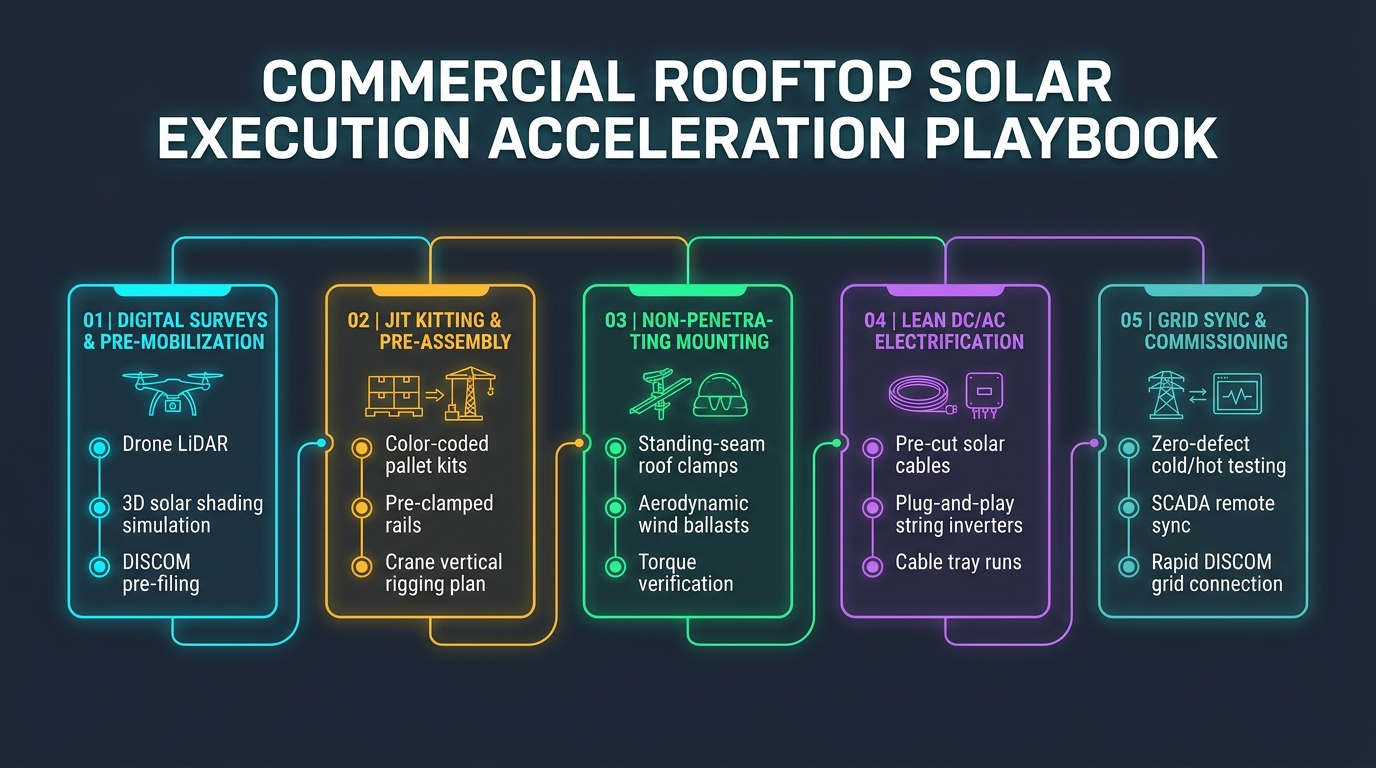
5 Technical Infographic: Execution Acceleration Framework
The schematic below outlines the 5 synchronized execution streams deployed by top-tier solar EPC project heads to collapse commercial rooftop execution from 75 days to under 45 days while upholding zero-harm HSE standards and first-pass CEIG electrical approvals.
6 Decentralized Inverter Layouts & Pre-Terminated DC Trunks
DC cabling across expansive industrial rooftops is fraught with safety and cost risks. Running high-voltage DC circuits (up to 1,100V DC) over hundreds of meters through hot roof cable trays introduces excessive $I^2R$ power dissipation, increases fire exposure under thermal expansion, and consumes massive labor in manual field crimping.
The modern fast-track standard employs decentralized string inverters (100 kW to 125 kW) mounted directly on rooftop parapets or elevated walkway canopies. This architecture delivers three profound schedule and performance advantages:
DC strings travel an average of only 15–20 meters to the nearest roof-mounted inverter, slashing DC copper cable procurement, eliminating voltage drop, and containing high-voltage DC hazards to localized roof zones.
Utilizing factory-manufactured, ultrasonic-welded DC branch harnesses with pre-installed MC4-Evo2 connectors. Field workers simply plug-and-click strings into inverters, eliminating 80% of manual field crimping defects.
Inverter 415V AC outputs terminate into roof-level AC Combiner Boxes with motorized MCCBs. A single armored 3.5C × 300 mm² XLPE aluminum cable or sandwich busduct drops down the riser shaft to the plant LT room.
All DC and AC cables must be laid in pre-galvanized (Class 3 or minimum 275 g/m² zinc coating) perforated steel cable trays equipped with snap-on ventilated covers. Routing cables through unshielded plastic PVC pipes on industrial roofs causes rapid UV embrittlement and thermal derating, violating CEA Electrical Safety Regulations 2010 (Section 35) and creating severe short-circuit arc fire liabilities.
7 Zero-Downtime Industrial HSE: LOTO & Rooftop Lifelines
A single serious safety incident on an industrial rooftop immediately halts the entire project, triggers statutory police and factory inspector inquiries, and destroys the EPC’s reputation with corporate clients. In C&I solar construction, the leading cause of catastrophic injuries is falls through fragile roof elements—specifically brittle polycarbonate and fiberglass skylights.
Zero-Harm Rooftop Safety Architecture (OSHA 1926.502 & IS 3521)
-
✓
100% Skylight Protection: Before laying a single rail, all roof skylights within 3 meters of work areas are covered with structural steel wire mesh cages capable of arresting a 150 kg impact load.
-
✓
Continuous Horizontal Lifeline Systems: 8 mm stainless steel (SS316) static lifelines anchored to structural rafters allow workers full unclipped mobility along the roof ridge with shock-absorbing lanyards.
-
✓
Edge Guardrails & Toe Boards: Free-standing counterweighted perimeter guardrails installed along non-parapet roof edges, eliminating the risk of tools or personnel falling into factory truck bays.
-
✓
Lockout/Tagout (LOTO) Tie-In Protocols: Electrical interconnection into the client's Main LT switchgear is conducted under strict Permit-to-Work (PTW) protocols during pre-scheduled 4-hour factory maintenance shutdowns, with verified zero voltage, padlocked breaker isolations, and discharged capacitance.
8 Lean Work Packaging & Real-Time BIM Velocity Tracking
Conventional rooftop contractors manage sites with vague Gantt charts pinned to site office walls, discovering schedule slippages only when weekly targets are missed. High-speed solar EPCs adopt Daily Work Packaging (DWP) derived from lean manufacturing principles:
The rooftop is divided into 250 kWp micro-zones. Specialized sub-teams (Structure, Module, Cable, Quality) move sequentially across zones in an unbroken tactical wave.
Site supervisors log completed clamps, modules, and cable terminations daily via mobile BIM apps, generating real-time velocity curves against planned burn-down schedules.
Before any string is connected, quality inspectors verify clamp torque with calibrated digital torque wrenches and apply tamper-evident torque lacquer marks on bolt heads.
When a micro-zone experiences an impediment (e.g., unexpected roof sheet rust requiring patch plating), only that specific 250 kWp zone pauses while the remaining three installation waves continue uninterrupted across adjacent bays.
9 Technical Comparison: Conventional vs. Accelerated Lean EPC
The matrix below compares key technical, operational, and commercial metrics between conventional ad-hoc C&I rooftop execution and the accelerated lean methodology practiced by V-Tech Renewables:
| Execution Parameter | Conventional Ad-Hoc Rooftop EPC | Accelerated Lean Methodology (V-Tech) |
|---|---|---|
| Site Survey & Layout | Manual tape measurements; 2D CAD with missing roof clash data | RTK Drone LiDAR + 3D BIM clash detection (±5 mm tolerance) |
| Mounting Structure System | Heavy continuous steel purlins (18–25 kg/m²); frequent roof penetrations | Aluminum mini-rails / non-penetrating clamps (10–12 kg/m² total) |
| Roof Warranty Protection | Self-tapping screws breach sheet warranties; high water leak risk | Round-point seam clamps preserve 100% of 20-year OEM roof warranty |
| Vertical Crane Rigging | Ad-hoc weekday hoisting blocking plant logistics; random pallet clustering | Weekend JIT hoisting; pallets engineered directly over column nodes |
| Inverter Architecture | Ground-level central/large string inverters; long DC cable runs | Rooftop decentralized string inverters (100–125 kW) + roof ACCB |
| DC Cable Installation | Field-crimped MC4 connectors; high defect rates and hot-spot risks | Factory pre-cut & ultrasonic-crimped branch harnesses with MC4-Evo2 |
| Fall Protection & HSE | Uncovered skylights, temporary rope lifelines; high liability | 100% steel skylight cages, SS316 engineered lifelines, LOTO PTW |
| Testing & Pre-Commissioning | Sequential post-construction testing; ad-hoc multimeters | Parallel micro-zone testing: automated Megger, IV-curve tracer, EL |
| Statutory CEIG / DISCOM Filing | Filed after physical plant completion; 45–60 day idle wait | Filed on Day 1 of mobilization; inspection readiness upon COD |
| 1 MWp Project Cycle Time | 75 – 90 Calendar Days | 35 – 45 Calendar Days (↓ 45% compression) |
10 Real-World Case Study: 2.4 MWp Auto Plant in Chakan, Pune
To understand the practical power of accelerated rooftop execution, examine a high-stakes 2026 deployment across an automotive component manufacturing complex in Chakan, Pune:
- Three interconnected Pre-Engineered Building (PEB) industrial sheds totaling 28,000 m² roof area.
- Active robotics welding line and Class-A automotive paint booth operating 24/7 beneath the roof deck.
- Zero allowable particulate contamination or roof leak breach.
- Host roof combined standing seam (Shed A) with aging trapezoidal galvalume (Sheds B & C).
- Drone LiDAR revealed 41 undocumented skylights and a 3% roof deflection over Shed B purlins.
- Shed A: S-5! seam clamps; Sheds B & C: EPDM-gasketed aluminum mini-rails.
- All 4,140 TOPCon bifacial modules hoisted during two consecutive 12-hour weekend crane slots.
- 20 × 110 kW string inverters mounted on roof walkways connected to 3 × 800 kVA ACCB panels.
11 16-Point Fast-Track Rooftop Installation & Pre-Commissioning Checklist
Solar EPC project heads and site managers should audit their commercial rooftop project against this 16-point gate verification protocol:
12 Frequently Asked Questions (FAQ)
How can commercial solar EPCs verify roof load-bearing capacity without stalling construction schedules?
Rather than waiting for manual civil engineering reviews on mobilized sites, high-velocity EPCs perform structural load assessments during pre-mobilization. By combining aerial RTK drone photogrammetry with as-built structural drawings, engineers model purlins, rafters, and trusses in STAAD.Pro against IS 875 (Part 3: 2015) wind load standards. For sheet roofs, adopting lightweight aluminum mini-rail systems (adding only 10–12 kg/m² including modules) avoids structural purlin reinforcements required by conventional heavy steel purlin structures (18–25 kg/m²), bypassing weeks of reinforcement delays.
What are the advantages of non-penetrating roof clamps over traditional screw fastening?
Non-penetrating standing-seam clamps preserve the client's original building envelope warranty (often 15 to 25 years from manufacturers like Tata BlueScope or Kirby) by clamping securely onto standing seams with torque-calibrated round-point set screws without piercing the metal sheet. This eliminates thermal expansion water leakage risks, reduces waterproofing liability, and accelerates mounting installation speed by 45% compared to drilling self-tapping screws through purlins with secondary sealing washers.
How do EPC site heads prevent factory production disruptions during rooftop crane hoisting?
Site managers schedule vertical material hoisting during pre-planned industrial factory maintenance windows or non-production weekends. A dedicated crane rigging plan identifies designated structural column bays on the roof where pallets are distributed immediately above primary portal frames rather than mid-span sheet sections. Color-coded, pre-kitted material packages (rails, fasteners, mid/end clamps, and pre-cut cable harnesses) are hoisted in synchronized batches, eliminating roof clutter and ensuring zero interruption to the factory floor below.
Why is decentralized string inverter placement superior to central inverters for fast-track C&I rooftops?
Decentralized string inverters (typically 100 kW to 125 kW units) mounted on rooftop walkway stanchions or weather-canopied parapet walls drastically shorten DC cable runs. High-voltage DC cables (up to 1100V/1500V DC) are terminated within 15 to 25 meters of the PV array, reducing costly DC copper cabling by up to 60%, minimizing conduit congestion, and simplifying fire safety zoning. Power is aggregated at roof-level AC combiner boxes (ACCB), allowing a single medium-voltage AC aluminum armored cable or busduct riser to descend to the main electrical room, cutting electrical installation cycle times by over 30%.
What steps fast-track DISCOM net-metering and CEIG electrical inspection approvals?
Fast-tracking utility synchronizations requires parallel-path documentation rather than sequential post-construction filing. EPCs submit the Single Line Diagram (SLD), protection coordination study, equipment BIS/IEC test certificates, and earthing layout to the DISCOM and Chief Electrical Inspectorate (CEIG) on Day 1 of civil mobilization. Conducting pre-inspection third-party audits—including Megger insulation resistance, earth pit resistance (< 1 Ohm), and secondary injection relay testing—ensures first-attempt sign-off without compliance observation notices.
Need Engineering Leadership for Your High-Speed Rooftop Solar Portfolio?
From pre-mobilization 3D drone photogrammetry and STAAD structural purlin reviews to non-penetrating clamping engineering and turnkey CEIG statutory filings, V-Tech Renewables empowers EPCs and commercial asset owners to compress project timelines by 40% while eliminating structural and waterproofing risks.
Related Technical Articles in This Series
Effective Negotiation Tactics for Solar EPC Purchase Personnel
Volume discount tiering, dynamic raw material indexation formulas, and milestone risk gates.
Project Execution & ConstructionHow Modular Skid Solutions Speed Up Utility-Scale Construction
Factory-integrated power stations, civil strip footings, and 70% site labor reduction.
Structural EngineeringBOS Cost Reduction Through Optimized Structural Design
STAAD.Pro analysis, cold-formed high-strength steel, and aerodynamic wind tunnel calibration.