Effective Negotiation Tactics for Solar EPC Purchase Personnel: Volume Discount Structuring, Dynamic Indexation & Favorable Payment Milestones
An authoritative commercial engineering and strategic procurement masterclass for solar EPC purchase managers, commercial directors, and Owner’s Engineers: moving beyond ad-hoc price haggling to deploy the Solar Kraljic Matrix, dynamic commodity indexation formulas, phased milestone risk gateways, bankable payment security instruments (APBG/PBG), and multi-megawatt framework contracting.

1 The Strategic Imperative: Beyond Price Haggling to Total Value Creation in Multi-Megawatt Solar Procurement
In utility-scale and commercial-industrial (C&I) solar photovoltaic projects, equipment procurement accounts for an overwhelming 65% to 75% of total project capital expenditure (CapEx). Yet, in far too many Engineering, Procurement, and Construction (EPC) organizations, the negotiation process remains trapped in an outdated, one-dimensional mindset: aggressive, transactional price haggling over upfront cents-per-watt-peak ($/Wp) or unit component rates.
This rudimentary approach frequently backfires with devastating consequences. When an EPC purchase manager extracts an unsustainable price concession from a Tier-1 solar module or inverter manufacturer without addressing underlying contractual terms, the supplier inevitably protects its margins through subtle, detrimental counter-moves:
The "Cheap Price" Backfire Trap
Suppliers subjected to excessive price squeezes quietly modify their Bill of Materials (BOM)—downgrading encapsulant gel content, substituting thinner aluminum structural frames, or utilizing cheaper bypass diodes. Furthermore, during seasonal production crunches, low-margin orders are demoted in factory dispatch queues, triggering crippling project site delays.
The Strategic Total Value Architecture
Sophisticated solar procurement executives negotiate Total Cost of Ownership (TCO), working capital flexibility, and risk transference. A contract negotiated with favorable payment milestones, 100% bank-guaranteed advances, index-linked price adjustments, and enforceable delay damages delivers far higher financial returns than a paper discount that leaves the EPC exposed to cash starvation and milestone default.
The Golden Rule of Solar EPC Procurement
A 2% price concession is worthless if tied to 100% advance payment terms without bank guarantees, while a 30-day delivery delay can wipe out an entire year’s EPC operating margin through developer liquidated damages. True negotiation leverage lies in commercial contract architecture, not rhetorical bluster.
2 The Solar EPC Kraljic Matrix: Categorizing Strategic, Bottleneck, Leverage, and Non-Critical Components
Before entering any supplier dialogue, high-performing procurement teams deploy the Kraljic Portfolio Matrix, customized specifically for solar balance of plant engineering. By mapping equipment along two primary axes—Profit Impact (CapEx Share) and Supply Market Complexity (Availability Risk)—purchase personnel can calibrate their negotiation posture with mathematical precision.
1. Strategic Items: PV Modules & Central/String Inverters
CapEx Share: 50% to 65% | Market Dynamics: Tier-1 ALMM capacity constraints, cell efficiency transitions (TOPCon/HJT), overseas shipping bottlenecks.
- Negotiation Tactic: Strategic Long-Term Partnerships & Capacity Reservations.
- Focus Areas: Bill of Materials (BOM) freeze, linear degradation guarantees (<0.40%/yr), factory slot booking, and dual-party indexation formulas.
- Avoid: Antagonistic bidding that forces Tier-1 manufacturers to drop supply allocation during peak commissioning quarters.
2. Bottleneck Items: 33kV Switchgear, Trackers & CT/PTs
CapEx Share: 4% to 8% | Market Dynamics: Stringent DISCOM utility vendor approval lists, long manufacturing lead times (16–26 weeks), specialized type test certificates.
- Negotiation Tactic: Security of Supply & Early Engineering Alignment.
- Focus Areas: Guaranteed delivery schedules with aggressive liquidated damages, dual-vendor qualification in technical bidding, and vendor-held buffer stocks.
- Avoid: Squeezing price at the expense of delivery guarantees—a 4-week switchgear delay stalls grid synchronization entirely.
3. Leverage Items: Solar DC Cables, Transformers & MMS Steel
CapEx Share: 18% to 25% | Market Dynamics: Multiple certified manufacturers, commoditized manufacturing, standard IS/IEC compliance specifications.
- Negotiation Tactic: Aggressive Competitive Tendering & Volume Consolidation.
- Focus Areas: Electronic reverse auctions, bundled BOS procurement, IEEMA commodity indexation clauses, and extended credit terms (90–120 days).
- Opportunity: High purchasing power allows extraction of maximum price concessions and extended supplier warranty commitments.
4. Routine / Non-Critical: Fasteners, Clamps & Cable Ties
CapEx Share: 2% to 4% | Market Dynamics: Highly abundant local suppliers, off-the-shelf catalog availability, low technical barrier.
- Negotiation Tactic: Process Automation & Administrative Cost Elimination.
- Focus Areas: Annual rate contracts (ARC), vendor-managed inventory (VMI), consolidated catalog ordering, and quarterly batch invoicing.
- Avoid: Spending senior procurement hours negotiating individual purchase orders for bolts and hardware.
3 Dynamic Price Indexation Formulas: Structuring Raw Material Hedging for Polysilicon, Copper, Silver, and Steel
Solar hardware pricing is inextricably tied to volatile international commodities: semiconductor-grade polysilicon for PV cells, London Metal Exchange (LME) Grade A copper for conductors, conductive silver metallization pastes, and hot-rolled coil (HRC) steel for mounting structures. In inflationary or volatile markets, demanding fixed-price contracts forces suppliers to pad their bids with a 6% to 12% contingency buffer to insure against potential cost spikes.
Astute solar purchase personnel dismantle this contingency premium by proposing a transparent Price Variation Clause (PVC) anchored to audited, third-party benchmarks:
The Standardized Solar Hardware Price Variation Formula
The Deadband Collar (±5%)
To eliminate petty administrative disputes, negotiate an agreed "deadband" (e.g., ±5%). If commodity price shifts remain within this corridor, the contract price remains strictly fixed at P₀. Adjustments trigger only when movements exceed the boundary.
Bilateral Risk Sharing
Structure indexation so that extreme price spikes above the deadband are shared equally (50% absorbed by supplier, 50% adjusted on purchase order). Conversely, during raw material price crashes, the EPC contractor captures 50% of the downside savings.
Index Freeze Gate
Establish that raw material indices freeze at the scheduled manufacturing start date (FAT cut-off date). If the supplier delays manufacturing, they cannot pass on subsequent material price increases occurring during their own delay period.
4 Multi-Stage Milestone Payment Structuring: Balancing Working Capital with Supplier Risk Mitigation
Cash flow is the lifeblood of any solar EPC enterprise. Equipment manufacturers frequently insist on restrictive commercial terms: 10% to 20% advance upon PO issuance and 80% to 90% against Letter of Credit (LC) prior to dispatch. Agreeing to such terms transfers 100% of the operational risk onto the EPC: once the supplier collects full payment before equipment arrives on site, the EPC loses all leverage in resolving transit breakage, missing Balance of System hardware, or factory performance shortfalls.
Professional solar EPC procurement directors negotiate a 5-Stage Milestone Payment Waterfall that synchronizes supplier cash outlays with verifiable technical quality gates:
5 Technical Infographic: The Solar EPC Negotiation & Contractual Risk Mitigation Architecture
The visual framework below synthesizes the complete strategic procurement system: categorizing balance of system assets through the Solar Kraljic Matrix, embedding mathematical commodity indexation hedging collars, and governing vendor cash outlays through milestone security gates backed by bank guarantees.
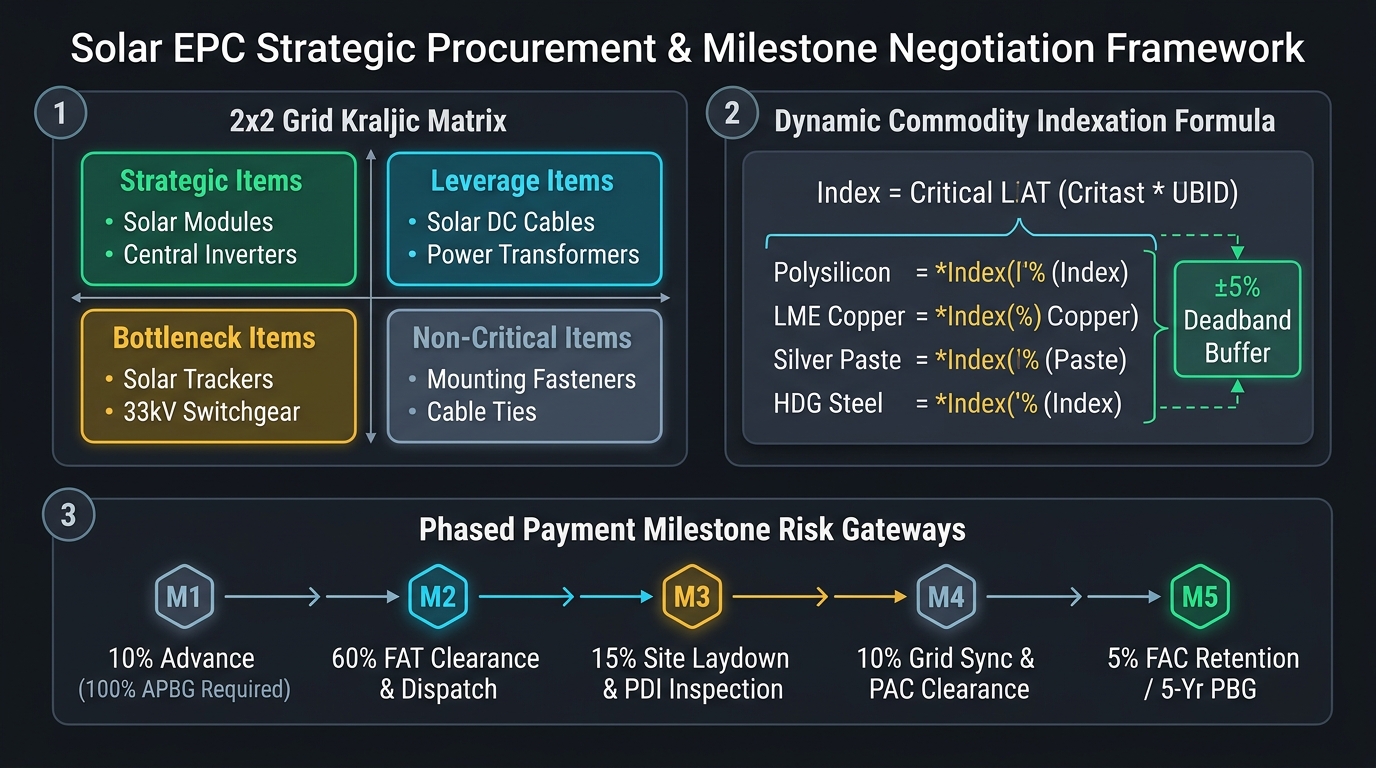
• Portfolio Categorization: High-CapEx strategic assets (modules/inverters) are ring-fenced with dedicated factory slot reservations and strict BOM controls, while high-friction bottleneck items (33kV switchgear, tracking controllers) prioritize strict delivery SLAs over unit price.
• Commodity Hedging Collar: Symmetrical ±5% deadband buffers protect both buyer and seller from routine market noise while sharing macro commodity shocks on a pre-agreed formulaic ratio.
• Risk-Gated Milestone Progression: Capital leaves the EPC’s treasury strictly upon passing objective technical verification gates (FAT/PDI reports, site delivery inspection, and grid COD certification).
6 Mastering Bank Guarantees: APBG, PBG, and Defect Liability Retentions
In multi-crore equipment procurements, commercial promises in a purchase order are only as enforceable as the financial security instruments underpinning them. Equipment vendors operating under tight operating margins may face insolvencies, parent-company restructuring, or factory cash crises. Without unconditional bank instruments, an advance payment or warranty claim becomes an unrecoverable unsecured debt.
1. Advance Payment Bank Guarantee (APBG) 100% Value of Advance
Never disburse a single rupee of mobilization or raw material advance without receiving an irrevocable, unconditional, and on-demand Advance Payment Bank Guarantee (APBG) issued by a first-class scheduled commercial bank in India (or confirmed by an Indian branch of an international bank for overseas suppliers).
2. Performance Bank Guarantee (PBG) 5% to 10% of Order Value
Suppliers frequently resist cash retentions on final milestones, citing working capital constraints. The optimal negotiation compromise is permitting 100% invoice payout against the submission of a 5% to 10% Performance Bank Guarantee (PBG) covering the 5-year inverter product warranty or 12–24 month module mechanical workmanship period.
7 Liquidated Damages (LD) & Performance Guarantees: Negotiating Bankable Delivery and Degradation Commitments
When a utility-scale solar project misses its Scheduled Commercial Operation Date (SCOD), the developer enforces punishing liquidated damages against the turnkey EPC contractor—frequently ranging from ₹15,000 to ₹35,000 per MWp per day of delay, or forfeiture of the developer-held Performance Bank Guarantee. To survive, the EPC must mirror these delay liabilities back into component supply purchase orders.
Delivery Liquidated Damages Architecture
- Standard Quantum: Negotiate 0.5% of total PO value per week of delay (or pro-rata per day), capped at 5% to 10% of total order value.
- Critical Path Linkage: If delivery is staggered by blocks, link LDs to the delayed block value, but stipulate that if missing hardware halts the entire subsystem (e.g., missing DC string cable halts inverter energization), LDs apply to the full impacted subsystem.
- Tight Force Majeure Exceptions: Explicitly state that upstream sub-vendor delays, port congestion, shipping freight container shortages, and raw material price spikes do not constitute Force Majeure events.
Long-Term Degradation & Yield Guarantees
- N-Type TOPCon Standards: First-year degradation strictly ≤ 1.0%; annual linear degradation strictly ≤ 0.40%/year from Year 2 to Year 30 (guaranteeing ≥ 87.4% output at Year 30).
- Shortfall Compensation Formula: Contractually mandate that generation shortfalls detected during annual plant performance audits trigger either: (a) free-of-cost delivery of supplementary modules to restore rated peak capacity, or (b) direct cash compensation calculated as: Loss = ΔkWp × Levelized PPA Tariff × 25-Year Generation Factor.
- Independent Lab Arbitration: Designate accredited testing institutes (e.g., PI Berlin, TÜV SÜD, National Institute of Solar Energy - NISE) as final arbiters for flash test and degradation disputes.
8 Volume Tiering and Framework Blanket Agreements (Call-Off Orders) Across Multi-Site Portfolios
One of the most pervasive inefficiencies in mid-sized solar EPC firms is the practice of fragmented purchasing: running separate procurement cycles for a 10 MWp rooftop project in Maharashtra, a 25 MWp captive plant in Gujarat, and a 15 MWp open access array in Karnataka. Sourcing in small, isolated batches sacrifices immense pricing power and creates administrative chaos.
Strategic purchase directors aggregate their multi-project pipeline into an Annual Framework Master Supply Agreement (MSA) featuring volume-tiered pricing ladders:
| Cumulative Annual Volume | Module Pricing Discount | Production Slot Lead Time | Payment Usance Terms | Dedicated Spares Stocking |
|---|---|---|---|---|
| 10 MWp to 49 MWp | Baseline Rate | 8 to 10 Weeks | LC at Sight | Standard Warranty Pool |
| 50 MWp to 99 MWp | 2.5% CapEx Rebate | 6 Weeks Guaranteed | 60-Day Usance LC | 0.25% Free Buffer Modules |
| 100 MWp to 249 MWp | 4.5% CapEx Rebate | 4 Weeks Priority Allocation | 90-Day Usance LC | 0.50% On-Site Consignment Spares |
| ≥ 250 MWp Multi-State | 6.5% – 8.0% CapEx Rebate | Dedicated OEM Assembly Line | 120 to 180-Day Usance Facility | 1.0% Regional Warehouse Consignment |
The "Call-Off" Mechanism: Flexibility Without Laydown Congestion
Under the Framework Agreement, the EPC contractor does not take immediate delivery of the entire aggregated capacity. Instead, the agreement defines the overarching commercial rates, BOM specifications, and warranty protocols, allowing project teams to issue individual Project Call-Off Orders with precise site delivery dates, synchronized with local civil piling and mounting structure installation schedules.
9 Vendor Financing, Letters of Credit (LC), and Extended Usance Terms in High-Interest Environments
In capital-intensive solar EPC contracting, cash conversion cycles typically span 90 to 180 days—the period required to procure hardware, complete site installation, synchronize with the transmission utility, and receive milestone disbursements from the project developer. Paying equipment manufacturers via sight LC drains working capital lines and incurs severe bank interest costs.
Negotiating Extended Usance Letters of Credit
Instead of an Irrevocable LC at Sight, negotiate a 90-Day or 180-Day Usance Letter of Credit (Deferred Payment LC). Under this structure, the supplier discounts the LC with their bank upon dispatch to receive immediate liquidity, while the EPC contractor’s bank honors the payment only after 90 to 180 days.
Supplier-Backed Vendor Credit & Factoring
Tier-1 global equipment manufacturers often have access to sovereign export credit agencies (ECAs) and low-cost international trade finance pools (e.g., Chinese Sinosure, European export credit guarantees).
10 Comprehensive Comparison Matrix: Weak/Ad-Hoc Negotiation vs. High-Leverage Strategic Solar Procurement
The technical comparison table below contrasts the outcomes of conventional, ad-hoc transactional purchasing against the structured strategic negotiation architecture deployed by elite solar EPC procurement leaders.
| Commercial & Technical Parameter | Weak / Ad-Hoc Transactional Buying | High-Leverage Strategic Solar EPC Procurement |
|---|---|---|
| 1. Core Procurement Objective | Lowest headline price per watt ($/Wp) on spot market. | Lowest 25-year Levelized Cost of Energy (LCOE) & Total Cost of Ownership (TCO). |
| 2. Portfolio Strategy | Single-project ad-hoc purchase orders issued reactively. | Portfolio volume aggregation under Annual Master Supply Frameworks with phased call-offs. |
| 3. Raw Material Volatility Risk | Fixed-price bid with supplier padding (or unilateral supplier cancellation on spikes). | Dynamic mathematical Price Variation Clause (PVC) with ±5% deadband and bilateral risk sharing. |
| 4. Advance Payment Terms | 10%–20% clean cash advance without bank guarantee security. | Advance strictly released against 100% unconditional, on-demand APBG from scheduled commercial bank. |
| 5. Factory Acceptance Testing (FAT) | Vendor internal self-certification accepted; no independent inspector. | Mandatory third-party Owner's Engineer PDI sign-off and Class AAA+ flash test verification before dispatch. |
| 6. Dispatch Payment Gate | 100% payment released before goods leave supplier factory gate. | Maximum 60% released against MDCC; 15%–20% retained until physical site receipt and GRN sign-off. |
| 7. Delivery Liquidated Damages (LD) | Toothless delay clauses; Force Majeure covers supplier supply issues. | 0.5%/week enforceable delay LD capped at 10%; raw material supply explicitly excluded from Force Majeure. |
| 8. Bill of Materials (BOM) Control | Unspecified; supplier free to swap sub-tier components at will. | Legally binding BOM freeze detailing cell type, wafer thickness, EVA/POE gel content, ARC glass, and junction box. |
| 9. Defect Liability Security | Zero retention; paper warranty without financial instrument backstop. | 5% cash retention throughout DLP or substitution with 5-year Performance Bank Guarantee (PBG). |
| 10. Financing & Payment Credit | Sight LC or advance wire transfer locking up EPC working capital. | 90 to 180-day Usance LC with supplier-subsidized discounting interest; vendor trade credit facilities. |
| 11. Spares & O&M Alignment | Spares purchased piecemeal post-commissioning at high catalog rates. | Mandatory 0.5%–1.0% batch-matched reserve module crates and inverter swap-out pools included in master PO. |
| 12. Technical Dispute Resolution | Supplier factory lab test results deemed final and uncontestable. | Independent accredited third-party test lab (NABL/TÜV/PI Berlin) arbitration protocol with loser-pays costs. |
11 Real-World Case Study: 200 MWp Utility-Scale & C&I Portfolio Sourcing Across Gujarat and Rajasthan
Aggregating 200 MWp Sourcing to Slash CapEx by ₹14.8 Crore and Eliminate Working Capital Distress
A leading Indian renewable EPC contractor was awarded three separate solar projects: a 120 MWp utility ground-mount park in Khavda, Gujarat; a 50 MWp open access captive plant in Bikaner, Rajasthan; and a 30 MWp distributed rooftop portfolio across Maharashtra industrial estates. Initial project estimates calculated component sourcing costs at ₹542 Crore across 18 fragmented vendor purchase orders.
Suppliers demanded 15% upfront cash advances, sight LCs, and unhedged raw material clauses due to rising polysilicon and copper spot volatility, threatening the EPC with a ₹62 Crore working capital deficit.
V-TECH RENEWABLES structured a centralized Master Framework Agreement consolidating all 200 MWp volume. Implemented a 5-stage milestone waterfall, 100% APBG advance backing, 120-day Usance LCs, and an LME/PVInsights indexation formula with a ±5% deadband.
Secured a ₹14.8 Crore (2.73%) direct CapEx rebate, preserved ₹48 Crore in working capital via 120-day LC usance, and achieved 100% on-time delivery across all three project sites without a single day of LD penalties.
12 Solar EPC Chief Procurement Officer’s 16-Point Negotiation & Contract Execution Checklist
Before authorizing signature on any multi-megawatt component purchase order or master supply agreement, verify that every contractual safeguard has been negotiated and executed:
Phase 1: Pre-Bid, Sourcing & Commercial Structuring
Phase 2: Quality Gates, Liquidated Damages & Execution
13 Frequently Asked Questions (FAQ)
Why is simple price-per-watt ($/Wp) haggling counterproductive in solar EPC procurement?
Focusing solely on lowest upfront price per watt peak ($/Wp) creates severe hidden liabilities for solar EPC contractors. Equipment suppliers squeezed on margins frequently degrade internal Bill of Materials (BOM)—substituting lower-grade EVA encapsulants, thinner aluminum frames, or uncertified junction boxes—and prioritize higher-paying clients during shipping bottlenecks. Furthermore, an aggressive upfront discount is easily wiped out by punitive payment terms (e.g., 100% advance without bank guarantees), weak warranty remedies, and absence of liquidated damages (LDs) for delivery delays, which can trigger project completion penalties of ₹15,000 to ₹35,000 per MWp per day from the asset owner.
How does a dynamic price variation clause (PVC) protect solar EPC contractors against raw material volatility?
A dynamic Price Variation Clause (PVC) mathematically links the final contract price of capital equipment to independent, publicly verifiable commodity indices—such as PVInsights or InfoLink for polysilicon, London Metal Exchange (LME) or MCX for copper and aluminum, and Joint Plant Committee (JPC) or Platts for hot-rolled steel coil. Crucially, a professional PVC incorporates a "deadband collar" (typically ±5%), meaning commodity price fluctuations within this band do not adjust the contract price. Movements beyond the deadband are shared proportionally (e.g., 50/50 or 60/40), preventing suppliers from building speculative risk premiums into baseline quotes and eliminating the threat of unilateral supplier contract repudiation during sudden market rallies.
What is the recommended milestone payment structure for utility-scale solar module and inverter procurement?
A bankable, risk-mitigated milestone payment schedule balances supplier manufacturing cash flow with EPC capital protection: Milestone 1: 10% Mobilization Advance secured by a 100% unconditional Advance Payment Bank Guarantee (APBG) from a scheduled commercial bank; Milestone 2: 55% to 60% upon successful Factory Acceptance Testing (FAT) / Pre-Dispatch Inspection (PDI) sign-off by an independent Owner's Engineer and issuance of Material Dispatch Clearance Certificate (MDCC); Milestone 3: 15% to 20% upon physical delivery at project site laydown yard and verification of shipping manifests against marine transit insurance; Milestone 4: 10% upon Preliminary Acceptance Certificate (PAC) / physical grid synchronization; Milestone 5: 5% Final Retention held for the 12-24 month Defect Liability Period (DLP) or released against a 5-year Performance Bank Guarantee (PBG).
How do framework blanket agreements (call-off contracts) benefit solar EPC contractors with multi-project pipelines?
Framework blanket agreements allow solar EPC contractors to aggregate procurement volumes across multiple geographically dispersed projects (e.g., combining 100 MWp to 250 MWp across disparate C&I rooftops and ground-mount plants) into a single master agreement. This unlocks top-tier volume discount rebates (saving 4% to 8% in direct CapEx), locks in guaranteed factory production line slots during peak Q4 commissioning rushes, standardizes technical specifications and warranty terms across projects, and permits phased "call-off" purchase orders with project-specific delivery schedules, eliminating laydown congestion and working capital lockup.
What essential clauses must be included in solar purchase contracts to enforce delivery and performance liquidated damages (LDs)?
Bankable solar purchase contracts must enforce: 1) Delivery Liquidated Damages: 0.5% per week of delay (or fraction thereof) capped at 5% to 10% of total contract value, with an explicit stipulation that supply chain bottlenecks and raw material shortages do not constitute Force Majeure; 2) Performance & Degradation Warranty Remedies: Guaranteed maximum 1.0% first-year degradation and 0.40%/year linear degradation for N-Type TOPCon modules over 30 years, with contractual covenants for direct module replacement or cash compensation based on capitalized 25-year energy yield shortfall; 3) Independent Laboratory Dispute Mechanism: Agreement that test results from accredited third-party laboratories (e.g., PI Berlin, TÜV Rheinland, or NABL labs) are final and binding in quality disputes, with testing costs borne by the losing party.
Optimize Your Solar Procurement Strategy with V-TECH RENEWABLES
From drafting bankable Master Supply Frameworks and dynamic commodity price variation models to conducting independent Pre-Dispatch Inspections (PDI) and enforcing contract liquidated damages, V-TECH RENEWABLES provides complete strategic procurement advisory, Owner’s Engineering, and technical due diligence for utility-scale and C&I solar developers and EPC leaders across India.
Related Technical Articles in This Series
Green Procurement: Meeting ESG Mandates in the Solar Supply Chain
Scope 3 upstream decarbonization, digital product passports, and circular recycling.
Procurement & ConstructionHow Modular Skid Solutions Speed Up Utility-Scale Construction
Factory integration, civil strip footing vs control rooms, busbar physics, and commissioning acceleration.
Procurement & O&MManaging Spares Inventory for Post-Commissioning O&M Obligations
Multi-echelon stocking hierarchies, MTBF/MTTR downtime risk modeling, and defect liability mitigation.