Managing Spares Inventory for Post-Commissioning O&M Obligations: Multi-Echelon Stocking, MTBF/MTTR Risk Modeling & Defect Liability (DLP) Mitigation
An authoritative engineering, operations, and procurement masterclass for solar EPC executives, O&M directors, and purchase managers: structuring 3-tier multi-echelon spares inventories, modeling Poisson failure distributions and holding costs against plant availability guarantees (98.5%–99.5%), enforcing vendor Advance Replacement SLAs, preventing catastrophic liquidated damages during the Defect Liability Period (DLP), and ensuring long-term asset profitability.

1 The Post-COD Availability Trap: Why Spares Decide EPC Profitability
When a utility-scale solar photovoltaic plant achieves Commercial Operation Date (COD), celebration is often premature for the Engineering, Procurement, and Construction (EPC) contractor. COD marks the immediate transition into the contractual Defect Liability Period (DLP)—typically spanning 24 to 60 months—during which the EPC guarantees strict plant availability levels (98.5% to 99.5%) and Performance Ratio (PR) benchmarks under severe legal and financial liabilities.
In modern Power Purchase Agreements (PPAs) signed with central utilities like SECI, NTPC, or state DISCOMs, generation shortfalls triggered by unscheduled plant downtime carry draconian Liquidated Damages (LDs). These penalties frequently equal 150% to 200% of the lost PPA tariff revenue, compounded by contractual availability damages ranging from ₹15,000 to ₹35,000 per MWp per day of unresolved outage.
The Critical Working Capital Dilemma
Solar purchase managers face an existential balancing act. Overstocking spares locks up 4% to 7% of total plant CapEx in illiquid inventory carrying an annual holding cost (cost of debt, warehousing, insurance, obsolescence) of 14% to 18%. Conversely, understocking spares leaves the EPC entirely vulnerable to global supply chain lead times (8 to 16 weeks for specialized electrical hardware), where a single transformer bushing or inverter IGBT bridge failure can wipe out the contractor’s entire 8% gross project margin.
The objective of an institutional spares management strategy is not to store infinite components on-site, but to deploy a scientifically engineered, multi-echelon stocking protocol that maximizes component availability while minimizing capital lockup.
2 Mathematical Failure Physics: Poisson Distributions, MTBF & MTTR Modeling
Determining spare parts inventory must never rely on arbitrary vendor recommendations or rule-of-thumb guesswork. Rigorous solar asset management uses reliability engineering principles derived from the classical Bathtub Curve: infant mortality during Year 1 of COD, constant random failure rates during the operational plateau, and wear-out failures approaching end of design life.
1. Quantifying Reliability Metrics: MTBF and Failure Rates
For any population of critical components (e.g., $N$ operational string inverters or tracker drive motors), reliability performance is defined by the Mean Time Between Failures (MTBF) and its inverse, the hourly failure rate ($\lambda$):
During the stable operating phase, component failures occur as independent, memoryless events modeled by a Poisson Distribution. The probability $P(k)$ of experiencing exactly $k$ failures across a population of $N$ units operating over mission time $t$ (e.g., 8,760 annual hours) is formulated as:
2. Safety Stock Calculation Under Demand & Lead Time Uncertainty
Because procurement lead times ($L$) and failure frequencies ($D$) both exhibit standard deviations ($\sigma_L$ and $\sigma_D$), the statistically required Safety Stock ($SS$) to maintain a target service level (e.g., 99.5% service level where the normal distribution factor $Z = 2.576$) is calculated as:
3. The Holding Cost vs. Downtime Penalty Decision Rule
To evaluate whether an expensive component must be stocked on-site, EPC engineers apply the financial threshold equation:
Where $r_{\text{carrying}}$ is the annual inventory carrying rate (typically 16% in India factoring cost of debt, warehousing, and insurance). Whenever the expected downtime cost exceeds the annual holding cost, immediate on-site stocking is mathematically mandatory.
3 The 3-Tier Multi-Echelon Stocking Hierarchy: On-Site, Cluster & OEM Buffers
To achieve 99.5% plant availability without overburdening project balance sheets, industry leaders deploy a 3-tier multi-echelon inventory architecture. This model segregates components by replacement urgency (Mean Time to Repair, MTTR), component unit cost, and geographical mobility.
Tier 1: On-Site Critical Spares
Stored permanently inside the plant's dedicated warehouse. Zero logistics transit delay. Immediate deployment by on-site O&M technicians upon fault alarm.
- Inverter IGBT power modules & driver boards
- 1500V DC gPV fast-acting fuses
- String monitoring cards & DSP control boards
- Class A thermopile pyranometers
- MC4-Evo2 connectors & Class 5 DC cabling
- 0.5% batch-matched PV module reserve
Tier 2: Regional Cluster Depot
Shared across a cluster of 3 to 8 solar plants within a 150–200 km radius. Shared capital expenditure amortized across hundreds of megawatts.
- Complete spare string inverters (250–350 kW)
- Tracker slew drive gearboxes & motor controllers
- Motorized 33 kV disconnector mechanisms
- Auxiliary station transformers (100–250 kVA)
- Substation numeric protection relays
Tier 3: OEM Consignment Buffer
Contractually reserved buffer inventory physically held at the OEM's national manufacturing center or central bonded warehouse, backed by guaranteed dispatch SLAs.
- Main Inverter Duty Transformer (IDT) spares
- 66/132/220 kV substation power transformer bushings
- GIS / AIS circuit breaker interrupter poles
- Custom single-axis tracker torque tube extrusions
4 Component-by-Component Spares Engineering Breakdown
A granular, subsystem-level engineering analysis reveals how specific electrical, electronic, and structural components degrade under high-voltage solar operation and which failure modes dictate stock quantities:
A. Inverter Subsystems: Central Stations vs. High-Capacity String Architectures
Inverters are the primary source of unscheduled downtime in solar farms, accounting for 65% to 75% of all corrective maintenance tickets.
- Central Inverters (2.5 MW to 4.4 MW skids): Sub-assembly replacement is mandatory. The site must maintain at least two fully assembled IGBT phase power bridges with pre-mounted gate drive cards and thermistors per 50 MWp block. In addition, stock 100% replacement fans for forced-air cooling, internal auxiliary power supplies (24V DC / 230V AC), and a complete set of 1500V DC input contactors.
- String Inverters (250 kW to 350 kW units): The modern industry standard is Box-Swap Replacement. Because repairing complex multi-MPPT electronics in dusty field environments causes contamination, O&M teams swap the entire inverter unit. Maintain an on-site swap stock of 1.5% to 2.0% of installed inverter count. Defective units are subsequently repaired under factory RMA warranty conditions.
B. PV Modules: The Current-Matching & Degradation Imperative
Stocking spare PV modules involves complex electrical matching physics. Due to manufacturing batch variations, modules from different production runs have diverging Current at Maximum Power Point ($I_{mpp}$) and temperature coefficients.
In a 1500V DC string of 28 to 32 modules, string current is constrained by the lowest $I_{mpp}$ module. If an EPC replaces a damaged 13.8A N-Type TOPCon module with an older 13.2A spare, the entire 18 kWp string experiences a 4.3% permanent output reduction. Worse, if a module with a lower short-circuit current is installed, it is subjected to continuous reverse-bias heating during peak irradiance, inducing hot spots and catastrophic EVA/POE delamination.
C. High-Voltage Substation & Inverter Duty Transformers (IDTs)
Main step-up transformers represent the single highest financial catastrophe risk. A complete transformer replacement has a procurement lead time of 6 to 12 months. EPCs must maintain zero-lead-time consumable and protective spares on-site:
- One complete set of 33 kV HV and LV transformer bushings with current transformers (CTs).
- Spare Buchholz relay, Magnetic Oil Gauge (MOG), and pressure relief valve (PRV).
- Reconditioned silica gel breathers and 200 liters of inhibited transformer oil in sealed drums.
- Substation numerical protection relay spares pre-flashed with site logic configurations.
D. Single-Axis Trackers & Weather Monitoring Stations (WMS)
Tracker downtime stalls generation across hundreds of modules at non-optimal tilt angles. EPCs must maintain 1.5% spare slew drive gearboxes, 2.0% tracker drive motors (24V DC / 48V DC brushless), and spare Network Control Units (NCU). For WMS, maintain one calibrated secondary standard thermopile pyranometer (ISO 9060 Class A) to maintain uncompromised PR calculation integrity during statutory audits.
5 Technical Infographic: Solar EPC O&M Spares & Uptime Framework
The visual framework below illustrates the strategic relationship between the 3-Tier Multi-Echelon Spares Architecture, MTTR targets, the Defect Liability Period (DLP) risk mitigation curve, and the mathematical equilibrium between holding costs and liquidated damages.
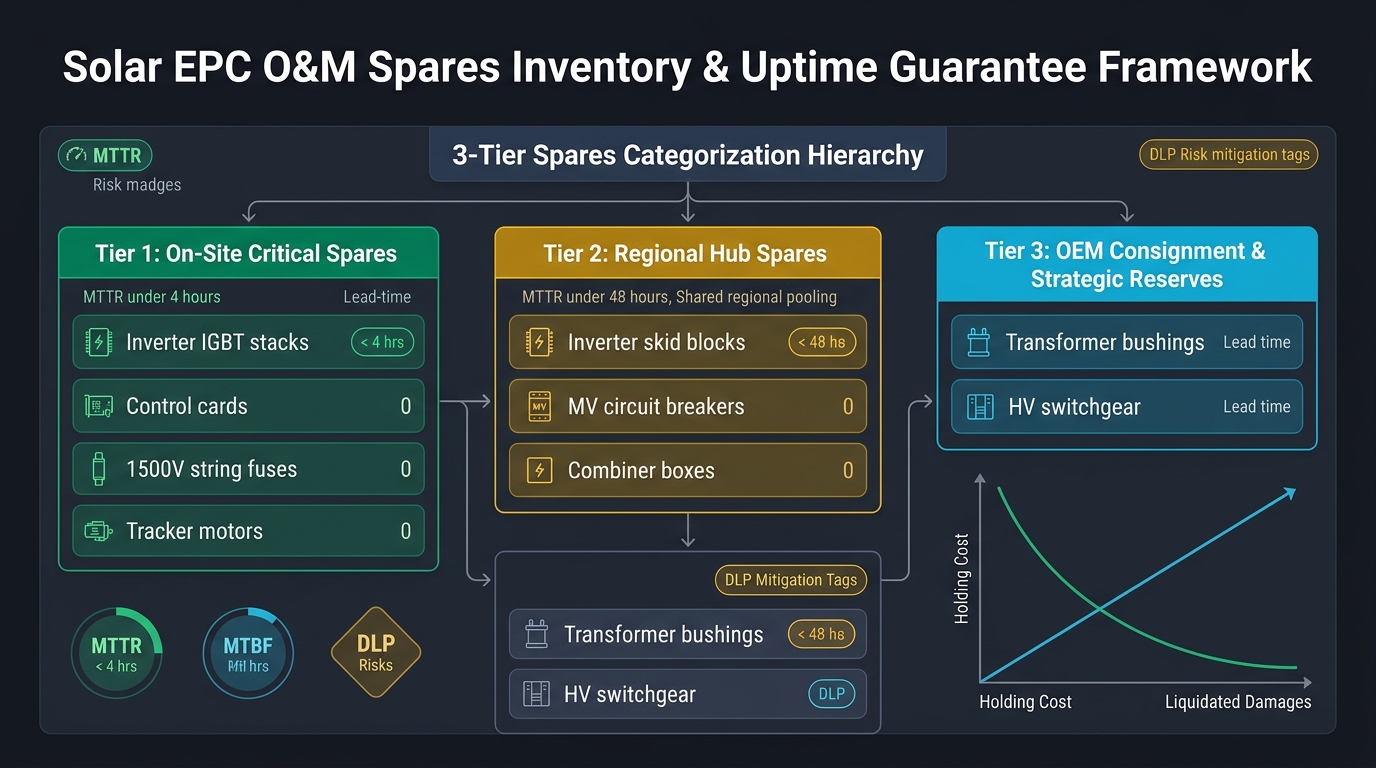
As demonstrated in the infographic, holding 100% of major equipment on-site creates exponential carrying costs with diminishing reliability returns. Conversely, relying exclusively on factory re-orders creates catastrophic downtime exposure during unexpected failure spikes. The optimal operational sweet spot is achieved at the intersection of Tier 1 on-site fast-turnover spares and Tier 2 regional cluster pooling.
6 Defect Liability Period (DLP) Contractual Pass-Through & Vendor SLAs
A recurring commercial failure mode among solar EPCs is the Warranty Decoupling Trap. The EPC enters into an overarching EPC contract with the plant owner guaranteeing a 2-year Defect Liability Period with a 4-hour fault response commitment and a 99.2% availability SLA. However, the EPC’s purchase orders with Tier-1 component OEMs specify standard vendor terms: a 30-day RMA return-and-inspect protocol before replacement authorization.
Key Contractual Pass-Through Mechanisms
7 Environmental Warehousing & Component Preservation Standards
Many solar power plants are situated in harsh geographical terrains: the Thar Desert of Rajasthan (temperatures exceeding 50°C), coastal corridors of Gujarat and Tamil Nadu (ISO 9223 C5 marine salt corrosivity), or high-altitude cold deserts. Uncontrolled warehousing ruins sensitive electronic and structural spares long before they are installed in the field.
Climate-Controlled Electronics Storage
Inverter gate drive boards, communication modules, and numeric protection relays must reside in a dedicated climate-controlled storage room maintained at 20°C to 25°C with relative humidity below 60%. The storage facility must incorporate conductive anti-static flooring (ESD protection) and grounded shelving to eliminate electrostatic discharge damage during handling.
Electrolytic Capacitor Reforming Protocols
High-voltage DC bus electrolytic and film capacitors stored without voltage de-passivate over time as aluminum oxide dielectric layers degrade. If energized suddenly after 18+ months in storage, they suffer explosive dielectric breakdown. EPC maintenance teams must execute annual capacitor reforming using a ramped DC voltage supply per manufacturer specifications.
PV Module Storage & Micro-Crack Prevention
Spare module crates must remain stored vertically on flat concrete plinths under covered sheds, protected from direct sunlight, rain, and rodents. Crates must never be stacked more than two tiers high. Pallets must remain wrapped in moisture-barrier plastic; partial crates must be mechanically braced to prevent cell flexure, solder ribbon fatigue, and sub-surface micro-cracking during wind vibration.
Substation Bushings & Transformer Spares
High-voltage transformer porcelain and composite resin-impregnated paper (RIP) bushings must be stored vertically in specialized weather-resistant cradles. Oil-filled components must be inspected quarterly for gasket weeping, and silica gel desiccant breathers must be replaced the moment blue-to-pink or orange-to-green saturation exceeds 50%.
8 Digital Inventory Management: CMMS, RFID Serialization & SCADA Links
Legacy manual paper registers and isolated spreadsheets inevitably lead to stock obsolescence, untracked component cannibalization, and phantom inventory. When a midday inverter trip occurs, discovering that a critical fuse was consumed three months ago without replenishment guarantees a multi-day generation penalty.
Institutional solar EPCs integrate digital Computerized Maintenance Management Systems (CMMS) directly with plant SCADA supervisory networks:
- Automated Work-Order Triggering: When SCADA registers an inverter trip or tracker motor stall error code, the CMMS automatically generates a corrective maintenance ticket, reserves the required spare part from warehouse stock, and logs technician dispatch.
- RFID and 2D Barcode Serialization: Every critical component (from 1500V fuses to inverter control boards) is tagged with a unique 2D DataMatrix code upon warehouse receiving. Scanning the tag records factory flash data, manufacturing date, warranty expiration, and installation history.
- Min-Max Dynamic Reorder Points: When consumable inventory breaches safety stock thresholds, the CMMS automatically transmits electronic purchase requests to pre-contracted Tier-1 suppliers under framework call-off contracts.
9 Comprehensive Solar O&M Spares Specification & Sizing Matrix
The technical sizing table below details recommended spares quantities, storage specifications, and MTTR targets for a standardized 100 MWp utility-scale solar PV facility:
| Subsystem | Component Description | Criticality | Recommended Sizing Ratio | Storage Environment | Target MTTR | Sourcing Tier |
|---|---|---|---|---|---|---|
| PV Modules | N-Type TOPCon / HJT Monofacial/Bifacial | High | 0.5% – 1.0% of installed modules | Covered warehouse, vertical crate | < 8 Hours | Tier 1 (On-Site) |
| Inverter (Central) | Complete IGBT Phase Power Modules | Critical | 2 complete bridge assemblies / 50 MW | Climate-controlled (<25°C, <60% RH) | < 4 Hours | Tier 1 (On-Site) |
| Inverter (String) | Complete 250–350 kW Inverter Units | High | 1.5% – 2.0% of installed units | Enclosed warehouse, dry rack | < 2 Hours | Tier 1 (On-Site) |
| DC Electrical | 1500V DC 25A–32A gPV String Fuses | High | 5.0% of installed string fuse count | Standard parts bins, dry | < 1 Hour | Tier 1 (On-Site) |
| DC Electrical | MC4-Evo2 Male & Female Connectors | Medium | 3.0% of total installed mating pairs | Sealed moisture-proof bags | < 1 Hour | Tier 1 (On-Site) |
| Trackers | Slew Drive Gearboxes & DC Motors | High | 1.5% gearboxes, 2.0% motors | Covered warehouse, grease sealed | < 12 Hours | Tier 2 (Cluster Depot) |
| Transformers | 33 kV IDT Bushings & CT Sets | Critical | 1 complete 3-phase set per substation | Vertical mounting cradle, dry | < 24 Hours | Tier 1 (On-Site) |
| Substation HT | 33 kV Vacuum Circuit Breaker Poles | Critical | 1 complete pole assembly per substation | Climate-controlled warehouse | < 12 Hours | Tier 2 (Cluster Depot) |
| Instrumentation | ISO 9060 Class A Thermopile Pyranometer | High | 1 pre-calibrated unit with certificate | Padded instrument case, lab storage | < 4 Hours | Tier 1 (On-Site) |
10 Real-World Case Study: 100 MWp Ground-Mount Project in Gujarat
Mitigating Lightning Surges & Recovering ₹1.65 Crore in Potential Outage Penalties
Project Context & Challenge: A premier Tier-1 solar EPC commissioned a 100 MWp utility solar project in Banaskantha, Gujarat, equipped with 3.125 MW central inverter stations and single-axis trackers. The 2-year EPC Defect Liability Period stipulated an uptime availability guarantee of 99.2%, with liquidated damages penalizing ₹30,000 per MWp per day of unresolved generation shortfall.
The Crisis Event: In July 2025, during an intense monsoon convective storm, severe induced electrical surges bypassed secondary surge arresters on two DC feeder circuits. Four central inverter IGBT power stacks and 28 tracker drive motor controllers suffered dielectric puncture, instantly taking 12.5 MW of inverter capacity and 4.2 MW of tracker blocks offline. Standard OEM procurement turnaround for replacement IGBT bridges was quoted at 6 to 8 weeks due to global semiconductor backlogs.
The Multi-Echelon Engineering Intervention: Because V-TECH RENEWABLES had engineered an optimized 3-tier spares protocol during the EPC procurement phase:
- Two spare IGBT bridge assemblies were immediately requisitioned from the on-site climate-controlled Tier-1 warehouse, restoring the first 6.25 MW block within 3.5 hours.
- The regional Tier-2 cluster pooling hub (located 90 km away in Mehsana) dispatched two additional shared IGBT assemblies and 30 tracker motor drives within 7 hours.
- Full 100 MWp capacity was restored to 100% operation within 18 hours of the storm, completely averting an estimated 42-day partial outage.
Financial & Contractual Outcome: The swift recovery averted ₹1.65 Crore in direct PPA generation losses and liquidated damage deductions. Furthermore, by utilizing regional cluster pooling rather than purchasing redundant full inverters for each standalone site, the EPC reduced total portfolio inventory holding CapEx by ₹84 Lakhs, securing an unblemished 99.42% annual availability certification.
11 16-Point Solar Purchase Manager Spares Inventory & DLP Audit Checklist
This comprehensive, phased audit checklist equips solar procurement leads, O&M directors, and Owner’s Engineers to establish an unassailable spares management framework:
Phase I: Sizing & Statistical Modeling
- ✓ 01. Bathtub Failure Profile Analysis: Quantify supplier-certified MTBF and calculate required Poisson safety stock for all high-criticality electronics.
- ✓ 02. Holding Cost vs. Outage LD Evaluation: Apply the 16% annual inventory holding formula against contractual daily downtime liquidated damages.
- ✓ 03. Multi-Echelon Tier Allocation: Formally map all Bill of Materials (BOM) items into Tier 1 (on-site), Tier 2 (cluster depot), or Tier 3 (OEM consignment).
- ✓ 04. 1.0% Module Batch-Matching Freeze: Enforce factory crating of 0.5%–1.0% modules strictly matched by cell type, wattage, and ±1.5% Impp current binning.
Phase II: Vendor Warranty & Contractual Pass-Through
- ✓ 05. Advance Replacement Agreement (ARA): Bind all Tier-1 inverter and switchgear OEMs to dispatch replacements within 24–48 hours before factory forensics.
- ✓ 06. Back-to-Back Availability SLAs: Ensure vendor warranty response terms strictly mirror or exceed the EPC's contractual DLP obligations to the plant owner.
- ✓ 07. 10% DLP Retention PBG: Withhold a 5%–10% performance bank guarantee until the conclusion of the DLP to guarantee vendor spares replenishment.
- ✓ 08. Dedicated Factory Buffer Allocation: Secure contractual proof of reserved OEM buffer stock for long-lead power transformer bushings and switchgear.
Phase III: Warehouse Preservation & Logistics
- ✓ 09. Climate-Controlled Clean Room: Mandate an air-conditioned room (<25°C, <60% RH) with anti-static ESD flooring for sensitive inverter electronics.
- ✓ 10. Capacitor Reforming Schedule: Establish a documented annual DC reforming procedure for unenergized inverter electrolytic and film capacitors.
- ✓ 11. Vertical Module Stacking Compliance: Verify spare PV module crates are stored vertically on concrete plinths, max 2-tiers high, protected from UV and moisture.
- ✓ 12. Transformer Breather Desiccant Checks: Implement monthly inspections of silica gel breathers and oil levels on spare substation bushings and IDTs.
Phase IV: Digital CMMS & Handover Protocols
- ✓ 13. 2D DataMatrix Serialization: Apply barcode/RFID serialization to every spare item, linking serial numbers to flash test curves and warranty logs.
- ✓ 14. SCADA-Triggered Work Orders: Connect the plant SCADA monitoring architecture directly to the CMMS for automated spare part reservation upon fault detection.
- ✓ 15. Dynamic Min-Max Reorder Logic: Automate electronic reorder triggers with Tier-1 vendors whenever safety stock levels are breached.
- ✓ 16. Formal Post-DLP Reconciliation Audit: Conduct a joint tripartite inventory inspection (Owner-EPC-O&M) prior to DLP sign-off, replenishing consumed stock.
12 Frequently Asked Questions (FAQ)
What is the financial danger of understocking critical solar spares during the Defect Liability Period (DLP)?
Understocking critical spares during the 2 to 5-year Defect Liability Period (DLP) exposes the EPC contractor to severe contractual Liquidated Damages (LDs) for failing guaranteed plant availability (typically 98.5% to 99.5%) and Performance Ratio (PR) thresholds. If a long-lead component such as an Inverter Duty Transformer bushing, central inverter IGBT bridge, or 33 kV vacuum breaker fails without an on-site spare, replacement lead times often stretch between 6 and 16 weeks. A 25 MW inverter block outage in peak generation months can cause over ₹15,00,000 to ₹35,00,000 in lost generation revenue and contractual penalties per week, rapidly eroding the EPC's entire project profit margin.
How does the multi-echelon 3-tier spares inventory architecture optimize holding costs?
The multi-echelon architecture divides spares into three distinct logistics rings: Tier 1 (On-Site Emergency Spares) holds zero-lead-time, rapid-replacement components (fuses, MC4 connectors, pyranometers, inverter IGBT power modules, control cards) with an MTTR target under 4 hours; Tier 2 (Regional Cluster Depot) pools expensive, medium-criticality assets (complete spare string inverters, tracker motors, 33 kV isolator drives) across multiple solar plants within a 150–200 km radius with a 24–48 hour delivery SLA; and Tier 3 (OEM Factory Consignment) relies on contractual vendor buffer agreements for catastrophic, capital-intensive equipment (step-up transformers, substation switchgear). This strategy reduces on-site working capital lockup by 35% to 45% while preserving 99.2%+ plant uptime.
Why must replacement PV modules be batch-matched by cell technology and current binning?
In utility-scale strings operating at 1500V DC, all series-connected modules carry identical string current. If a failed module is replaced with a spare having a different maximum power point current (Impp) or mismatched wafer technology (e.g., replacing an N-Type TOPCon module with an older P-Type PERC spare), the entire string's output is throttled down to the lowest-performing module's current. Furthermore, current mismatches above 2.0% induce continuous reverse-bias voltage stress on lower-current cells, causing localized thermal overheating (hot-spots), bypass diode degradation, and accelerated cell browning. EPCs must maintain a 0.5% to 1.0% batch-matched reserve with identical flash test current bins (±1.5% Impp).
What is an Advance Replacement Agreement (ARA) and why is it essential for solar EPC procurement?
An Advance Replacement Agreement (ARA) is a non-negotiable procurement clause between the solar EPC and Tier-1 component OEMs (inverters, trackers, switchgear). Under standard OEM warranties, manufacturers require defective units to be decommissioned, shipped to their regional service center, inspected, and verified before releasing a warranty replacement—a process taking 3 to 8 weeks. An ARA obligates the manufacturer to dispatch a replacement unit or spare assembly within 24 to 48 hours of notification, prior to root-cause inspection, ensuring plant downtime is minimized while forensic analysis proceeds independently.
How do environmental storage conditions in site warehouses impact solar spare parts shelf life?
Utility solar plants are frequently constructed in harsh desert, coastal, or high-humidity tropical climates where ambient warehouse temperatures can exceed 48°C and relative humidity reaches 85%+. Electronic spares such as inverter IGBT drivers, DSP control boards, and communication cards require climate-controlled storage (<25°C, <60% RH) with ESD protection. High-voltage DC link capacitors suffer electrolyte drying and dielectric oxide layer degradation if stored unenergized, requiring controlled reforming every 12 to 18 months. Transformer silica gel breathers and Buchholz relays require sealed desiccant packaging to prevent moisture ingress into dielectric oil.
Protect Plant Availability with Institutional Spares Optimization & DLP Due Diligence
From statistical MTBF/MTTR reliability modeling and multi-echelon warehouse design to negotiating bulletproof Tier-1 OEM Advance Replacement Agreements, V-TECH RENEWABLES empowers solar developers and EPCs to eliminate post-COD liquidated damages.