Green Procurement: Meeting ESG Mandates in the Solar Supply Chain: Scope 3 Decarbonization, Traceability & Circular BOS Sourcing
An authoritative engineering, sustainability governance, and strategic procurement masterclass for solar EPC directors, Owner’s Engineers, and corporate clean-energy purchase heads: moving beyond $/Wp metrics to navigate Scope 3 value-chain decarbonization, low-embodied-carbon polysilicon smelting, digital product passports (DPP), green steel structural racking, SF6-free switchgear, biodegradable transformer fluids, SEBI BRSR Core compliance, and cradle-to-cradle circular recycling.
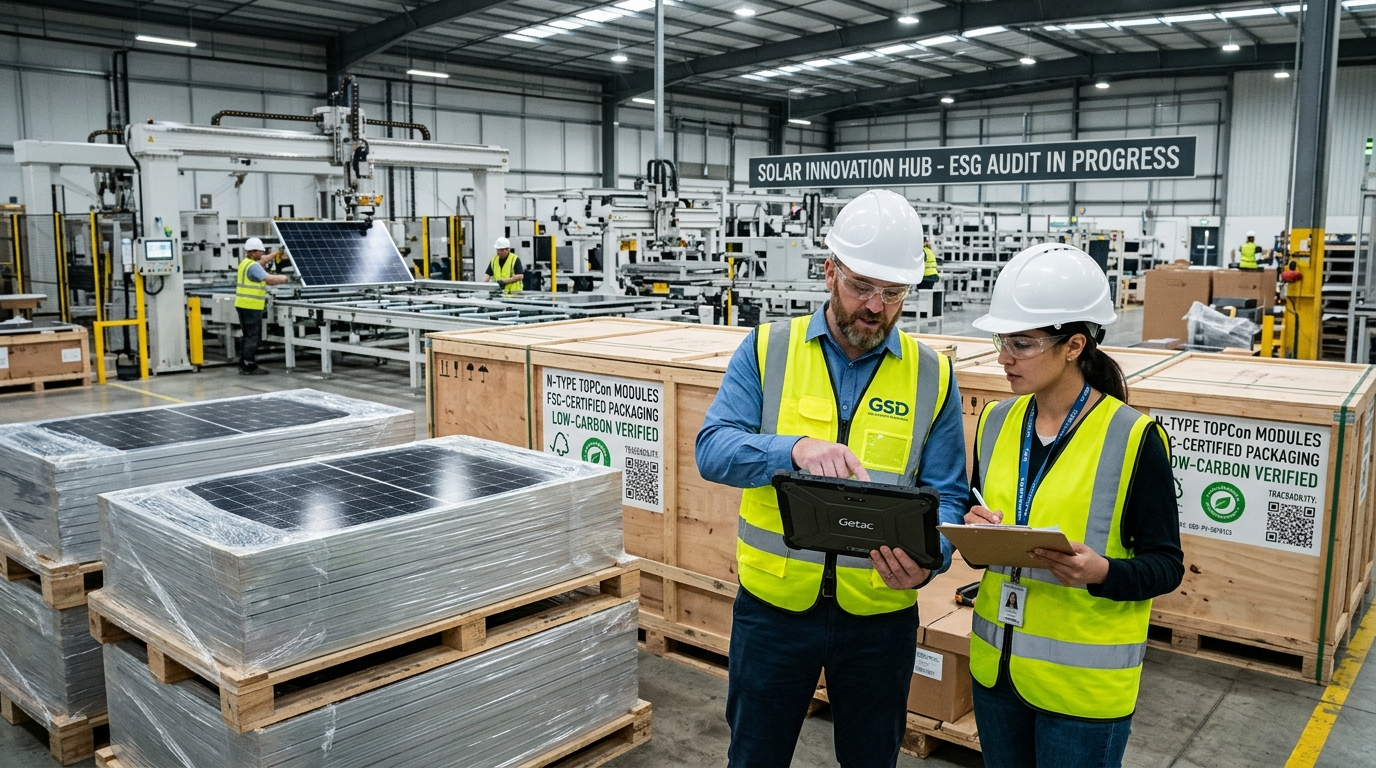
1 The ESG Paradigm Shift: Why Clean Megawatts No Longer Excuse Dirty Supply Chains
For over a decade, the global solar photovoltaic (PV) sector operated under an unspoken moral exemption: because solar power generates zero emissions during its operational lifespan, procurement departments were granted blanket permission to source the absolute cheapest hardware available on the spot market. Solar Engineering, Procurement, and Construction (EPC) contractors and developers focused single-mindedly on driving down capital expenditure (CapEx) toward razor-thin cents-per-watt-peak ($/Wp) benchmarks.
Today, that exemption has completely evaporated. The clean energy transition has entered the era of uncompromising supply chain accountability. Global institutional financiers, sovereign wealth funds, and blue-chip corporate power off-takers (including Fortune 500 tech hyperscalers, automotive OEMs, and pharmaceutical giants committed to RE100 and Science Based Targets initiatives) have recognized a sobering reality: a solar farm’s green energy output does not erase the carbon-heavy, environmentally destructive, and socially fraught footprint of its upstream manufacturing.
The Corporate Scope 3 Imperative
Under the GHG Protocol Corporate Standard, a corporate power buyer’s renewable Power Purchase Agreement (PPA) addresses operational Scope 2 emissions. However, the capital equipment purchased to build the generating facility directly impacts the developer’s and off-taker’s Scope 3 Category 1 (Purchased Goods and Services) and Category 2 (Capital Goods) disclosures. Sourcing hardware manufactured in coal-dependent grids undermines net-zero corporate claims.
Regulatory & Legal Border Barriers
With statutory reporting mandates such as India’s SEBI BRSR Core, the European Union’s Corporate Sustainability Due Diligence Directive (CSDDD), the Carbon Border Adjustment Mechanism (CBAM), and stringent provenance enforcement under the United States Uyghur Forced Labor Prevention Act (UFLPA), solar assets built with unverified, opaque components face customs detentions, tariff penalties, and severe reputational damage.
The Definition of Green Solar Procurement
Green Procurement in solar engineering is the deliberate, structured selection of modules, balance-of-system (BOS) electrical hardware, structural mounting systems, and site logistics based on verified whole-lifecycle environmental impact. It integrates cradle-to-gate Life Cycle Assessment (LCA per ISO 14040/44), audited greenhouse gas emissions intensity (ISO 14067), certified ethical provenance (ISO 20400), non-toxic biodegradable materials, and verified end-of-life deconstruction recycling protocols directly into technical tender specifications.
2 Deconstructing Embodied Carbon: Polysilicon Smelting, Wafers, Ingot Pulling & Framing
To decarbonize solar procurement, purchase managers and solar design engineers must first understand where the embodied carbon physically resides. In a typical utility-scale or commercial solar PV facility, between 82% and 92% of the facility’s entire cradle-to-gate carbon footprint originates in the manufacturing of the photovoltaic modules themselves, with the remaining 8% to 18% shared across civil foundations, steel mounting structures, power transformers, cabling, and inverters.
Within a solar PV module, embodied emissions are heavily concentrated in high-temperature, thermal-electric processing stages. The embodied carbon anatomy breaks down across four primary tiers:
1. Polysilicon Refining & Smelting (48% – 58% of Module Footprint)
Metallurgical-grade silicon (MGS, 98% purity) extracted from quartz sand is converted into semiconductor-grade hyper-pure polysilicon (9N to 11N, 99.9999999% purity) predominantly via the modified Siemens process, which vaporizes trichlorosilane (TCS) gas onto heated silicon filaments at 1,100°C. This process is intensely thermal-electric, demanding 50 to 65 kWh of electrical energy per kilogram of polysilicon produced. When this smelting occurs in industrial regions powered by sub-critical coal-fired thermal power plants, the carbon intensity soars to 70 to 85 kg CO2e per kg of polysilicon. Conversely, advanced facilities utilizing Fluidized Bed Reactor (FBR) granular silicon technology powered by dedicated hydropower or captive solar microgrids slash energy consumption by up to 75%, generating less than 18 to 25 kg CO2e per kg.
2. Czochralski (CZ) Ingot Pulling & Diamond Wire Wafering (18% – 24%)
Purified polysilicon is melted in quartz crucibles inside argon-shielded CZ crystal-growing furnaces maintained at 1,425°C for 40 to 60 continuous hours to produce mono-crystalline cylindrical ingots. Modern large-format ingots (for M10R and G12 wafer standards) require 25 to 35 kWh/kg of electricity. High-speed diamond wire saws then slice ingots into ultra-thin wafers. Green procurement specifications enforce wafer thickness optimization (down to 130 μm for N-Type TOPCon and 110 μm for Heterojunction HJT) and ultra-low diamond wire diameters (down to 34–36 μm), minimizing silicon kerf loss and reducing raw material demand by 14% to 18% per watt.
3. Anodized Aluminum Structural Framing (12% – 16%)
While often overlooked as simple mechanical hardware, the extruded anodized aluminum frame encircling a 600W+ utility bifacial module weighs approximately 2.6 to 3.2 kg. Standard primary electrolytic aluminum produced using coal-powered smelting consumes ~15 kWh/kg and emits an astonishing 14 to 18 kg CO2e per kg of aluminum. Consequently, a module’s frame can account for up to 50 kg CO2e—nearly 20% of the entire finished panel’s embodied carbon! Specifying certified low-carbon recycled secondary aluminum or hydropower-smelted aluminum certified under the Aluminium Stewardship Initiative (ASI) reduces frame emissions to < 4.0 kg CO2e per kg, delivering an instant 12% reduction in overall module footprint.
4. Cell Metallization, Soldering & Encapsulants (8% – 12%)
Advanced cell architectures like N-Type TOPCon require silver-aluminum screen-printing paste for metallization fingers. Green procurement audits enforce: (a) silver consumption reduction via multi-busbar (16BB to 24BB) and zero-busbar (0BB) wire interconnection technologies; (b) substitution of toxic lead-bearing solder ribbons (traditional 60/40 Sn-Pb) with RoHS-compliant lead-free bismuth-silver-tin (Sn-Bi-Ag) low-temperature solder alloys; and (c) halogen-free, non-toxic encapsulant films. Utilizing cross-linked Polyolefin Elastomer (POE) instead of standard EVA eliminates acetic acid off-gassing and damp-heat degradation, safeguarding 25-year reliability without toxic leaching.
Module Embodied Carbon Intensity Calculation (Cradle-to-Gate)
• $M_i$: Mass of raw material component $i$ (polysilicon, glass, aluminum frame, copper ribbon, POE, silver paste).
• $EF_i$: Upstream cradle-to-gate carbon emission factor of material $i$ (kg CO2e / kg material).
• $E_j$: Electrical/thermal energy consumed during processing stage $j$ (smelting, crystal growth, wafering, cell diffusion, laminating).
• $GridEF_j$: Specific regional carbon emission factor of the electrical grid powering manufacturing bay $j$ (kg CO2e / kWh).
• $P_{STC}$: Nameplate peak power rating of the module at Standard Test Conditions (kWp).
→ Benchmark comparison: Standard coal-grid Mono PERC yields 580–720 kg CO2e/kWp; Low-carbon hydro-smelted TOPCon yields 280–340 kg CO2e/kWp (slashing embodied carbon by 52%).
3 Supply Chain Traceability & Chain of Custody: Quartz Mine to Finished Module
Evaluating embodied carbon is impossible without verifiable provenance. In conventional tier-structured solar purchasing, an EPC contractor signs a purchase order with a Tier-1 module manufacturer, completely blind to the fact that the manufacturer sources wafers, ingots, and polysilicon from half a dozen unvetted sub-tier vendors who intermingle raw materials in massive industrial holding silos.
Under rigorous green procurement guidelines, solar purchase managers must establish end-to-end Chain of Custody (CoC) traceability governed by international frameworks like ISO 22095. Modern bankable traceability relies on three distinct operational models:
1. Identity Preservation (IP)
The highest standard of traceability. Raw quartz from an audited, certified mine is processed in dedicated, segregated furnaces. The resulting polysilicon, ingots, wafers, and cells are physically tagged, containerized, and routed through dedicated production runs with zero physical co-mingling. Every finished module can be mapped to a specific batch of quartz and polysilicon.
2. Segregation (SG)
Certified low-carbon or ethically audited materials from multiple verified suppliers are kept strictly separate from uncertified or non-compliant materials throughout storage, smelting, and cell assembly. Certified inputs can mix with other certified inputs, but non-compliant feedstock is strictly segregated at all factory gates.
3. Mass Balance (MB)
Certified and non-certified materials are co-mingled in production processes, but strict administrative mass-balance accounting ensures that the volume of certified solar modules sold never exceeds the exact mass equivalent of certified green polysilicon purchased and fed into the production system.
The Digital Product Passport (DPP) & Forensic Verification
Leading solar developers now mandate Digital Product Passports (DPP). Each individual module frame and backsheet features a permanent, laser-etched 2D Data Matrix QR code paired with an internal RFID tag. Scanning the code queries an immutable cloud ledger or distributed blockchain database, instantly surfacing:
4 Green Balance of System (BOS): Low-Carbon Structural Steel, PosMAC & Clean Cabling
A solar PV plant is far more than silicon panels. Across a 100 MWp utility-scale solar project, the Balance of System (BOS) requires approximately 4,000 to 5,500 metric tonnes of structural steel for module mounting structures (MMS) and tracker torque tubes, over 800 kilometers of electrical cabling, and dozens of heavy medium-voltage power stations. Failing to apply ESG standards to BOS procurement erodes up to 40% of the project’s potential Scope 3 decarbonization gains.
1. Low-Carbon "Green Steel" & Advanced Zn-Al-Mg Coatings
Traditional structural steel produced via the Blast Furnace–Basic Oxygen Furnace (BF-BOF) route emits 1.8 to 2.2 tonnes of CO2 per tonne of crude steel. By contrast, green procurement tender specs prioritize steel manufactured via the Electric Arc Furnace (EAF) route utilizing high recycled scrap content (>75%) or Direct Reduced Iron (DRI) powered by renewable hydrogen or natural gas, compressing embodied emissions down to 0.4 to 0.7 tonnes CO2/tonne steel (a 70% reduction).
Furthermore, replacing energy-intensive post-fabrication Hot-Dip Galvanizing (HDGI, requiring molten zinc immersion baths at 450°C) with continuous pre-coated Zinc-Aluminium-Magnesium alloy steel (Zn-Al-Mg, such as PosMAC or Magnelis) eliminates toxic acid pickling waste streams, provides superior self-healing corrosion protection in harsh C4/C5 environments per ISO 9223, and reduces lifecycle coating carbon by 35%.
2. Low-Embodied-Energy Cabling & Halogen-Free Polymers
Primary copper refining is highly carbon- and water-intensive (~4.5–6.5 kg CO2e/kg Cu). Where technically feasible in utility-scale array trunk lines, 800V AC inverter feeds, and 33 kV collector networks, utilizing electrical-grade AA 8000 series aluminum alloy conductors slashes embodied conductor weight by 50% and reduces supply chain transportation emissions, while costing 35% less than copper.
For insulation and sheathing, green procurement mandates Low Smoke Zero Halogen (LSZH) electron-beam cross-linked polyolefin (XLPO) per EN 50618 and IEC 62930. Unlike toxic polyvinyl chloride (PVC), XLPO contains zero halogens (chlorine, bromine), emits zero corrosive hydrochloric acid gas in fire scenarios, utilizes non-toxic mineral flame retardants, and achieves full compliance with European RoHS and REACH environmental regulations.
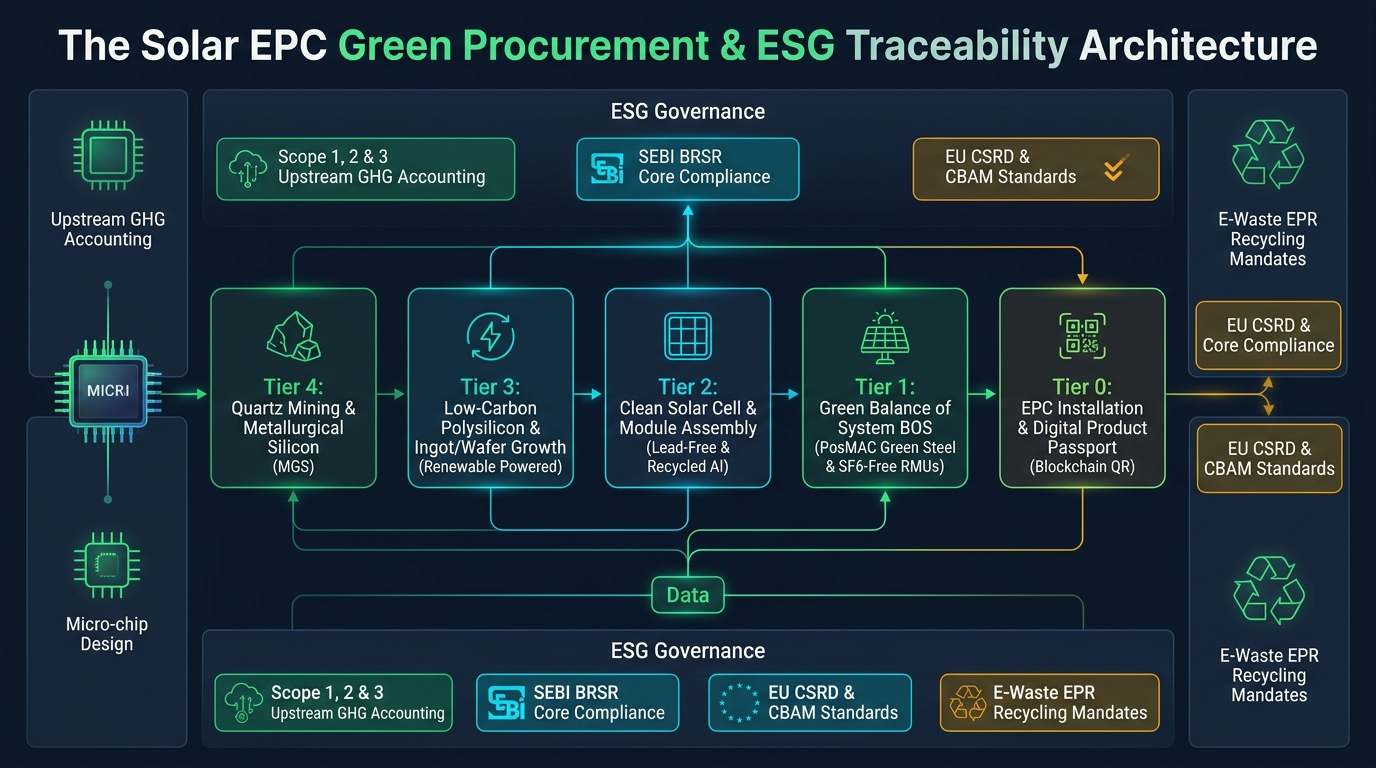
5 Technical Infographic: The Solar EPC Green Procurement & ESG Architecture
The technical schematic below illustrates the end-to-end multi-tier green procurement and ESG compliance framework deployed by V-TECH RENEWABLES across commercial and utility-scale solar projects. It maps upstream raw material provenance through clean component fabrication, digital product passport serialization, and corporate governance compliance gateways:
Key Architectural Takeaways from the Framework:
Cradle-to-Gate Scope 3 Accounting: Tracking greenhouse gas intensity across all 5 supply tiers enables precise product carbon footprint (PCF) declarations per ISO 14067, directly feeding corporate off-taker annual sustainability disclosures.
Immutable Serialized Traceability: Replacing easily falsified paper mill certificates with laser-etched QR codes linking physical hardware directly to digital lab test reports and chemical fingerprint audits.
Multi-Regulatory Compliance Harmony: A unified procurement audit dossier satisfies both domestic statutory mandates (SEBI BRSR Core, CPCB E-Waste EPR) and international trade requirements (EU CSRD, CBAM, US UFLPA) without duplicate administrative audits.
6 Medium-Voltage Decarbonization: Natural Ester Transformers & SF6-Free Switchgear
When auditing solar power conversion stations and medium-voltage substations, traditional specifications harbor two massive environmental hazards: toxic petroleum-based transformer mineral oils and sulfur hexafluoride (SF6) gas-insulated switchgear. Green procurement eliminates both through proven electrical engineering innovations:
Natural Ester Dielectric Fluid (IEC 62770)
Traditional Inverter Duty Transformers (IDTs) use uninhibited mineral oil refined from petroleum. In the event of a tank rupture or gasket leak, mineral oil persists in soil and groundwater for decades, contaminating agricultural aquifers.
Specifying Natural Ester Fluids (derived from renewable soybean, canola, or sunflower seed oils) provides non-toxic, >99% readily biodegradable performance per OECD 301. Furthermore, natural ester boasts a high fire flash point (>316°C vs 145°C for mineral oil), earning a K-class fire safety rating (IEC 61039). This allows EPCs to eliminate costly concrete fire deluge barriers and deluge water storage tanks, reducing civil CapEx while boosting site safety.
SF6-Free Clean Dry-Air Ring Main Units (RMUs)
Sulfur hexafluoride (SF6) is the most potent greenhouse gas known to science, with a Global Warming Potential (GWP) of 24,300 over 100 years and an atmospheric atmospheric lifetime of 3,200 years. Just 1 kg of leaked SF6 is equivalent to emitting 24.3 tonnes of CO2!
Leading EPC specifications now mandate SF6-Free 33 kV Ring Main Units (RMUs) utilizing vacuum circuit breakers for arc interruption paired with clean dry synthetic air (N2/O2 mixture) or solid dielectric insulation. This achieves a GWP of < 1, eliminates hazardous decomposition by-products (toxic SOF2 and HF gas during arcing), removes mandatory end-of-life gas recycling logging, and future-proofs assets against looming global SF6 bans.
7 Statutory & Corporate Reporting Frameworks: SEBI BRSR Core, EU CSRD, CBAM & UFLPA
Green procurement is no longer a voluntary corporate marketing exercise; it is driven by non-negotiable legal and regulatory disclosure regimes. EPC project heads and procurement teams must align their tender documentation with four major reporting pillars:
1. SEBI BRSR Core (India Mandate)
Under Securities and Exchange Board of India (SEBI) guidelines, the top 1,000 listed entities in India must submit annual Business Responsibility and Sustainability Reporting (BRSR) filings, with mandatory reasonable assurance for the BRSR Core subset. Key mandatory KPIs directly impacting solar procurement include: Principle 2 (Products lifecycle sustainability and sustainable sourcing percentage), Principle 6 (Scope 1, Scope 2, and upstream Scope 3 emissions, water intensity, and waste recovery), and Principle 8 (Inclusive supply chain labor and human rights audits). EPC contractors unable to supply third-party audited carbon dossiers are rapidly being disqualified from corporate RFPs.
2. European Union CSRD & CSDDD
The Corporate Sustainability Due Diligence Directive (CSDDD) and Corporate Sustainability Reporting Directive (CSRD) enforce strict cross-border legal liability on EU parent companies and their global subsidiaries. Companies must identify, prevent, and remediate actual and potential human rights and environmental impacts throughout their global supply chains. Failure to produce verifiable audit trails down to Tier-3 and Tier-4 solar suppliers can trigger judicial fines of up to 5% of global annual turnover.
3. Carbon Border Adjustment Mechanism (CBAM)
The EU CBAM levies import carbon border taxes on carbon-intensive raw materials—specifically steel and aluminum. Indian and Asian structural mounting fabricators exporting structures or tracker hardware to international markets (or supplying multinational developers with European parentage) must verify specific embedded emissions ($t\text{CO}_2e/t\text{Steel}$). Utilizing high-emission blast-furnace steel triggers punitive financial import surcharges.
4. US Uyghur Forced Labor Prevention Act (UFLPA)
Enforced by U.S. Customs and Border Protection (CBP), UFLPA establishes a rebuttable presumption that any goods mined, produced, or manufactured wholly or in part in the Xinjiang Uyghur Autonomous Region (XUAR) are produced with forced labor. Because over 35% of the world’s polysilicon historically originated in XUAR, customs enforcement requires flawless documentary proof of quartz mine-to-finished module segregation. Shipments lacking forensic chain-of-custody dossiers are permanently seized at ports.
8 Sustainable Packaging, Site Laydown & Low-Carbon Transport Logistics
Even when solar hardware is manufactured cleanly, conventional logistics practices create severe environmental waste on project sites. On a 100 MWp solar farm utilizing ~165,000 modules, traditional packaging generates over 5,500 wooden pallets (consuming ~180 metric tonnes of virgin lumber), 25 metric tonnes of non-recyclable single-use polyethylene plastic wrap, and hundreds of cubic meters of expanded polystyrene foam.
Green procurement tender covenants enforce three critical logistical transformations:
1. Returnable Steel Racks
Mandating collapsible, returnable heavy-duty structural steel module shipping racks instead of disposable timber pallets. Racks are loaded at the factory, offloaded at the tracker bay via all-terrain telehandlers, collapsed flat, and returned to OEM factories for reuse across 50+ shipping cycles, eliminating site timber waste entirely.
2. Zero-Plastic Packaging
Eliminating petroleum-based plastic stretch wrap and foam corner protectors. Packaging specifications require 100% recyclable heavy corrugated honeycomb paperboard, bio-based water-resistant paper tarpaulins, and reusable tensioned polyester/canvas retention straps with quick-release ratchets.
3. Multi-Modal Rail Logistics
Transitioning long-distance overland container transport from diesel tractor-trailers to electrified Indian Railways dedicated freight corridors (DFCs). Moving 1,000 container loads of solar hardware by rail rather than highway trucking slashes transit greenhouse gas emissions by 68% to 74%.
9 Circular Economy & End-of-Life PV Recycling: India’s E-Waste Rules 2022 Compliance
The ultimate test of ESG integrity is what happens when a solar asset reaches the end of its 25-to-30 year design life, or when damaged modules are removed during construction commissioning. Historically, decommissioned panels were dumped into municipal landfills, risking long-term heavy metal leaching (lead, antimony, and cadmium) into soil water tables.
In India, the legal framework transformed permanently with the enactment of the E-Waste (Management) Rules 2022 by the Ministry of Environment, Forest and Climate Change (MoEFCC). Key statutory requirements include:
1. Extended Producer Responsibility (EPR) Mandate
Solar cell and module manufacturers, brand owners, and commercial solar EPC asset developers are legally designated as Producers. All entities must maintain active registration on the CPCB EPR Portal. Developers must document the exact serial numbers, quantities, and weights of all panels commissioned, and are held legally liable for channelizing end-of-life or damaged modules to certified registered recyclers.
2. Mandatory Material Recovery Targets
Under Schedule I and Chapter V of the Rules, simple mechanical shredding into road construction aggregate is prohibited. Certified recyclers must meet aggressive material recovery quotas:
3. Design for Deconstruction (DfD) Specifications
Green procurement tender covenants require module OEMs to incorporate Design for Deconstruction principles: utilizing thermoplastic POE encapsulants that cleanly delaminate under controlled thermal dissolution (pyrolysis at 480°C) without releasing toxic fluorinated volatiles, utilizing standardized mechanical frame corner keys rather than permanent glue, and providing standardized end-of-life recycling take-back guarantees backed by escrow recycling bonds.
10 Comprehensive Technical Comparison Matrix: Conventional vs. Green ESG Procurement
The technical comparison matrix below highlights the engineering, carbon intensity, and regulatory differences across twelve key parameters between conventional $/Wp low-bid purchasing and rigorous ESG green procurement:
| Parameter | Conventional Low-Bid Procurement | Green ESG Procurement (V-Tech Standard) |
|---|---|---|
| 1. Polysilicon Smelting Energy | Sub-critical coal grid (70–85 kg CO2e / kg Si) | Hydropower / captive solar microgrid (<25 kg CO2e / kg Si) |
| 2. Module Embodied Carbon | 580 – 720 kg CO2e / kWp (high cradle-to-gate impact) | 280 – 340 kg CO2e / kWp (52% reduction in Scope 3) |
| 3. Aluminum Frame Metallurgy | Primary coal-smelted electrolytic aluminum (14–18 kg CO2/kg) | Recycled secondary or ASI-certified hydro aluminum (<4 kg CO2/kg) |
| 4. Interconnect Ribbon Solder | Traditional tin-lead (60/40 Sn-Pb) hazardous alloy | Lead-free, RoHS-compliant Sn-Bi-Ag low-temperature alloy |
| 5. Cell Encapsulant Chemistry | Standard EVA (risk of acetic acid leaching and PID) | Cross-linked Polyolefin (POE) / EPE (non-toxic, zero acetic acid) |
| 6. Structural Steel Racking | Blast furnace (BF-BOF) steel with batch hot-dip zinc baths | EAF green steel (>75% scrap) with continuous Zn-Al-Mg / PosMAC |
| 7. Transformer Dielectric Fluid | Petroleum mineral oil (persistent ground pollutant, flash 145°C) | Natural ester fluid (IEC 62770, >99% biodegradable, K-class flash >316°C) |
| 8. 33 kV MV Switchgear Medium | Sulfur hexafluoride (SF6) gas (GWP = 24,300 over 100 yrs) | Clean dry synthetic air / solid insulated vacuum switchgear (GWP < 1) |
| 9. Supply Chain Traceability | Paper mill certificates; high risk of material co-mingling | Digital Product Passport (DPP), QR/RFID, ISO 22095 segregation |
| 10. Site Packaging & Dunnage | Single-use wood pallets, plastic stretch film, polystyrene foam | Returnable steel shipping racks, honeycomb paperboard, zero plastic |
| 11. Regulatory Audit Bankability | Vulnerable to SEBI BRSR, CBAM, and UFLPA audit flags | Full ISO 14067 LCA, ISO 20400, and BRSR Core assurance-ready |
| 12. Decommissioning & Circularity | Undefined disposal; non-compliant with E-Waste Rules 2022 | CPCB EPR registration, DfD disassembly, >85% material recovery |
11 Real-World Case Study: 120 MWp Corporate RE100 Open Access Solar Project in Maharashtra
120 MWp Group Captive Solar PV Farm • Solapur / Chhatrapati Sambhajinagar, Maharashtra
The Engineering & Compliance Challenge:
The off-taking consortium required 100% of their open-access solar power to comply with mandatory SEBI BRSR Core assurance and international corporate Scope 3 decarbonization audits. Initial low-bid EPC tenders submitted by competing contractors proposed standard coal-grid Tier-1 modules, petroleum-filled transformers, and unvetted structural steel—exposing the corporate clients to massive Scope 3 reporting liabilities and audit qualification flags.
V-Tech Renewables Green Procurement Intervention:
- Low-Carbon TOPCon Module Sourcing: Tender specifications locked in 610W N-Type TOPCon bifacial modules utilizing polysilicon smelted exclusively at a hydro-powered facility in Sichuan, paired with recycled secondary aluminum frames (<3.8 kg CO2/kg Al). Overall module carbon intensity was certified at 312 kg CO2e/kWp (vs 640 kg CO2e/kWp market average).
- Full Digital Product Passport & Isotopic Audit: Established serialized 2D Data Matrix QR codes for all 200,000 modules, backed by independent LA-ICP-MS metallurgical testing verifying quartz provenance and ensuring zero co-mingled feedstock.
- Green Structural BOS: Sourced 5,200 tonnes of cold-formed mounting steel produced via the EAF scrap route and coated with PosMAC 3.0 Zn-Al-Mg alloy, eliminating 6,200 tonnes of embodied CO2 compared to standard blast furnace HDGI.
- Eco Medium-Voltage Station Design: Deployed 33 kV Inverter Duty Transformers filled with biodegradable natural ester fluid (IEC 62770) and SF6-free clean dry-air Ring Main Units across all 20 power conversion blocks.
Quantifiable Results & Tangible ROI:
12 16-Point Solar Purchase Manager ESG & Green Procurement Audit Checklist
Solar procurement teams and project directors must integrate this 16-point audit checklist across their Request for Proposal (RFP) technical tenders, factory Pre-Dispatch Inspections (PDI), and site handover gateways:
Phase 1: RFP Tender Specifications & Upstream Provenance
Phase 2: Factory QA/QC, Logistics & Circular Handover
13 Frequently Asked Questions (FAQ)
What is green procurement in the context of utility-scale and commercial solar EPC projects?
Green procurement in solar EPC refers to the systematic purchasing of solar modules, inverters, structural steel, electrical cabling, and transformers based not merely on upfront capital cost (CapEx) and peak wattage ($/Wp), but on verified environmental, social, and governance (ESG) criteria. This includes auditing upstream Scope 3 embodied greenhouse gas emissions (such as hydro- or solar-powered polysilicon smelting), verifying conflict-free and forced-labor-free supply chain provenance via digital product passports, procuring low-carbon secondary aluminum and green steel structural racking, selecting non-toxic biodegradable dielectric fluids and SF6-free switchgear, and ensuring compliance with statutory extended producer responsibility (EPR) recycling mandates.
Why are corporate off-takers and industrial clients enforcing strict ESG supply chain audits on solar EPCs?
Large corporate and multinational power off-takers (such as RE100 signatories, data center operators, and listed industrial conglomerates) face rigorous statutory disclosure obligations. In India, SEBI's Business Responsibility and Sustainability Reporting (BRSR Core) framework mandates reasonable assurance on Scope 3 value-chain greenhouse gas emissions, fair labor standards, and sustainable sourcing for the top 1,000 listed companies. Globally, regulations like the EU Corporate Sustainability Due Diligence Directive (CSDDD), the Carbon Border Adjustment Mechanism (CBAM), and the US Uyghur Forced Labor Prevention Act (UFLPA) impose heavy financial penalties, import bans, or cross-border carbon tariffs on companies utilizing opaque, coal-intensive, or unverified supply chains. Consequently, corporate clients require EPCs to provide full traceability dossiers and cradle-to-gate Life Cycle Assessments (LCAs).
Where does the highest embodied carbon exist in a solar PV plant's lifecycle?
Between 82% and 90% of a solar plant's total cradle-to-gate lifecycle greenhouse gas emissions originate in the upstream manufacturing of components—primarily polysilicon refining, ingot pulling, and aluminum frame extrusion. Producing semiconductor-grade polysilicon through the modified Siemens process requires 50 to 65 kWh of electricity per kilogram. In regions relying on coal-fired grids, this generates 70 to 85 kg CO2e per kg of polysilicon. Furthermore, conventional electrolytic aluminum frame manufacturing contributes 12 to 18 kg CO2e per kg of aluminum. By transitioning to hydro-powered polysilicon facilities (<25 kg CO2e/kg Si) and certified low-carbon recycled aluminum frames (<4 kg CO2e/kg Al), EPCs can slash total module embodied carbon by over 45%.
How does digital product passport (DPP) technology prevent supply chain co-mingling in solar procurement?
A Digital Product Passport (DPP) creates an immutable, digital twin of every manufactured solar module and key Balance of System (BOS) component using serialized QR codes, RFID tags, or distributed ledger blockchain records. It links each serialized module to its specific batch of raw quartz sand, metallurgical silicon smelting facility, wafer ingot pull, cell doping line, and bill of materials (BOM). Under ISO 22095 Chain of Custody models (Identity Preservation and Segregation), DPP platforms verify that Tier-1 clean polysilicon was physically isolated from unverified feedstock during production, preventing fraudulent certificate-swapping and ensuring bankable compliance during independent third-party customs or corporate ESG audits.
What are the regulatory requirements under India's E-Waste (Management) Rules 2022 for solar module recycling?
Under the Ministry of Environment, Forest and Climate Change (MoEFCC) E-Waste (Management) Rules 2022, solar photovoltaic panels, cells, and modules are explicitly classified under Chapter V. Solar manufacturers, importers, and EPC asset developers are legally designated as producers subject to Extended Producer Responsibility (EPR). Entities must register on the Central Pollution Control Board (CPCB) EPR portal, maintain detailed inventories of installed modules, and meet mandatory recycling recovery targets—requiring at least 70% to 80% material recovery by weight (including glass, aluminum frames, silicon, and precious metals) through authorized recyclers, with strict non-compliance penalties and environmental compensation levies.
De-Risk Your Solar Portfolio with V-TECH RENEWABLES ESG Advisory
From cradle-to-gate Life Cycle Assessments (ISO 14040/44) and SEBI BRSR Core value chain assurance to upstream solar factory provenance audits and circular E-Waste EPR compliance, V-TECH RENEWABLES provides end-to-end ESG consulting, Owner’s Engineering, and technical procurement advisory for corporate clean energy buyers, utility developers, and EPC leaders across India.
Related Technical Articles in This Series
How Modular Skid Solutions Speed Up Utility-Scale Construction
Factory integration, civil strip footing vs control rooms, busbar physics, and commissioning acceleration.
Procurement & O&MManaging Spares Inventory for Post-Commissioning O&M Obligations
Multi-echelon stocking hierarchies, MTBF/MTTR downtime risk modeling, and defect liability mitigation.
Procurement & BOSConsolidating Suppliers to Reduce Administrative Overhead in Solar Procurement
Eliminating the unbundled component myth, bundled BOS sourcing, and synchronized JIT site logistics.