Consolidating Suppliers to Reduce Administrative Overhead in Solar Procurement: The Solar EPC's Guide to Supplier Rationalization & Bundled BOS Sourcing
A comprehensive strategic engineering and procurement guide for solar EPC owners, project directors, and purchase managers: eliminating costly multi-vendor administrative drag, neutralizing mechanical and electrical interface risks, bundling Balance of System (BOS) packages, and capitalizing on end-to-end engineering-procurement integration to protect project IRR.
02 The Interface Risk Nightmare: Where Multi-Vendor Procurement Fractures
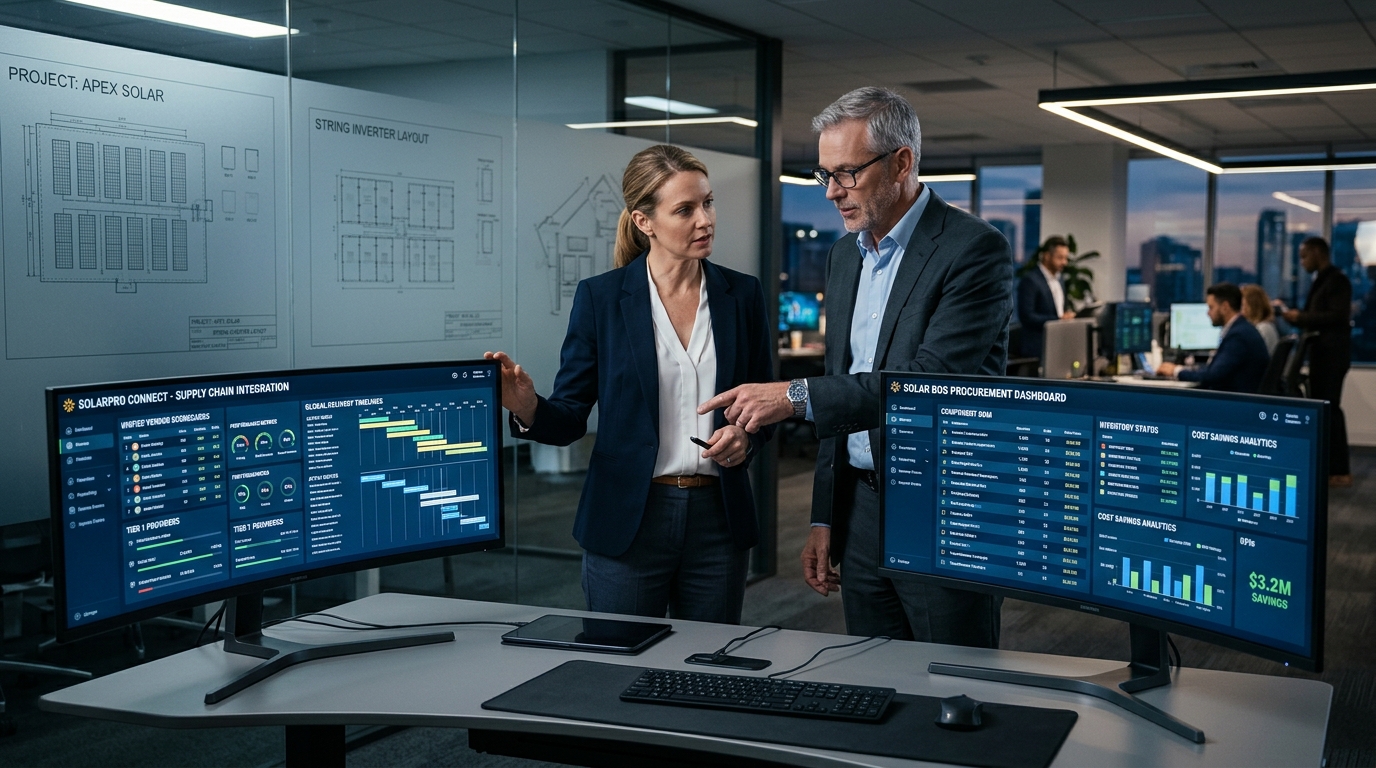
Beyond administrative drag, the greatest technical danger of fragmented procurement is Interface Risk—the physical, structural, and electrical failure modes that emerge at the demarcation boundaries between independently procured components. In an unbundled sourcing model, no single vendor holds responsibility for end-to-end component fit, compatibility, or system-level performance.
- Module Clamping Mismatch: MMS purlin pre-punched hole patterns do not align with the module manufacturer's updated 400mm-500mm mounting zones, voiding mechanical load warranties under IS 875 Part 3 wind pressures.
- Fastener Galling & Electrolysis: Stainless steel 304 bolts used on galvanized steel structures without dielectric isolation washers trigger rapid bimetallic galvanic corrosion in saline or high-humidity environments.
- Tracker Torque Tube Deflection: Drive torque tubes fail to interface with third-party damper brackets, causing severe torsional flutter during high-wind stow transitions.
- Terminal Lug Sizing Traps: Inverter DC input terminal blocks are engineered for maximum 6 sq mm cables, but the EPC's independent cable purchase specified 1x10 sq mm copper cables to mitigate 25-year ohmic voltage drop.
- Connector Cross-Mating Violations: Modules arrive with factory Staubli MC4-Evo2 connectors, while combiner box harnesses arrive with generic "MC4-compatible" clones. Intermating them violates IEC 62548 Section 7.3.8 and creates lethal thermal runaway arcing hazards.
- String Inverter MPPT Voltage Clipping: Modules selected without reference to inverter DC operating windows experience severe clipping during cold winter mornings when $V_{oc}(T_{min})$ breaches 1500V DC maximum input.
When interface mismatches occur on-site, the inevitable outcome is Vendor Finger-Pointing. The module supplier blames the MMS manufacturer; the MMS supplier blames the structural engineer; the inverter supplier blames the cabling contractor. The EPC contractor is left trapped in the middle, footing the bill for emergency field drilling, adaptor brackets, expedited re-cabling, and idle civil crew wages while the project deadline burns.
03 Strategic Supplier Rationalization: The Kraljic Matrix for Solar EPCs
World-class procurement organizations do not treat all commodities identically. By applying the proven Kraljic Portfolio Matrix specifically adapted for utility-scale and C&I solar procurement, EPCs can rationally separate strategic high-value assets from routine Balance of System hardware that should be aggressively consolidated.
Components: Tier-1 N-Type TOPCon bifacial modules, Central / High-Power String Inverters, 33kV/132kV Power Transformers.
Procurement Strategy: Direct long-term framework contracts, factory floor vendor audits, indexation collars, and deep technical vetting. Maintain direct relationships with 2 to 3 tier-1 manufacturers.
Components: DISCOM-compliant Class 0.2S CT/PT metering units, specialized bi-metallic friction-welded lugs, CEIG-mandated outdoor motorized isolators.
Procurement Strategy: Pre-qualification of regional utility-approved vendors. Consolidate within bundled electrical substation packages to eliminate procurement bottlenecks.
Components: Module Mounting Structure (MMS) cold-formed steel (YSt 450/550 Galvalume / POSMAC), 1500V DC XLPO Solar Cables, AC LT/HT Power Cables.
Procurement Strategy: Volume consolidation and bundled purchasing. Bundle structural steel, hardware, and fasteners into a single turn-key structural package to capture bulk pricing.
Components: Cable ties, UV-resistant labeling, HDPE conduits, earthing chemical compounds, perimeter fencing, lightning arrestors.
Procurement Strategy: Complete catalog bundling and vendor-managed inventory (VMI). Never issue individual purchase orders; fold entirely into the consolidated BOS partner scope.
By implementing this rationalization, an EPC transitions from an unwieldy roster of 35 suppliers down to an optimized 3-Package Procurement Architecture:
- Strategic Generation Package: Direct contract with Tier-1 PV Module and String Inverter OEMs.
- Integrated Balance of System (BOS) Package: Turnkey structural and DC/AC electrical components procured through an integrated engineering-procurement partner.
- Grid Substation & Interconnection Package: Unified HT switchyard, power transformer, and DISCOM-cleared telemetry equipment.
04 Bundling Balance of System (BOS): Electrical & Structural Synergy
Balance of System (BOS) accounts for approximately 40% to 52% of total solar plant CapEx, yet it encompasses over 85% of all individual part numbers and SKUs. Bundling electrical and structural BOS packages under a single accountable engineering supplier yields immediate technical and financial synergies that cannot be unlocked through piecemeal buying.
Procured as a single pre-engineered mechanical assembly certified to IS 875 Part 3 wind speeds:
- • Cold-Formed High-Yield Steel Columns, Rafters & Purlins (YSt 450 / YSt 550)
- • Advanced Anti-Corrosion Metallic Coatings (Pre-Galvanized, POSMAC, or 80-120μm HDGI)
- • SS304/SS316 Fastener Assemblies with Serrated Flange Nuts & EPDM Washers
- • Anodized Aluminum Clamps (Mid & End Clamps) matched to exact module frame depth (30mm/35mm)
- • Integrated Grounding / Bonding Pins for continuous metallic equipotential bonding
- • Foundation Piling Anchor Cages & Precision Template Jigs
Procured as a fully pre-tested, harmonized electrical circuit complying with IEC 62548 & IEC 61439-2:
- • 1500V DC Electron-Beam Cross-Linked Solar Cables (EN 50618 H1Z2Z2-K certified)
- • Genuine Staubli MC4-Evo2 Inline Connectors & Pre-Crimped Harness Extensions
- • Pre-Wired DC Array Junction Boxes (AJB) with 1500V DC Type I+II Surge Protection (SPD)
- • UV-Resistant Perforated Cable Trays with Snap-On Covers & Heavy-Duty Trefoil Clamps
- • Copper-Bonded Steel Earth Rods, Maintenance-Free Carbon Backfill & Testing Pits
- • Complete CEIG-Compliant Warning Signage, Mimic Diagrams & Safety Equipment
When structural and electrical packages are bundled, dimensional clearances, cable tray routing brackets, clamp earthing pathways, and foundation plinth penetrations are resolved in the digital CAD/BIM model before a single piece of steel is cut or a cable reel is shipped.
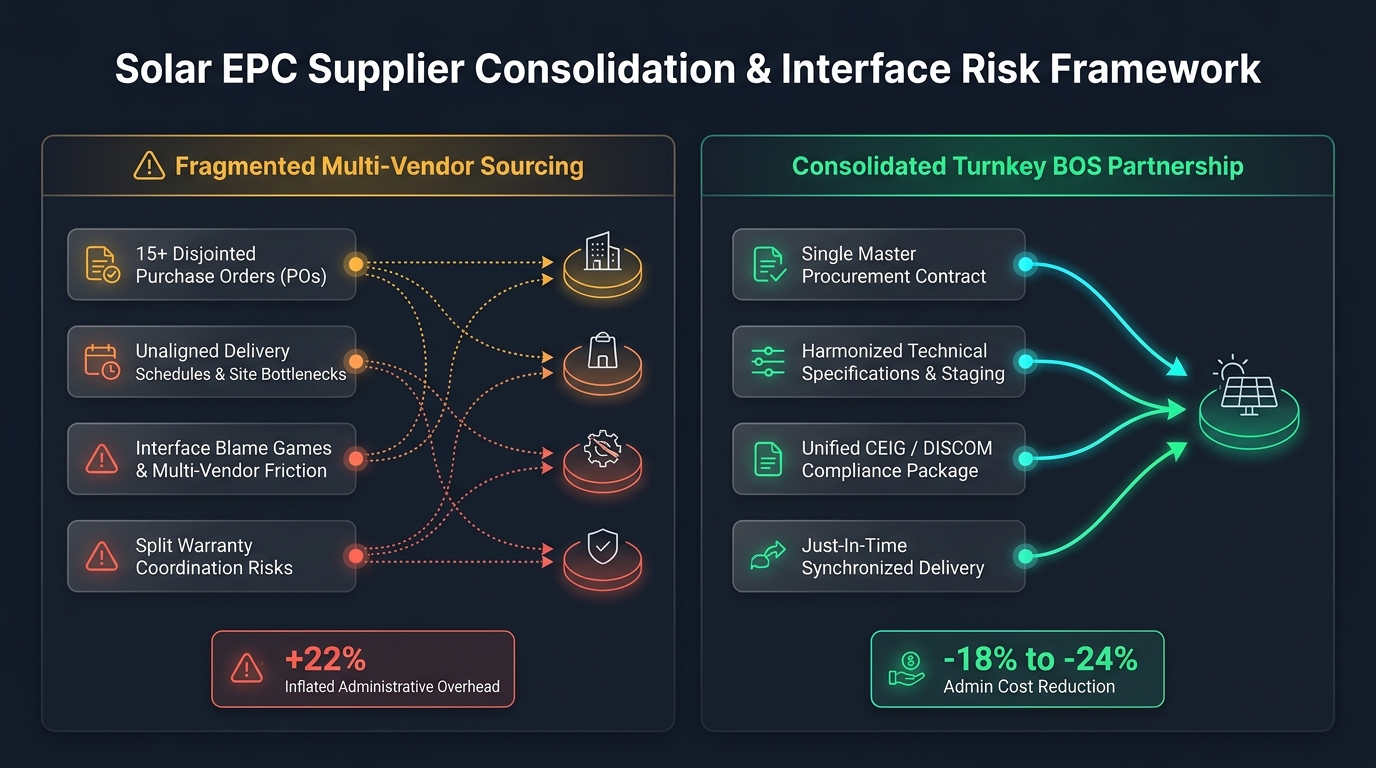
05 Technical Infographic: Solar EPC Supplier Consolidation & Interface Risk Framework
The visual framework below compares the operational realities of fragmented multi-vendor procurement against a consolidated engineering and turnkey BOS partnership, detailing transaction friction, risk transfer, delivery synchronicity, and bottom-line margin preservation.
06 The Turnkey Engineering-Procurement Advantage: Linking Design to Sourcing
The fundamental flaw in traditional solar project execution is the Siloed Wall between Engineering and Procurement. Engineering consultants produce theoretical drawings based on generic catalogue datasheets. Procurement departments then negotiate with completely different vendors based on unit price. When hardware reaches the field, site engineers must frantically redline drawings to accommodate the actual physical dimensions and electrical properties of the purchased components.
Partnering with an integrated engineering and supply specialist like V-TECH RENEWABLES bridges this structural divide through Pre-Engineered Procurement:
Exact module flash-test IV curves and bifacial backside irradiance models are fed directly into DC cable sizing calculations, maintaining strictly ≤ 1.0% ohmic loss while preventing over-speccing costly copper conductors.
Structural FEA calculations in STAAD.Pro directly generate computerized CNC fabrication files for purlin roll-forming, ensuring purlin hole patterns, tilt angles, and ground clearances match site topography with zero field welding.
Single Line Diagrams (SLDs) and protection coordination curves are drawn incorporating the exact verified CT/PT ratios, relay ANSI codes, and breaker breaking capacities of the supplied switchgear, guaranteeing first-attempt CEIG approval.
By fusing detailed engineering design with component sourcing, the EPC eliminates change orders, engineering revision cycles, and the recurring nightmare of mismatched terminal connections.
07 Synchronized Site Logistics & Just-In-Time (JIT) Delivery Optimization
On an active utility-scale solar construction site, logistics mismanagement destroys productivity. In an uncoordinated multi-vendor procurement scenario, freight deliveries arrive haphazardly:
- Twenty trucks of solar modules arrive before the mounting structures are erected, forcing the EPC to double-handle delicate pallets into temporary laydown yards, increasing micro-crack risks by over 300%.
- Mounting structure purlins arrive 4 weeks before the foundation anchor bolts, leaving steel exposed to weather while civil piling crews sit idle.
- Inverter skids arrive without the requisite pad-mounting hardware or cable gland plates, incurring crane standby charges of ₹75,000 per day.
| Construction Phase | Consolidated Package Delivered | Synchronized Timing | Operational Benefit |
|---|---|---|---|
| Phase 1: Civil & Foundation | Anchor bolts, pile templates, earth rods & perimeter earthing strip | Day 1 – Day 15 | Immediate piling without bolt waiting; 0 laydown congestion |
| Phase 2: Mechanical Assembly | MMS columns, rafters, purlins & torque-inspected fasteners | Day 16 – Day 35 | Direct offloading to installation blocks; zero double-handling |
| Phase 3: Module & DC Balance | Solar PV modules, clamps, DC cables, combiner boxes & connectors | Day 36 – Day 60 | Direct mounting from flatbeds to MMS; EL integrity preserved |
| Phase 4: AC & Grid Tie-In | Inverters, HT cables, transformers, switchgear & CEIG mimic panels | Day 61 – Day 75 | Rapid termination and statutory pre-commissioning testing |
Consolidating suppliers allows the EPC to enforce strict Block-Level JIT Kitting. Components are dispatched in synchronized batches matched to civil milestone completion, reducing site laydown footprint by 65% and eliminating port and trucking demurrage fees.
08 Unified Quality Assurance & Single-Window Warranty Administration
When an EPC procures from 20 different vendors, managing factory quality assurance becomes a logistical impossibility. Sending internal QA engineers or third-party inspection agencies to 20 separate workshops across 5 states requires immense budget and coordination. As a result, EPCs skip inspections on "minor" items like cable trays, combiner boxes, and fasteners—precisely the components where factory quality shortcuts cause devastating ground-faults, water ingress, and structural failures 3 years into plant life.
A consolidated supply partner manages centralized, ISO 2859-1 Level II quality inspections across all bundled sub-components before containerization. The EPC receives a single, unified Pre-Dispatch Inspection (PDI) dossier covering steel zinc thickness (XRF / magnetic gauge), DC cable spark testing, and IP66 enclosure sealing.
Instead of submitting separate warranty claims to multiple vendors who dispute responsibility, the EPC holds a single contractual warranty backed by defined Service Level Agreements (SLAs). If an inverter fault is traced to a combiner box surge failure, the consolidated partner replaces the assembly without cross-vendor disputes.
This unified framework also eliminates the dangerous "Broker Warranty Pass-Through" trap, where component brokers disappear or claim they are merely commercial intermediaries with zero product performance liability.
09 Comprehensive Multi-Vendor vs. Consolidated Solar Procurement Matrix
The comprehensive engineering and commercial matrix below details the operational trade-offs between managing an unbundled multi-vendor sourcing model versus transitioning to a consolidated engineering-procurement partnership.
| Evaluation Metric | Fragmented Multi-Vendor Sourcing | Consolidated Engineering & BOS Partner | Project Impact |
|---|---|---|---|
| Purchase Orders (POs) | 20 – 30 separate POs issued and managed | 2 – 3 consolidated package contracts | 85% reduction in contracting administration |
| Vendor Prequalification & KYC | 25 separate audits, balance sheets & GST checks | Single master partner evaluation | Saves 4-6 weeks in pre-construction phase |
| Interface Engineering Risk | High: frequent dimensional & terminal mismatches | Zero: single integrated engineering design envelope | Eliminates costly field re-drilling and rework |
| Invoicing & Accounting | 60+ invoices, multiple credit terms, complex GST reconciliation | Milestone-based progress billing against single PO | 65% reduction in accounts payable person-hours |
| Freight & Demurrage | Unsynchronized dispatches; high truck detention fees | Synchronized JIT delivery aligned with civil milestones | Cuts freight and demurrage costs by ₹12-25L |
| Statutory DISCOM / CEIG Drawings | Repeated drawing revisions due to mismatched vendor data | First-pass compliant SLD and layout documentation | Prevents 30-45 day grid connection delays |
| Factory Quality Audits (PDI) | Infeasible across 20 workshops; skipped on BOS items | Centralized ISO 2859-1 Level II inspection dossiers | Ensures strict quality compliance across all SKUs |
| Site Laydown Footprint | Massive laydown yard required; double handling damage | Streamlined laydown with direct-to-block installation | Cuts internal site handling costs by 40% |
| Warranty & RMA Claims | Multiple vendors dispute liability; finger-pointing | Single window accountability with 48h SLA response | Guaranteed plant uptime and O&M protection |
| Total Cost of Ownership (TCO) | High hidden costs: +18% to +24% administrative overhead | Lowest true TCO: volume pricing + zero rework penalties | Directly expands contractor net operating margin |
10 Real-World Case Study: 100 MWp Ground-Mount Project in Gujarat
Rescuing a High-Stakes Utility Project from Multi-Vendor Administrative Collapse
In early 2026, an EPC executing a 100 MWp utility-scale solar plant in Gujarat faced critical schedule collapse. Driven by an aggressive attempt to squeeze purchasing margins, the internal procurement group had split the project scope across 24 separate vendors. By Month 4 of construction, the project was paralyzed:
Accounts payable was backlogged with unmatched e-way bills and pricing discrepancy holds totaling ₹18.4 Crore.
Purlins fabricated in Punjab did not match the mounting holes of TOPCon modules shipped from Mundra, stalling installation.
State electrical inspectors rejected the SLD due to discrepancies between transformer protection ratings and breaker trip curves.
The V-TECH RENEWABLES Intervention
Retained as the Owner's Engineer and Turnkey Balance of System specialist, V-TECH RENEWABLES executed an emergency procurement restructuring:
- Vendor Rationalization: Terminated 16 non-performing peripheral vendor contracts and consolidated the entire structural and DC/AC electrical BOS into a single turnkey package under unified engineering governance.
- Digital Pre-Engineering: Re-engineered the MMS clamp profiles and purlin connection details in STAAD.Pro to eliminate on-site drilling, issuing pre-inspected clamp assemblies that restored module mechanical warranties.
- Unified DISCOM/CEIG Dossier: Harmonized switchgear protection coordination and redrafted complete electrical Single Line Diagrams, securing CEIG statutory approval within 9 days of resubmission.
- Sequenced JIT Staging: Implemented block-by-block synchronized deliveries, converting a chaotic 12-acre laydown yard into direct truck-to-purlin installation flow.
11 16-Point Solar Purchase Manager Supplier Consolidation & Rationalization Checklist
Before releasing purchase tenders for utility-scale or C&I projects, procurement directors should execute this comprehensive 16-point consolidation audit across four operational dimensions.
12 Frequently Asked Questions (FAQ)
How does supplier consolidation reduce administrative overhead in solar EPC projects?
Supplier consolidation reduces administrative overhead by condensing 15 to 25 separate purchase orders (POs), contracts, and vendor qualifications down to 2 to 3 integrated turnkey packages. This slashes internal transaction costs by 18% to 24%, cuts accounts payable invoice matching and GST reconciliation workload by over 60%, minimizes freight coordination and expediting calls, and dramatically simplifies site receiving quarantine and documentation audits.
What is "interface risk" in solar Balance of System (BOS) procurement?
Interface risk arises when physical, electrical, or structural boundaries between independently procured components fail to integrate seamlessly. Classic examples include module mounting structure (MMS) purlin hole spacing conflicting with module manufacturer clamping zones, DC combiner box terminal lugs not accepting larger cross-section solar cables, or string inverter MPPT voltage windows failing under high-temperature DC voltage fluctuations. In multi-vendor setups, each supplier disclaims liability, resulting in expensive site re-engineering and commissioning delays.
Does supplier consolidation lead to higher component prices through "margin stacking"?
No, this is an industry misconception. While component brokers may add trading markups, partnering with an integrated engineering and procurement firm (or a consolidated tier-1 BOS manufacturer) actually lowers net delivered cost. The bundled volume unlocks tier-1 factory pricing that mid-sized EPCs cannot achieve individually, while eliminating redundant freight legs, shared logistics demurrage, multiple third-party inspection mobilizations, and costly site rework.
How does bundling engineering design with equipment procurement streamline DISCOM and CEIG approvals?
When engineering design is unified with procurement, technical drawings (such as Single Line Diagrams, cable schedules, and STAAD structural reports) are drafted using exact verified manufacturer data sheets, type-test certificates, and CT/PT terminal specs rather than generic assumptions. This eliminates drawing revisions and queries from state DISCOMs and Electrical Inspectorate (CEIG) authorities, cutting statutory approval cycles from 6-8 weeks down to under 15 days.
What contractual safeguards should EPCs include when entering a consolidated supply agreement?
Key contractual safeguards include: (1) Single-point interface liability where the consolidated partner warrants end-to-end component fit and interoperability; (2) Back-to-back 25-year manufacturer warranties backed by insurance or escrow; (3) Synchronized Just-In-Time (JIT) delivery milestones tied to civil readiness with liquidated damages for site-blocking delays; (4) Pre-Dispatch Inspection (PDI) sign-off rights with ISO 2859-1 Level II sampling; and (5) Guaranteed 48-hour Mean Time to Resolution (MTTR) for defective part replacement.
Ready to Streamline Your Solar Procurement and Eliminate Interface Risk?
Partner with V-TECH RENEWABLES for integrated solar engineering, PVsyst yield simulations, STAAD structural optimization, and turnkey Balance of System (BOS) supply packages. Consolidate your supply chain, protect your project IRR, and guarantee first-attempt statutory approvals.