Vendor Audits: Ensuring Quality Control at the Factory Floor: A Solar EPC's Pre-Dispatch Inspection & Manufacturing Quality Guide
An authoritative technical engineering and procurement guide for solar EPC directors, purchase managers, and Owner's Engineers: establishing foolproof factory floor vendor audits, Bill of Materials (BOM) freeze governance, in-line robotic gate controls, dual-stage electroluminescence (EL) forensics, Class AAA+ sun simulator calibration, and ISO 2859-1 Pre-Dispatch Inspection (PDI) sampling protocols that prevent multi-crore site failures.

01 The Multi-Crore Site Failure Trap: Why Factory Audits Preempt Disaster
In modern utility-scale solar development, photovoltaic modules account for 48% to 58% of total project CapEx, while inverters, power transformers, and balance-of-system (BOS) switchgear comprise another 18% to 24%. Yet, despite this massive capital commitment, procurement executives frequently treat manufacturing oversight as a transactional paperwork exercise, relying solely on generic manufacturer datasheets, third-party laboratory type-test certificates, and self-certified factory test reports.
This hands-off procurement strategy represents one of the most perilous financial traps in the renewable energy industry. The economic reality of solar component manufacturing is brutal: the cost to rectify a manufacturing defect on the factory floor is less than 6% of the cost to resolve that exact same defect after it reaches an operating project site.
- • Defect Detection: Dual-stage inline EL & Class AAA+ flash testing
- • Action: Immediate string rework or raw cell scrap before lamination
- • Direct Cost per Rectified Unit: $0.50 – $2.00 (₹42 – ₹168)
- • Supply Chain Disruption: Zero site delivery delay; buffer lots utilized
- • Contractor Legal Exposure: Nil; contractual warranty gates enforce vendor liability
- • Net 100 MWp Exposure: ≤ ₹1.5 Lakh total absorption
- • Defect Detection: Drone thermography, hot-spot burning, string trip
- • Action: De-stringing, crane de-mounting, packing, re-freight, RMA claims
- • Direct Replacement Cost: $85 – $140+ per module (₹7,140 – ₹11,760)
- • Generation Revenue Loss: 3 to 6 months downtime per defective string
- • Contractual Consequence: Liquidated damages (LDs) for delayed commercial operation (COD)
- • Net 100 MWp Exposure (at 2.5% defect rate): ₹3.5 to ₹5.0 Crore in direct losses
In a standard 100 MWp utility solar project utilizing 585W bifacial N-Type TOPCon panels (approximately 171,000 modules), an undetected 2.5% defect rate yields 4,275 compromised panels scattered across 400+ acres of desert or scrubland terrain. Locating, unbolting, re-wiring, repackaging, and litigating replacement claims for thousands of modules in the field not only demolishes the EPC contractor's operating margins but permanently degrades plant Capacity Utilization Factor (CUF), imperiling long-term debt servicing and power purchase agreement (PPA) commitments.
02 Regulatory Standards & Quality Mandates: IEC, ISO, BIS & ALMM Framework
Factory audits must be grounded in an unyielding technical and statutory framework. When auditing solar PV module, inverter, and transformer manufacturing facilities, solar EPCs and independent technical advisors must audit compliance against both global performance standards and national statutory requirements.
IEC 62941: The Gold Standard for PV Manufacturing QMS
While ISO 9001 certifies generic business management processes, IEC 62941 (Terrestrial photovoltaic (PV) modules — Quality system for PV module-manufacturing) is tailored specifically for the solar photovoltaic industry. It dictates rigorous requirements for raw material traceability, Bill of Materials (BOM) freeze, automated process capability ($C_{pk} \ge 1.33$), sun simulator spectral mismatch auditing, continuous environmental stress screening (thermal cycling and damp heat), and change control governance.
IEC 61215 & IEC 61730 Design & Safety Qualification
IEC 61215 governs design qualification and type approval (mechanical load 5400 Pa snow / 2400 Pa wind, hail impact, PID susceptibility, and UV conditioning), while IEC 61730 (Parts 1 & 2) enforces module electrical safety, dielectric withstand (Hi-Pot), impulse voltage insulation, fire performance Class C/A, and ground continuity. Crucially, a type test certificate is valid only for the exact combination of bill of materials tested.
Bureau of Indian Standards (BIS) & IS 14286
In India, the Ministry of New and Renewable Energy (MNRE) mandates compulsory registration under the Electronics and Information Technology Goods (Requirements for Compulsory Registration) Order. Solar modules must hold valid registration under IS 14286 / IS/IEC 61730. Factory auditors must cross-examine the supplier's active BIS registration number, certified factory location address, and certified maximum power ratings against physical production line nameplates.
ALMM (Approved List of Models & Manufacturers) Mandate
For all government-tendered, open-access, PM-KUSUM, and grid-connected commercial solar projects in India, modules must be enlisted in the latest MNRE ALMM List-I. During factory audits, auditors must verify that the manufacturing unit's rated annual capacity, model series, and manufacturing machinery precisely match the specific factory premises inspected and gazetted by the National Institute of Solar Energy (NISE).
03 Bill of Materials (BOM) & Raw Material Verification: The First Line of Defense
The most pervasive risk encountered during factory audits is unauthorized Bill of Materials (BOM) substitution. When solar module manufacturers submit prototypes for IEC/BIS certification, they invariably assemble "Golden Samples" using premium, high-grade components: high-gel POE encapsulants, thick-gauge silver-coated ribbons, premium German/Japanese EVA, and flame-retardant junction boxes.
However, under the commercial pressure of razor-thin margins or supply chain crunches during mass commercial execution, secondary sub-tier components are frequently swapped in without notifying the EPC or Owner's Engineer. A rigorous factory audit freezes the approved BOM and enforces strict incoming raw material verification.
Audit wafer thickness consistency (130µm ± 10µm for N-type TOPCon, 150µm ± 15µm for P-type PERC). Check incoming batch inspection reports for minority carrier lifetime (≥ 1,000 µs for TOPCon), sheet resistance uniformity (±5%), and micro-crack screening via incoming 100% automated optical inspection (AOI) before cell stringing.
For bifacial glass-glass modules, pure POE or co-extruded EPE encapsulants are critical on the rear side to prevent Potential Induced Degradation (PID) and acetic acid corrosion. Auditors must verify film storage climate (temperature < 25°C, relative humidity < 60%) to prevent premature polymerization. Audit warehouse inventory for shelf-life expiry (≤ 6 months from extrusion) and demand daily laboratory Gel Content Soxhlet extraction test logs (mandatory ≥ 80% cross-linking for EVA, ≥ 70% for POE).
Verify glass thickness (2.0mm heat-strengthened for dual-glass bifacial, 3.2mm fully tempered for monofacial). Test anti-reflective (AR) coating durability through abrasion testing (ISO 9211), verify solar spectral transmittance (≥ 94.2% at 380–1100 nm), and inspect fragmentation break patterns (minimum 40 particles within a 50mm × 50mm square per EN 12150).
Audit multi-busbar (MBB) and 16BB round wire ribbons. Check core copper purity (≥ 99.99% ETP copper), coating thickness of Sn-Pb or Sn-Ag-Cu solder layer (15µm–25µm), yield strength (≤ 90 MPa to prevent cell bowing stress), and elongation capacity (≥ 20% to withstand diurnal thermal fatigue).
Inspect IP68 split-type junction boxes. Verify genuine bypass diodes (Schottky barrier diodes rated for ≥ 30A forward current, ≥ 50V reverse breakdown), UL 94 V-0 flame rating of PPO housing, two-part silicone potting gel filling completeness (zero air void cavities), and authentic Stäubli MC4-EVO2 or certified 1500V DC connectors.
04 In-Line Manufacturing Quality Gates: From Cell Stringing to Final Lamination
A high-speed module manufacturing line operates with robotic precision, producing a finished solar module every 20 to 30 seconds. To prevent defective sub-assemblies from moving downstream, an automated plant features four critical in-line manufacturing quality gates that auditors must verify on the floor.
G1 Cell Stringing & High-Frequency Induction Soldering
Temperature & Pull ForceAutomated stringers feed wafers, apply flux, and solder ribbons using high-frequency infrared or electromagnetic induction. Audit Mandate: Verify infrared soldering temperature profiles (calibrated to 230°C–255°C ± 5°C). Overheating causes silicon micro-fissures and thermal warp; underheating produces cold solder joints with high contact resistance. Auditors must witness physical 180° ribbon pull-force tests conducted every 4 hours: ribbon peel strength must exceed 1.5 N/mm per IEC 61215 with zero silicon cratering.
G2 Automated Layup & Pre-Lamination Optical Inspection (AOI)
Optical Geometry ±0.5mmRobotic arms lay out glass, encapsulant sheets, soldered cell strings, busbar copper ribbons, and top encapsulant/glass layers. Audit Mandate: Inspect automated optical inspection (AOI) vision systems. Ensure inter-cell spacing tolerance (≤ ±0.3mm), string-to-string parallel alignment (≤ ±0.5mm), and edge margin clearances (≥ 12mm from active cells to glass edge) are strictly maintained. Foreign object debris (hair, solder splatter, dust particles) must trigger automatic rejection before the sandwich enters the laminator.
G3 Multi-Stage Vacuum Lamination & Thermal Cross-Linking
Vacuum <1 mbar / 148°CThe lamination chamber cures encapsulant polymers under vacuum and elevated heat, creating a hermetic, bubble-free laminate. Audit Mandate: Review 9-point thermocouple temperature uniformity logs across upper and lower heating plates (temperature differential across entire 2.4m × 1.3m bed must not exceed ±2.0°C). Chamber vacuum must reach < 1.0 mbar within 120 seconds to evacuate all entrapped air. Verify total dwell cycle time (typically 360–420 seconds at 145°C–152°C). Inadequate vacuum causes micro-bubbles; excessive pressure crushes fragile wafers.
G4 Framing, Silicone Seal Dispensing & Junction Box Potting
Hermetic SealingAnodized aluminum frames provide structural rigidity against 5400 Pa mechanical loads, sealed with structural neutral silicone or double-sided adhesive tape. Audit Mandate: Inspect automated robotic silicone dispensing nozzles. Ensure continuous bead volume without gaps or air bubbles along frame grooves. Measure aluminum frame anodization layer thickness (≥ 15µm Class AA15 per ISO 7599). Verify automatic two-part silicone potting dispensing in junction boxes with gravimetric mixing ratio checks (±2% tolerance) to guarantee IP68 ingress protection.
05 Technical Infographic: Solar EPC Vendor Audit & PDI Protocol Matrix
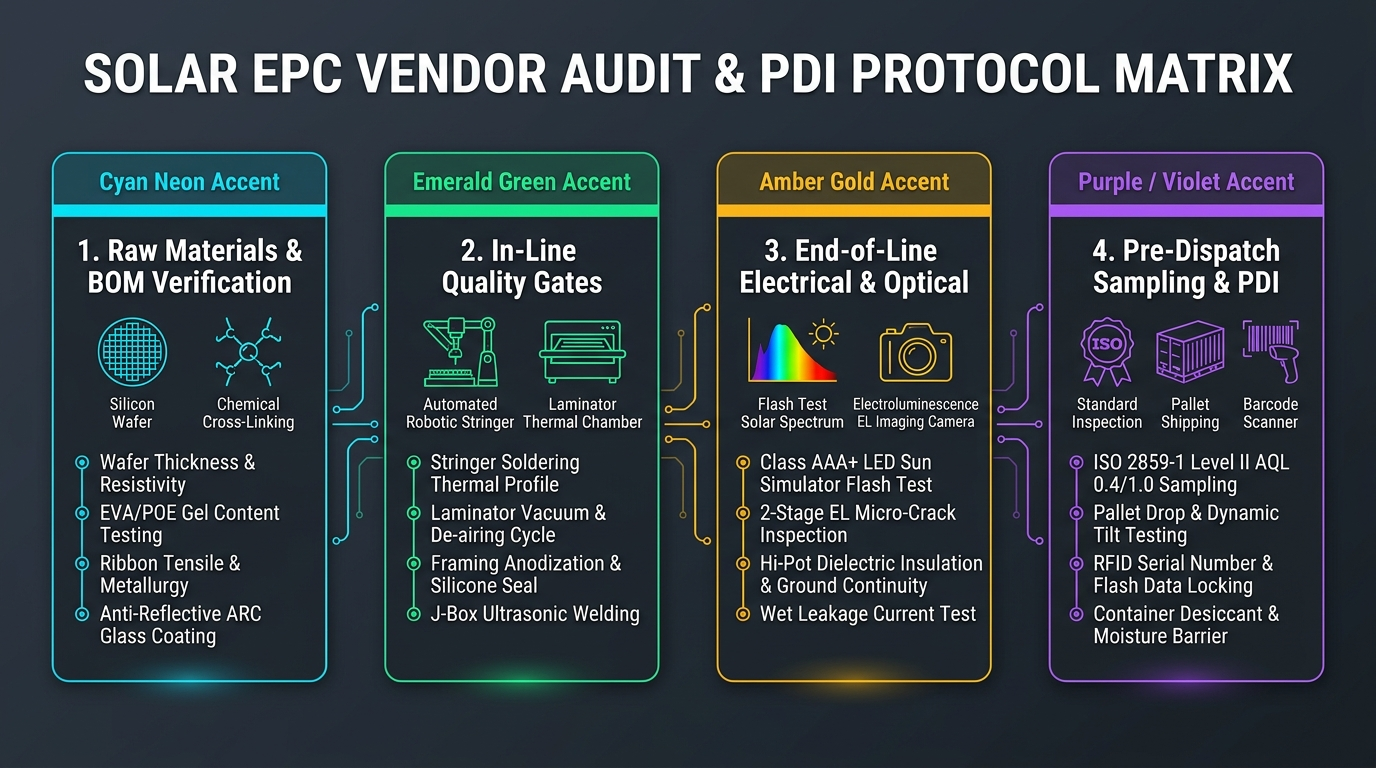
Freezes wafer specifications, anti-reflective glass transmittance, POE gel cross-linking ratio (≥80%), and genuine MC4-EVO2 connectors against certified type-test records.
Enforces 180° ribbon pull strength (>1.5 N/mm), automated 9-point thermal lamination uniformity (±2°C), and continuous frame silicone bead dispensing.
Mandates Class AAA+ LED flash testing calibrated to primary Golden Modules, 2-stage EL micro-crack screening, and 6,000V DC Hi-Pot insulation withstand testing.
Applies ISO 2859-1 Level II normal sampling with strict AQL 0.4 major defect threshold, ISTA pallet drop tests, and tamper-proof RFID container bolt seals.
06 End-of-Line Diagnostic Testing: Electroluminescence (EL) & Sun Simulator Flash Calibration
Once a module exits the automated framing and junction box curing line, it must pass through rigorous end-of-line (EOL) electrical and optical diagnostics. These tests represent the final objective hurdle before packaging. Two diagnostic systems are paramount: Electroluminescence (EL) imaging and Sun Simulator Flash Testing.
Dual-Stage Electroluminescence (EL) Crack Forensics
Electroluminescence operates on the inverse of the photovoltaic effect: when a forward electrical current is injected through the module's terminal cables in a darkened chamber, the solar cells emit near-infrared radiation (~1,150 nm wavelength). High-resolution CCD or InGaAs cameras capture this emission. Active, healthy silicon emits bright light, while fractured areas, dead grid fingers, and micro-cracks appear as stark black voids.
Scans assembled strings immediately after automatic stringing before sandwich layup. Identifies raw wafer micro-cracks, mechanical edge chipping, and defective soldering ribbon joints. Discovering cracks at this stage allows robotic or manual replacement of a single 50-cent cell without wasting expensive glass, EVA, backsheet, or lamination chamber energy.
Scans the fully framed, cured, and wired module. Crucially uncovers latent stress cracks, soldering dislocations, and cell breakage induced by thermal shock and vacuum pressure within the laminator. Any module exhibiting dendritic cracks spanning >30% of a cell area or isolating active electrical zones must be downgraded or rejected immediately.
Class AAA+ Sun Simulator Flash Test Calibration & Traceability
Every solar module's nameplate capacity ($P_{mp}$), open-circuit voltage ($V_{oc}$), short-circuit current ($I_{sc}$), and fill factor ($FF$) are measured on an automated flashtester under Standard Test Conditions (STC: 1000 W/m² irradiance, 25°C cell temperature, AM 1.5G spectrum per IEC 60904-3).
| Parameter | Class A Requirement | Class A+ Requirement | Auditor Verification Protocol |
|---|---|---|---|
| Spectral Match (300–1200 nm) | 0.75 – 1.25 | 0.875 – 1.125 | Verify spectroradiometer certification records (≤ 6 months) |
| Spatial Non-Uniformity | ≤ 2.0% | ≤ 1.0% | 64-point matrix sensor uniformity map across entire active aperture |
| Temporal Instability (STI / LTI) | ≤ 0.5% | ≤ 0.25% | Monitor pulse stability during 10–30 ms flash duration |
The Golden Module Mandate: Auditors must verify that the factory flashtester is calibrated at least once per shift using an internationally traceable "Golden Reference Module" certified by accredited metrology laboratories such as Fraunhofer ISE (Germany), TÜV Rheinland, or NREL (USA). Unscrupulous manufacturers frequently configure flashtesters with a subtle +1.5% to +2.5% positive power offset, artificially inflating reported wattage and shortchanging the EPC of megawatt-hours of contracted energy yield.
07 Statistically Rigorous Pre-Dispatch Inspection (PDI) Sampling: ISO 2859-1 (AQL)
When conducting a Pre-Dispatch Inspection on finished production lots stored in the manufacturer's finished goods warehouse, testing every single module is economically impractical. Instead, solar EPCs and Owner's Engineers mandate statistically defensible acceptance sampling per ISO 2859-1 (ANSI/ASQ Z1.4): Sampling procedures for inspection by attributes — Part 1: Sampling schemes indexed by acceptance quality limit (AQL) for lot-by-lot inspection.
Inspection Level & Defect Classification
Pre-Dispatch Inspections must adhere to General Inspection Level II (Normal Single Sampling Plan). Defects discovered during sampling are categorized into three distinct severity tiers, each governed by its own Acceptable Quality Limit (AQL):
Defects that compromise electrical safety, present life-threatening shock or fire hazards, or cause immediate operational shutdown. Examples include: broken or shattered tempered glass, reversed electrical polarity, exposed live conductor wiring, missing ground continuity, failure of Hi-Pot dielectric withstand test (dielectric breakdown at 6,000V DC peak), or unpotted, unsealed junction boxes. A single critical defect rejects the entire production lot instantly.
Defects that materially reduce module energy output, induce premature power degradation, or cause long-term mechanical failure. Examples include: flash test power output below nameplate tolerance ($P_{mp} < P_{rated}$), dendritic microcracks on cells spanning >30% of cell width on EL scan, encapsulant delamination >10 mm² or within 20mm of active cells, soldering ribbon cold joints, severe frame bow (>2.5mm), or missing safety grounding markings.
Defects that affect aesthetic appearance or minor workmanship without degrading electrical energy yield or mechanical durability over 25 years. Examples include: light surface anodization scratches on frame outer flange (<50mm length), minor barcode label misalignment, slight EVA excess flash around frame lip, or negligible anti-reflective coating color hue variation.
| Lot Size (Modules) | Sample Size ($n$) | Critical (AQL 0.0) [Ac / Re] | Major (AQL 0.4) [Ac / Re] | Minor (AQL 1.0) [Ac / Re] |
|---|---|---|---|---|
| 1,201 – 3,200 | 125 | 0 / 1 | 1 / 2 | 3 / 4 |
| 3,201 – 10,000 | 200 | 0 / 1 | 2 / 3 | 5 / 6 |
| 10,001 – 35,000 | 315 | 0 / 1 | 3 / 4 | 7 / 8 |
| 35,001 – 150,000 | 500 | 0 / 1 | 5 / 6 | 10 / 11 |
08 Factory Floor Red Flags & Contractual Quality Gateways
Experienced solar quality auditors look beyond polished PowerPoint presentations and boardroom hospitality. Factory floor realities reveal whether a manufacturer genuinely prioritizes quality or merely orchestrates a stage-managed audit.
Automated visual stringer cameras or AOI stations taped over, muted, or set to broad sensitivity thresholds to maintain factory line speed quotas at the expense of defect detection.
Unqualified line operators manually replacing damaged cells with uncalibrated soldering irons, uncontrolled flux chemistry, and zero secondary EL verification post-repair.
EVA and POE film rolls stored at ambient warehouse temperatures exceeding 30°C without active air-conditioning, inducing pre-cross-linking and brittle laminates.
Flashtester reference cells with expired laboratory calibration certificates (>12 months old) or artificial positive calibration correction factors inserted into test software.
Modules on production conveyors without internal glass barcode labels, preventing reverse genealogical tracking of specific wafer ingot, ribbon spool, and EVA batch lots.
Vertical module packaging pallets using substandard cardboard corner posts (<4mm thickness), missing anti-static plastic wrapping, or lacking desiccants for oceanic container transit.
Contractual Quality Gateways in Solar EPC Agreements
To transform technical factory audit findings into legally enforceable protections, solar EPCs and asset owners must hardcode specific Quality Gateways into equipment supply contracts:
- • Unannounced Factory Access: The EPC and its appointed Independent Engineer (IE) retain unhindered physical access to manufacturing premises, raw material warehouses, and testing laboratories with 48 hours' written notice.
- • Pre-Dispatch Inspection Certificate as Payment Milestone: Milestone payment releases (typically 10% to 20% of purchase order value) are strictly contingent upon formal issuance of an unconditional PDI Inspection Certificate signed by the EPC's QA Lead.
- • Supplier Liability for Re-Inspection Costs: In the event a production lot is rejected under ISO 2859-1 AQL criteria, the manufacturer absorbs 100% of the cost of lot sorting, re-testing, and third-party auditor re-mobilization flights and accommodation.
- • BOM Change Approval Protocol: Any modification to the bill of materials (including raw cell supplier, encapsulant formulation, backsheet supplier, or junction box model) requires formal engineering submittal and written approval from the Owner's Engineer.
09 Comprehensive Solar Module Vendor Audit & PDI Inspection Matrix
The following technical audit matrix serves as the standard engineering baseline employed by V-TECH RENEWABLES quality assurance auditors during manufacturing plant evaluations and Pre-Dispatch Inspections across India and international supply corridors.
| Stage | Audit Parameter | Inspection Tool / Method | Acceptance Threshold | Governing Standard | Severity |
|---|---|---|---|---|---|
| Incoming Raw Materials | EVA / POE Gel Content | Soxhlet solvent extraction | ≥ 80% (EVA) / ≥ 70% (POE) | ASTM D2765 | Major |
| Incoming Raw Materials | Glass ARC Transmittance | UV-Vis Spectrophotometer | ≥ 94.2% (380–1100 nm) | ISO 9050 / EN 410 | Major |
| Cell Stringing | Ribbon Soldering Peel Force | Digital 180° peel tester | > 1.5 N/mm (zero cratering) | IEC 61215-2 | Major |
| Cell Stringing | Pre-Lamination EL Scan | High-resolution NIR CCD | Zero active cell micro-cracks | IEC TS 60904-13 | Major |
| Lamination | Temperature Bed Uniformity | 9-channel thermocouple data logger | ± 2.0°C across entire platen | IEC 62941 | Major |
| Framing & JB | Frame Anodization Layer | Eddy-current thickness gauge | ≥ 15 µm (Class AA15) | ISO 2360 / ISO 7599 | Minor |
| End of Line | Dielectric Insulation (Hi-Pot) | High voltage safety tester | Zero breakdown at 6000V DC | IEC 61730-2 MST 16 | Critical |
| End of Line | Wet Leakage Insulation | Water bath megohmmeter | > 40 MΩ·m² at 1500V DC | IEC 61215-2 MST 17 | Critical |
| End of Line | Flash Power Tolerance | Class AAA+ LED sun simulator | 0 to +3% positive power binning | IEC 60904-9 | Major |
| Packaging & Dispatch | Pallet Dynamic Shock & Drop | ISTA 3A incline impact test | Zero glass crack / zero frame warp | ISTA 3A / ASTM D4169 | Major |
10 Real-World Case Study: 150 MWp Rajasthan Utility-Scale Solar Project Audit
Bhadla Solar Park • 150 MWp N-Type TOPCon Pre-Dispatch Audit
A premier institutional IPP commissioned V-TECH RENEWABLES to conduct independent manufacturing qualification audits and Pre-Dispatch Inspections (PDI) for a 150 MWp utility-scale solar PV facility in Rajasthan. The project utilized 585W bifacial N-Type TOPCon dual-glass modules procured under a high-volume supply agreement with a Tier-1 manufacturing facility in Gujarat.
- Laminator Zone 3 Thermal Drift: Multi-channel thermocouple logging uncovered a localized +11°C temperature drift in heating plate zone 3 of Laminator #2 (operating at 162°C instead of setpoint 151°C). Subsequent Soxhlet extraction tests revealed premature encapsulant decomposition and localized gel content dropping to 66% (statutory minimum ≥80%), which would have triggered catastrophic premature delamination within 3 years in the extreme heat of Rajasthan.
- Flashtester Sun Simulator Offset: Cross-checking the factory's primary LED sun simulator against V-TECH's independent Fraunhofer-certified Golden Module revealed an uncalibrated +1.8% positive flash power offset. Modules certified as 585W were in reality testing at an average of 574.5W.
- PDI Lot Defect Rate: During ISO 2859-1 AQL inspection of Batch #3 (25,000 modules; sample size 315), 7 major defects were identified (4 dendritic microcracks on EL and 3 instances of ribbon displacement), exceeding the rejection threshold of 4.
- Lot Quarantine & Recalibration: Batch #3 was officially rejected and quarantined. The manufacturer was compelled to halt Laminator #2, replace faulty heating elements, re-profile thermal platens, and recalibrate the flashtester software against the Fraunhofer reference standard.
- 100% Re-Flash & Re-Binning: 32,000 modules were re-flashed at the supplier's cost under V-TECH auditor surveillance, resulting in appropriate wattage derating and fair commercial price adjustments.
- Financial Value Preserved: Eliminating the 1.8% power offset and preventing premature delamination protected ₹4.75 Crore in lifetime PPA generation revenue and averted contractual liquidated damages for the IPP.
11 16-Point Solar Purchase Manager Factory Audit & PDI Checklist
Solar procurement heads, supply chain managers, and quality assurance leads should mandate this 16-point operational checklist across every component manufacturing contract:
- ✓ 01. Verify active BIS registration, IEC 61215/61730 certificates, and MNRE ALMM List-I gazetted capacity.
- ✓ 02. Execute legally binding Bill of Materials (BOM) Freeze agreement listing sub-tier suppliers for all 14 module components.
- ✓ 03. Audit manufacturer's ISO 9001, ISO 14001, and IEC 62941 quality system surveillance audit reports.
- ✓ 04. Review laboratory calibration records for factory sun simulators and Golden Reference Modules (≤ 12 months).
- ✓ 05. Inspect automated cell stringer infrared temperature profiles (230°C–255°C) and ribbon tensioning.
- ✓ 06. Witness random 180° soldering peel-force tests on cell busbars (mandatory >1.5 N/mm pull strength).
- ✓ 07. Verify 100% Stage 1 Pre-Lamination EL inspection line for wafer micro-cracks and dead fingers.
- ✓ 08. Audit multi-channel thermocouple logs for laminator vacuum (<1 mbar) and platen uniformity (±2°C).
- ✓ 09. Inspect 100% Stage 2 Post-Lamination EL scans for pressure-induced cell cracks and busbar bridges.
- ✓ 10. Perform calibration check on Class AAA+ sun simulator using certified independent Golden Module.
- ✓ 11. Enforce strictly positive power binning (0 to +3%) with zero negative flash tolerance on $P_{mp}$.
- ✓ 12. Verify 100% automated Dielectric Hi-Pot (6000V DC) and Ground Continuity resistance (<0.1 Ω).
- ✓ 13. Execute ISO 2859-1 Level II normal sampling with strict AQL 0.0 critical and AQL 0.4 major defect caps.
- ✓ 14. Audit vertical wooden pallet construction, heavy cardboard corner protection, and anti-static wrapping.
- ✓ 15. Affix 3-axis dynamic impact shock loggers (>3G trigger) on random pallets prior to container loading.
- ✓ 16. Secure container doors with numbered RFID tamper-evident bolt seals recorded on the PDI Release Certificate.
12 Frequently Asked Questions (FAQ)
What is the difference between a factory qualification audit and a Pre-Dispatch Inspection (PDI)?
A factory qualification audit assesses the overall capability, quality management system (ISO 9001, IEC 62941), equipment calibration, environmental controls, and supply chain governance of a manufacturer before placing a purchase order. In contrast, a Pre-Dispatch Inspection (PDI) is a lot-specific verification conducted on finished goods before shipment release. PDI inspects the exact modules or components produced for your specific order against the approved Bill of Materials (BOM), utilizing ISO 2859-1 statistical sampling (AQL), flash test power verification against calibrated Golden Modules, dual-stage electroluminescence (EL) defect checks, Hi-Pot insulation tests, and pallet structural packaging audits.
Why are factory floor defect rectifications significantly cheaper than site-level module replacements?
Correcting or scrapping a defective cell, mismatched ribbon, or delaminated encapsulant during manufacturing costs less than $0.50 to $2.00 per unit in raw materials and localized labor. Once defective modules reach a remote project site, identifying, decommissioning, crating, re-testing, returning, and replacing a single damaged module costs upwards of $85 to $140 per unit when factoring in crane and machinery mobilization, site engineer diagnostics, freight demurrage, transit insurance deductibles, and lost generation revenue. For a 100 MWp utility solar project with an uninspected 2.5% defect rate (over 4,200 panels), unaddressed factory defects create over ₹3.5 to ₹5.0 Crore in direct replacement CapEx and contractual liquidated damages.
What standard sampling plan and AQL thresholds should solar EPCs mandate during Pre-Dispatch Inspections?
Solar EPCs and Owner's Engineers should enforce ISO 2859-1 (ANSI/ASQ Z1.4) General Inspection Level II Normal Single Sampling Plan. Defect classifications must adhere to rigorous Acceptable Quality Limits (AQL): Critical Defects (AQL 0.0 - zero tolerance for safety risks like reversed polarity, glass breakage, arcing junction boxes, or dielectric breakdown); Major Defects (AQL 0.4 for performance-degrading issues like negative flash power tolerance, cell microcracks covering >30% area, EVA delamination >10mm², or incorrect cell binning); and Minor Defects (AQL 1.0 for cosmetic blemishes, minor frame anodization scratches, or label misalignments). For a batch of 20,000 modules (sample size 315 units), the batch must be rejected if 4 or more major defects are detected.
How does dual-stage electroluminescence (EL) testing identify invisible micro-cracks before lamination?
Dual-stage electroluminescence (EL) applies forward electrical bias to solar cells, causing recombining electrons and holes to emit near-infrared light (1,150 nm) captured by cooled silicon CCD/InGaAs cameras. Stage 1 (Pre-Lamination EL) scans raw stringed cells immediately after automated soldering, identifying wafer micro-fractures, mechanical stress chips, and dead finger grid lines before the expensive encapsulation process. Stage 2 (Post-Lamination EL) scans the finished, cured module to detect latent microcracks and internal contact dislocations induced by lamination vacuum pressure (up to 1 bar) and thermal stresses. Rejecting defective strings at Stage 1 saves the cost of glass, EVA/POE, backsheet, and lamination cycle time.
What contractual safeguards should be embedded in equipment purchase agreements regarding factory audits?
Equipment purchase agreements must include: (1) Mandatory Independent Engineer (IE) factory access rights with 5 business days' notice; (2) Unconditional BOM Freeze schedules prohibiting supplier component substitutions without formal written EPC engineering change approval; (3) Pre-Dispatch Inspection (PDI) sign-off as a contractual condition precedent for dispatch release and milestone payment authorization (typically 10%–20% of PO value); (4) Manufacturer obligation to provide certified Golden Module calibration records traceable to Fraunhofer ISE or NREL; and (5) Clear contractual liability where the vendor reimburses all third-party re-inspection expenses and flight logistics if a production lot fails PDI thresholds.
Secure Bankable Quality with V-TECH RENEWABLES Factory Audits
Protect your multi-crore solar capital investments before components ever leave the manufacturing plant. V-TECH RENEWABLES provides independent factory qualification audits, Bill of Materials forensic verifications, and on-site Pre-Dispatch Inspections (PDI) across India's leading solar manufacturing facilities.