The Impact of Copper Price Fluctuations on Solar Cabling Budgets: Hedging Strategies & Aluminum Alternative Evaluations
An authoritative structural and electrical engineering guide for solar EPC purchase managers, project directors, and Owner's Engineers analyzing the economics of copper price volatility: metallurgical conductivity physics, 1500V DC string vs. trunk circuit sizing, friction-welded bi-metallic terminations, 25-year PVsyst ohmic loss lifecycle modeling, and bankable LME/MCX commodity hedging collars.
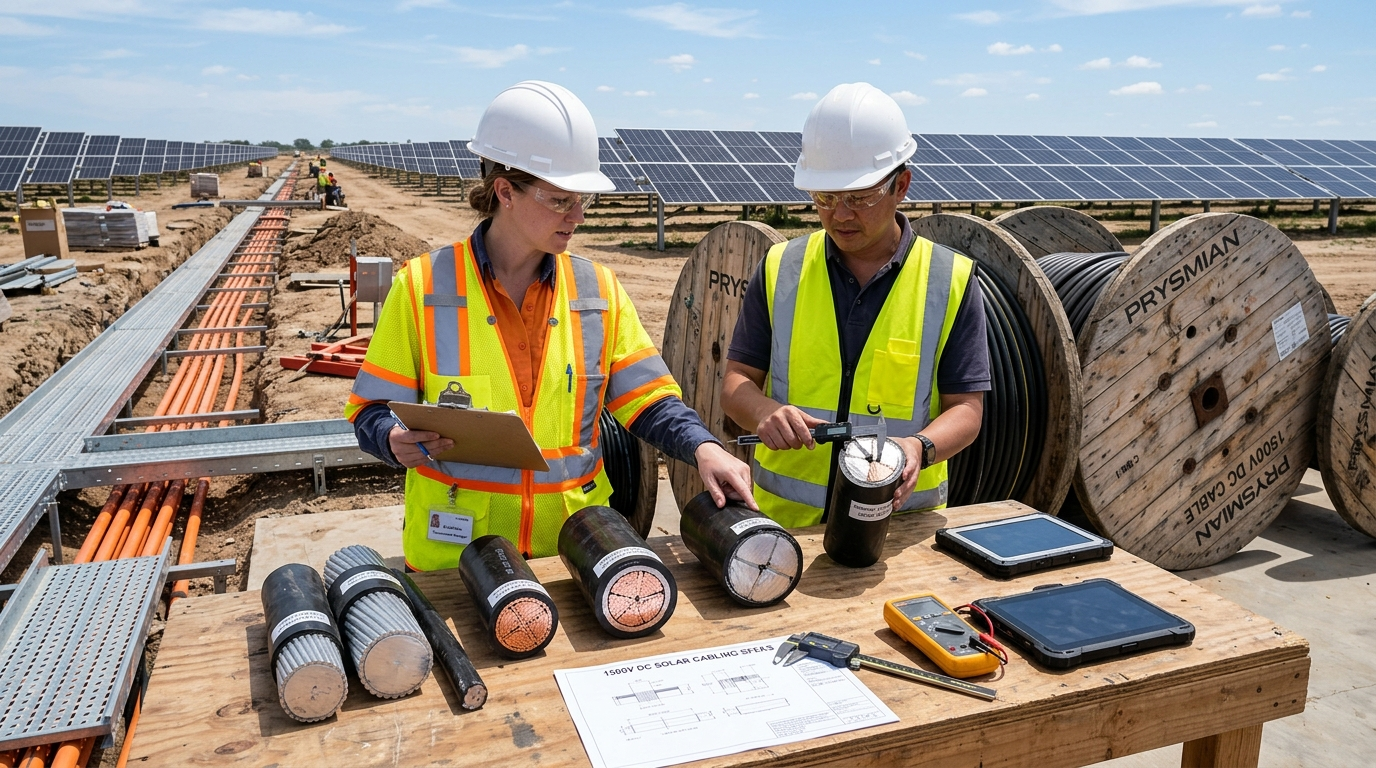
01 The Volatility Trap: Why Copper Price Swings Threaten Solar EPC Profitability
In utility-scale and large commercial and industrial (C&I) photovoltaic engineering, electrical balance of system (EBOS) infrastructure constitutes 12% to 18% of non-module project CapEx, with low-voltage and medium-voltage power cabling forming its single largest component line item. A 100 MWp utility solar farm requires between 380 to 520 kilometers of 1500V DC string cables, 65 to 95 kilometers of heavy-gauge DC trunk cables connecting array combiner boxes to central inverter blocks, and over 45 kilometers of 33 kV medium-voltage AC reticulation cabling.
Historically, engineering procurement teams treated cabling as a late-stage commodity, issuing purchase orders 60 to 90 days before mechanical completion based on static pre-bid budget estimates. However, the global copper market has entered a structural paradigm shift characterized by severe price volatility. London Metal Exchange (LME) copper cash prices regularly fluctuate between $8,200/MT and $10,800+/MT within single project delivery cycles, exacerbated in Asian and emerging markets by foreign exchange depreciation (USD to INR exchange rate shifts).
- • Total Cabling CapEx (100 MWp Baseline): ₹18.5 Crore ($2.22M)
- • Pure Copper Conductor Cost Component: 55%–65% (₹11.2 Crore)
- • 25% Unanticipated LME Copper Price Spike: +₹2.80 Crore Overrun
- • Total EPC Operating Margin on 100 MWp: 6.0% (₹21.0 Crore)
- • EBITDA Margin Depletion: −13.3% of Total Profit Wiped Out
- • Copper Maintained: 1500V DC Strings on Trackers (Class 5 Tinned Cu)
- • Aluminum Re-Engineered: DC Trunk & 33kV MV Feeders (AA 8000 / EC Al)
- • Net Conductor CapEx Reduction: ₹4.20 Crore Instant CapEx Relief
- • Bilateral IEEMA/LME Price Collar: Caps Risk to ±3.5% Deadband
- • EPC Profit Protection: 100% Margin Preserved + ₹1.4 Crore Bonus Incentive
When raw copper rallies during the 6 to 9 month gestation period between EPC tender submission and hardware dispatch, fixed-price contracts without contractual Price Variation Clauses (PVC) force EPCs to absorb the entire loss. To survive in high-inflation commodity environments, forward-looking engineering heads and procurement managers are deploying a two-pronged strategy: strategic financial hedging combined with a rigorous, physics-based techno-commercial evaluation of electrical-grade aluminum conductors across solar array circuits.
02 Metallurgy & Electrical Physics: Annealed Copper vs. Electrical Grade Aluminum
Evaluating aluminum as a replacement for copper requires an uncompromised understanding of electrical physics, metallurgical conductivity, and thermodynamic behavior. Neither metal is universally superior; each possesses distinct physical properties that dictate appropriate deployment across the solar electrical hierarchy.
1. Electrical Conductivity & The Resistivity Multiplier
Under the International Annealed Copper Standard (IACS), pure electrolytic tough pitch (ETP) annealed copper is defined as 100% IACS, corresponding to a volumetric electrical resistivity (ρ) of 0.017241 Ω·mm²/m at 20°C. In contrast, pure Electrical Conductor (EC) Grade Aluminum (Alloy 1350) achieves 61.0% to 61.8% IACS, exhibiting an electrical resistivity of 0.028264 Ω·mm²/m at 20°C.
To maintain identical DC resistance (R = ρ × L / A) and achieve equivalent voltage drop under identical circuit length and string current:
Therefore, an aluminum conductor requires approximately 64% larger cross-sectional area than an annealed copper conductor to deliver identical ohmic resistance and ampacity. In real-world cable schedules, this dictates stepping up by one or two standard metric sizes: 4 mm² Cu → 6 mm² Al; 16 mm² Cu → 25 mm² Al; 240 mm² Cu → 400 mm² Al; 300 mm² Cu → 500 mm² Al.
2. The 50% Mass Gravitational Advantage
While aluminum requires a 1.64× volumetric expansion, its specific gravity is dramatically lower than copper:
- Density of Electrolytic Copper: 8.89 g/cm³
- Density of Electrical Aluminum: 2.70 g/cm³ (−69.6% lighter per unit volume)
When accounting for the 1.64× cross-sectional upsize, the resulting mass comparison yields:
An electrically equivalent aluminum conductor weighs exactly half (50%) of the copper conductor it replaces. This mass reduction generates massive compounding savings across structural balance of system (BOS): cable tray dead loads are halved, mechanical pulling tension during underground conduit installation drops by 40%–50%, and long-distance freight shipping costs from wire mills to remote desert project sites decrease substantially.
3. Thermodynamic & Mechanical Properties: EC 1350 vs. AA 8000 Alloys
Early historical failures of aluminum cabling in commercial buildings during the 1970s stemmed from deploying pure utility-grade EC 1350 aluminum wire into mechanical screw terminals. EC 1350 suffers from low yield strength (70–110 MPa) and severe mechanical creep (cold flow under screw pressure).
Modern solar engineering mandates AA 8000 series aluminum alloy (specifically AA 8030 or AA 8176) per ASTM B800/B801 and IEC 60228 standards. AA 8000 alloys incorporate controlled micro-alloying elements of iron (0.3%–0.8%) and copper/silicon, creating a fine-grained metallurgical microstructure that delivers:
- Superior Tensile Yield Strength: 115 to 150 MPa (preventing necking during pulling).
- Exceptional Creep Resistance: Over 5× higher resistance to permanent deformation under terminal clamping torque compared to EC 1350.
- Enhanced Elongation & Flexibility: Capable of multiple reverse bends without micro-fissuring or strand hardening.
- Thermal Expansion Differential: Aluminum expands at 23.1 × 10⁻⁶/K vs. 16.5 × 10⁻⁶/K for copper (~40% higher expansion). Under diurnal thermal cycles (cooling to 5°C at night and heating to 65°C under peak mid-day desert irradiance), aluminum conductors undergo significant thermal pulsing, which mandates specialized spring-loaded termination hardware.
03 Solar Cabling System Hierarchy: Where Aluminum Excels and Where Copper is Non-Negotiable
A common procurement mistake is treating solar plant cabling as an "all-copper" or "all-aluminum" binary decision. Bankable solar electrical engineering divides the plant into distinct operational zones, deploying copper where mechanical flexibility and connector compatibility are paramount, and transitioning to aluminum where high current volume, long distances, and fixed laying conditions maximize financial returns.
1. 1500V DC String Cabling (Modules to Combiner / Inverter)
Mandatory Conductor: Class 5 Flexible Tinned CopperOperating under EN 50618 (H1Z2Z2-K) and IEC 62930, 4 mm² and 6 mm² solar DC string cables link PV modules in series. Copper remains non-negotiable for string cabling for four critical engineering reasons:
- Tracker Torsional Fatigue: Modern single-axis solar trackers rotate ±60 degrees daily. Class 5 fine-stranded flexible copper withstands millions of rotational bending cycles without strand fatigue. Aluminum strands quickly work-harden and shear.
- Standard PV Connector Compatibility: MC4, EVO2, and Amphenol connectors are engineered exclusively with stamped copper-alloy crimp barrels. Inserting an aluminum conductor into standard MC4 terminals creates a high-resistance galvanic connection prone to arcing and catastrophic fire.
- UV & Thermal Cycling: String cables rest directly on module purlins and torque tubes, subjected to direct solar irradiation and temperatures up to 85°C. Tin-plated copper prevents atmospheric oxidation over the 25-year service life.
2. 1500V DC Array Trunk Cables (Combiner Box to Central Inverter)
Optimal Conductor: AA 8000 / Class 2 Aluminum XLPOMain DC trunk lines transmit consolidated power (200A to 600A) from array junction boxes to central inverters over 150 to 500-meter straight buried trenches or dedicated ladder trays.
Transitioning from 240 mm² or 300 mm² copper to 400 mm² or 500 mm² single-core aluminum XLPO insulated cables yields a 35% to 45% net CapEx saving on the trunk line item. Because these cables are permanently laid in static underground sand-bedded trenches or rigid cable trays, tracker rotation fatigue is completely eliminated. With bi-metallic compression lugs at both ends, reliability matches copper identically.
3. AC Low-Voltage Inverter Output (Inverter to Step-Up Transformer)
Optimal Conductor: Multi-Core / Single-Core Armored AluminumLinking string inverters (typically 250 kW to 350 kW capacity at 800V AC) to compact inverter duty transformers (IDT) involves short to medium cable runs carrying high AC currents.
Deploying 1.1 kV XLPE insulated, aluminum-conductor armored cables (e.g., 3C × 300 mm² or 3C × 400 mm² A2XWY) is global industry standard. Sizing conductors to maintain AC voltage drop strictly below 0.75% to 1.0% offsets any minor ohmic penalty, while the lower cable mass eases termination into compact inverter marshalling compartments.
4. 33 kV Medium-Voltage Collection Grid (Transformer to Substation)
Industry Standard: 33 kV XLPE Armored AluminumUtility-scale solar farms transmit aggregated power at 33 kV (or 11 kV/22 kV) over multi-kilometer runs to the main pooling substation. Virtually 98% of utility-scale solar farms globally specify stranded compacted aluminum conductors (IS 7098 Part 2 / IEC 60502-2, e.g., 3C × 300 mm² or 3C × 400 mm² A2XFY). Given high transmission voltages, operating currents are relatively low, making dielectric insulation and lightning impulse withstand the governing design factors rather than conductor resistivity. Copper in 33 kV collection grids represents an unnecessary, economically unviable CapEx premium.
5. Plant Grounding & Lightning Protection Grid
Recommended Material: Hot-Dip Galvanized Steel / Copper-Bonded SteelPer IS 3043 and IEEE 80, grounding networks disperse fault currents and lightning surges into the earth. Bare copper conductor strips buried in soil present severe theft hazards and trigger accelerated galvanic corrosion against adjacent galvanized steel module structure piles. Engineering best practice dictates Hot-Dip Galvanized Iron (HDGI) steel flats (50×6 mm or 75×10 mm) for perimeter and equipment earthing, paired with UL 467 molecularly bonded copper-clad steel earth rods (250 μm copper coating) for deep earth boreholes.
04 The 25-Year Life-Cycle Ohmic Loss Calculation: PVsyst I²R Energy Yield Trade-offs
The most dangerous financial trap in solar cable procurement is evaluating cable solely on upfront CapEx without modeling 25-year Levelized Ohmic Generation Losses. An undersized cable that saves ₹15 Lakh during initial purchasing can quietly dissipate ₹60 Lakh in lost power revenue over the life of a 25-year Power Purchase Agreement (PPA).
1. The Physics of Ohmic Energy Dissipation
Whenever electrical current flows through a conductor, energy is irreversibly converted into heat via Joule heating:
Because power dissipation scales with the square of current (I²), ohmic losses peak precisely during maximum midday generation hours (11:00 AM to 2:00 PM), exactly when solar modules operate at peak power and ambient conductor temperatures reach 55°C to 65°C. Operating conductor resistivity increases by +0.393% per °C for copper and +0.403% per °C for aluminum, compounding energy loss if thermal derating is ignored.
| Design Parameter | Option A: Baseline Copper | Option B: Undersized Al (Flawed) | Option C: Optimized Al (Engineered) |
|---|---|---|---|
| Conductor Cross-Section | 1C × 240 mm² Cu | 1C × 240 mm² Al | 1C × 400 mm² Al |
| Loop DC Resistance (20°C) | 0.0718 Ω/km | 0.1177 Ω/km (+64%) | 0.0706 Ω/km (−1.7%) |
| PVsyst DC Ohmic Loss % | 0.98% | 1.61% (+0.63% loss) | 0.96% (−0.02% gain) |
| Initial Cable CapEx | ₹4.80 Crore | ₹2.10 Crore | ₹2.85 Crore |
| Annual Generation Lost | 835,000 kWh | 1,372,000 kWh | 818,000 kWh |
| 25-Yr Revenue Loss (@ ₹2.75/kWh) | ₹5.74 Crore | ₹9.43 Crore (+₹3.69 Cr Lost) | ₹5.62 Crore |
| Net 25-Year Lifecycle TCO | ₹10.54 Crore | ₹11.53 Crore (Worst) | ₹8.47 Crore (₹2.07 Cr Net Saved) |
The conclusion is mathematically indisputable: Undersizing aluminum (Option B) is an engineering disaster where initial CapEx savings are wiped out nearly two times over by lifetime generation losses. Conversely, optimizing the aluminum cross-section to 400 mm² (Option C) delivers lower electrical resistance than the original 240 mm² copper, improves plant Performance Ratio (PR), and achieves a net 25-year lifecycle savings of ₹2.07 Crore on a 50 MWp installation.
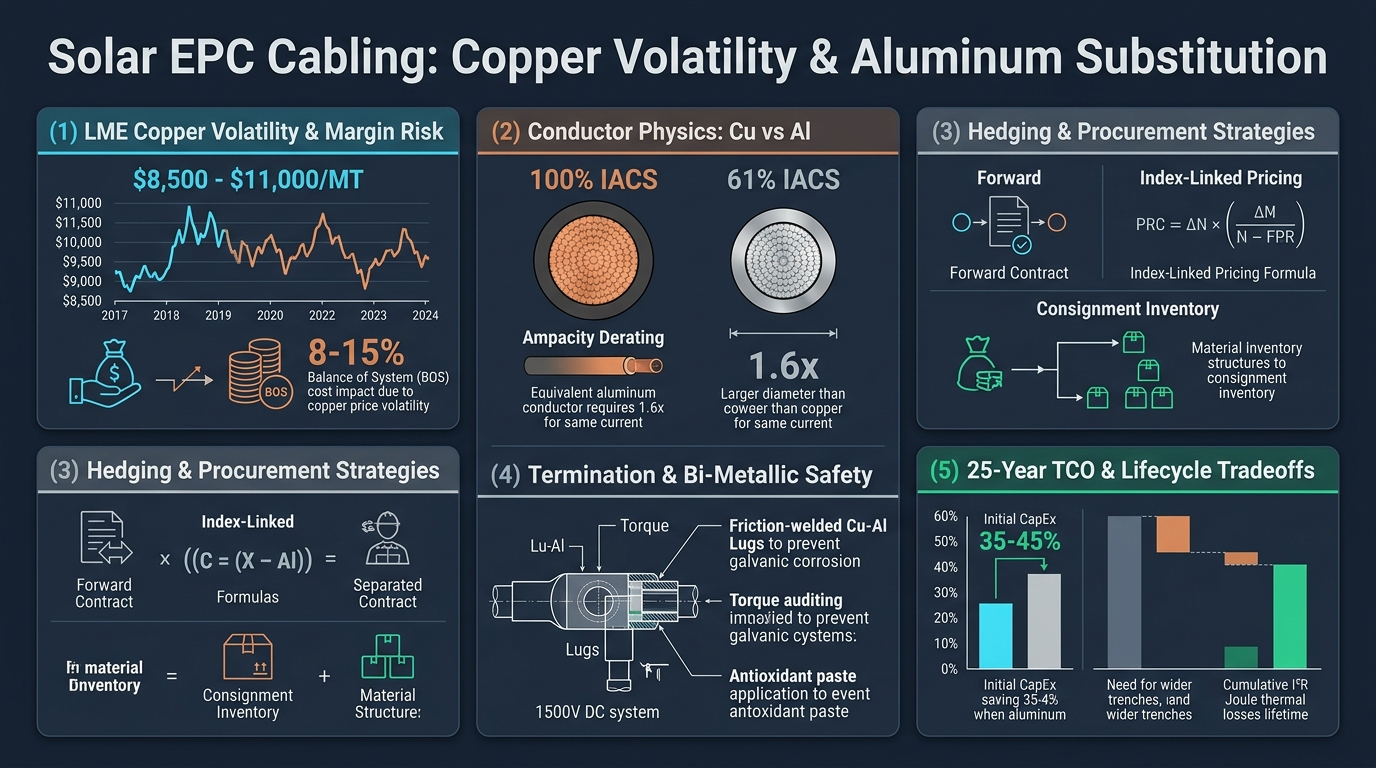
05 Technical Infographic: Copper vs. Aluminum Engineering & Procurement Decision Matrix
06 Critical Termination Engineering: Bi-Metallic Friction-Welded Lugs, Cold Flow & Galvanic Mitigation
If aluminum cable offers such compelling financial and weight advantages, why do some solar asset managers remain hesitant? The answer lies almost entirely in historical field termination failures. When aluminum cabling fails, it does not fail mid-span in the trench—it fails at the electrical termination interface inside combiner boxes, switchgear, and inverters.
The 3 Deadly Failure Mechanisms of Improper Aluminum Terminations
Copper has a standard electrode potential of +0.34V, whereas Aluminum sits at −1.66V (−0.80V in galvanic series). This massive 1.14V potential differential creates an active galvanic cell in the presence of atmospheric humidity or condensation. Aluminum acts as the sacrificial anode, oxidizing into non-conductive aluminum hydroxide powder, degrading contact area and triggering thermal runaway.
Within milliseconds of exposure to atmospheric air, aluminum forms a microscopic, transparent oxide film (Al&sub2;O&sub3;). Aluminum oxide is a hard ceramic electrical insulator. If an aluminum strand is crimped without scratch-brushing and oxide-inhibiting compound, contact resistance skyrockets. Under high current load, localized I²R heating melts insulation and sparks fires.
Under continuous mechanical compression from standard bolt torque, aluminum slowly flows away from high-stress contact zones. Over hundreds of diurnal heating and cooling cycles, standard mechanical bolted connections relax and lose torque (dropping from 45 N·m to below 15 N·m within 12 months), creating loose micro-gaps, intense electrical arcing, and busbar flashovers.
The Non-Negotiable Engineering Mitigation Standards
To guarantee 25-year bankable reliability identical to copper, solar EPCs must enforce four non-negotiable termination protocols across all aluminum installations:
- Friction-Welded Bi-Metallic Lugs (IEC 61238-1-1 Class A): Never permit electroplated aluminum lugs or copper-washers in high-current paths. Enforce factory friction-welded lugs where a 99.5% pure solid electrolytic copper palm is molecularly forge-welded to an electrical aluminum barrel under rotational friction. The aluminum cable inserts into the aluminum barrel, while the copper palm bolts directly to copper inverter busbars, completely sealing the bimetallic interface within solid metal.
- Conical Belleville Spring Washers (DIN 6796): Standard flat spring washers flatten permanently after initial tightening. Solar terminations must incorporate high-tensile conical Belleville disc spring washers (DIN 6796). Belleville washers store elastic mechanical energy, acting as a dynamic spring that maintains continuous clamping force (>15 kN) across a 60°C diurnal temperature delta, fully compensating for aluminum thermal expansion and cold creep.
- Zinc-Impregnated Synthetic Oxide Inhibitor Compound: The aluminum cable barrel must be pre-filled with high-temperature synthetic grease containing suspended zinc particles (e.g., Penetrox A or equivalent). When the compression die closes, the microscopic zinc particles rupture through the insulating aluminum oxide film under thousands of psi, establishing thousands of microscopic metallic contact bridges while grease seals out air and moisture.
- Calibrated Hexagonal Compression Crimping: Prohibit manual indent punch crimping. Mandate calibrated electro-hydraulic crimping tools equipped with DIN standard hexagonal dies matched specifically to the cable conductor outside diameter and lug wall thickness. Dual-stage crimping ensures complete compaction without work-hardening or shearing delicate aluminum outer strands.
07 Cable Tray Sizing, Mechanical Pulling & Structural Balance of System (BOS) Impacts
Switching from copper to aluminum generates ripple effects across civil, structural, and mechanical balance of system infrastructure that must be accounted for during detailed AutoCAD / Civil 3D layout drafting.
1. Cable Outside Diameter (OD) & Cable Tray Fill Ratios
While an aluminum conductor is 50% lighter than its copper equivalent, its 1.64× larger cross-sectional area increases the overall outside diameter (OD) of the finished cable by approximately 15% to 25%, depending on insulation thickness and armoring.
Under National Electrical Code (NEC Article 392) and IS standards, cable tray volumetric fill ratios for power cables are restricted to a maximum of 40% to 50% to ensure adequate convective air circulation and heat dissipation. When substituting aluminum, engineers must verify whether existing perforated or ladder cable trays can accommodate the increased diameter:
- A tray carrying sixteen 1C × 240 mm² copper cables typically requires a 300 mm wide ladder tray.
- Carrying the equivalent sixteen 1C × 400 mm² aluminum cables mandates upsizing to a 450 mm or 500 mm wide ladder tray or introducing a second tier.
- However, because the sixteen aluminum cables weigh 50% less, the structural steel support arms, brackets, and rooftop purlin load bearings experience dramatically lower stress, eliminating the risk of tray sagging or rooftop structural overloading.
2. Bending Radius Clearance in Inverter Stations
Aluminum conductors exhibit greater stiffness per unit cross-section than Class 5 flexible stranded copper. Per IEC 60502-1:
- Class 5 Flexible Copper: Minimum bending radius is 6× to 8× cable OD.
- Class 2 Compact Stranded Aluminum: Minimum bending radius is 12× to 15× cable OD for armored cables.
In compact central inverter power stations or skids, tight 90-degree cable entry transitions can over-stress aluminum conductors if trench depths are insufficient. EPC CAD teams must design inverter foundation trenches with minimum depths of 1000 mm to 1200 mm to accommodate the gentler sweeping radius of 400 mm² and 500 mm² aluminum feeders, preventing sheath tearing and insulation damage during pulling.
3. Pulling Tension & Conduit Trenching Dynamics
Maximum allowable pulling tension applied directly to conductor pulling eyes is governed by material yield limits:
Although aluminum possesses a lower tension rating per square millimeter, its 50% lighter mass dramatically reduces gravitational drag friction against HDPE duct walls. In real site execution, long pulls of 300 to 450 meters through underground ducts require significantly lower total winch pulling force for aluminum than for heavy copper, reducing cable pulling crew sizes by 25% and eliminating intermediate pulling pits.
08 Financial Risk Management: LME Hedging, MCX Indexation & Supplier Collar Contracts
Technical re-engineering to aluminum solves half the equation. For circuits where copper remains mandatory (such as 1500V DC string cabling) or during transitional project phases, solar EPCs must master financial risk management and contractual hedging mechanisms to shield their balance sheets from commodity volatility.
1. Contractual Price Variation Clauses (PVC) with EPC Clients
When bidding on utility-scale solar tenders or bilateral C&I turnkey contracts with execution timelines exceeding four months, signing a 100% fixed-price contract for raw metals is reckless. Tier-1 EPCs negotiate structured Price Variation Formulas tied to independent commodity clearinghouses:
Where P is final payable cable price, P0 is base price at bid date, Cu / Cu0 is the ratio of London Metal Exchange (LME) or IEEMA continuous cast copper rod index on the date of factory raw material booking, Poly represents polymer insulation pellets, and L represents labor indices.
2. The Bilateral Collar Structure (±3.5% Deadband)
Developers frequently resist open-ended price variation clauses because lenders require CapEx certainty for debt sizing. The bankable compromise is a Collar Agreement:
- The Deadband (±3.5%): If LME copper moves within ±3.5% of the base price between contract award and raw material freeze, no price adjustment occurs. The EPC absorbs minor variations.
- The Sharing Corridor (+3.5% to +12.0%): If copper spikes above +3.5%, the cost increase beyond the deadband is shared equally (50:50) between developer and EPC, or passed through 100% to the developer against certified mill invoices.
- The Hard Ceiling (+12.0% Cap): Above +12%, the contract mandates an engineering review gate to evaluate substituting remaining trunk runs with aluminum or re-optimizing combiner layouts.
- Downside Participation: If copper crashes below −3.5%, the developer receives a corresponding credit, ensuring fair commercial reciprocity.
3. Exchange-Traded Hedging: MCX India & LME Forward Contracts
For large EPC firms managing multi-hundred-megawatt annual installation pipelines, treasury teams can hedge metal exposure directly on commodities exchanges:
- MCX Copper Futures (India): Upon signing a fixed-price EPC contract requiring 180 metric tons of copper across string and substation cables, the treasury enters long forward contracts on Multi Commodity Exchange (MCX) India for equivalent tonnage matching scheduled delivery tranches. If spot prices rise, exchange trading profits offset higher cable vendor invoices rupee-for-rupee.
- Back-to-Back Cable Mill Raw Material Booking: Within 7 days of receiving client mobilization advance, the EPC issues back-to-back supply orders to Tier-1 cable manufacturers (e.g., Polycab, KEI, Havells, Apar, RR Kabel) with an explicit milestone clause locking in copper cathode / CC rod prices with primary refiners (Hindalco, Vedanta). The manufacturer reserves physical metal allocation in advance, completely de-linking the project from spot market inflation.
09 Comprehensive Solar EPC Cabling Specification, Sizing & Procurement Matrix
This comprehensive matrix serves as an authoritative specification guide for solar electrical designers and procurement managers, establishing conductor selection, standard compliance, sizing multipliers, and termination standards across all solar circuits.
| Circuit / Subsystem | Voltage Rating | Recommended Conductor | Governing Standard | Sizing Multiplier | CapEx Index | Termination Standard |
|---|---|---|---|---|---|---|
| DC String Cables (Modules → Array) | 1500V DC | Class 5 Tinned Copper | EN 50618 / IEC 62930 | 1.0× (4 / 6 mm²) | 100 (Baseline) | MC4-EVO2 Stamped Copper Crimp |
| DC Array Trunk (SCB → Inverter) | 1500V DC | Class 2 Stranded Aluminum (AA 8000) | IEC 60502-1 / UL 4703 | 1.64× (300 / 400 mm²) | 55–62 (−40%) | Friction-Welded Bi-Metallic Lugs + DIN 6796 |
| AC Low-Voltage (Inverter → IDT) | 690V / 800V AC | Multi-Core Armored Aluminum (A2XFY) | IS 7098 (Pt 1) / IEC 60502 | 1.60× (240 / 300 mm²) | 58–65 (−38%) | Bi-Metallic Heavy Lugs + Oxide Grease |
| MV Collection (IDT → Substation) | 11 kV / 33 kV AC | Tree-Retardant XLPE Armored Al (A2XFY) | IS 7098 (Pt 2) / IEC 60502-2 | 1.55× (300 / 400 mm²) | 52–58 (−45%) | Heat-Shrink 33kV Terminations + Shear Bolts |
| Perimeter & Equipment Grounding | Ground Fault | Hot-Dip Galvanized Steel Strip (HDGI) | IS 3043 / IEEE 80 | 50×6 mm / 75×10 mm | 22–28 (−75%) | Overlapped Arc Welding + Cold Zinc Paint |
| Instrumentation & SCADA RS485 | Low-Volt DC/Data | Shielded Twisted Pair Tinned Copper | EIA RS-485 / IEC 61158 | 1.0× (0.5 / 1.0 mm²) | 100 (Mandatory) | Gold-Plated Ferrules / Screw Terminals |
10 Real-World Case Study: 75 MWp Maharashtra Utility & C&I Portfolio Optimization
Mitigating a 28% LME Copper Spike to Save ₹1.82 Crore on a 75 MWp Multi-Site Portfolio
In late 2024, a major Indian solar EPC contractor was awarded a 75 MWp hybrid portfolio consisting of a 50 MWp ground-mounted solar park in Ahmednagar and 25 MWp of distributed industrial PEB rooftops across the Pune manufacturing belt. The EPC contract was signed under a strict fixed-price turnkey agreement. Within 90 days of contract execution, an unexpected global copper supply crunch drove LME copper cash prices up by +28.4% (from $8,350/MT to $10,720/MT).
The Engineering Crisis
The EPC's original electrical single-line diagram (SLD) specified all-copper cabling throughout the plant, including 1500V DC trunk runs (1C × 240 mm² Cu) and 800V AC inverter links (3C × 185 mm² Cu). The 28.4% copper rally threatened a ₹2.41 Crore net CapEx overrun on cabling procurement alone, which would have eradicated 40% of the EPC's budgeted net margin. The client developer refused any price adjustment, citing fixed tariff obligations under Maharashtra Electricity Regulatory Commission (MERC) open-access regulations.
V-TECH RENEWABLES Engineering Intervention
Retained as Owner's Engineer and technical optimization consultants, V-TECH RENEWABLES conducted a comprehensive electrical re-engineering audit:
- Preserved Critical Copper Circuits: String cables were rigorously maintained in EN 50618 Class 5 flexible tinned copper (4 mm² and 6 mm²) to protect tracker rotation endurance on the Ahmednagar single-axis arrays and maintain standard MC4 warranty compliance.
- Re-Engineered DC Trunk Infrastructure: All 1500V DC array combiner box trunk cables were re-sized from 240 mm² Cu to 400 mm² single-core AA 8000 aluminum XLPO. PVsyst modeling proved DC ohmic loss decreased slightly from 0.98% to 0.95%, improving yield while reducing conductor procurement cost by 42%.
- Optimized Inverter AC Links: Inverter output runs were transitioned from 3C × 185 mm² Cu to 3C × 300 mm² armored aluminum (A2XFY), maintaining AC voltage drop at 0.78%.
- Stringent Termination QA/QC: V-TECH engineers mandated 100% factory friction-welded bi-metallic lugs, DIN 6796 Belleville disc spring washers torqued with calibrated digital wrenches, and pre-applied synthetic oxide inhibitor paste.
11 16-Point Solar Purchase Manager Cabling & Hedging Audit Checklist
Use this exhaustive 16-point technical and commercial checklist before finalizing cable schedules, approving sub-vendor purchase orders, or releasing factory pre-dispatch inspections (PDI).
- □ 1. Price Variation Clause (PVC): Verify contract incorporates an IEEMA or LME-indexed formula with defined base dates and booking milestones.
- □ 2. Collar Deadband Boundaries: Establish mutual ±3.5% deadbands with 50:50 sharing above the band to eliminate open-ended developer disputes.
- □ 3. Currency Hedging Protocol: Check whether foreign exchange variations (USD to INR) are hedged in conjunction with LME metal movements.
- □ 4. Primary Refiner Lock-in: Require cable vendor to submit metal booking confirmations from primary smelters (Hindalco, Vedanta) within 14 days of PO.
- □ 5. Conductor Segmentation Audit: Ensure Class 5 flexible copper is maintained for string cabling and aluminum is restricted to static trunk/AC runs.
- □ 6. 1.64× Area Upsize Verification: Confirm aluminum trunk sizing delivers equal or lower resistance than original copper specifications.
- □ 7. PVsyst 25-Year Ohmic Loss: Verify total plant DC ohmic loss is modeled ≤ 1.0% and AC ohmic loss ≤ 0.8% under peak operating temperature (65°C).
- □ 8. AA 8000 Series Alloy Mandate: Prohibit pure EC 1350 aluminum; specify AA 8030/AA 8176 alloy per ASTM B800 for creep resistance.
- □ 9. Friction-Welded Bi-Metallic Lugs: Audit termination BOM for certified friction-welded lugs (IEC 61238-1-1 Class A); reject electroplated lugs.
- □ 10. DIN 6796 Belleville Washers: Mandate conical spring washers with specified torque settings on all aluminum-to-copper busbar joints.
- □ 11. Oxide Inhibitor Application: Ensure installation specifications require pre-filling lug barrels with zinc-loaded synthetic inhibitor paste.
- □ 12. Cable Tray Fill & Bending Radius: Verify tray widths maintain ≤ 40% fill ratio and trench depths allow 12× to 15× cable OD bending radii.
- □ 13. Factory PDI Conductor Resistance Test: Witness Kelvin double-bridge electrical resistance test per IEC 60228 at 20°C on random reel samples.
- □ 14. Spark & High-Voltage Dielectric Testing: Confirm 100% inline spark testing during extrusion and factory high-voltage immersion tests.
- □ 15. Reel Storage & Moisture Sealing: Enforce heat-shrink end caps on all cable reels in site laydown yards to prevent water ingress into aluminum strands.
- □ 16. Calibrated Crimp Tool Certification: Audit contractor site tools to verify calibrated electro-hydraulic crimpers with matching DIN hexagonal dies.
12 Frequently Asked Questions (FAQ)
What percentage of total solar EPC project cost is typically attributed to cabling?
Electrical cabling represents between 3.5% to 6.5% of total utility-scale solar EPC CapEx and up to 8% in complex commercial rooftop installations. In a 100 MWp utility solar project, electrical cabling encompasses between 350 to 500 kilometers of 1500V DC string cables, 60 to 90 kilometers of heavy DC trunk cables, and dozens of kilometers of AC low-voltage and 33 kV medium-voltage collection cables. Consequently, an unhedged 25% spike in global copper pricing directly inflates total project CapEx by ₹1.2 to ₹2.5 Crore per 100 MWp, which can erode 20% to 40% of the EPC contractor's net operating margin.
Can aluminum conductors be safely used for 1500V DC string cables on single-axis solar trackers?
For 1500V DC string cabling (connecting individual PV modules in series to combiner boxes or string inverters), Class 5 flexible stranded tinned copper remains the mandatory engineering standard per EN 50618 and IEC 62930. While aluminum string cables exist, aluminum's lower fatigue endurance under continuous mechanical oscillation on single-axis trackers (which rotate ±60 degrees daily) induces micro-fissuring and strand breakage. Furthermore, standard MC4-EVO2 PV connectors utilize stamped copper alloy crimp terminals that form a high galvanic couple with aluminum, leading to rapid terminal oxidation, thermal runaway, and field arc-fault fires unless specialized, cost-prohibitive sealed bi-metallic barrel connectors are deployed.
What is the exact sizing multiplier when replacing copper with aluminum conductors in solar designs?
Due to aluminum's electrical conductivity (61% IACS) compared to annealed copper (100% IACS), the cross-sectional area of an aluminum conductor must be approximately 1.64 times larger (Area_Al = 1.64 × Area_Cu) to achieve equal electrical resistance (R = ρ·L/A) and equivalent voltage drop. In practice, electrical design engineers step up by 1 to 2 standard metric cable sizes: e.g., 4 mm² copper steps to 6 mm² aluminum, 16 mm² copper steps to 25 mm² aluminum, 240 mm² copper steps to 400 mm² aluminum, and 300 mm² copper steps to 500 mm² aluminum. Even after upsizing, the aluminum conductor weighs 50% less than the copper equivalent, slashing freight and pulling tension.
How do friction-welded bi-metallic lugs prevent terminal burnout in aluminum cable installations?
Directly connecting an aluminum cable to a copper busbar or circuit breaker terminal triggers three failure modes: galvanic corrosion (due to the 1.14V electrochemical potential gap), insulating aluminum oxide (Al2O3) buildup, and thermal creep loosening. Friction-welded bi-metallic lugs resolve this by joining a 99.5% pure solid copper contact palm to an electrical-grade aluminum crimp barrel through molecular friction welding under high forge pressure. The aluminum cable is crimped into the aluminum barrel with zinc-loaded oxide inhibitor compound, while the copper palm bolts directly to the copper busbar, completely eliminating bimetallic interface exposure to atmospheric humidity.
How do Price Variation Clauses (PVC) protect solar EPC contractors against copper price spikes?
A Price Variation Clause (PVC) dynamically ties contractual cabling payment milestones to recognized benchmark indices such as the London Metal Exchange (LME) copper cash settlement price or the Indian Electrical and Electronics Manufacturers' Association (IEEMA) copper rod index. Standard bankable PVC structures incorporate a ±3% to ±5% collar deadband where the EPC contractor absorbs minor fluctuations. If market prices rise beyond the upper threshold between contract signing and the raw material booking milestone, the excess cost is either passed through 100% to the developer or shared bilaterally (e.g., 50:50), preventing project stalled delivery and EPC insolvency.
Protect Your Solar EPC Margins Against Commodity Volatility
Avoid multi-crore budget overruns, dangerous terminal burnout, and excessive 25-year ohmic generation losses. Partner with V-TECH RENEWABLES for advanced PVsyst electrical loss simulations, optimal copper-to-aluminum cable re-engineering, factory mill PDI inspections, and bankable commodity risk hedging advisory.