Choosing the Right Mounting Structure Material: Galvanized Iron vs. Aluminum
A comprehensive structural engineering and procurement analysis comparing Hot-Dip Galvanized Iron (HDGI) and Extruded Anodized Aluminum: mechanical yield limits, wind-load structural dynamics, ISO 9223 atmospheric corrosivity mapping, industrial PEB rooftop dead-weight constraints, bimetallic galvanic isolation, and 25-year Total Cost of Ownership (TCO) financial modeling.
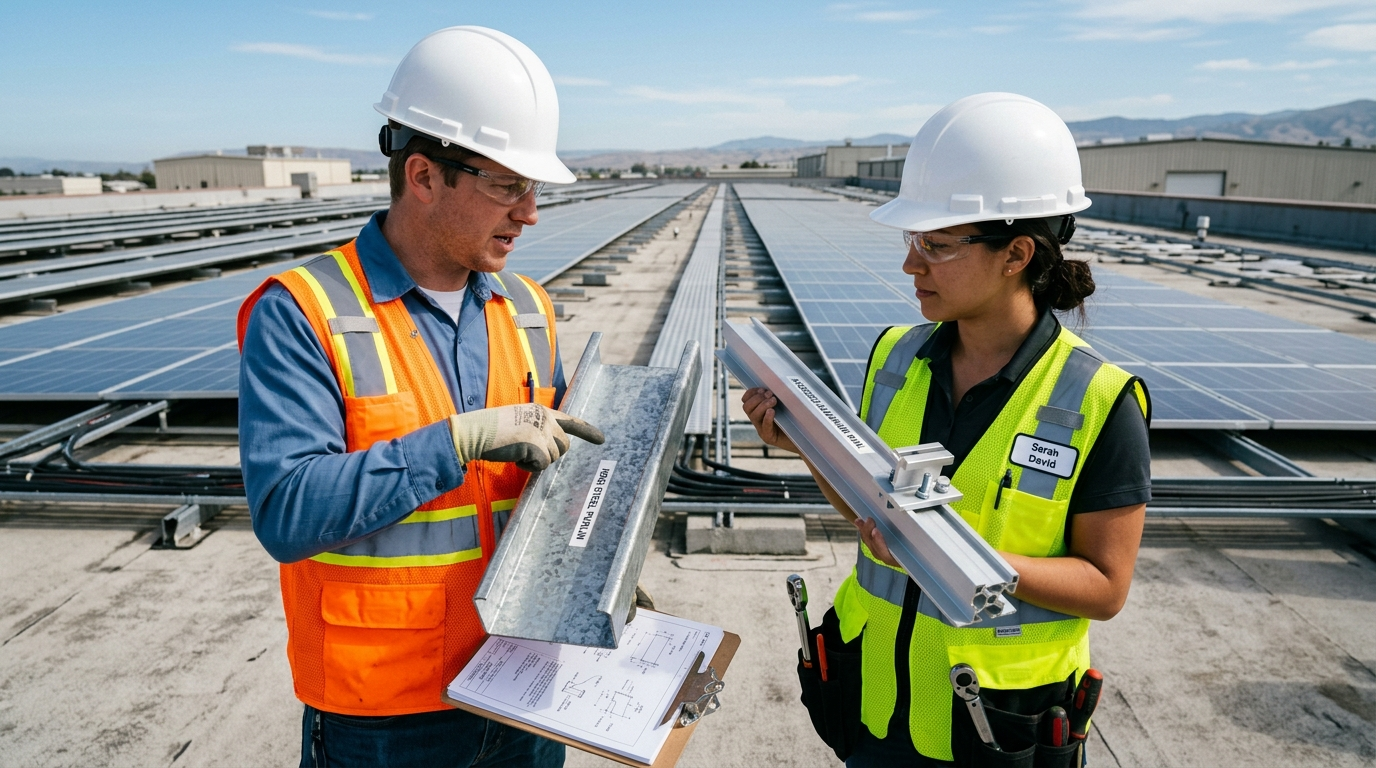
01 The Structural Backbone: Why MMS Material Dictates 25-Year Bankability
In utility-scale and commercial & industrial (C&I) photovoltaic project engineering, the Module Mounting Structure (MMS) is frequently dismissed by inexperienced procurement teams as simple "structural metalwork" or low-tier Balance of System (BOS) steel. Financial models focus aggressively on photovoltaic module efficiency ratings, inverter conversion curves, and tariff bid pennies. Yet, the mounting structure represents between 9% and 14% of total project CapEx and accounts for more than 30% to 40% of the entire physical mass deployed on site.
More critically, the mounting structure is the solitary mechanical barrier standing between multimillion-dollar photovoltaic asset portfolios and nature's violent atmospheric forces: cyclonic wind shears exceeding 180 km/h, seismic ground accelerations, heavy monsoon deluge ponding, corrosive coastal sea-salt spray, and thermal expansion cycles traversing 50°C diurnal gradients. If an electrical inverter trips, an automated software restart or modular card replacement restores generation within hours. If an MMS structural beam yields, buckles, or corrodes prematurely, the result is catastrophic: twisted tracker torque tubes, micro-cracked bifacial cell strings, ripped rooftop sheeting, sheared module clamps, and total insurance denial.
The rapid market transition to 600W+ to 720W+ large-format modules (dimensions up to 2,384 mm × 1,303 mm) and ultra-thin N-Type TOPCon/HJT silicon wafers (110–130 μm) has escalated structural demands exponentially. Under dynamic wind pressure, structural deflection in mounting purlins transfers excessive mechanical torque directly into the glass-cell matrix. A deflection of merely L/120 to L/180 across a purlin span is sufficient to trigger extensive sub-surface micro-cracking and busbar delamination, permanently destroying energy yields. The choice between Hot-Dip Galvanized Iron (HDGI) and Extruded Aluminum is no longer merely a pricing dispute—it is a foundational structural integrity decision.
Solar procurement directors and Owner's Engineers must navigate a multi-dimensional matrix: raw metal pricing, yield strength, fabrication tolerances, site logistics weight, assembly labor hours, atmospheric corrosivity mapping (ISO 9223), and 25-year lifecycle residual values. This guide deconstructs the metallurgy, physics, and economics of Galvanized Iron versus Extruded Aluminum to provide EPC purchase heads with an unassailable engineering framework.
02 Metallurgy & Manufacturing: HDGI vs. Extruded 6063-T6 Aluminum
To evaluate performance, purchase managers must look beyond superficial marketing terms and understand the raw chemical metallurgy, rolling, and surface treatment methodologies that govern steel and aluminum manufacturing.
1. Hot-Dip Galvanized Iron & Structural Steel (HDGI)
Solar structural steel relies on low-carbon structural steel grades conforming to IS 2062 (Grades E250 to E350) in India, or ASTM A36 / ASTM A572 Grade 50 internationally. After steel plates are slit, roll-formed, laser-cut, and punched with mounting bolt slots into C-channels, Z-purlins, Hat-sections, or tubular columns, the fabricated members undergo Batch Hot-Dip Galvanizing in accordance with IS 4759 / ASTM A123 / ISO 1461:
- Chemical Surface Pre-Treatment: Steel components pass through caustic degreasing baths, acid pickling (hydrochloric or sulfuric acid) to strip mill scale and iron oxides, water rinsing, and pre-fluxing in zinc ammonium chloride to prevent oxidation before immersion.
- Molten Zinc Immersion: Fabricated components are immersed into a molten zinc bath held at 445°C to 455°C. An iron-zinc metallurgical diffusion reaction occurs, forming four distinct intermetallic alloy layers: Gamma (75% Fe, 25% Zn), Delta (90% Zn, 10% Fe), Zeta (94% Zn, 6% Fe), topped by an outer layer of 100% pure zinc (Eta).
- Zinc Coating Thickness: Standard solar specifications require an average coating thickness of 80 to 100 microns (μm), corresponding to 550 to 700 g/m² total surface mass. The metallurgical bond between the zinc-iron alloy layers and the underlying steel exceeds 3,600 psi (25 MPa), rendering it highly resistant to mechanical abrasion during transit.
- Alternative Coated Steels: For high-volume roll-forming, EPCs increasingly evaluate Pre-Galvanized Sheet (GP per IS 277) with continuous zinc coatings (275 to 450 g/m²), and revolutionary Zinc-Aluminum-Magnesium (ZAM / PosMAC / Magnelis) alloy coatings per ASTM A1046 / EN 10346, which offer self-healing edge corrosion protection through magnesium-zinc carbonate hydroxide crystallization.
2. Structural Extruded Aluminum (Alloy 6063-T6 / 6005-T5)
Structural solar aluminum components are produced from heat-treatable aluminum-magnesium-silicon wrought alloys, predominantly AL 6063-T6 (architectural and structural grade) and AL 6005-T5 / 6082-T6 (high-strength structural grade) governed by ASTM B221 / IS 733:
- Extrusion Engineering: Heated cylindrical aluminum billets (450°C to 500°C) are forced through precision hydraulic dies under thousands of tons of pressure. Unlike roll-formed steel that is constrained to uniform sheet thicknesses, aluminum extrusion allows complex, aerodynamically optimized cross-sections with variable wall thicknesses, integrated cable routing raceways, screw bosses, and proprietary snap-in clamp locking channels.
- T6 Artificial Aging Heat Treatment: Post-extrusion profiles undergo solution heat treating followed by rapid water/air quenching and artificial precipitation hardening at ~175°C for 6 to 8 hours (T6 temper), maximizing tensile yield strength and hardness.
- Anodic Oxidation (Anodizing): Extrusions are immersed in an electrolytic sulfuric acid bath where DC current converts the surface into a dense, crystalline aluminum oxide (Al2O3) barrier per IS 1868 / ASTM B580. High-performance solar profiles specify Class AA15 or AA25, achieving an anodic film thickness of 15 to 25 microns (μm). This ceramic-hard layer is non-conductive, self-passivating, and impervious to atmospheric oxidation.
03 Mechanical Strength, Yield Limits & Wind-Load Structural Capacity
When structural engineering software (STAAD Pro or SAP2000) simulates extreme wind events in accordance with IS 875 (Part 3): 2015 or ASCE 7-16, the fundamental mechanical properties of the material dictate section sizing, member spans, and deflection boundaries.
| Mechanical Property | HDGI Steel (IS 2062 E250 / E350) | Extruded Aluminum (6063-T6) | High-Strength Al (6005-T5 / 6082-T6) |
|---|---|---|---|
| Density (ρ) | 7.85 g/cm³ (~7,850 kg/m³) | 2.70 g/cm³ (~2,700 kg/m³) | 2.71 g/cm³ (~2,710 kg/m³) |
| Yield Strength (Fy) | 250 – 350 MPa | 160 – 215 MPa | 240 – 260 MPa |
| Ultimate Tensile Strength (Fu) | 410 – 490 MPa | 205 – 245 MPa | 260 – 310 MPa |
| Modulus of Elasticity (Young's E) | 200 – 210 GPa | 68.9 – 70.0 GPa | 70.0 – 71.0 GPa |
| Thermal Expansion Coefficient (α) | 12.0 × 10⁻⁶ / °C | 23.4 × 10⁻⁶ / °C | 23.1 × 10⁻⁶ / °C |
| Stiffness-to-Weight Ratio | Moderate (~26.1 GPa / g·cm−3) | Equivalent (~25.6 GPa / g·cm−3) | High (~26.2 GPa / g·cm−3) |
The Elasticity Gap and Deflection Dynamics
The most consequential engineering distinction is the Modulus of Elasticity. Steel possesses an elasticity modulus of ~205 GPa, almost triple that of structural aluminum (~70 GPa). In beam bending theory, deflection (δ) under distributed wind load (w) over span (L) is governed by:
Because E is in the denominator, an aluminum section identical in cross-sectional geometry (Moment of Inertia I) to a steel beam will deflect nearly 300% more under the exact same wind gust. To maintain deflection within acceptable limits (≤ L/180) and protect brittle silicon cells from torsion, structural designers utilizing aluminum must engineer profiles with substantially higher Moments of Inertia (deeper vertical ribs and thicker structural flanges), or restrict support spans to 1.5 to 2.4 meters, compared to steel purlin spans that comfortably achieve 3.5 to 5.0 meters on ground-mount utility tables.
However, because aluminum is extruded, engineers can distribute metal mass precisely where bending moments demand—thickening outer flanges to 2.5 mm while slimming internal shear webs to 1.4 mm. In steel roll-forming, wall thickness is uniform throughout the entire cross-section, leading to dead weight inefficiencies.
04 Atmospheric Corrosivity & Environmental Mapping (ISO 9223 C1–C5)
Solar power plants are contracted to generate clean electricity over 25 to 30 years under unyielding outdoor exposure. Selecting an MMS material without rigorous site-specific atmospheric corrosivity evaluation per ISO 9223 / ISO 12944 is the leading cause of premature structural decommissioning.
| ISO 9223 Corrosivity Category | Typical Environmental Conditions | Zinc Loss (HDGI Steel) | Aluminum Behavior (AA20/AA25) | Procurement Recommendation |
|---|---|---|---|---|
| C1: Very Low | Heated dry interiors, desert zones with <30% RH (e.g., central Rajasthan). | ≤ 0.1 μm / year | Negligible surface dulling | HDGI (65–80 μm) or GP Steel (CapEx optimum). |
| C2: Low | Rural inland areas, low pollution, unpolluted atmosphere (e.g., MP, Telangana interiors). | 0.1 – 0.7 μm / year | Extremely slow surface oxidation (<0.05 μm/yr) | HDGI (80 μm) provides >50 years structural life. |
| C3: Medium | Urban and light industrial zones with moderate SO2 or coastal areas with low salinity. | 0.7 – 2.1 μm / year | Passive alumina layer intact; zero structural loss | HDGI (80–100 μm) or Aluminum (AA15 anodized). |
| C4: High | Heavy industrial zones (chemical/fertilizer hubs) and coastal regions 1 to 5 km from sea. | 2.1 – 4.2 μm / year | Resistant to chlorides; minor pitting if pH >4.5 | Anodized Aluminum (AA20/AA25) or PosMAC/ZAM 450 g/m². |
| C5: Very High (Marine/Industrial) | Direct coastal shoreline (<1 km), high chloride spray, offshore salt flats, heavy chemical acid gas corridors. | 4.2 – 8.4 μm / year (Zinc depleted in 10–12 yrs) | Excellent chloride tolerance with AA25 hard anodizing | Extruded Aluminum AA25 mandatory for long-term viability. |
In standard C1–C3 zones, HDGI provides extraordinary sacrificial anode protection: the zinc coating corrodes preferentially, shielding exposed cut edges and drill holes via cathodic protection. An 80-micron zinc layer losing 1.5 μm per year lasts over 50 years.
However, in C4 and C5 marine environments (e.g., Gulf of Kutch in Gujarat, coastal Andhra, Tamil Nadu shores), airborne chloride ions break down the protective zinc carbonate patina. Zinc consumption surges past 5 to 8 μm annually. Once the 80-micron coating depletes (typically within 10 to 14 years), aggressive ferric oxidation (red rust) consumes the load-bearing steel core, resulting in catastrophic loss of section modulus. Aluminum, conversely, forms an instantaneous, self-healing aluminum oxide (Al2O3) film that is immune to neutral chloride attack, making it the premier choice in marine atmospheres.
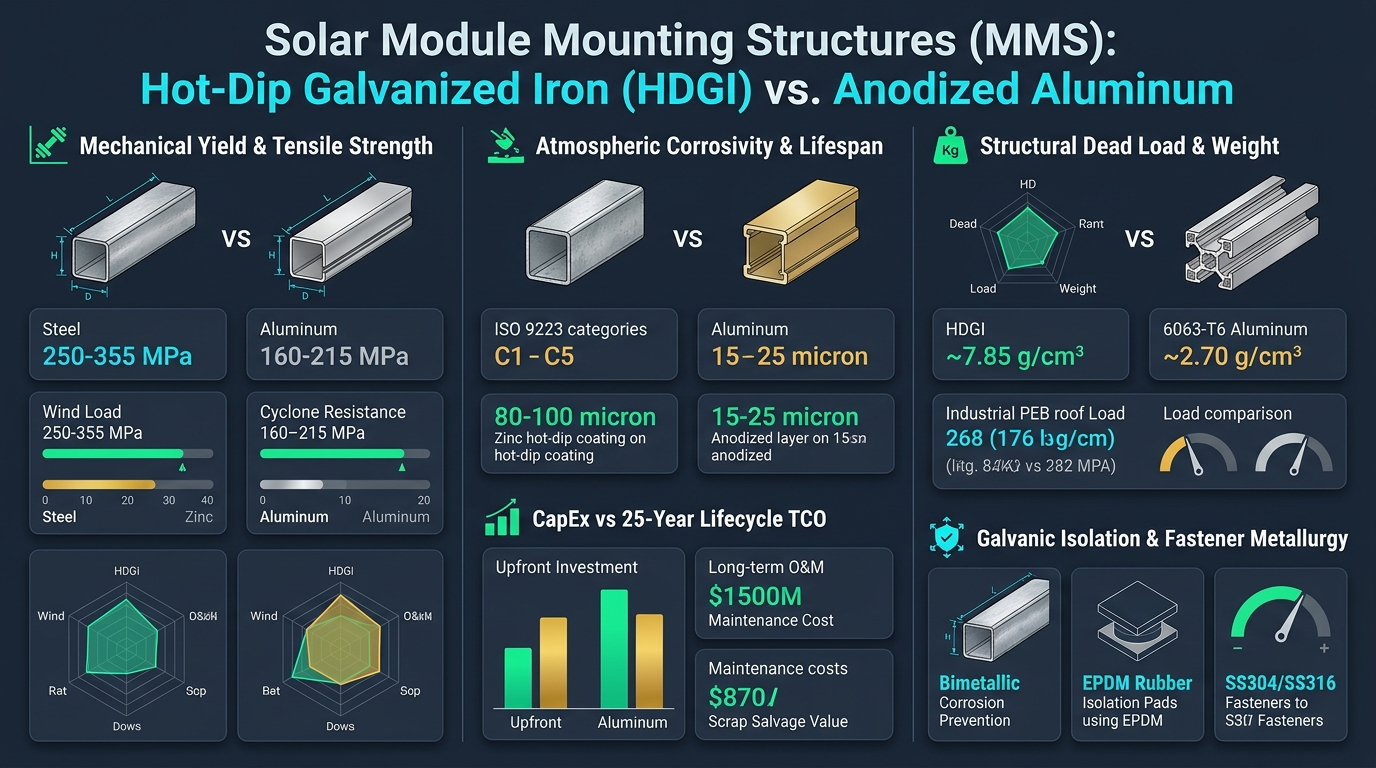
05 Technical Infographic: MMS Material Selection Matrix & Trade-offs
06 Dead Load Dynamics: Industrial Rooftop PEB Sheds vs. Ground Mounts
The mechanical physical boundary conditions of Rooftop C&I installations versus Ground-Mount utility plants establish fundamentally contrasting material priorities.
1. Industrial Pre-Engineered Building (PEB) Rooftops: The Dead-Weight Constraint
Industrial factory buildings, warehouse logistics sheds, and pharmaceutical plants across India and global manufacturing hubs are constructed using highly optimized PEB structural designs. PEB structural engineers design roof rafters, portal frames, and cold-rolled purlins with minimal excess safety margins to reduce steel tonnage. In most PEB roofs, the allowable superimposed dead load for non-process additions is strictly restricted to 12 to 15 kg/m².
- • Dual-Glass 580W PV Modules: 13.5 kg/m²
- • HDGI Steel Purlins, Legs & Base Plates: 11.5 kg/m²
- • Fasteners, Walkways & Cable Trays: 2.0 kg/m²
- • Total Superimposed Dead Load: 27.0 kg/m²
- ✖ Exceeds PEB allowable limit by 80–125%; mandates multi-lakh structural column retrofitting or triggers roof collapse hazard.
- • Dual-Glass 580W PV Modules: 13.5 kg/m²
- • 6063-T6 Aluminum Mini-Rails & Clamps: 1.8 kg/m²
- • Fasteners & Cable Clips: 0.5 kg/m²
- • Total Superimposed Dead Load: 15.8 kg/m²
- ✔ Complies seamlessly with PEB structural reserve; zero internal steel reinforcement needed; fast non-penetrative clamp mounting.
By selecting extruded aluminum mini-rails or standing seam clamps for metal roofs, the EPC purchase manager eliminates hundreds of metric tons of dead weight, avoiding internal structural shed retrofitting costs that often exceed ₹15 to ₹40 Lakh per MWp.
2. Utility-Scale Ground-Mount Installations: The Rigidity Mandate
On ground-mounted utility solar farms, dead load weight is not a constraint; in fact, structural mass and rigidity are assets. Ground arrays are anchored into rammed steel posts, concrete bore piles, or precast ballast blocks designed to counteract massive overturning wind moments.
Here, HDGI steel reigns supreme. Its high modulus of elasticity (205 GPa) allows wide 4.0 to 5.0-meter spans between vertical posts, reducing the required number of civil pile foundations per megawatt by 25% to 35%. Constructing a 100 MWp ground-mount plant using aluminum would require nearly double the pile foundations to control deflection, inflating civil piling and drilling budgets beyond any material savings.
07 Bimetallic Galvanic Corrosion & Fastener Metallurgy
One of the most insidious failure modes in solar structural installations is bimetallic galvanic corrosion. Galvanic corrosion occurs when two electrochemically dissimilar metals are in direct electrical contact in the presence of an electrolyte (atmospheric moisture, rain, high-humidity condensation, or coastal marine mist).
The Module-to-Steel Dilemma
Nearly 100% of commercially manufactured solar PV modules utilize an extruded anodized aluminum frame. When this aluminum module frame is bolted directly to a carbon steel or galvanized steel purlin without isolation:
- Steel vs. Aluminum Couple: The electrochemical potential difference between aluminum (−0.80V) and steel (−0.60V) is 0.20V. In moist environments, this voltage drives galvanic electron transfer: aluminum becomes the sacrificial anode, experiencing intense localized pitting corrosion along the flange, leading to frame failure and clamp slippage.
- Zinc vs. Aluminum Couple: On newly galvanized steel, zinc (−1.10V) is anodic to aluminum (−0.80V), meaning zinc initially sacrifices itself. However, once the thin zinc layer at the contact point corrodes away, direct steel-aluminum contact accelerates.
- Fastener Best Practice: Structural bolting between aluminum rails and steel posts, or module mid/end clamps, must utilize Grade A2-70 (SS304) or A4-80 (SS316) stainless steel bolts. Under no circumstances should raw carbon steel or zinc-plated (Class 4.8) bolts be paired with aluminum. Non-conductive UV-resistant EPDM rubber washers or nylon sleeves must isolate dissimilar metals, while electrical grounding continuity is achieved through UL 467 certified stainless steel grounding clips with engineered penetration teeth.
08 CapEx vs. 25-Year Lifecycle TCO Financial Modeling
Procurement managers who focus solely on raw cost per kilogram commit a critical financial error. The initial invoice price of extruded aluminum (approximately ₹2,20,000 to ₹2,80,000 per MT) appears astronomical compared to fabricated HDGI structural steel (approximately ₹68,000 to ₹88,000 per MT). However, when evaluated on a Total Cost of Ownership (TCO) basis per Watt-peak installed over 25 years, the economic calculus shifts dramatically.
| Financial & Operational Dimension | Hot-Dip Galvanized Iron (HDGI) | Extruded Anodized Aluminum | TCO Impact Analysis |
|---|---|---|---|
| Raw Material Cost / MT | ₹70,000 – ₹85,000 | ₹2,30,000 – ₹2,80,000 | Aluminum raw cost is ~3.2x higher per ton. |
| Required Mass / MWp (Rooftop) | 22 – 30 Metric Tons | 7 – 10 Metric Tons | Aluminum requires 65% less tonnage for identical capacity. |
| Logistics & Freight Trips | 8 – 12 Trailer Loads / MWp | 3 – 4 Trailer Loads / MWp | ₹2.5 – ₹4.5 Lakh freight savings per MWp on distant hauls. |
| Rooftop Crane / Hoisting Overhead | Heavy mobile cranes required | Manual / lightweight electric hoists | Saves ₹1.5 – ₹3.0 Lakh in crane hire charges on high sheds. |
| Installation Labor Speed | Bolting & aligning heavy steel purlins | Pre-punched click-in clamp channels | Aluminum accelerates mechanical assembly by 35–45%. |
| 25-Year Recoating & Maintenance | ₹6–12 Lakh / MWp (in C4/C5 zones) | ₹0 (Zero maintenance required) | Avoids disruptive rooftop structural recoating during O&M. |
| End-of-Life Scrap Salvage Value | ₹20,000 – ₹26,000 / MT (~25%) | ₹1,50,000 – ₹1,90,000 / MT (~70%) | Aluminum yields 5x higher residual cash recovery at Year 25. |
When accounting for reduced structural tonnage (65% lower mass), lower freight costs, rapid snap-in assembly, zero maintenance recoating in harsh atmospheres, and high scrap salvage recovery (up to 70% of ingot value), extruded aluminum proves financially superior for rooftop and coastal C&I projects, whereas HDGI steel delivers unbeatable CapEx economy for inland utility-scale ground mounts.
09 Comprehensive Solar MMS Material Specification & Procurement Matrix
This comprehensive engineering matrix provides solar EPC purchase teams with an instant technical reference across twelve operational specifications:
| Specification | Batch Hot-Dip Galv Steel (HDGI) | Pre-Galvanized GP / PosMAC | Extruded Aluminum (6063-T6) |
|---|---|---|---|
| Governing Material Standard | IS 2062 / ASTM A36 / A572 | IS 277 / ASTM A1046 (ZAM) | ASTM B221 / IS 733 (Alloy 6063) |
| Coating / Surface Process | IS 4759 / ASTM A123 Hot-Dip | Continuous Zinc or Zn-Al-Mg Alloy | IS 1868 / ASTM B580 Anodizing |
| Coating Thickness Spec | 80 – 100 μm (550–700 g/m²) | 275 – 450 g/m² (continuous) | 15 – 25 μm (Class AA15 / AA25) |
| Yield Strength (Fy) | 250 – 350 MPa | 250 – 300 MPa | 160 – 215 MPa |
| Modulus of Elasticity | 205 GPa (High Rigidity) | 205 GPa (High Rigidity) | 70 GPa (Requires deep profile) |
| Optimum Support Span | 3.5 – 5.0 meters | 3.0 – 4.2 meters | 1.5 – 2.4 meters (mini-rail: direct sheet) |
| Corrosivity Suitability | ISO C1 – C3 (Poor in C5 coastal) | C1–C3 (GP) / C1–C4 (PosMAC) | ISO C1 – C5 (Superior in marine) |
| PEB Shed Dead Weight Suitability | Poor (10–14 kg/m² added) | Moderate (8–11 kg/m² added) | Exceptional (1.5–3.5 kg/m² added) |
| Cut Edge Self-Healing | Moderate (zinc sacrificial creep) | High in PosMAC (Mg carbonate barrier) | Instant self-passivating Al2O3 oxide |
| Galvanic Risk with Al Module Frame | High (requires EPDM/nylon isolator) | High (requires isolation pads) | Zero (identical electrochemical potential) |
| Recycled Scrap Recovery Value | 20% – 30% of base steel price | 15% – 25% of sheet price | 60% – 75% of aluminum ingot price |
| Primary Application Domain | Utility Ground-Mount Solar Farms | Inland Large Rooftops & Trackers | Industrial PEB Rooftops & Coastal Sites |
10 Real-World Case Study: 12 MW Coastal Industrial Portfolio in Gujarat
In early 2025, a Tier-1 EPC was awarded a 12 MWp captive solar project for a heavy specialty chemical manufacturing complex located in the Dahej SEZ, Gulf of Khambhat, Gujarat. The installation was bifurcated into:
- 8 MWp Rooftop Array: Dispersed across five massive Pre-Engineered Building (PEB) chemical processing and warehousing sheds with standing-seam and trapezoidal sheeting.
- 4 MWp Ground-Mount Array: Situated adjacent to the plant boundary, directly facing the marine shoreline (<1.5 km from high-tide line, designated ISO 9223 C5 Marine & Industrial Corrosive Zone).
To submit the lowest bid, the original EPC procurement proposal called for standard pre-galvanized (GP 275 g/m²) steel purlins for both the rooftop sheds and ground mount. When the client appointed V-TECH RENEWABLES as the Independent Owner's Engineer to conduct a technical design audit, two critical vulnerabilities were unmasked:
- Roof Structural Overload: The original steel elevated structure added 14.2 kg/m² dead load. Combined with 13.8 kg/m² dual-glass modules, total superimposed dead load hit 28.0 kg/m²—exceeding the PEB shed's certified 12 kg/m² limit by 133%. Structural STAAD Pro modeling proved that under 170 km/h design gust winds, roof purlins would buckle, risking catastrophic structural shed failure. Strengthening the internal steel portal frames would require ₹1.45 Crore in structural retrofitting and 45 days of plant shutdown.
- Atmospheric Zinc Depletion: In Dahej's humid, airborne chloride marine environment with ambient chemical sulfur dioxide (SO2) emissions, the 275 g/m² (approx. 38 μm) pre-galvanized zinc coating would corrode at 6 to 8 μm/year. The coating would be completely consumed within 5 to 6 years, triggering severe red rust and premature structural failure well before the 25-year PPA term.
V-TECH RENEWABLES re-engineered the mounting architecture utilizing a tailored hybrid structural strategy:
Replaced elevated steel racking with AL 6063-T6 Anodized Aluminum Mini-Rails (Class AA25 hard anodized, 25 μm coating) attached directly to sheet crowns with EPDM gaskets and non-penetrative standing seam clamps. Total structural weight dropped from 14.2 kg/m² to 2.1 kg/m². Total array dead load stabilized at 15.9 kg/m², safely within the PEB shed's verified structural reserve without spending a single rupee on internal shed retrofitting.
Engineered heavy-duty cold-formed structural columns and purlins utilizing Zinc-Aluminum-Magnesium (PosMAC / ZAM 450 g/m²) alloy steel paired with Grade A4-80 (SS316) marine-grade stainless steel hardware and UV-resistant EPDM isolation pads. Retained wide 4.2-meter spans to minimize expensive civil bore pile foundations in high-salinity marshy soil.
- ₹1.45 Crore Structural Retrofit Eliminated: The client avoided expensive shed steel reinforcement and 45 days of industrial plant shutdown.
- 3 Weeks Accelerated Rooftop Commissioning: Lightweight aluminum mini-rails accelerated mechanical mounting by 40%, commissioning the 8 MWp rooftop 22 days ahead of schedule.
- ₹55+ Lakh 25-Year Recoating Savings: Anodized AA25 aluminum and PosMAC steel eliminated the recurring need for on-site cold-galvanizing paint touch-ups.
- Full Bankability Sign-off: International insurance underwriters issued full 25-year structural performance coverage without premium surcharges.
11 16-Point Solar Purchase Manager MMS Material Selection Checklist
Before releasing purchase orders or approving factory pre-dispatch inspection (PDI) clearances for mounting structures, solar procurement directors must verify this 16-point technical audit checklist:
- ✓ Base Steel Chemical MTC: Verify certified Mill Test Certificates per IS 2062 / ASTM A36 confirming Carbon ≤0.22%, Silicon ≤0.04% or 0.15–0.25% (Sandelin curve avoidance).
- ✓ Zinc Bath Purity: Enforce virgin zinc ingots conforming to IS 209 (minimum 99.95% Zn purity) in galvanizing kettles; prohibit scrap dross contamination.
- ✓ Magnetic Thickness Audit: Calibrated Elcometer testing verifying minimum 80 μm spot thickness and 100 μm average across purlins and columns per IS 4759.
- ✓ Pivoting Hammer Adhesion Test: Confirm zinc coating adhesion per IS 2629; zero flaking or peeling under mechanical impact.
- ✓ Post-Fabrication Galvanizing: Prohibit cutting, slot punching, or welding after galvanizing; all machining must occur prior to molten zinc bath immersion.
- ✓ Salt Spray Testing (ASTM B117): Mandatory 1,000-hour neutral salt spray certification without red rust appearance for harsh C3/C4 environments.
- ✓ Roll-Forming Tolerances: Flange perpendicularity within ±1.5°, hole center distance within ±1.0 mm, camber ≤L/1000 per IS 1852.
- ✓ Cold Galvanizing Compound: Supply high-zinc repair paint (≥92% zinc in dry film per ASTM A780) for field scratch repairs.
- ✓ Alloy Verification (Spectrometry): Verify 6063-T6 or 6005-T5 chemical composition (Mg 0.45–0.90%, Si 0.20–0.60%) via optical emission spectrometer.
- ✓ Webster Hardness Testing: Measure hardness per ASTM B647; minimum 12–14 Webster hardness (HW) confirming full T6 temper aging.
- ✓ Eddy-Current Anodizing Check: Measure anodic film thickness per ISO 2360; enforce minimum 15 μm (AA15) for inland and 25 μm (AA25) for coastal installations.
- ✓ Acid Dissolution Sealing Test: Verify sealing quality of anodic oxide pores per ASTM B680 / ISO 3210 (mass loss ≤30 mg/dm²).
- ✓ Fastener Metallurgy Audit: Confirm mid and end clamps utilize genuine Grade A2-70 (SS304) or A4-80 (SS316) bolts; verify non-magnetic properties.
- ✓ EPDM Isolation Gaskets: Verify high-density, UV-stabilized, ozone-resistant EPDM rubber backing pre-bonded to mini-rails and roof brackets.
- ✓ Pull-Out & Clamp Torque Validation: Laboratory mechanical tensile testing validating clamp pull-out resistance exceeding 3.5 kN without thread stripping.
- ✓ PEB Shed Structural Certification: Secure vetted structural engineering endorsement from a registered structural auditor before roof installation.
12 Frequently Asked Questions (FAQ)
What is the primary engineering difference between Hot-Dip Galvanized Iron (HDGI) and Extruded Aluminum for solar mounting?
The primary structural difference lies in density, yield strength, and modulus of elasticity. HDGI structural carbon steel (IS 2062 / ASTM A36) has a density of approximately 7.85 g/cm³ and a high modulus of elasticity (~200 GPa) with yield strength between 250 and 355 MPa, making it exceptionally rigid and capable of supporting wide spans (3.5 to 5.0 meters) under extreme cyclone wind loads. Extruded aluminum alloy 6063-T6 (density ~2.70 g/cm³) is nearly 65% lighter with an elasticity modulus of ~69 GPa and yield strength of 160 to 215 MPa. While aluminum deflects more under equivalent bending moments requiring tighter purlin spacing, its light weight, corrosion-free anodized protective layer, and versatile extruded geometries make it the premier choice for rooftop installations where dead weight is strictly restricted.
Why is aluminum preferred over galvanized steel for industrial Pre-Engineered Building (PEB) rooftop solar installations?
Industrial PEB factory sheds are designed with lean structural margins where existing metal purlins and rafters typically allow an additional superimposed dead load of only 12 to 15 kg/m². A conventional HDGI steel racking system adds 8 to 14 kg/m² on its own, which when combined with large-format dual-glass PV modules (13 to 15 kg/m²), easily pushes total dead load to 22–28 kg/m², violating structural safety margins and requiring expensive internal structural retrofitting. In contrast, extruded aluminum mini-rails or standing seam clamp systems weigh merely 1.5 to 3.5 kg/m², keeping total system weight well within the roof's allowable structural reserve while eliminating roof penetrations and waterproofing breach risks.
How does ISO 9223 atmospheric corrosivity dictate the choice between HDGI and Anodized Aluminum?
ISO 9223 categorizes atmospheric corrosivity from C1 (Very Low/Dry) to C5 (Very High Marine/Industrial) and CX (Extreme Offshore). In C1 to C3 inland rural and light urban environments, batch hot-dip galvanized steel with an 80–100 micron (550–700 g/m²) zinc coating provides a 25-year design life at minimal initial CapEx. However, in C4 and C5 coastal environments (within 5 km of the sea with high airborne chloride salinity) or chemical corridors (SO2 and ammonia emissions), zinc corrodes rapidly at 4 to 8 microns per year, depleting the protective coating in under 12 years. In these aggressive environments, anodized aluminum (class AA20 or AA25 with 20–25 micron anodic oxidation) or advanced Zinc-Aluminum-Magnesium (ZAM / PosMAC) alloy-coated steels are mandatory to prevent catastrophic structural corrosion.
What causes bimetallic galvanic corrosion between solar PV modules and steel structures, and how is it prevented?
Commercial solar PV modules feature an anodized aluminum alloy frame. When an aluminum frame is placed in direct physical contact with a carbon steel or galvanized steel mounting structure in the presence of an electrolyte (rainwater, dew, condensation), a bimetallic galvanic couple is formed due to their electrochemical potential difference (-0.80V for aluminum vs -0.60V for carbon steel). The aluminum acts as an active sacrificial anode and undergoes localized pitting, frame thinning, and structural fatigue. To prevent galvanic corrosion, solar EPCs must enforce electrical isolation using UV-stabilized EPDM rubber pads, nylon isolation bushings, or Dacromet-coated fasteners, paired with certified stainless steel (SS304/SS316) grounding clips with sharp piercing pins for equipment grounding.
From a Total Cost of Ownership (TCO) perspective, when does aluminum justify its higher initial CapEx?
While raw extruded aluminum profiles cost approximately 2.5 to 3.5 times more per metric ton than structural carbon steel, aluminum justifies its premium in three key scenarios: (1) Industrial rooftops where avoiding structural roof column strengthening saves between ₹15 to ₹40 Lakh per MWp; (2) Fast-track projects where lightweight aluminum components reduce freight transport trips by 60%, eliminate mobile crane hiring, and accelerate mechanical assembly by 35–45% via pre-engineered click-in clamps; and (3) Coastal/C5 marine environments where zero-maintenance anodized aluminum eliminates recurring structural recoating costs (₹8–12 Lakh per MWp every 7–8 years) while retaining 60–75% scrap salvage value at the end of the 25-year PPA lifecycle.
Optimize Your Solar Mounting Structure Engineering & Procurement
Avoid structural roof rejections, cyclonic wind damage, and multi-crore corrosion failures. Partner with V-TECH RENEWABLES for STAAD Pro structural wind-load simulations, PEB shed load assessments, civil pile foundation engineering, and independent third-party factory mill inspections.