Handling Defective Deliveries: RMA Best Practices for Solar Purchase Teams
Streamlining Return Merchandise Authorizations (RMA), establishing rigid receiving quarantine gates, unmasking hidden micro-cracks with mobile darkroom EL forensics, enforcing contractual advance replacement mandates, and shielding project balance sheets through supplier debit notes and transit insurance subrogation.

01 The Multi-Crore Crisis of Defective Deliveries in Solar EPC
In modern utility-scale and large commercial & industrial (C&I) solar execution, logistics velocity often masks severe quality vulnerabilities. Building a 100 MWp utility solar plant requires offloading and staging over 160,000 dual-glass photovoltaic modules across 260+ ocean freight containers and 400+ overland multi-axle trailer consignments. Alongside modules, the project must ingest 3,500 metric tons of galvanized structural steel, 450 kilometers of high-voltage DC/AC cabling, 25 to 35 multi-megawatt inverter stations, and delicate step-up transformers.
When equipment arrives at a remote desert or semi-arid project site with concealed transit damage, manufacturing defects, or non-compliant technical specifications, the purchase team stands at the precipice of a compounding financial disaster. Traditional procurement departments treat defective deliveries as routine clerical disputes—exchanging protracted email threads with vendor sales representatives while defective crates sit idle in open staging yards. This reactive posture is catastrophic.
- PPA Commercial Operation Date (SCOD) Delay Penalties: Power Purchase Agreements with state DISCOMs, SECI, or NTPC enforce daily delay Liquidated Damages (LDs) ranging from ₹50,000 to ₹1,00,000 per megawatt per month—often translating to ₹5 to ₹10 Lakh per day for a 100 MWp asset. A 30-day delay waiting for replacement modules erodes the developer's equity IRR by 150 to 220 basis points.
- Idle Site Assembly Gangs & Crane Detention: A mechanical installation stoppage leaves 150 to 300 skilled laborers idle (standing overhead of ₹2.5 to ₹4.5 Lakh daily). Specialized crawler cranes and telehandlers on site accrue standby hire charges of ₹45,000 to ₹80,000 per shift.
- Port Demurrage and Shipping Line Detention: If customs clearance is stalled due to damaged cargo disputes or mislabeled serial batches, shipping lines impose punitive container detention charges ($150 to $250 per container per day past the 14-day free period), rapidly amassing multi-crore dead losses.
- 25-Year Latent Underperformance: Installing sub-surface micro-cracked modules or thermally stressed inverters to meet artificial mechanical completion deadlines locks in irreversible Performance Ratio (PR) degradation, early-stage hot spot fires, and catastrophic warranty repudiation down the road.
A institutionalized Return Merchandise Authorization (RMA) pipeline—anchored by forensic receiving inspection, contractual advance replacement mandates, and automated financial debit mechanisms—transforms delivery quality control from an operational bottleneck into a legally fortified shield.
02 Defect Taxonomy & Root Causes Across Solar Hardware
Effective RMA management requires procurement managers and field quality engineers to speak a precise technical language. Rejecting equipment on ambiguous grounds like “damaged packaging” gives tier-1 manufacturers immediate contractual grounds to reject liability. Delivery defects must be classified by their exact metallurgical, electrical, and mechanical failure mechanisms.
Photovoltaic Modules
- Micro-Cracks (Sub-Surface Fractures): Dendritic, cross-cell, and parallel wafer cracks in ultra-thin (130–140μm) N-Type TOPCon or HJT cells caused by resonant harmonic vibration during transit over unpaved access roads. Completely invisible to visual audits.
- Dual-Glass Perimeter Micro-Chipping: Corner fractures and edge chips on 2.0mm heat-strengthened glass from excessive strapping tension (>2,200 N) or substandard corner protector pads.
- Delamination & Bubble Formation: Inadequate lamination pressure or substandard POE/EVA crosslinking leading to moisture ingress, snail trails, and premature Potential-Induced Degradation (PID).
- Junction Box & Diode Failure: Cold-solder joints, potting void formation, and cracked bypass diodes failing reverse-bias flash testing under IEC 61215.
Inverters & Power Conversion
- Internal PCB Ribbon Disconnection: High-G vertical shock spikes (>3.0G) shearing delicate ribbon connectors between the main control DSP board and driver boards.
- IGBT & DC-Link Capacitor Damage: Internal mechanical mounting tab shears on multi-kilowatt power stacks, causing high-voltage arcing during initial commissioning energization.
- Enclosure Seal Compromise: Compressed or torn EPDM gaskets degrading IP65/IP66 ingress protection, permitting desert dust and ambient moisture intrusion into internal electronics.
- Terminal Busbar Micro-Fractures: Sheared torque bolts or micro-cracked copper/aluminum AC connection busbars from rough transport without internal anti-vibration bracing.
Mounting Structures & Hardware
- Zinc Coating Sub-Thickness: Hot-dip galvanizing coating below the statutory 80–120μm threshold (IS 4759 / ASTM A123) or uneven Zn-Al-Mg / PosMAC micro-alloying layers failing Positector electromagnetic gauge audits.
- Zinc Flaking & Embrittlement: Poor surface preparation (acid entrapment during pickling) causing zinc spangle flaking upon torque-wrench tightening.
- CNC Punch Hole Tolerances: Bolt-slot deviations exceeding ±1.5mm on cold-formed purlins, preventing table squaring and inducing severe micro-cracking stress on clamped module frames.
- Fastener Hydrogen Embrittlement: Electro-galvanized Grade 8.8 and 10.9 high-tensile bolts suffering catastrophic delayed stress cracking under load due to skipped de-embrittlement baking.
DC Cabling & Transformers
- Cable Drum Flange Crushing: Substandard timber drum construction collapsing in transit, pinching and flattening 1500V DC XLPO outer sheathing and fracturing the conductor core.
- Dielectric Insulation Pinholes: Sub-surface extrusion micro-voids in solar cable insulation failing spark testing (EN 50618) and water immersion resistance tests.
- Transformer Core Displacement: Severe railway or road shunting shocks dislodging internal core-and-coil assemblies in Inverter Duty Transformers (IDTs), skewing impedance values.
- Nitrogen Blanket Pressure Loss: Pressure gauge drop on sealed transformer tanks indicating hermetic seal rupture, allowing ambient moisture to saturate internal dielectric oil.
03 The 5-Stage Solar RMA Operational Lifecycle Framework
To prevent defective equipment from slipping into field installation or getting bogged down in administrative limbo, top-tier solar EPC purchase teams operate a closed-loop 5-stage RMA lifecycle. Each phase is bound by contractual Service Level Agreements (SLAs), documented handoffs, and digital evidence capture.
Stage 1: Staging & Inbound Gate Quarantine Gate
The moment a delivery truck reaches the site weighbridge, the gate intake protocol activates. Logistics personnel verify tamper-evident container bolt seal numbers against the bill of lading. External packaging is audited for crushed pallet corners, broken timber runners, wet cardboard, or broken strapping. Calibrated impact indicators—such as SpotSee ShockWatch (2G/5G) and TiltWatch Plus—are inspected and photographed immediately. If an indicator is tripped (showing red) or packaging integrity is compromised, the entire consignment is immediately tagged with neon-orange barcodes and diverted into a secure, fenced Quarantine Holding Bay. Zero inventory moves to active installation zones until formal clearance.
Stage 2: Defect Identification & Forensic Logging
Within 24 hours of quarantine isolation, the EPC QA/QC engineering team executes a deep forensic inspection. Every unit's unique QR code and serial number are logged into the site's digital quality management system. For PV modules, pallets undergo de-banding inside an anti-collapse safety enclosure, followed by high-throughput inspection inside an on-site Mobile Darkroom Electroluminescence (EL) Trailer. Both forward-bias (0.1 Isc and 1.0 Isc) EL imagery and I-V flash curves are captured, logged, and timestamped against the manufacturer's pre-dispatch flash test factory certificates. A comprehensive digital Non-Conformance Report (NCR) is automatically generated with tamper-proof metadata.
Stage 3: Formal RMA Notice & Claim Filing
The procurement department issues an official Formal RMA Claim Notice to the manufacturer's contractual legal and customer service contacts within the mandatory notice window (typically 48 to 72 hours). The RMA dossier includes: (a) Signed Delivery Challan endorsed with “Accepted Under Protest – Defect Quarantine Applied”, (b) The Digital NCR with high-resolution macro photography of physical damage, (c) High-resolution EL DICOM/RAW image files proving sub-surface micro-cracking, (d) 3-axis IoT accelerometer shock trip logs, and (e) An itemized Bill of Quantities (BOQ) of defective units. The notice sets a rigid 72-hour OEM response SLA to acknowledge liability or schedule an on-site joint inspection.
Stage 4: Commercial & Financial Backstops
To ensure the project schedule remains completely uncompromised, the purchase team invokes the contractual Advance Replacement Mandate. The OEM is obligated to release replacement inventory from its domestic port buffer warehouse within 7 to 14 days without waiting for the defective equipment to be returned. Simultaneously, the EPC finance controller issues a formal Supplier Debit Note covering the invoice value of rejected units, site sorting man-hours, mobile EL testing charges, and crane standby detention fees. Pending Letter of Credit (LC) milestones or retention payments are frozen up to 125% of the claimed amount until replacement delivery is certified.
Stage 5: Resolution, Reverse Logistics & Root Cause Closeout
Once replacement hardware is delivered, tested, and accepted, the defective inventory is resolved via one of two paths: (1) On-Site Certified Destruction: For severely fractured dual-glass modules where reverse logistics freight exceeds residual salvage value, panels are crushed on site in the presence of an independent surveyor, and a formal Certificate of Destruction is executed to prevent gray-market leakage; or (2) Reverse Logistics: The OEM arranges and funds 100% of reverse transport, packaging, and customs re-clearance within 30 days. Finally, the vendor must submit an 8D Corrective Action Report (CAR) detailing the root cause (e.g., packaging redesign, trailer suspension change) before final project commissioning sign-off.
04 Technical Infographic: Solar EPC RMA & Warranty Claim Architecture
The technical infographic below illustrates the integrated operational, testing, and financial workflow that purchase teams must deploy when handling defective deliveries at utility solar sites.
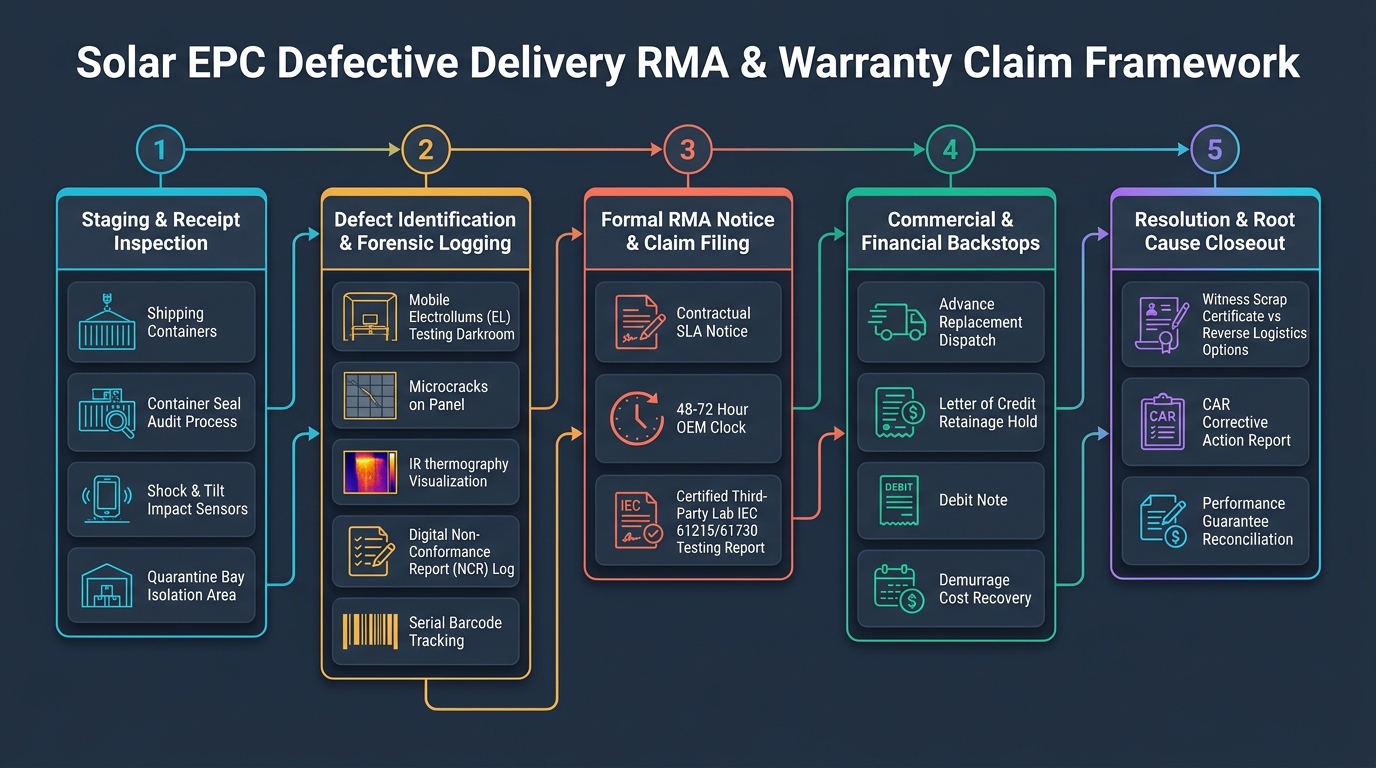
Key Operational Takeaways from the Framework:
- Separation of Physical Flow from Legal Flow: Never halt site installation while arguing with an OEM. The quarantine bay isolates defective lots immediately, allowing clean pallets to progress to tracker erection while the legal RMA mechanism operates in parallel.
- Forensic Evidentiary Standard: Manufacturers reject over 65% of claims citing “improper on-site handling.” Capturing EL imagery within 48 hours of container seal break provides indisputable temporal proof that micro-cracks originated prior to site possession.
- Financial Leverage Preservation: Once the final payment milestone or Letter of Credit is released, an EPC forfeits 90% of its commercial leverage. The ability to issue unilateral debit notes against pending invoices or retention funds is the single most potent motivator for swift OEM resolution.
05 Contractual RMA Clauses Every Purchase Team Must Demand
The most sophisticated site QA/QC inspection protocol is useless if the underlying Equipment Supply Agreement leaves the purchase team legally toothless. During contract negotiations, EPC purchase directors must neutralize standard OEM contract traps and mandate four non-negotiable clauses.
Clause 1: Eliminating the “Deemed Acceptance” Trap
Contractual DefenseThe OEM Trap: Standard OEM terms state: “Equipment shall be deemed irrevocably accepted unless Buyer provides written notice of defects within 5 (five) calendar days of delivery.” In a 100 MW project receiving 40 containers weekly, inspecting 25,000 modules in 5 days is physically impossible.
The Mandated Revision: Establish a bifurcated acceptance schedule:
Clause 2: Mandatory Advance Replacement Protocol
Schedule ShieldThe OEM Trap: Standard warranty terms follow a “Return-First, Inspect-Later” model. The buyer must pack, ship, and wait for factory testing before replacement dispatch, creating a 60-to-90 day delay that destroys project SCOD.
The Mandated Revision: Enforce unconditional advance replacement backed by domestic stock:
Clause 3: 100% Comprehensive Incidental Cost Allocation
Cost ShieldThe OEM Trap: Standard OEM terms limit warranty obligations to “repair or replacement FOB factory,” explicitly disclaiming de-installation labor, site sorting costs, mobile EL testing fees, crane hire, freight, and re-import customs duties.
The Mandated Revision: Broaden seller liability to encompass all direct remediating expenses:
Clause 4: Independent Laboratory Tie-Breaker Mechanism
Dispute ArbiterTo avoid endless technical stalemates, specify a named list of pre-approved accredited laboratories (such as National Institute of Solar Energy [NISE], TÜV Rheinland, UL Solutions, or PI Berlin). The contract must state that if the buyer and seller cannot agree on defect causation within 14 days, a jointly selected sample shall be dispatched to the referee lab. The referee lab's findings shall be final and legally binding on both parties, with the losing party bearing 100% of testing and shipping costs.
06 Mobile Darkroom Electroluminescence (EL) & Forensic Field Testing
Visual inspection on a solar job site is notoriously inadequate. Empirical data from over 2.5 GW of third-party audits reveals that less than 20% of transport-induced module defects are visible to the naked eye. The remaining 80% consist of sub-surface silicon micro-cracks, fractured busbar finger contacts, bypass diode open-circuits, and internal cell delamination.
When an EPC unloads dual-glass modules (featuring 2.0mm semi-tempered glass and thin 130μm N-Type TOPCon wafers), the glass frequently flexes without shattering. However, the brittle crystalline silicon wafer inside fractures under dynamic mechanical stress. If these panels are installed, the micro-cracks propagate under thermal cycling (ΔT ≈ 50°C daily desert swings). Within 12 to 24 months, the cracked cell segments become electrically isolated, forming localized high-temperature hot spots (>120°C) that melt encapsulant, trigger backsheet burn-through, and permanently degrade string PR by 2.5% to 5.0%.
Mobile Darkroom Testing Architecture
Deploying a customized, air-conditioned 20-foot or 40-foot containerized Mobile Darkroom EL Trailer directly into the site staging yard revolutionizes quality assurance:
Pneumatic roller conveyors and automated dual-bias testing fixtures achieve a throughput of 150 to 200 modules per hour, keeping pace with daily offloading.
Modules are tested under low forward current (0.1 Isc) to reveal series resistance and shunting, and full current (1.0 Isc) to illuminate micro-cracks and dead cell zones.
High-resolution cooled InGaAs or specialized CMOS cameras generate DICOM images matched against the manufacturer's pre-dispatch factory EL records via barcode OCR.
Standardizing Micro-Crack Severity (IEC TS 60904-13)
To prevent subjective arguments between field engineers and OEM representatives, the site QA/QC protocol must strictly classify EL defects into three standardized tiers per IEC TS 60904-13:
| Defect Class | EL Morphological Signature | Long-Term Operational Risk | Contractual RMA Action |
|---|---|---|---|
| Class A (Minor) | Hairline cracks parallel to busbars; zero inactive cell area; brightness >95% uniform. | Low short-term risk; potential propagation under severe wind-load vibrations. | Acceptable within AQL limits (≤0.65%); serial number logged for 5-year warranty tracking. |
| Class B (Moderate) | Cross-cell cracks intersecting multiple gridlines; 5% to 15% partial cell darkening. | Localized resistance heating; 0.5%–1.5% string mismatch loss; progressive hot spot formation. | Conditional rejection; vendor must replace if batch defect rate exceeds 2.0% of shipment. |
| Class C (Critical) | V-shaped corner cracks, dendritic branching, completely severed wafer sections; >15% dark area. | Severe hot spot (>130°C); bypass diode continuous conduction; fire hazard; irreversible degradation. | Mandatory Immediate Rejection; 100% replacement via Advance Replacement protocol. |
07 Inverter & High-Value BOS RMA Claim Mechanics
While PV modules account for the largest unit volume, inverters, power conversion systems (PCS), and inverter duty transformers (IDTs) represent the highest single-point financial and schedule risks. A defective 3.125 MW central inverter station or a damaged 33 kV transformer halts the energization of an entire block, stranding megawatts of installed DC capacity.
String vs. Central Inverter RMA Architectures
The RMA execution model diverges radically depending on whether the project utilizes decentralized high-capacity string inverters (250–350 kW) or centralized skid-mounted inverter stations (3.125–4.4 MW):
Do not attempt component-level field repairs on string inverters. The purchase contract must mandate an On-Site Spare Consignment Pool (1.5% to 2.0% of installed capacity) stored in a climate-controlled container at site.
- Defective unit swapped within 4 hours by general electrical technicians.
- Serial number reported to OEM portal; OEM collects defective unit in bulk quarterly.
- OEM replenishes the consignment pool within 14 days under standard warranty.
Central inverters cannot be replaced as complete units due to foundation and MV interconnection constraints. The RMA agreement must govern modular sub-assemblies (IGBT power phase legs, DSP boards, DC contactors).
- Contractual SLA: Factory service engineer on site within 24 to 48 hours.
- Pre-stocked critical spares container (IGBT stack, control card, auxiliary power supply).
- Mean Time to Repair (MTTR) guarantee ≤72 hours backed by lost-generation LDs.
When an inverter or transformer fails during commissioning or trial run, OEM field service engineers almost universally claim: “Failure was caused by severe grid voltage surges, harmonics, or lightning spikes outside IEC 62109 operating envelopes, invalidating warranty coverage.”
To dismantle this defense, solar purchase teams and engineering leads must ensure the project substation is equipped with a Class A Power Quality Analyzer (IEC 61000-4-30) and continuous digital fault recording (DFR) at the 33 kV pooling switchboard. By matching high-speed timestamped voltage/current oscillography against the inverter's internal event log, the EPC can definitively prove that grid parameters were within statutory Indian Electricity Grid Code (IEGC) tolerances, proving internal hardware component failure and forcing 100% OEM warranty honored replacement.
08 Financial Safeguards: Supplier Debit Notes, Retainage & Insurance
A technical claim without financial enforcement is merely an academic exercise. Purchase teams must establish tight coordination with project finance and accounting controllers to enforce commercial remedies the instant an NCR is confirmed.
The Supplier Debit Note Execution Formula
When equipment is rejected at the receiving quarantine gate, the finance team calculates and issues an immediate Supplier Debit Note. The debit amount ($D_{\text{total}}$) is not limited to invoice price; it incorporates all verified project friction expenses:
Under standard master procurement contracts, this Debit Note is automatically set off against:
- Next Progress Milestone Payment: Immediate deduction from the next scheduled delivery payment tranche.
- Unreleased Retention Money: The 5% to 10% cash retention held back until Provisional Acceptance Certificate (PAC).
- Performance Bank Guarantee (PBG) Encashment: If the supplier refuses to honor debit notes or stalls advance replacement beyond 21 days, the EPC has the contractual right to encash an equivalent portion of the supplier's PBG.
Marine Cargo Insurance vs. RMA Warranty: The Dual-Track Strategy
One of the most frequent errors made by junior purchase managers is pausing an insurance claim while negotiating with an equipment vendor, or vice versa. In international and domestic logistics, Marine Cargo Insurance (Institute Cargo Clauses A – All Risks) policies impose strict 7 to 14-day notice deadlines. If the EPC waits for an OEM to complete a 30-day investigation before notifying the cargo underwriter, the insurance claim will be summarily repudiated due to late notification.
The Dual-Track Protocol:
Hour 0–24: Issue joint notifications to both the equipment manufacturer (RMA claim) and the marine cargo insurance broker (formal Notice of Loss / Damage Under Policy).
Hour 24–72: Organize a Joint Inspection Survey at the site quarantine yard with the insurance surveyor, the carrier's representative, and the OEM technical lead. Preserve container seals, shock loggers, and damaged pallets in situ.
Day 7–14: Execute a Letter of Subrogation with the cargo insurer. This allows the insurer to pay out the claim for damaged hardware to the EPC, while the insurer's legal team pursues recovery from the shipping line or trucking transporter, keeping project cash flows liquid.
09 Comprehensive Solar Equipment RMA & Defect Resolution Matrix
The reference matrix below outlines standardized defect thresholds, quarantine actions, contractual remedies, and financial recovery pathways across all major solar power plant hardware categories.
| Component | Typical Delivery Defect | Acceptance Threshold (AQL) | Immediate Site Action | Contractual RMA Remedy | Financial Recovery Path |
|---|---|---|---|---|---|
| N-Type TOPCon PV Modules | Sub-surface silicon micro-cracks, dual-glass corner chipping, failed bypass diodes. | AQL 0.65% (Critical defects ≤0; Class B ≤1.5%). | Quarantine bay diversion; 100% mobile darkroom EL screening; timestamped NCR logging. | Advance Replacement within 10 days DDP Site from domestic bonded warehouse. | Supplier Debit Note on next invoice milestone; retention hold of 125% claimed value. |
| String Inverters (250–350 kW) | PCB ribbon fractures, transport shock sensor trip (>3G), damaged IP66 seals. | Zero tolerance (0% defective allowed on main electronic assemblies). | Quarantine unenergized; inspect shock sensors; internal borescopic inspection. | Immediate unit swap from on-site 2% consignment spare pool; OEM collects rejected unit. | OEM replenishes spare pool in 14 days; backcharge testing and crane detention. |
| Central Inverter Skids (3.125 MW+) | Busbar bolt shear, IGBT stack transit displacement, enclosure distortion. | Zero tolerance (100% pre-commissioning mechanical & electrical FAT verification). | Refuse delivery challan sign-off; tag skid “Quarantine – Under Protest”; notify OEM. | OEM factory engineer dispatch ≤24h; modular power core replacement ≤72h MTTR. | Enforce commissioning delay LDs (₹1.5L/day); freeze skid milestone payment. |
| Mounting Structure (MMS Purlins/Rafters) | Galvanizing <80μm, slot punching deviation >1.5mm, cold-forming twisting. | IS 4759 / ISO 1461: Coating ≥80μm; bolt hole center tolerance ±1.0mm. | Positector gauge audit (10 points per member); reject lot if >3% samples fail. | Supplier re-galvanizes or re-punches batch within 7 days; hot-dip dip rectification. | Backcharge site re-sorting labor and idle assembly gang costs (₹2.5L/day). |
| 1500V DC XLPO Solar Cables | Drum flange crushed, outer sheath scuffing, conductor cross-section sub-gauge. | EN 50618: Zero conductor pinholes; electrical resistance per IEC 60228 Class 5. | Inline high-voltage spark testing; conductor micrometer and resistance measurement. | Supplier dispatches replacement cable drums within 10 days; scrap unrolled cable. | Debit note netting against cable manufacturer's pending progress payment. |
| Inverter Duty Transformers (IDT) | Nitrogen cushion pressure loss, core displacement, cracked high-voltage bushings. | Zero leakage; core insulation resistance >1000 MΩ; dielectric breakdown >60 kV. | Inspect impact recorder; test oil moisture and breakdown voltage (BDV) on site. | OEM sends specialized oil filtration / bushing replacement team; factory rebuild if core shifted. | Activate Marine Cargo Policy ‘All Risks’; freeze Letter of Credit final tranche. |
10 Real-World Case Study: 150 MWp Rajasthan Project Averting a 45-Day Delay
How Institutional RMA Procedures Prevented ₹2.4 Crore in Transit Losses and Averted ₹1.8 Crore in SCOD Penalties
In late 2025, a Tier-1 solar EPC was executing a prestigious 150 MWp utility-scale solar project near Bhadla, Rajasthan under a tight 12-month Scheduled Commercial Operation Date (SCOD) commitment with a state power utility. Between weeks 18 and 22, the project was scheduled to ingest 75 MWp of 580 Wp bifacial dual-glass N-Type TOPCon modules imported through Mundra Port and hauled 540 kilometers inland via multi-axle trailers.
The Crisis:
During Week 19, an initial consignment of 38 ocean containers (comprising 23,560 modules across 760 pallets) arrived at the site laydown yard. While visual inspection showed minor cardboard scuffing, the site receiving team noticed that 12 containers had tripped their SpotSee ShockWatch 5G impact indicators to vivid red, indicating severe dynamic shock during the final 45-kilometer stretch of corrugated, unpaved desert access road.
Immediate Forensic Actions:
- Rigid Quarantine Isolation: The quality manager immediately flagged all 38 containers into the fenced quarantine yard, refusing to sign clean delivery challans and endorsing bills of lading with “Accepted Under Protest – High-G Transit Shock Triggered.”
- Mobile Darkroom EL Deployment: An on-site containerized mobile EL testing unit screened an ISO 2859-1 Level II sampling of 1,250 modules over 48 continuous hours. The results were alarming: 14.8% of sampled modules exhibited Class C severe micro-cracks (cross-wafer dendritic fractures crossing multiple busbars), caused by trailer mechanical leaf-spring resonance and inadequate pallet dunnage.
- Digital NCR Issuance: Within 36 hours of offloading, a comprehensive digital NCR containing cloud-linked EL RAW files, timestamped ShockWatch logs, and GPS transit telemetry was served to the module manufacturer's global headquarters.
Contractual Enforcement & Outcome:
The manufacturer initially attempted to deflect blame, claiming micro-cracks occurred during site offloading. However, because the EPC had negotiated a robust Advance Replacement Clause (Section 14.2) and maintained continuous chain-of-custody video telemetry from the container gate break, the EPC finance controller immediately froze the release of a ₹12.5 Crore pending Letter of Credit milestone.
Faced with LC suspension, the OEM released 5.2 MWp (9,000 modules) of identical-bin buffer stock from its Mundra bonded warehouse within 6 days.
100% of the defective 3,480 modules were replaced at zero cost to the EPC; reverse logistics and recycling were borne entirely by the OEM.
Mechanical installation never halted; the project commissioned 11 days ahead of statutory SCOD, avoiding ₹1.8 Crore in potential DISCOM delay penalties.
11 16-Point Solar Purchase Manager Defective Delivery & RMA Checklist
Solar procurement directors, site purchase leads, and quality managers should enforce this 16-point operational checklist across every delivery to guarantee commercial protection and contractual compliance.
Phase A: Pre-Dispatch & Contractual Fortification
Phase B: Gate Intake & Quarantine Isolation
Phase C: Forensic Testing & Digital RMA Filing
Phase D: Commercial Enforcement & Closeout
12 Frequently Asked Questions (FAQ)
What is the typical contractual notification window for defective solar deliveries?
Standard manufacturer supply contracts frequently attempt to restrict defect notification windows to 48 to 72 hours from offloading, after which equipment is deemed irrevocably accepted. However, industry best practice for solar EPCs is to negotiate a bifurcated notification structure: 7 calendar days for apparent physical defects (pallet crushing, broken glass, frame warpage, moisture ingress) and 30 to 45 calendar days for latent electrical or sub-surface defects (micro-cracks detected via mobile darkroom electroluminescence testing, bypass diode short-circuits, or insulation breakdown under high-voltage dielectric testing).
Why is an “Advance Replacement” clause essential in solar equipment purchase agreements?
Without an Advance Replacement clause, original equipment manufacturers (OEMs) typically require the EPC to return defective modules, inverters, or transformers to an overseas factory or regional repair depot for forensic inspection before replacement units are fabricated or dispatched. This traditional warranty loop takes 60 to 120 days, virtually guaranteeing that the project will miss its PPA Scheduled Commercial Operation Date (SCOD) and incur crippling delay liquidated damages (often ₹5 to ₹10 Lakh per day for a 100 MW project). An Advance Replacement mandate obligates the OEM to dispatch verified replacement stock from domestic buffer warehouses within 7 to 14 days upon receipt of a certified digital Non-Conformance Report (NCR) and photographic/EL evidence, shifting the transit and inspection delay risk away from the EPC.
How does mobile darkroom Electroluminescence (EL) testing prevent RMA dispute rejections?
Visual inspection detects less than 20% of transit-induced solar module damage. Micro-cracks—sub-surface silicon wafer fractures caused by dynamic transit vibration, air-suspension trailer failures, or violent rough-road hauling—are completely invisible to the naked eye. By deploying on-site mobile darkroom EL testing trailers, EPCs capture high-resolution forward-bias infrared emission images (IEC TS 60904-13) within 24 to 48 hours of pallet offloading. By comparing these receiving EL images with the manufacturer's pre-dispatch flash-test EL images stored in cloud escrow, the EPC establishes definitive forensic proof that damage occurred during transit or factory packaging, eliminating OEM claims that defects were caused by site handling or mechanical mounting crews.
How should an EPC finance team execute a Supplier Debit Note for defective deliveries?
A Supplier Debit Note must be supported by an ironclad Non-Conformance Report (NCR) dossier that includes pallet and container serial numbers, calibrated sensor readings, high-resolution photographs, mobile EL scans, and an itemized cost schedule. The debit note should quantify not only the direct invoice cost of the rejected components, but also contractual backcharges: third-party laboratory inspection fees, mobile darkroom testing costs, crane standby detention charges, extra sorting labor, and site warehousing overheads. In accordance with master purchase terms, this debit note is netted off directly against upcoming progress payments, unreleased retention funds, or drawn from unencumbered Performance Bank Guarantees (PBGs).
What is the difference between an RMA warranty claim and a Marine Cargo Transit Insurance claim?
An RMA warranty claim is filed directly against the equipment manufacturer for non-conformances rooted in manufacturing defects, substandard packaging design, or failure to meet contractual specifications per IEC standards. In contrast, a Marine Cargo / Inland Transit Insurance claim is filed against the cargo underwriter under Institute Cargo Clauses (A) ‘All Risks’ for damage caused by external perils during transport (container dropped by port gantry cranes, vehicle rollover, road vibration exceeding 2.5G, water ingress during maritime transit). Solar purchase teams must initiate dual-track notifications within 72 hours: notifying both the OEM for contractual RMA advance replacement and the transit insurer for a joint surveyor inspection, ensuring neither claim window expires while technical fault liability is apportioned.
Fortify Your Solar Procurement Against Delivery Defects
V-TECH RENEWABLES provides comprehensive Owner's Engineer, Third-Party Inspection (TPI), Mobile Darkroom EL Audits, and Contractual Due Diligence services to protect solar developers and EPCs from multi-crore delivery disputes.
Related Technical & Procurement Guides
Securing Long-Term Supply Agreements for Utility-Scale Projects
Locking in Tier-1 capacity, raw material price indexation formulas, and production milestone gates.
Procurement & Supply ChainThe Total Cost of Ownership (TCO) Approach to Solar Purchasing
Why lowest upfront CapEx triggers multi-crore LCOE losses across a 25-year asset lifecycle.
Procurement & Supply ChainManaging Logistics & Transit Damage for Delicate PV Modules
Mitigating micro-cracks in dual-glass N-Type TOPCon modules with shock loggers and mobile EL darkrooms.