Securing Long-Term Supply Agreements for Utility-Scale Projects
Locking in Tier-1 manufacturer capacity, mitigating upstream polysilicon and metal volatility through dynamic indexation formulas, synchronizing staged deliveries with civil execution, and enforcing bankable warranty structures for multi-hundred megawatt portfolios.
01 The Multi-Hundred Megawatt Dilemma: Spot Risks vs. LTSA Stability
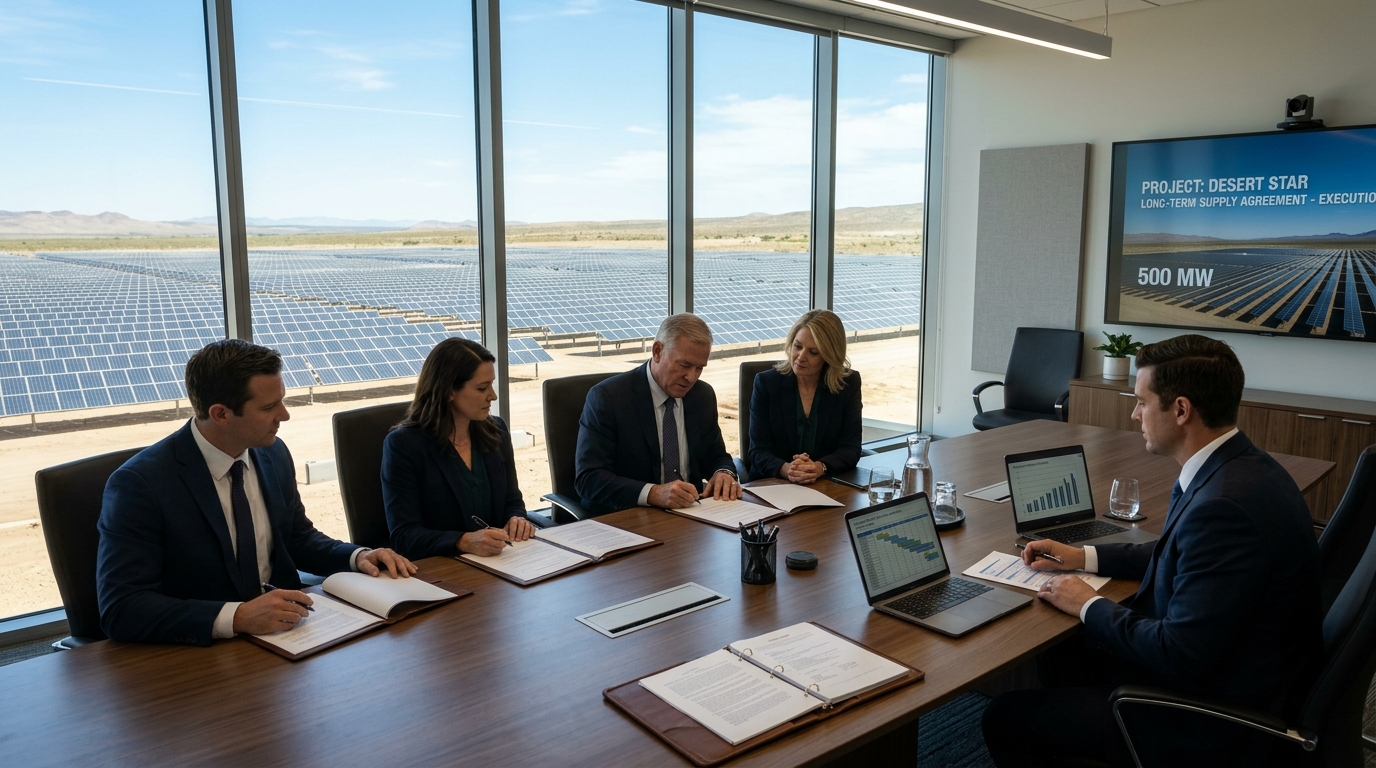
In modern utility-scale solar development, executing projects between 100 MWp and 1,000+ MWp transforms procurement from a tactical purchasing activity into a critical project risk vector. When a developer signs a Power Purchase Agreement (PPA) with a government entity (such as SECI, NTPC, or state DISCOMs), they commit to a strict Scheduled Commercial Operation Date (SCOD)—frequently backed by encashable Performance Bank Guarantees (PBGs) ranging from ₹10 Lakh to ₹20 Lakh per megawatt. In this high-stakes environment, attempting to procure capital-intensive equipment on the spot market is an existential gamble.
- Capacity Allocation Rationing: During sudden global demand surges or raw material constraints, Tier-1 original equipment manufacturers (OEMs) prioritize multi-gigawatt framework buyers, bumping spot-order buyers to the back of production queues by 3 to 6 months.
- BOM Fragmentation & Yield Mismatch: Purchasing modules in fragmented spot batches forces the EPC to blend distinct silicon wafer vintages, varying front-glass coatings, and disparate current-voltage (I-V) bin distributions within the same block, causing permanent mismatch losses of 0.8% to 2.4% in PVsyst simulations.
- Pricing Disadvantage: Without volume aggregation, spot purchasers forfeit the 6% to 12% purchasing discount enjoyed by multi-gigawatt developers, eroding the already razor-thin internal rate of return (IRR) of competitively bid solar auctions.
- Zero Customization Leverage: Spot buyers must accept factory-standard Bills of Materials (BOMs), unable to mandate enhanced encapsulation (such as 100% POE over EVA for high-damp-heat environments), bespoke cable lengths for tracker torque tubes, or specialized high-altitude transformer bushings.
A Long-Term Supply Agreement (LTSA) eliminates these vulnerabilities by transforming the buyer-vendor relationship into an integrated strategic alliance. By securing manufacturing pipeline capacity 12 to 24 months in advance, locking transparent pricing indexation mechanisms, and establishing binding quality protocols, the LTSA creates the operational certainty required to achieve financial close and satisfy non-negotiable PPA grid synchronization deadlines.
02 Contractual Framework: Master Supply Agreements vs. Project Call-Offs
Structuring an LTSA requires a two-tiered contractual architecture that balances long-term portfolio commitment with project-specific financial and jurisdictional ring-fencing. Attempting to execute a single, rigid purchase contract across a multi-hundred megawatt pipeline exposes both parties to severe commercial gridlock if a single project site faces land acquisition delays, transmission right-of-way (RoW) disputes, or local permitting hurdles.
Executed at the corporate developer or portfolio EPC holding level. Establishes the umbrella legal, commercial, and technical framework across the entire multi-year procurement volume.
- Aggregated multi-project volume commitment (e.g., 500 MW – 1.5 GW).
- Standardized technical specifications & approved BOM freeze.
- Global price indexation formulas and margin collars.
- Factory quality gate regimes (M0 to M5) and audit rights.
- Parent Company Guarantee (PCG) formats & warranty backstops.
- Intellectual property, dispute resolution & governing law.
Executed by the individual Project Special Purpose Vehicle (SPV) or designated EPC contractor for each specific solar asset upon achieving financial close and regulatory clearances.
- Exact project delivery schedule & site GPS coordinates.
- Firm wattage bin distributions (e.g., 600W to 620W N-Type TOPCon).
- Project-specific Letter of Credit (LC) and payment security.
- Specific Incoterms (e.g., DAP Site or DDP Laydown Yard).
- Site-specific liquidated damages caps & milestone triggers.
- Project financing bank step-in rights & collateral assignment.
This modular contracting structure enables developers to leverage the full purchasing power of their multi-gigawatt pipeline while insulating individual project Special Purpose Vehicles (SPVs) from reciprocal liabilities. If Project Alpha experiences a 60-day grid substation delay, the MSA mechanism allows the developer to reallocate upcoming factory production batches to Project Beta with minimal administrative friction and zero OEM cancellation penalties.
03 Mathematical Price Indexation: Raw Material Collars & Formulas
The greatest failure mode of historical long-term solar contracts has been the rigid fixed-price model. During volatile market cycles—such as the historic 2021–2022 polysilicon surge from $9/kg to $40/kg, or metal supply bottlenecks—manufacturers holding fixed-price contracts either defaulted, delayed dispatches indefinitely under dubious Force Majeure claims, or demanded renegotiation. Conversely, when polysilicon crashed to historic lows below $6/kg in 2024–2026, fixed-price buyers found themselves trapped in uncompetitive capital expenditure structures.
Modern utility LTSAs eliminate this friction through dynamic mathematical price indexation linked to transparent, third-party published commodity indices.
Structuring the Mutual Price Collar & Deadband
To prevent unmanageable budget swings that could violate project debt-covenants or debt-service coverage ratios (DSCR), bankable supply contracts embed neutral deadbands and bilateral collars:
04 Production Capacity Reservation: Rolling Forecasts & Gates
Securing multi-hundred megawatt volumes requires booking physical factory throughput without unnecessarily freezing balance-sheet capital before site civil foundations are ready. The industry standard utilizes a Rolling 12-Month Production Allocation Framework governed by strict milestone gates.
Developer provides non-binding monthly capacity projections across designated module wattages (e.g., 600W+ TOPCon). Manufacturer reserves high-level ingot/wafer sourcing capacity. Zero financial penalty for shifting volume between planned quarters.
Volume is locked within a ±10% tolerance band. Developer verifies statutory PPA milestones, grid substation transmission connectivity approvals, and land possession. Manufacturer schedules dedicated automated cell and module assembly lines.
Execution of binding Call-Off PO. Bill of Materials (BOM) is permanently fingerprinted (exact EVA/POE supplier, junction box model, frame alloy, and cell metallization). 100% of volume is firm. Developer opens Irrevocable Documentary Letter of Credit (LC).
Independent Engineer (IE) conducts on-site factory audits: 100% inline electroluminescence (EL) verification, Golden Module sun simulator calibration, and flash-test data file audit. Issuance of formal Factory Acceptance Certificate (FAC) prior to container stuffing.
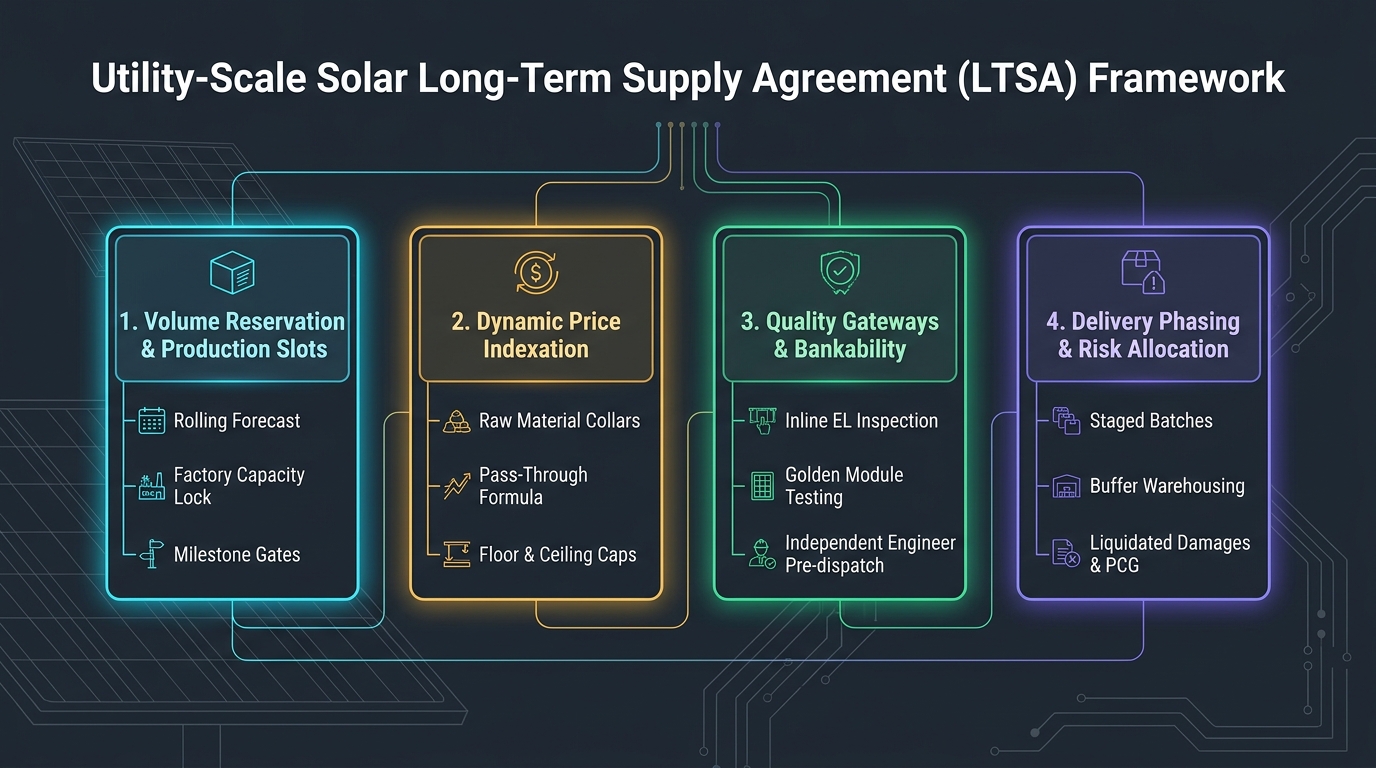
05 Technical Infographic: Utility Solar LTSA Framework
06 Factory Quality Gateways & Independent Engineer Sign-Off
Securing price and volume is worthless if the delivered hardware suffers from sub-surface micro-cracks, PID vulnerability, or false nameplate wattage ratings. In utility solar projects, where a 1% generation deficit on a 500 MW asset represents over ₹6.5 Crore in annual revenue loss, the LTSA must establish non-negotiable, independent quality verification protocols that operate directly on the factory floor.
OEMs frequently substitute cheaper encapsulation materials (e.g., standard EVA instead of POE/EPE) or down-gauged aluminum frames after contract signing. The LTSA must include a legally binding Bill of Materials Specification Appendix that freezes component manufacturers by name and part number. Any unapproved deviation automatically constitutes a material breach and grounds for container rejection.
To eliminate "flash tester calibration drift," the LTSA mandates calibrated "Golden Modules" verified by accredited calibration laboratories (such as Fraunhofer ISE, TÜV Rheinland, or NREL per IEC 60904-1). Factory flash testers must be calibrated against these reference modules before every 50 MW production shift, ensuring measured STC wattages match site realities.
Contractual enforcement of dual-stage Electroluminescence (EL) testing: (1) Post-lamination EL before frame assembly to catch cell fractures, and (2) Final EL before packaging to detect handling-induced micro-cracks. High-resolution raw EL image files for 100% of serialized modules must be deposited into a cloud data escrow accessible by the buyer's Owner's Engineer.
07 Delivery Phasing, Staged Dispatches & Demurrage Elimination
One of the most catastrophic logistics failures in utility solar execution is the uncoordinated "module flood." If an overseas manufacturer dispatches 200 MW of modules in a single ocean charter while the site has only completed 40 MW of module mounting structure (MMS) piling, the developer faces immediate operational paralysis:
- Port Demurrage & Container Detention: Hundreds of 40-foot high-cube shipping containers sit stranded at port yards or dry ports, accumulating daily detention fees ranging from $80 to $150 per container per day—costing crores within weeks.
- Laydown Yard Weathering: Storing thousands of module crates in unpaved, dusty desert laydown yards exposes delicate packaging to high ambient moisture, torrential monsoon flooding, or extreme thermal cycling that degrades cardboard integrity and promotes glass breakage.
- Double Handling & Micro-Cracking: Modules dumped in overcrowded laydown yards must be relocated multiple times using rough site telehandlers, increasing mechanical transit micro-cracks by up to 300%.
The "Just-In-Time" (JIT) Block-Level Dispatch Protocol
To eliminate these risks, the LTSA must establish a strict Milestone-Linked Staged Dispatch Schedule. Dispatches are contractually throttled to the EPC's verified weekly installation rate (typically 25 MW to 35 MW per week for a 500 MW asset). Furthermore, contracts must specify DAP Site or DDP Laydown Yard Incoterms (2020) where feasible, or incorporate 21 to 28 Days of Free Container Detention negotiated directly into the manufacturer's master ocean shipping liner agreements.
08 Delay Liquidated Damages (LDs) & Force Majeure Boundaries
When a utility solar project misses its PPA grid connection milestone, state transmission utilities or government off-takers levy brutal encashment penalties. The LTSA must provide commensurate contractual teeth through carefully drafted Delay Liquidated Damages (LDs) while strictly circumscribing OEM Force Majeure claims.
- Standard Delay Penalty: 0.5% of the delayed shipment value per calendar week of delay for the first 4 weeks, escalating to 1.0% per week thereafter.
- Aggregate LD Cap: Lenders and project financiers mandate an aggregate delay LD cap between 10% and 15% of the total PO contract value.
- Direct Offset Mechanism: Buyer retains the express contractual right to offset accrued liquidated damages directly against any outstanding letter of credit (LC) payments or retention releases without requiring prior judicial or arbitral decree.
Manufacturers routinely draft overly broad Force Majeure definitions that treat standard commercial risks as excusable delays. A bankable LTSA must explicitly exclude:
- Upstream raw material price spikes (e.g., polysilicon surges).
- Sub-supplier insolvencies or routine component stockouts.
- Routine port congestion or shipping freight rate increases.
- Standard seasonal weather events (monsoon, seasonal fog).
- Unavailability of factory labor or machinery breakdown.
09 Warranty Backstopping, Parent Company Guarantees & Escrow
A 25-to-30 year solar module performance warranty is an uncollateralized long-term debt obligation. Given the cyclical nature of the solar manufacturing sector—where dozens of former top-tier module makers entered bankruptcy over the past 15 years—relying solely on an operating subsidiary's balance sheet is unacceptable to project finance syndicates.
Must be executed by the ultimate listed or holding parent entity, not an undercapitalized offshore shell entity or regional trading subsidiary. The PCG must be unconditional, joint-and-several, and enforceable without requiring the buyer to exhaust remedies against the primary supplier.
Underwritten by investment-grade reinsurance syndicates (such as Munich Re, Swiss Re, or Ariel Re). Crucially, the policy must name the Project SPV and its Lenders as primary loss payees, survive the OEM's corporate insolvency, and feature pre-paid non-cancellable premiums for the entire 25-to-30 year asset horizon.
A cash-backed or bank-guaranteed performance bond (typically 5%–10% of contract value) issued by an acceptable international or scheduled domestic bank, remaining active through project commissioning and the initial 24-month operational defect liability period (DLP).
10 Comprehensive Equipment Supply Agreement Matrix
While solar PV modules command the largest portion of procurement CapEx, utility LTSA strategies must simultaneously encompass other long-lead Balance of System (BOS) capital equipment: central inverter skids, single-axis solar trackers, and high-voltage power transformers.
| Equipment Class | Standard Lead Time | Key Indexation Benchmark | Critical Factory Gate Review | Essential Warranty / PBG Standard |
|---|---|---|---|---|
| PV Modules (TOPCon / HJT) | 3 – 6 Months | PVInfoLink Polysilicon, LBMA Silver, Domestic Glass | Golden Module Calibration, 100% Inline EL, BOM Fingerprint | 12-Yr Product / 30-Yr Performance + Munich Re Insurance |
| Central Inverter Skids (3.125 MW+) | 6 – 9 Months | LME Copper, IGBT Semiconductor Index, Steel HRC | Full Temperature Rise at 50°C, Fault Ride-Through (FRT) | 5-Yr Base + 10-Yr Extended SLA + 99.5% Availability Guarantee |
| Single-Axis Trackers (SAT) | 4 – 7 Months | Domestic / Platts HRC Steel, Zinc/ZAM Coating Index | Torque Tube Torsion Testing, Slew Drive Backlash Audit | 10-Yr Structural / 5-Yr Drive & Controls + 10% PBG |
| 33kV / 220kV / 400kV Transformers | 12 – 18 Months | LME Copper, CRGO Silicon Steel, Transformer Mineral Oil | Lightning Impulse Withstand, Temperature Rise, Dissolved Gas (DGA) | 5-Yr Comprehensive Warranty + 10% Performance Bond |
500 MWp Hybrid Utility Solar Project in Bhadla / Pavagada Solar Park
A leading independent power producer (IPP) and national solar EPC contracted V-TECH RENEWABLES as Owner's Engineer and Strategic Procurement Advisor to structure and negotiate a master Long-Term Supply Agreement for a 500 MWp utility-scale solar asset.
The Strategic Challenge: The project faced an aggressive 14-month SCOD target during a volatile period of polysilicon and freight volatility. Simultaneously, the state grid utility imposed a ₹15 Lakh/MW/month delay penalty. Spot quotes from Tier-1 suppliers required 100% upfront firm pricing with severe cancellation clauses.
The LTSA Solution: V-TECH RENEWABLES structured a dual Master Supply Agreement with two Tier-1 manufacturers (350 MW primary, 150 MW secondary). The agreement incorporated a dynamic price indexation formula with a ±3.5% neutral collar deadband, an M0-to-M4 rolling capacity allocation lock, and an independent on-site engineering team conducting 100% inline EL and Golden Module calibration audits. Delivery dispatches were contractually pegged to verified weekly MMS table erection milestones (30 MW/week).
The Financial & Technical Outcome: When polysilicon surged temporarily by 18%, the contract's 12% ceiling cap insulated the project from ₹42.8 Crore in cost escalation. Staged dispatches and 28-day free container detention saved over ₹8.6 Crore in port storage and demurrage fees. All 500 MWp was energized 21 days ahead of the PPA SCOD, securing full performance bank guarantee release and delivering a 1.4% higher Performance Ratio (PR) due to zero cell mismatch losses.
11 15-Point Utility Solar Supply Agreement Contract Audit Checklist
Before executing any multi-hundred megawatt Master Supply Agreement or Call-Off Purchase Order, project directors and procurement heads should verify these 15 non-negotiable clauses:
12 Frequently Asked Questions (FAQ)
How far in advance should an EPC negotiate an LTSA for a utility solar project?
For solar PV modules and high-power string inverters, Master Supply Agreements should be initiated 9 to 12 months prior to the scheduled site civil commencement, with production allocations locked 90 to 120 days before dispatch. However, for critical long-lead high-voltage Balance of System items—specifically 220kV/400kV Inverter Duty Transformers and power transformers—procurement agreements must be executed 14 to 18 months in advance due to global shortages of CRGO silicon electrical steel and specialized manufacturing backlogs.
What happens if domestic import policies or ALMM mandates change during an LTSA term?
Statutory changes—such as additions to the Approved List of Models and Manufacturers (ALMM), revisions in Basic Customs Duty (BCD), or Bureau of Indian Standards (BIS) renewals—must be governed by an explicit "Change in Law" Clause. The LTSA should stipulate that if a supplier's product loses regulatory eligibility through failure to maintain statutory registrations, the supplier must either substitute compliant equivalent hardware at no cost or allow the buyer to terminate the unfulfilled Call-Off without penalty and draw upon the Performance Bank Guarantee.
Can a developer reallocate committed LTSA volumes between different project SPVs?
Yes, provided the LTSA is structured as an umbrella Master Supply Agreement (MSA). Under a well-drafted MSA, the developer holding company retains the contractual right to assign upcoming manufacturing batches or redirect delivery destinations between wholly owned subsidiaries or project SPVs upon giving 30 to 45 days written notice, subject to adjustments in freight and local inland logistics costs.
How are module flash-test tolerances handled in utility supply contracts?
Utility contracts must enforce a strict positive power tolerance only (e.g., 0 to +5Wp). Furthermore, the contract must establish that the weighted average peak power of the total delivered lot must equal or exceed the nominal rated wattage (Pnom). Any module testing below the nominal rating is rejected at the factory gate, and flash test measurements must use an agreed third-party calibrated Golden Module baseline under IEC 60904-1 standards.
What is the role of an Owner's Engineer during LTSA execution?
An Owner's Engineer (such as V-TECH RENEWABLES) acts as the developer's technical watchdog throughout the LTSA lifecycle: defining technical specification schedules, auditing the manufacturer's quality management system (QMS), performing independent pre-dispatch inspections (PDI), verifying sun simulator calibrations, analyzing 100% inline EL images, and issuing formal Factory Acceptance Certificates (FAC) that release commercial letters of credit.
Optimize Your Multi-Megawatt Solar Procurement
From Master Supply Agreement drafting and indexation modeling to on-site factory QA/QC audits and Independent Engineer sign-off, V-TECH RENEWABLES safeguards your utility solar investments against technical and commercial risks.