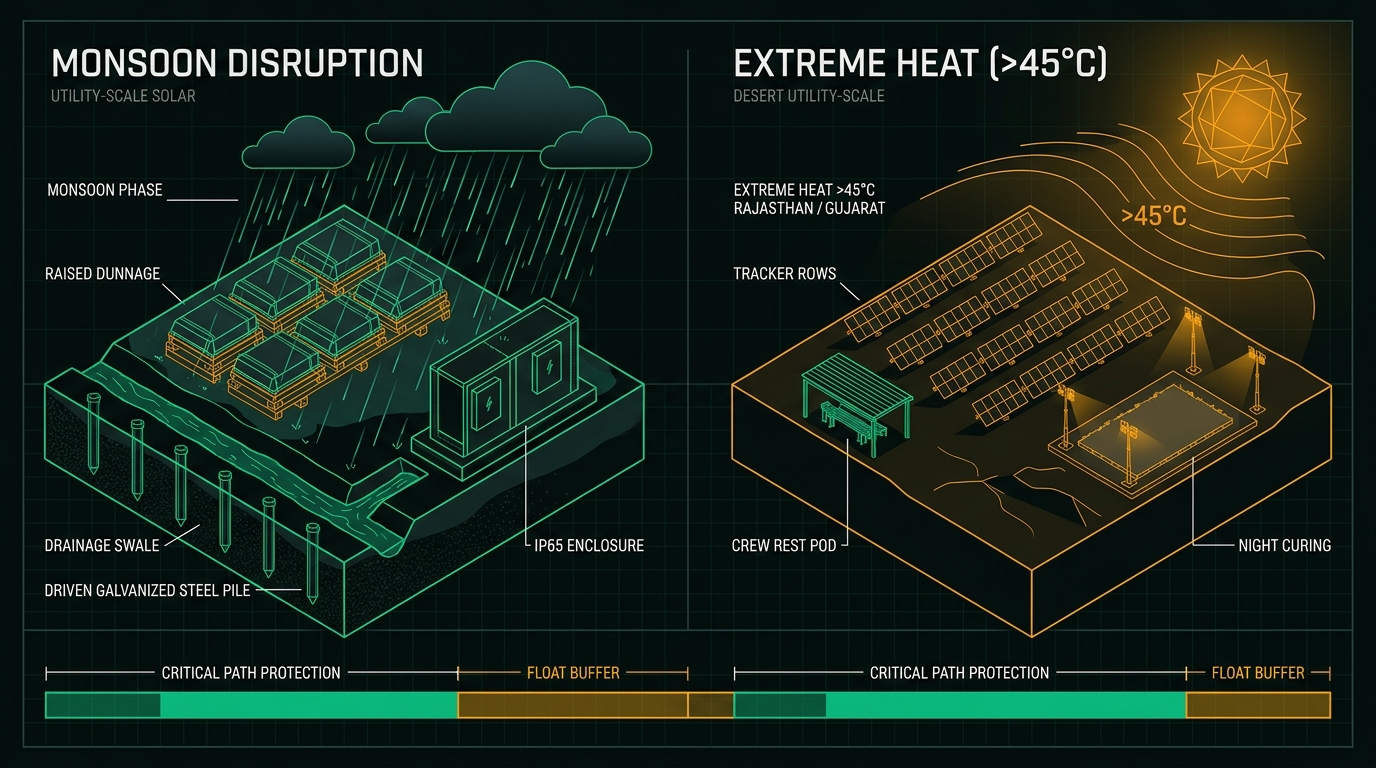
1. Why Weather Breaks Solar Critical Paths
Rain stalls hydraulic piling rigs overnight. Extreme afternoon heat cuts field bolting output in half. Both destroy baseline solar Gantt charts when planners treat site productivity as flat across all twelve months.
Indian utility-scale EPC teams navigate two severe weather windows every year: June–September southwest monsoons across central and western belts, and April–June heatwaves across Rajasthan and Gujarat. Unbuffered stoppages leave 1500 V DC module pallets sitting in muddy laydown yards, idle 33 kV/220 kV erection cranes on daily standby, and push commissioning past contracted CEIG inspection and DISCOM synchronization windows—triggering steep PPA liquidated damages and delayed revenue billing.
2. Monsoon Controls: Soil, Torque & Moisture
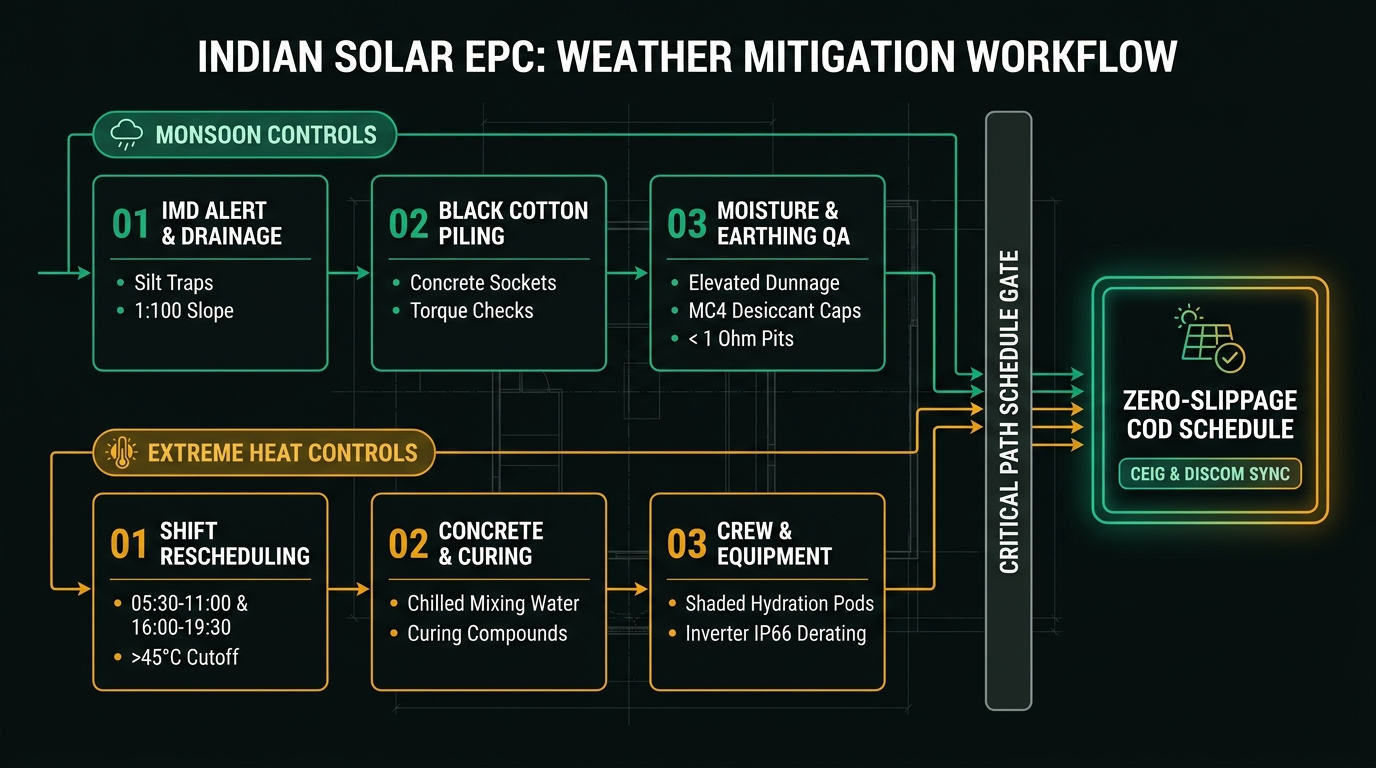
When IMD issues orange or red district rainfall alerts, black cotton soil swells rapidly and turns compacted haul roads into bog traps. Direct-driven piling loses plumb tolerance (±1.5°), forcing crews into pre-drilled M25 concrete sockets per IS 456. Before mounting IS 2062 galvanized purlins, check anchor alignment and IS 875 Part 3 wind-uplift fastener torque so gale gusts do not rack unfinished tables or strip module mounting clamps.
Waterlogged cable trenches delay backfilling for weeks without perimeter 1:100 drainage swales, check bunds, and silt traps. Verify chemical earthing pit resistance stays below 1.0 Ω per IS 3043 before trench closure, seal every unmated 1500 V DC MC4 string plug with IP68 desiccant caps to block moisture ingress, and set IP65/IP66 inverter skids on raised RCC plinths above local 100-year flood marks.
3. Extreme Heat Controls Above 45°C
Across Barmer, Bikaner, and Kutch, shade temperatures exceed 45°C while unshaded aluminum frames and module glass cross 70°C. Continuous midday shifts spike heat exhaustion and drop DC termination accuracy. Enforce strict 11:30–15:30 outdoor work cutoffs, splitting structural and cabling crews into dawn (05:30–11:00) and dusk (16:00–19:30) blocks supported by shaded cooling pods, wet-bulb thermometers, and cold electrolyte stations.
High ambient heat also sabotages civil foundations and power electronics. Concrete poured above 38°C flashes off mixing water, causing plastic shrinkage cracks on transformer and 3.125 MVA inverter plinths. Batch with chilled water, apply aliphatic curing compounds immediately after finishing, and move heavy foundation pours under floodlights at night while checking thermal derating curves on 40 kA switchgear and XLPE cable drums.
4. Monsoon & Heat Mitigation Workflow
Running parallel seasonal controls through a gated critical-path review keeps CEIG filings, trench sign-offs, and DISCOM synchronization slots intact despite storm or heatwave disruptions across utility-scale solar parks.
5. Weather Risk & Mitigation Matrix
Field teams apply distinct civil, electrical, and shift rules depending on whether IMD forecasts heavy rain or severe dry heat across utility sites.
| Control Area | Monsoon (IMD Alert) | Extreme Heat (>45°C) |
|---|---|---|
| Civil & Piling | Pre-drilled sockets; 1:100 swales | Night M25/M30 pours; chilled water |
| Electrical & IP | IP65/IP66 skids; MC4 caps; < 1 Ω pits | Thermal derating checks; shaded drums |
| Crew Shifts | Indoor AJB kitting on red alerts | 05:30–11:00 & 16:00–19:30 split shifts |
| Schedule Float | 15–20% buffer ahead of CEIG | 10–12% summer derating factor |
6. Procurement & Synchronization Buffers
Purchase teams protect project margins when factory dispatches track real weather gates instead of static baseline dates. Pre-position 300 mm raised timber dunnage, heavy-duty tarpaulins, and spare MC4 sealing caps on site before May, and hold 1500 V DC XLPE drums and 33 kV switchgear dispatches until plinth curing passes seven-day compressive strength checks and laydown drainage clears inspection.
Complete dry-weather IEC 62446 Megger insulation testing ahead of peak humidity to avoid false ground-fault delays and unplanned rework. Lock a 14-day weather float before CEIG inspection and DISCOM synchronization, supported by solar project management and site quality assurance reviews.
7. Frequently Asked Questions (FAQ)
What ambient threshold stops outdoor solar crew shifts?
Outdoor heavy erection pauses above 45°C ambient, shifting work to 05:30–11:00 and 16:00–19:30 windows.
How do EPCs prevent moisture faults during monsoon?
Cap unmated 1500 V MC4 leads, elevate IP65/IP66 skids, and complete IEC 62446 insulation tests before rain.
What schedule buffer protects CEIG and DISCOM milestones?
Hold 15–20% monsoon float on black cotton piling and 14 days ahead of CEIG inspection.
Related Engineering & Execution Insights
Protect Your Solar COD Schedule Against Seasonal Delays
Partner with V-TECH Renewables for geotechnical risk reviews, weather-buffered EPC scheduling, and Owner's Engineering supervision across India.