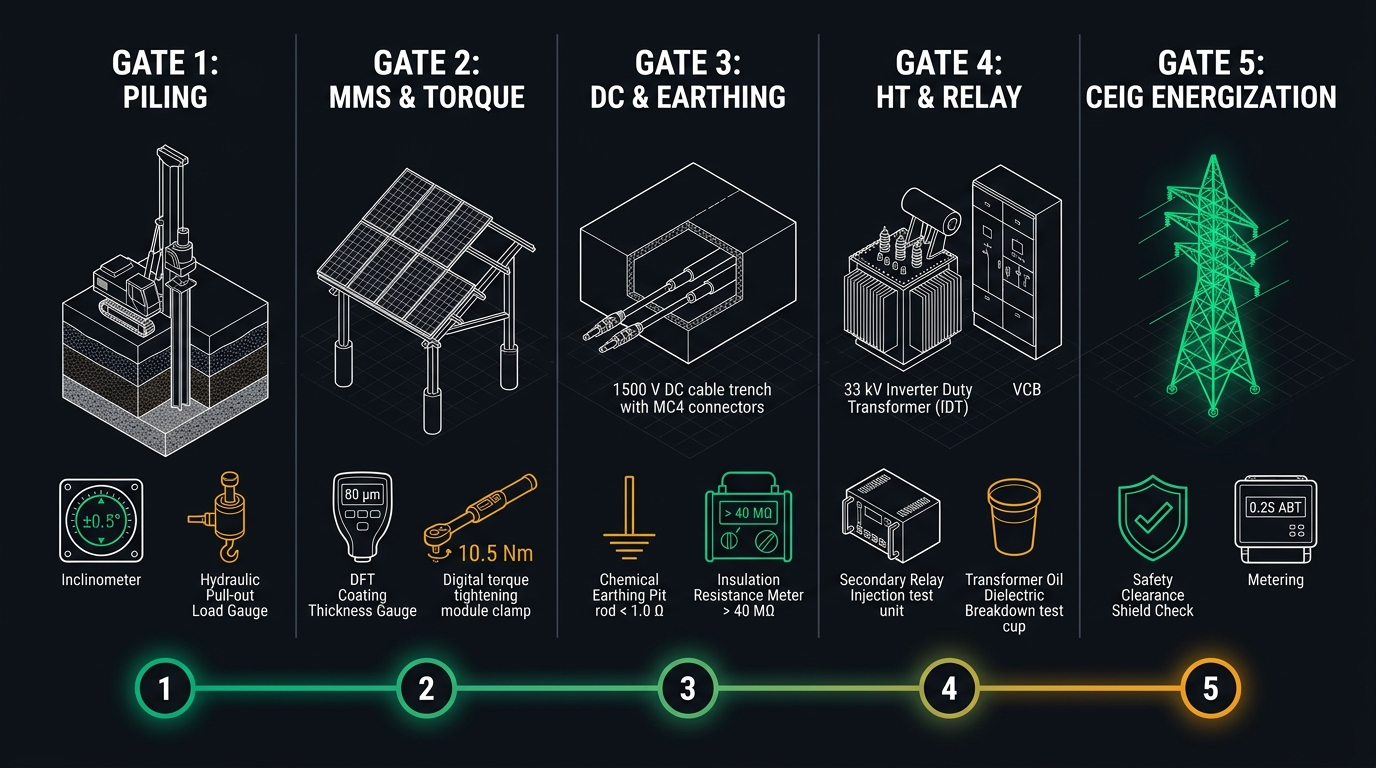
1. Why End-Only Inspections Fail
Backfilled trenches hide nicked cables. Mounted panels mask twisted piles. Waiting until commissioning to check workmanship guarantees expensive rework.
Across Indian utility and C&I sites, subcontractors chase daily megawatt targets while skipping basic checks. When an Owner's Engineer rejects work during pre-handover walkdowns, demobilized crews are already off-site. Rectifying a skewed tracker row or underground fault post-erection costs five to ten times more than catching it at the milestone gate—and puts CEIG energization and DISCOM synchronization windows directly at risk.
2. Gate 1 & 2: Piling, DFT & Torqueing
Quality begins below grade. Before releasing foundation piling and concrete works for table erection, log digital inclinometer plumbness (±0.5° for trackers, ±1.5° for fixed tilt) and embedment depth across every row. Witness static axial compression and lateral pull-out tests per IS 2911 with a 2.5 uplift safety factor, alongside seven-day and 28-day M25/M30 cube strength reports per IS 456.
Before bolting purlins, run an Elcometer dry-film thickness (DFT) sweep across hot-dip galvanized posts and rafters to verify at least 80 µm zinc coating per IS 4759. Once modules land on rails, ban uncalibrated impact drivers on final clamping. Enforce daily ISO 6789 torque checks (9.5–11.0 Nm on M8 SS304/SS316 fasteners), verify 400 ± 50 mm clamping zones and 10–15 mm expansion gaps, apply tamper-evident torque paint, and run mobile darkroom EL audits on incoming batches.
3. Gate 3 & 4: DC, Earthing & HT Bays
Trench closure and string termination require strict hold points. Verify chemical earth pits stay below 1.0 Ω and switchyard grids under 0.5 Ω per IS 3043 before backfilling, with equipotential module bonds below 0.1 Ω and river-sand bedding plus warning tiles above 1500 V DC XLPO runs. Audit MC4-Evo2 crimps via pull-force samples, check string Voc within ±2%, and run 1500 V DC Megger insulation resistance tests above 40 MΩ per IEC 62446-1 with SPDs isolated.
Inside 33 kV HT bays, test XLPE terminations via 0.1 Hz VLF Hi-Pot (2.5–3.0 U0) and confirm Inverter Duty Transformer oil BDV hits ≥ 60 kV with < 15 ppm moisture. Verify switchgear 40 kA short-circuit busbar torque, secondary relay injection (87T, 50/51, 86 Master Trip), CEA Regulation 64 phase-to-ground clearances, and Class 0.2S ABT CT burden and accuracy ahead of final commissioning tests.
4. Milestone QC Hold-Point Architecture
Gating subcontractor billing and material release behind signed stage-wise inspection cards eliminates unverified cover-ups across civil, mechanical, DC, and HT work fronts.
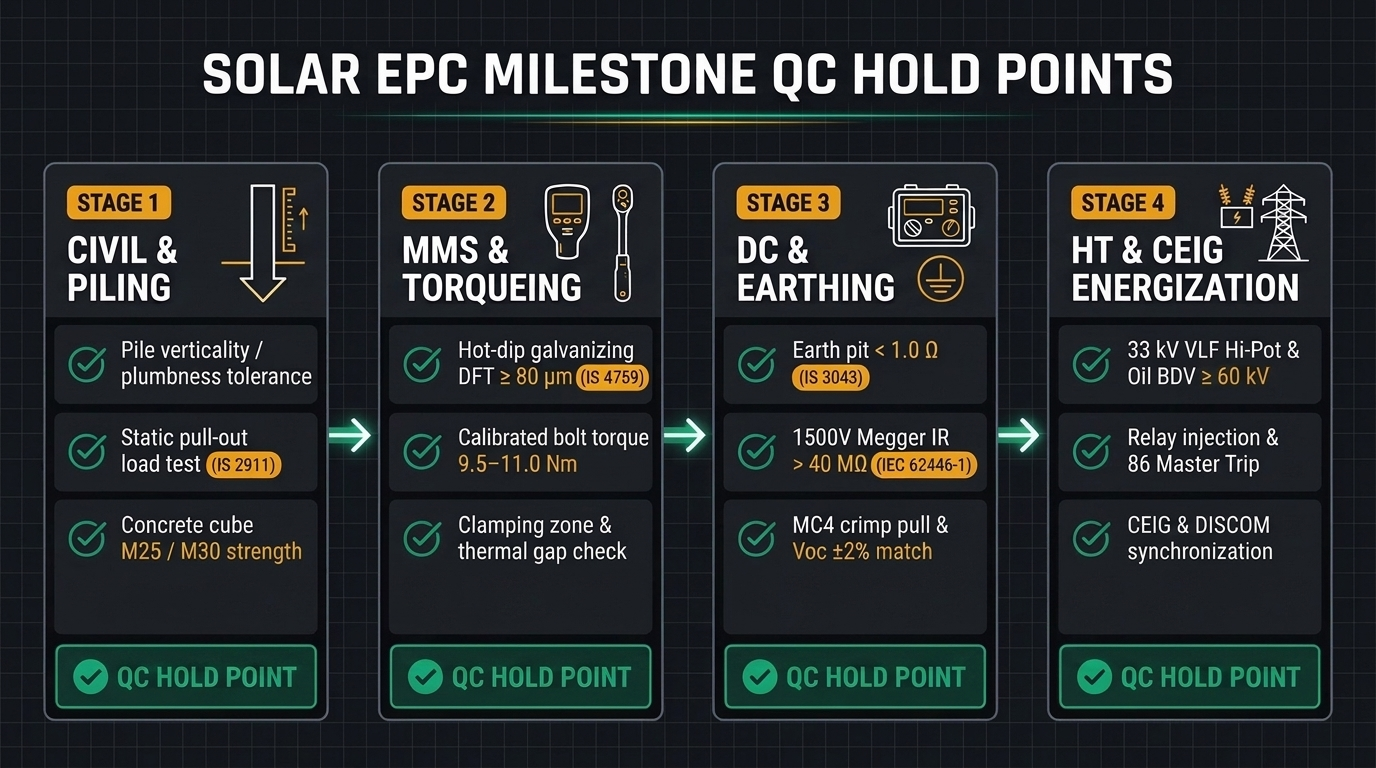
5. Stage-Wise QC Tolerance Matrix
Site QA teams lock each construction milestone against measurable acceptance thresholds before permitting the next contractor crew onto the block.
| Milestone Gate | Standard & Instrument | Acceptance Threshold |
|---|---|---|
| 1. Piling & Civil | IS 2911 / Inclinometer | ±0.5° tracker plumb; 2.5 FOS pull-out |
| 2. MMS & Torque | IS 4759 DFT / ISO 6789 | ≥ 80 µm zinc; 9.5–11.0 Nm M8 torque |
| 3. DC & Earthing | IS 3043 / IEC 62446-1 | Pit < 1.0 Ω; 1500 V Megger > 40 MΩ |
| 4. HT & CEIG | CEA 2023 / VLF & Relay | Oil BDV ≥ 60 kV; 86 trip & 0.2S ABT pass |
6. CEIG Handover & Purchase Controls
Milestone quality only sticks when purchase orders and subcontractor RA bills enforce it. Tie vendor milestone payments to factory PDI reports, NABL calibration certificates for torque wrenches and Meggers, and signed stage-wise QA dossiers. Holding back 10% subcontractor billing until Block-wise DC IR and earthing logs pass prevents rushed cover-ups.
Compile these signed test sheets directly into the CEIG and DISCOM synchronization dossier under CEA Technical Standards. For asset owners and EPCs scaling multi-site builds, V-TECH Renewables delivers independent solar quality assurance audits and Owner's Engineering PMC supervision from foundation staking to live grid charging.
7. Frequently Asked Questions (FAQ)
What makes a site QC checkpoint a hard hold point?
Subcontractors cannot cover, torque, backfill, or energize downstream work until the QA engineer logs calibrated test values.
Which IS and IEC tolerances govern DC and earthing checks?
IS 3043 requires earth pits below 1.0 ohm, while IEC 62446-1 requires 1500 V Megger IR above 40 megaohms.
What electrical checks clear CEIG and DISCOM energization?
Inspectors verify 33 kV Hi-Pot, transformer oil BDV >= 60 kV, relay trip injection, and Class 0.2S ABT metering.
Related Engineering & Execution Insights
Enforce Zero-Defect Solar Execution Across Every Site Gate
Partner with V-TECH Renewables for stage-wise QA/QC audits, mobile EL testing, and Owner's Engineering supervision from piling through CEIG energization.