1. Why RoW Breaks Solar Schedules
A 100 MWp solar array can sit mechanically complete while one disputed tower parcel blocks grid evacuation. Steel stays stacked in the yard. Cranes and stringing gangs rack up daily standby bills.
Right-of-Way (RoW) bottlenecks hit EPC margins harder than module rate swings. Purchase teams lock ACSR conductors, lattice stubs, and insulator strings months in advance. When a single farmer or panchayat halts tower excavation, working capital freezes alongside PPA liquidated damages and delayed collector substation bay tie-ins. Solving evacuation RoW requires pairing smart corridor engineering with structured community outreach before foundation crews mobilize.
2. Section 68, Section 164 & Telegraph Act
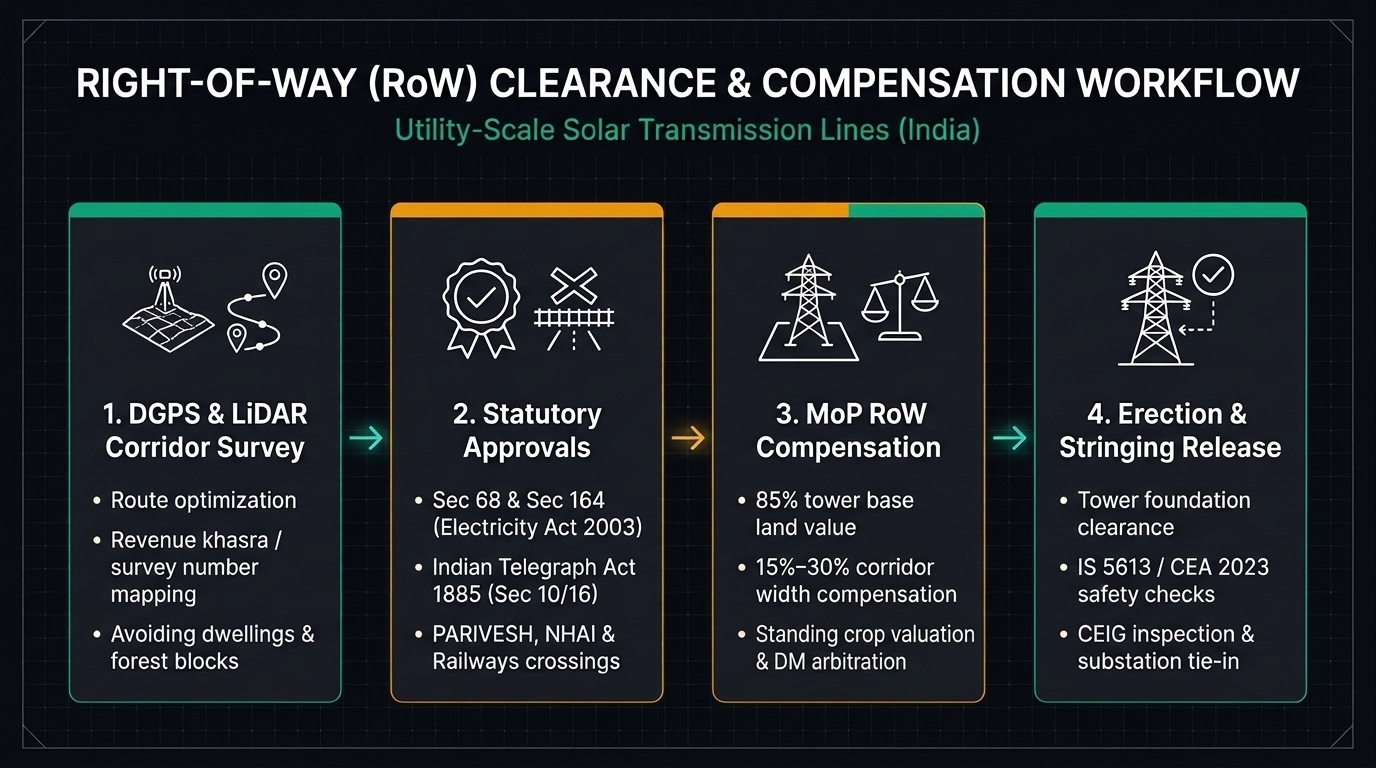
Under the Electricity Act, 2003, solar developers never purchase the entire transmission strip outright. Section 68 mandates prior permission from the Appropriate Government before installing overhead evacuation lines. Section 164 then grants Telegraph Authority powers drawn from Sections 10 and 16 of the Indian Telegraph Act, 1885.
That legal footing changes site execution. Section 164 lets authorized licensees enter private agricultural plots for surveying, concreting foundations, and stringing without land sale deeds, provided statutory compensation is settled. Should landowners block entry, the District Magistrate (DM) or District Collector adjudicates objections and orders police protection under Section 16. Relying on DM orders alone breeds hostility, however. Early gram sabha briefings, clean 7/12 or khasra record checks, and site grievance desks settle 85% of parcels peacefully.
3. Route Survey & MoP Compensation
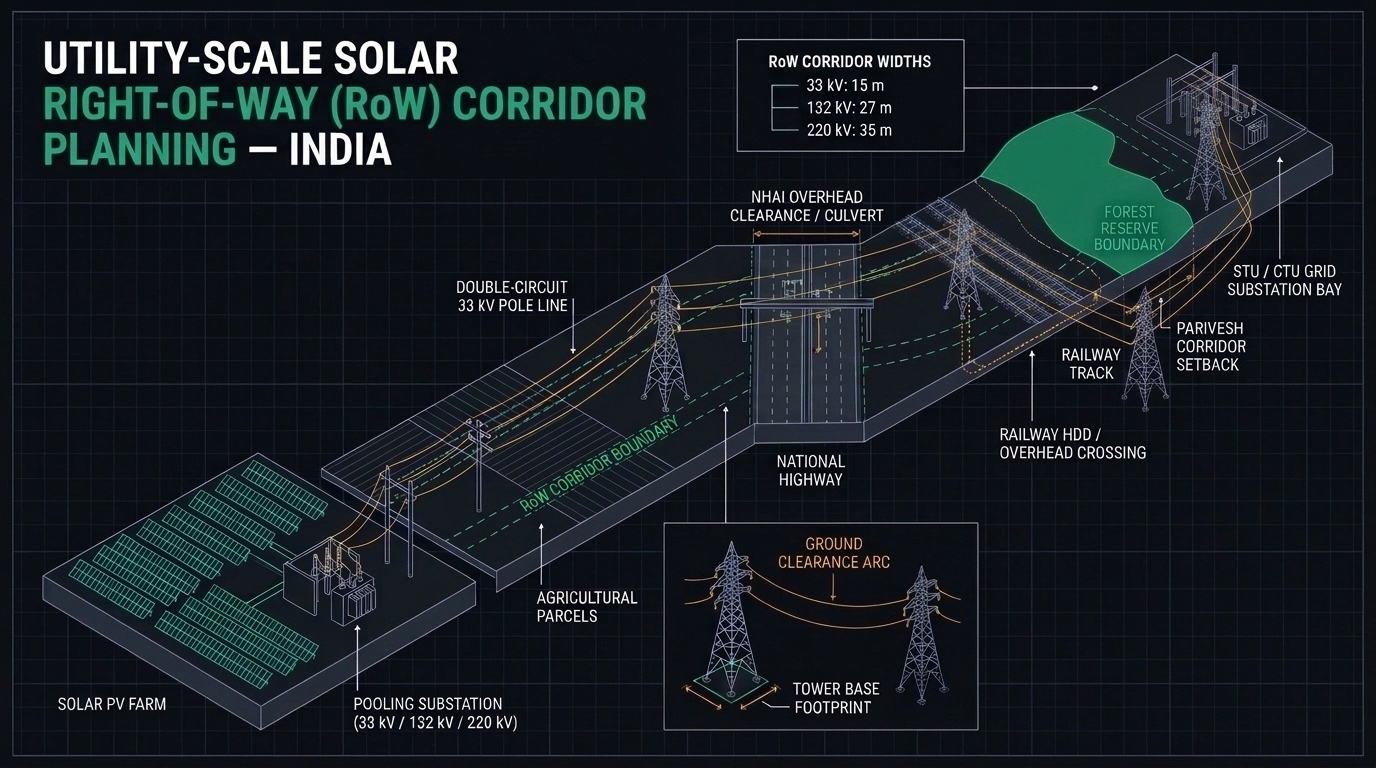
Disciplined route selection avoids legal deadlocks before pegging starts. Fly a DGPS and drone LiDAR corridor survey first, overlaying state revenue maps to bypass houses, borewells, temples, and reserve forests. Dodging even two hectares of notified forest cuts out 12-to-18-month PARIVESH Stage-I/II approvals and heavy Net Present Value payouts. File NHAI highway culvert permits and Indian Railways overhead or Horizontal Directional Drilling (HDD) XLPE sleeve crossings alongside collector substation bay engineering.
Budget landowner payouts cleanly per Ministry of Power (MoP) RoW guidelines. Reserve 85% of market or circle land value for the tower base footprint, plus 15% to 30% for the overhead corridor width as notified by the state. Pay 100% of standing crop and horticulture damage assessed jointly with revenue tehsildars before digging starts. Confirm tower spotting elevations early against seasonal flood lines and irrigation canals.
4. RoW Clearance Engineering Workflow
Sequencing LiDAR surveys, Section 68/164 filings, MoP compensation disbursal, and CEIG checks keeps erection gangs moving without idle gaps across agricultural stretches and infrastructure crossings.
5. Line Widths & Schedule Risk
Choosing between 33 kV double-circuit pole lines, 132 kV/220 kV lattice towers, and underground XLPE trenches alters statutory clearances, land payouts, and procurement lead times under IS 5613 and CEA Safety Regulations, 2023.
| Line Type | RoW | Clearances | Compensation | Schedule Risk |
|---|---|---|---|---|
| 33 kV Pole | 15 m | Sec 68, CEIG | Crop + pole | Low (4–8 wks) |
| 132 kV Tower | 27 m | Sec 68/164, STU | 85% + 15–30% | High (12–24 wks) |
| 220 kV Tower | 35 m | Sec 68/164, CTU | 85% + 15–30% | Severe (20–36 wks) |
| 33 kV XLPE | 2–4 m | NHAI, Rail HDD | Trench lease | Moderate |
6. EPC Field & Procurement Controls
Project and purchase managers must gate tower steel and conductor dispatches against cleared khasra lists, not baseline Gantt charts. Hold 5% buffer stock of 33 kV XLPE cable and HDPE ducts to execute quick HDD detours where village expansion squeezes pole spans. Coordinate collector substation bay tie-in outages early with STU/CTU system operators. Check every span against IS 5613 sag-tension tables, CEA ground clearances, and final CEIG and SLDC synchronization checks before charging the bay. Review our solar project management advisory and commissioning checklist for handover governance.
7. Frequently Asked Questions (FAQ)
How do Section 68 and Section 164 differ?
Section 68 authorizes overhead lines. Section 164 grants Telegraph Act powers for tower access and DM dispute resolution.
What are MoP RoW compensation norms?
MoP norms provide 85% tower base value, 15% to 30% corridor width, and 100% crop compensation.
When is 33 kV underground XLPE preferred?
Use 33 kV XLPE or HDD across congested roads, railways, and highways failing CEA 2023 clearances.
Related Engineering & Execution Insights
De-Risk Your Solar Evacuation Corridor Early
Partner with V-TECH Renewables for LiDAR corridor surveys, Section 68/164 and CEIG dossiers, and Owner's Engineering supervision across India.